
#On the Country Called Hollow
"Every tree is present and accounted for. That is the first thing wrong with them." — saying of the Irongate pickets
The Hollow Vale is the domain of Morwen, the Weeping Host, Sin-General of Envy. It lies on the far side of the Sagittal Line from Bastion-Irongate, where the Danube grinds through the Iron Gates gorge. The Bureau of War marks it hostile. The Bureau of Records marks it extent unconfirmed. Both stamps are accurate, and the second is the one that keeps clerks awake.
I cannot certify how far the Vale reaches. Field accounts carry it from the Danubian foothills south through country that was once Bulgaria, and the bolder accounts carry it into the Rhodope highlands. The Bureau of War's locked table is more modest and gives Morwen the western Balkans and the Danube approaches. The highlands about Shipka belong to Syrion and his fog by every assignment that matters. I will not hand Morwen a province because a cartographer was hurried with his pen. If the two dominions share a border, no living clerk has walked it.
Nor will I invent a founding. Morwen came through at the Sundering in A.S. 45, or in the bad seasons after it. The Lore Book has the Vale growing over generations from one blighted grove into its present breadth, and it does not say which generation did what. Of all the domains of the Seven, hers is the least willing to be dated. That suits a mistress who has never been willing to be anyone in particular.
#On the Trees and Waters
"Strike the bark and listen. If it answers in your brother's voice, stop striking."
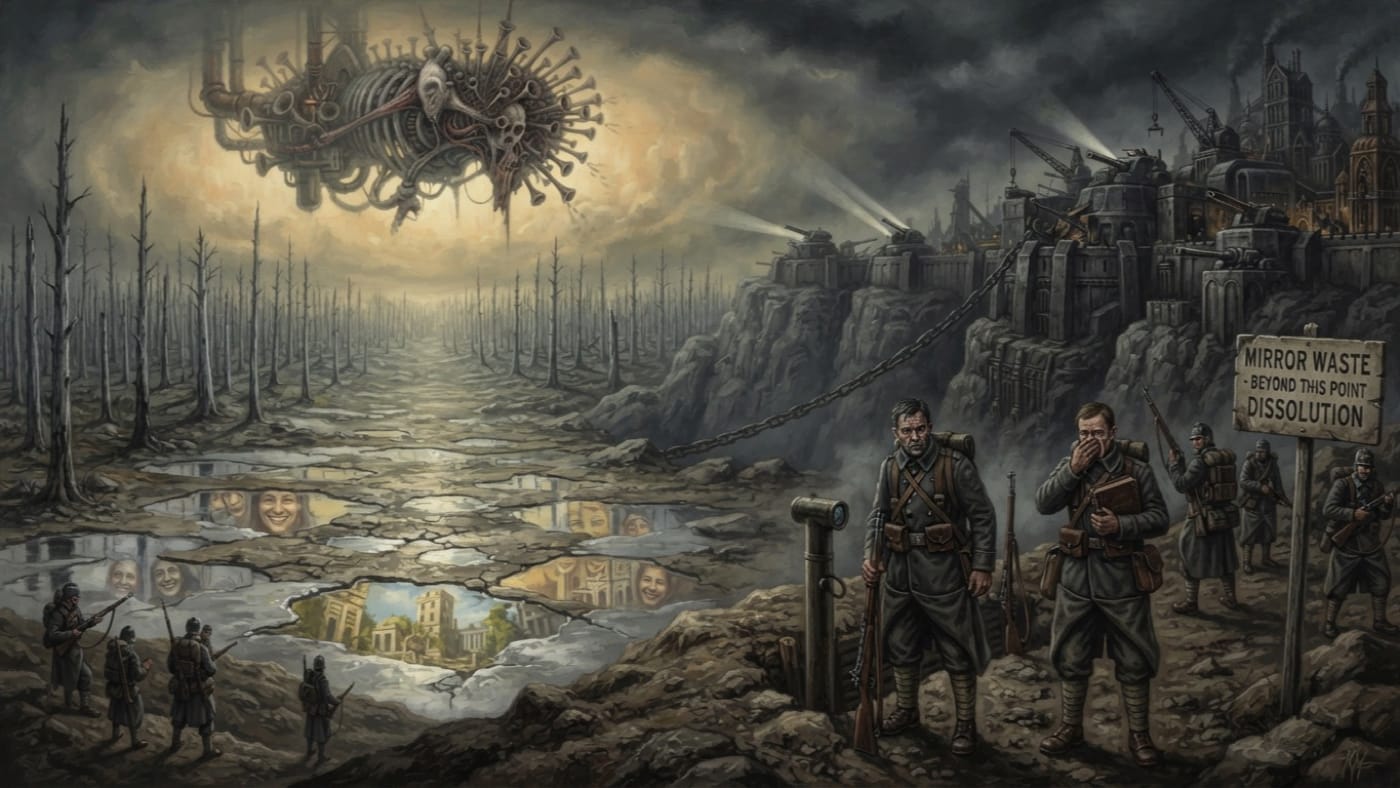
The forests are still standing, and I record this first because the reader expects ruin and the Vale does not provide it. The bark is whole and every branch is where a branch should be. Inside the trunk there is no heartwood, sap, beetle or rot. An ordinary dead forest at least decays. These trees have been emptied and left upright in their own outlines, like a reliquary whose bone has been lifted out and whose glass was polished afterwards.
Strike one and it rings. Every account agrees on the ringing, and every account agrees on the echo, which comes back late in a voice the listener knows and cannot place. Pickets who have heard it name a cousin, a schoolmaster, a dead sergeant. One wrote only mine, from before. The Bureau of Bells has twice asked for jurisdiction over the trees. The Bureau of War has twice refused on the grounds that nobody is to stand close enough to a Vale trunk to ring it.
Then there are the lakes. They lie flat and silver among the hollow timber, and they do not reflect the sky above them. Observers have seen other weather in them: rain under a dry noon, snow in high summer, a grey morning under a clear night. A man who kneels at the edge sees a face that is nearly his own, with a better jaw and steadier eyes. The thing in the water carries itself like a man who chose correctly at every crossroads and would be delighted to explain how.
The Codex holds one survey account, and I give it exactly as received. In A.S. 73 a party of surveyors, entered in later Records under the Bureau of Engineering, went into the Vale. Fourteen came back. Their maps disagreed on every river, ridge and road. In the margin of each map all fourteen had drawn the same face, and none of them remembered drawing it. The file says nothing of their route, their strength at departure or whatever else they saw, and I will not supply what the file leaves out.
#On the Palace and the Villages
"It is a market. There is bread. Every woman selling it has your aunt's hands."
Morwen's seat is the Palace of Echoes. The Lore Book describes reflective halls, a geometry that refuses to close, and doors, actual hinged and latched doors, that open onto stolen dreams and the selves their owners might have been. The field reports add a Hall of Faces; Galleries in which captured identities hang like plate in a sacristy; and Copy Warrens underground, where Morwen's servants spend months learning a man before they become him. The Bureau of Records cannot say whether these are wings of the Palace, separate works, or three frightened clerks' names for the same building. I will not draw a floor plan to spare the Bureau that embarrassment.
The Galleries are said to hold identities, and I choose that noun with care. Doctrine is plain that the Great Deceiver's creatures may not take souls or overrule the will. The reports speak instead of the particular quality of being one person and no other, which is taken, filed, worn and lent out. That loss is terrible enough without my adding souls to the inventory.
The Empty Villages are worse than the Palace because they look ordinary. From a ridge they keep market-day. Smoke rises from the right chimneys, bells ring the hours, and the church takes in its congregation and lets it out again. Come closer and the faces begin to repeat: a dozen grandmothers share one nose, three blacksmiths share one laugh. Closer still, a visitor may find his own face behind a stall. The inhabitants seem content, and many of them appear to remember no earlier self to miss.
So I record what they are as unknown. Some may be wholly Morwen's creatures. Some were peasants once and may still be peasants under borrowed faces. The Synod has never been placed to test whether any of them could be returned to themselves.
#On the Approach to Irongate
The ground between the Vale and the Line is reported as patches of glass-smooth reflection scattered through ordinary ruined fields. The trench-scholars call this strip the Mirror Waste. Other reports give the same name to the whole corrupted country from old Bulgaria into Romania, and I have seen a Records atlas that uses it both ways on facing sheets. The reader may choose either usage. The ground is indifferent.
Anyone who crosses it is attended by himself from several angles: one reflection taller, one smiling when he is not, one in the wrong uniform. Beyond it, on the cliffs of the gorge, Irongate keeps watch. It has batteries cut into living rock, chain-booms across the Danube, and tunnels that sing in the wind, which the garrison calls the Gasket Choir. In the honest judgement of the Synod's engineers it is the most beautiful fortification on the Line. Morwen envies it for exactly that reason. As far as anyone can judge, she has no interest in holding it. She means to hollow it, and leave its batteries and booms standing in their outlines like her trees.
So the Vale approaches the gorge sideways. Commanders' voices come from the wrong throats, and orders arrive correctly worded and wrongly meant. The Lore Book records Mimic-Knights who take the strength of the men they kill and Shade-Doppelgangers who walk into regiments as brothers. By every account the Choral Maw groans over the Vale: an organ of bone and sinew with a thousand throats, singing in stolen voices until a listener cannot tell his own thoughts from the chorus. Infernal engineers did not build it, because the Vale has none, and no engineer of ours would agree to tune it.
Morwen's servants have also captured presses and the copying apparatus of the Synod's own clerks. They do not understand this machinery and do not need to. A corrupted press that turns out flawless papers for men who exist twice is a weapon whether or not anyone in Hell knows how to mend its rollers.
Earlier editions of this Codex described the Weeping Host's pressure upon Bastion-Irongate as containable by conventional fortification and sufficient prayer.
The walls have held. The assessment did not. The garrison can man every battery on the gorge and still be unable to say who is manning them.
#On Recognition and Its Failures
"Count your fingers before you count your friends."
Irongate defends its walls with confidence. It establishes who its own people are with ink and fear, and the measures are as follows.
The first measure is challenge and response: recognition phrases and recitations of private history. These catch the poor copies. The good ones, the Face-Thieves who study a man for a season, pass with honours.
The second is the dulling of every surface under Mirror Discipline. Mirrors are banned or replaced with tin that distorts, standing water is drained, and men shave by touch. A man who never sees himself begins to forget his own face, and that forgetting is exactly what the Vale has been waiting for.
The third is the Ledgers of Self, which record each soldier's scars, habits and last confessed sins. A Ledger is a document, and the Vale makes a regular diet of documents.
The fourth is the Confession of Identity, in which a man recites what only he could know. I am obliged to report that confessors have more than once preferred a fluent false confession to a halting true one.
The protocol's flaw is plain to any Face-Thief. A copy that unmasks itself at a moment of its choosing takes the original to the scaffold with it, and the original has no means of proving himself. The Bureau knows this. It has filed the flaw and continued, because the alternative is to choose between two men on evidence it does not have.
Above all these measures stands the Singleton Doctrine, the Church's teaching that every person is unique and cannot be replaced. It is preached at Irongate every Sabbath. It has not yet been seen to stop anyone at the gate.
#On the Present Condition
As of A.S. 201 the Vale remains Morwen's. Its extent is unsurveyed, its population uncounted, and its interior has been described only by men whose maps disagree. Her hatred of Velkara, whose beauty she copies and spoils, keeps the eastern domains quarrelsome. The Bureau of War values that quarrel more highly than it would admit in a sealed folio. The gorge holds. The garrison stands its watches. Whether every man standing watch is the man the Ledger says he is remains an open question at Irongate, and no Bureau has offered to close it.