
#On Their Nature
"It is not malicious. It is hungry."
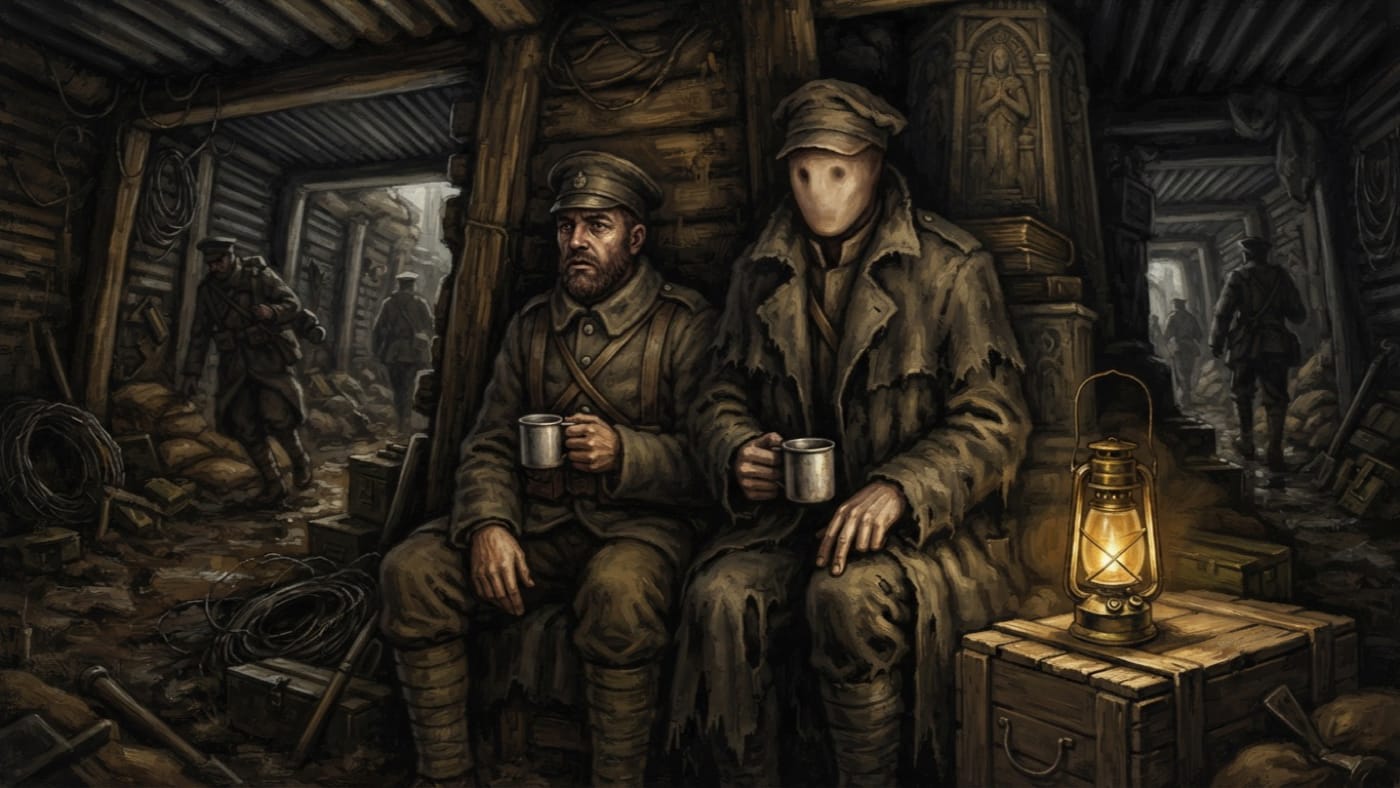
The Hollow One is the plainest of Morwen's demons and the hardest to file. It stands at the height of a man and carries a man's weight, and if someone has been careless enough to let it acquire boots, it leaves boot-marks in the mud of the approach trenches. Its skin is smooth. Its face has the general layout of a face, the way a blank sheet of vellum has the general layout of a deed. There is room for eyes, room for a mouth, room for everything, and nothing has yet been entered.
The field scholars of the Irongate sector list it first among the Weeping Host's six identity categories and call it raw material. I accept the term because it is unkind, and unkindness here is accurate. A Hollow One has no fixed self, and so it has too little self for malice. Malice needs someone to hold it. The Hollow One needs to become someone, and the sapper is nearby.
It has a body. The body can be shot, bayoneted, burned and carried on a stretcher to the surgeons, who have opened several and found nothing that explains them. That is the general rule for corporeal demons, and the Hollow One obeys it without being any help.
#On the Absorption of a Person
"First it learned how he held his cup."
Take a sapper of the Irongate tunnels, purely as an illustration. Give him a common name and an uncommon habit: he taps two fingers on his knee before answering an officer. Put a Hollow One somewhere within his ordinary day, behind a sandbag traverse, in a flooded recess or in the dark of a relief party, and wait.
The Morwen dossier gives a week. I repeat it as a picture and never as a schedule. No Bureau has established how close the thing must stand, whether it must touch or be looked at, or how long a man may share a trench with one and walk away whole. Any clerk who quotes seven days as a safe interval should be sent to count rivets.
The order of loss is better attested than its speed. Mannerisms go first, and the two fingers start tapping on a knee that is not the sapper's. Speech follows: his oath when the lamp gutters, his mother's word for rain, the half-laugh he gives before bad news. Then memory goes. The Hollow One begins to recall the tannery yard, the yellow dog and the father leaving for the Line, and it recalls them with the slight, warm hesitation of a man who was there. Past memory, the dedicated lore names a deeper loss and declines to define it. I decline with it.
All the while the sapper forgets. He does not notice that his fingers have gone still. He reaches for his oath and finds an empty place where he kept it. He tells the tannery story and stops halfway, because the ending has gone somewhere he cannot follow. His comrades notice before he does. They notice that the thing in the recess finishes his sentences.
The transfer is involuntary. The lore requires no prior envy, no bargain and no embrace. The sapper was standing his watch.
#On Those Who Become Hollow
"The borrowed self begins borrowing again."
There is a second road to the same blank, and the traveller paves it himself.
Morwen's temptations are rehearsed in the Palace of Echoes and carried by her lesser servants. They offer the self-rejecting a better life: an officer's confidence, a rival's face, a dead man's courage. The gift works, and that is its obscenity. The borrowed self then keeps on borrowing. A clerk who took one officer's poise starts to wear the chaplain's cadence, then the cook's laugh, then the habits of whoever shares his bench. He forgets his name, then remembers too many names, then forgets what names were for. At the extreme he takes in everyone and belongs to no one. He becomes a walking blank, filed by the Bureau under the same heading as the creature in the recess.
According to the Morwen dossier, the Bureau of Rites holds seven such dissolution cases under seal. I give the number as the dossier gives it. I have not read the seven and will not pretend to know what they contain.
The Ledger must keep the two roads apart. The sapper was robbed. The clerk was persuaded, and then his own persuasion robbed him. Doctrine treats the clerk's case as sin and the sapper's as wound. A court that confuses them hangs the wrong guilt round the wrong neck.
No office can say what remains inside a hollowed man. The lore says a person may still be in there, and that observers cannot tell. Doctrine holds that no demon can take the will. Both statements stand, and neither promises the clerk his name back. Nor does the existence of human Hollow Ones prove that every Hollow One in the Mirror Waste once had a mother. So far as anyone has recorded, some arrived blank, and no surgeon has found a seam between the two kinds.
#On Their Place in the Weeping Host
The six categories blur at the edges, which offends the scholars who drew them. The Mirror-Stalker steps out of a reflection already improved. The Face-Thief chooses one target and studies him for months. The Echo-Kin copies gait and gesture badly enough to be caught at arm's length, but well enough to make a man doubt his own hands. The Worn is a crowd of stolen lives in one coat. The Beloved arrives as the dead, and grief lets it in.
Next to these refinements the Hollow One is a crude instrument. It has one method, which is to stand near you.
The Palace keeps an archive of unworn lives as stock for Morwen's finer tools. It is tempting to draw a family tree from blank to thief to Beloved, the way heralds paint lions onto any family that can pay. No source supports that tree. Nobody has watched a well-fed Hollow One graduate into anything. The categories describe behaviour that frightened men have observed, and I leave them as that.
#On Identification and Countermeasures
"A clerk can inventory a man. He cannot certify him."
The garrison's first defence is recognition, and recognition is exactly what the Hollow One eats. A comrade who would have known the sapper by his tapping fingers now sees two men tap, or sees the tapping come from someone who should not be doing it.
After the Sector Nineteen inquiry of A.S. 193, the Ledgers of Self were revised to hold precisely the details a Hollow One drinks: gait, voice charts, scars, habits, family phrases, and the private bone-lines no copy is supposed to know. The Bureau of Records keeps each Ledger in three copies, field, sealed and dead. That layering helps against a forged page. It helps far less here, because the Hollow One never touches the page. It acquires the life the page describes while the man the page describes loses it.
Earlier manuals described the bone-lines as "copy-proof."
Corrected. Bone-lines are copy-resistant, and against absorption by proximity they resist only while the subject still remembers them. Once the subject has forgotten a bone-line and the creature has learned it, the line protects no one. It testifies for the wrong party.
In the Hush Court beneath the Transit Spine, a gloved clerk compares each claimant's answers with the sealed Ledger. The procedure assumes the true claimant knows his own life best. A hollowed sapper breaks that assumption from the inside. He hesitates over his sister's nickname, and the thing beside him does not. The court listens for fluency too smooth to be human, and it is right to listen. It still cannot make a forgotten memory testify for its owner.
Mirror Discipline comes from the same armoury, but it is no shield against this blade. It limits how long a man looks at a reflection: one count to recognise, two to assess, three to look away. It was written against the creatures that work through reflections and the vanity they feed on. No record shows it slowing a Hollow One by a single gesture.
The Singleton Doctrine does its proper work here, which is to forbid a false conclusion. A man who has lost his phrases is still one soul. A blank that has gained them does not become him. The evidence has moved; the person has not. The doctrine grants no immunity and was never meant to. It tells the clerk what he may stamp and what he may not.
Purity must be held back from its appetites too. Forgetfulness is common in a garrison that sleeps four hours a night. Widowers speak in their dead wives' turns of phrase. Recruits copy their sergeant's swagger. Men under shellfire lose names they knew at breakfast. None of this, on its own, is evidence of a Hollow One, and Purity has been reminded of that in writing more than once.
Absorption can run far enough that two claimants present the same evidence and neither can be disproved. When it does, the case passes to the Twinning protocol, and emergency policy may end in execution. The doctrine permits that outcome. It does not require it. That distinction has been paid for.
#On the Present Classification
As of A.S. 201, Hollow Ones remain active along the approaches to the Iron Gates gorge, in the bastion's tunnels and cliff batteries, and across the Mirror Waste between the Sagittal Line and the Hollow Vale. No ward made for them has been ratified, and no cure has been shown to work. I know of no file recording an absorbed memory coming back to its owner. Three things remain unestablished: where the kind came from, when it first appeared, and how a hollowed man comes to be counted among demons. Doctrine has declined to settle any of them by decree, which is the most restraint I have seen from it this decade.
The garrison's standing advice is older than the category. Keep your comrades close and the blank things far away, and watch whose fingers tap.