
#On the Province That Is Counted
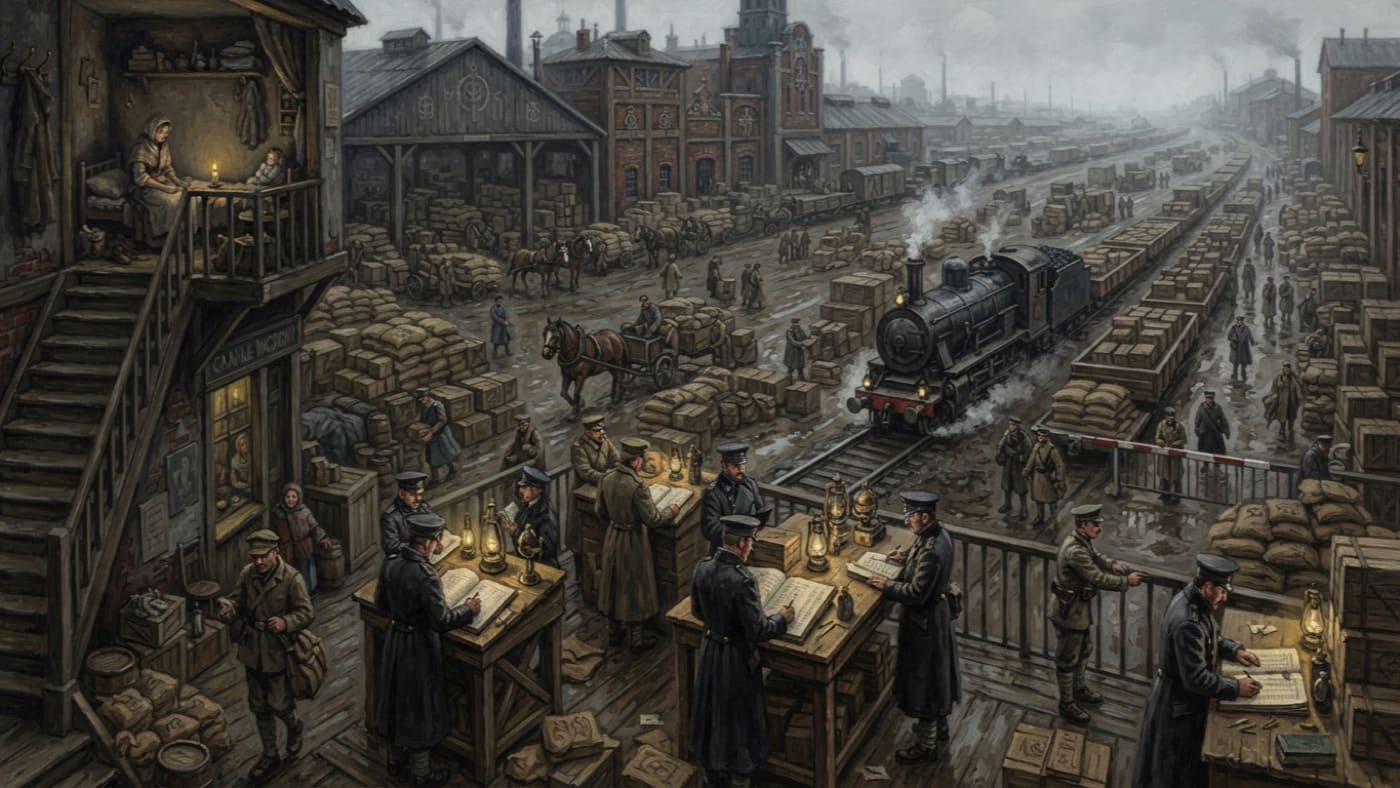
Moravia belongs to the Forward Heartlands, and the Synod values it for what passes through it. The Bureau's zone register lists it beside Bohemia, western Hungary and the Dalmatian coast in the third band of the Synodal map. The four regions share a single stated function: supply staging. A clerk wrote that phrase in one line. The people who live under it spend their days on sacks counted twice, wagons waiting for a seal, mules fed by ration and drivers fed by schedule, and a steady traffic of goods that belong to the front but have not reached it.
Nobody asks Moravia to hold the Line. Moravia's job is to keep the Line from starving. The sermons admire that difference and the requisition officers ignore it.
#On the Forward Heartlands
The word Forward is a courtesy. A traveller from the Atlantic provinces hears it and pictures Moravia under siege-light, every steeple a watchtower and every well poisoned. A Moravian hears it and thinks of carts. The Sagittal Line runs north to south from the Baltic to the Bosphorus, and the war is fought there, in its bastions and trench systems. Beyond the Line lies contested ground, and beyond that are the territories the Great Deceiver's generals hold. Moravia sits behind all of it, in the band of country where the Synod collects what it plans to spend.
The Line eats. It eats flour and lamp oil, boots and lint, horseshoes, rail spikes, wax, ink, cartridges, hymnals and the young. A bastion goes through in a week what a parish produces in a season, and it sends no thanks. Every stores-train bound for Bastion-Przemyśl or Bastion-Sibiu depends on a hundred smaller arrangements made behind it. A depot received the goods. A clerk signed for them. A road stayed passable. A granary answered for its count. Vienna, a shrine-town in the same zone, keeps its own convoy tallies for those bastions. The Forward Heartlands as a whole are where such arrangements get made, checked and blamed.
None of this makes Moravia a fortress. The Codex records no bastion there, no battle and no occupation. Moravia's danger is a duller kind: the danger of being audited.
#On Supply and Subsistence
Staging is accounting done out of doors. Cargo arrives under a manifest and must leave under a manifest. The two documents have to agree with each other, with the scale, with the seal on the sack, and with whatever the next depot claims it received. A Synodal manifest records weight, count, origin and destination. It also records the name of the clerk who will be blamed, which is its most important field. A convoy factor carries passage permissions for the wagons and their drivers, and spends part of every journey arguing with checkpoint officers over whether the paper and the load describe the same world.
The characteristic sin of a staging region is the discrepancy. A sack that weighs light at the second scale has been opened, or it has spoiled, or the first scale miscounted it. The Synod dislikes the third explanation because it implicates a clerk. Rations are issued against quotas. Quotas come from tables. The tables count mouths that somebody last counted in a better year. The grain keepers of the Heartlands know where this ends. Keep a store honestly and it will not feed the people standing in front of it. Keep it generously and it will not survive the audit. The prudent keeper lies in both directions and prays the inspectors come in a dry month, when spoilage reports are believed.
I describe these habits because they are the shared furniture of the whole Synodal supply system. Bohemia and the Dalmatian coast were issued the weighing table, the chit, the seal, the ration ledger and the polite falsification on the same pattern. The files give Moravia no depot of special notoriety, no famine and no prosecution of its own. A region whose stated function is staging is a region whose people are counted all day and count all day, and the Codex claims nothing more than that.
#On Passage
A staging region runs on permissions. The Synod wants to know where a wagon is going and why, and it wants the same for a person. Labourers, drivers, clerks, and pilgrims bound for a shrine to weep at the approved hour all travel on paper. All of them are stopped and asked to state a destination and a purpose. The checkpoint officers of the Heartlands are trained to match a face to a pass and a load to a manifest. Nobody trains them to search a memory.
This is the flaw in the system, and the Bureau of Orison and Song has never forgiven it. A sack can be weighed, and a permission can be stamped and later revoked. A tune in a woman's mouth goes through every checkpoint in the Forward Heartlands without declaring itself, because no manifest has a column for it. The Orison Licensing Acts of A.S. 94 were meant to add that column. Their enforcement still has to depend on someone hearing what the paperwork misses.
Vienna was reclaimed in A.S. 95, and pilgrims crowded its quarters from many provinces in the years that followed. The Codex knows of one traveller there who came from Moravia, and it knows her from a single sentence.
#On the Moravian Pilgrim
In A.S. 112, seventeen years after the reclamation, a folk lullaby about rain and barley spread through the pilgrim quarters near the Donaukanal. Exhausted mothers sang it to children who would not sleep, and the children slept. The tune moved from room to room the way anything useful moves among tired people. In the account of the Vienna Incident it passed through a wet-nurse, a laundress and two sisters from the Danube road. In the same passage, a pilgrim wife from Moravia took it to a boarding room above a candle shop.
That is everything the record holds on Moravia's part in the affair. She is a wife and a pilgrim, she is lodged above a candle shop, and she passes a tune up a flight of stairs. The record gives her no name.
The sentence shows how the song travelled. It moved by lodging, through hired rooms and shared stairwells and whoever happened to be awake and listening. No courier carried it under orders. The Codex keeps a separate entry for the melody smuggler, who moves forbidden tunes on purpose, with stitch-scores and listening cells. The Moravian wife does not belong in it. Nothing in the record says she meant anything by the song beyond a quiet room.
Her home tells us nothing about where the tune came from. The account calls the lullaby's origin pre-Concordat and provincial and names no province. A woman from Moravia sang it in Vienna. That does not make the song Moravian, any more than the laundress makes it a laundry song. The record does not say whether she learned it at home or on the road, or heard it for the first time through a Vienna wall.
What came after is Vienna's history, and I give it in proportion. The Bureau classified the cadence as carrying "potential for doctrinal contamination," and Tone Inquisitors swept the quarters behind a Bureau of Purity cordon. Within a month five thousand mothers in Vienna had their tongues branded. Their children went to Bureau of Mercy orphanages under the heading of protective transfer. The classification proved that children slept. It never showed that this particular tune opened a wound or served the Deceiver. That the setting contains dangerous tones is a fact about the setting. It is not evidence against these mothers.
I cannot say whether the Moravian wife was among the five thousand. The record gives her no arrest, no brand, no child and no confession, and I will not supply any of them. Her disposition was never written down, so I have nothing to correct.
An inherited Vienna summary dates the lullaby purge to A.S. 94.
Corrected. A.S. 94 is the year of the Orison Licensing Acts. The sweep of Vienna's pilgrim quarters, and the Moravian wife's one appearance in its record, belong to A.S. 112. The law came first, and the irons waited eighteen years for an occasion.
#On the Present Reckoning
Moravia keeps its station today. It stands in the third zone, behind the Line and ahead of the comfortable provinces, and it stages what the bastions consume. Wagons still wait for seals, and scales still disagree with each other. The clerks still write their own names in the column reserved for blame, with the fatalism the column deserves.
The Bureaus can count everything that leaves a Moravian yard except what the drivers and pilgrims carry home behind their teeth. Whether the wife from the candle-shop room ever came home, and what she hummed on the road if she did, the record does not say. Orison has a word for what the record leaves out. The word is potential, and it has already been used once to brand five thousand tongues.
The province is filed as staging ground. Every sack on the manifest is accounted for.