
#On the Third Band of Obedience
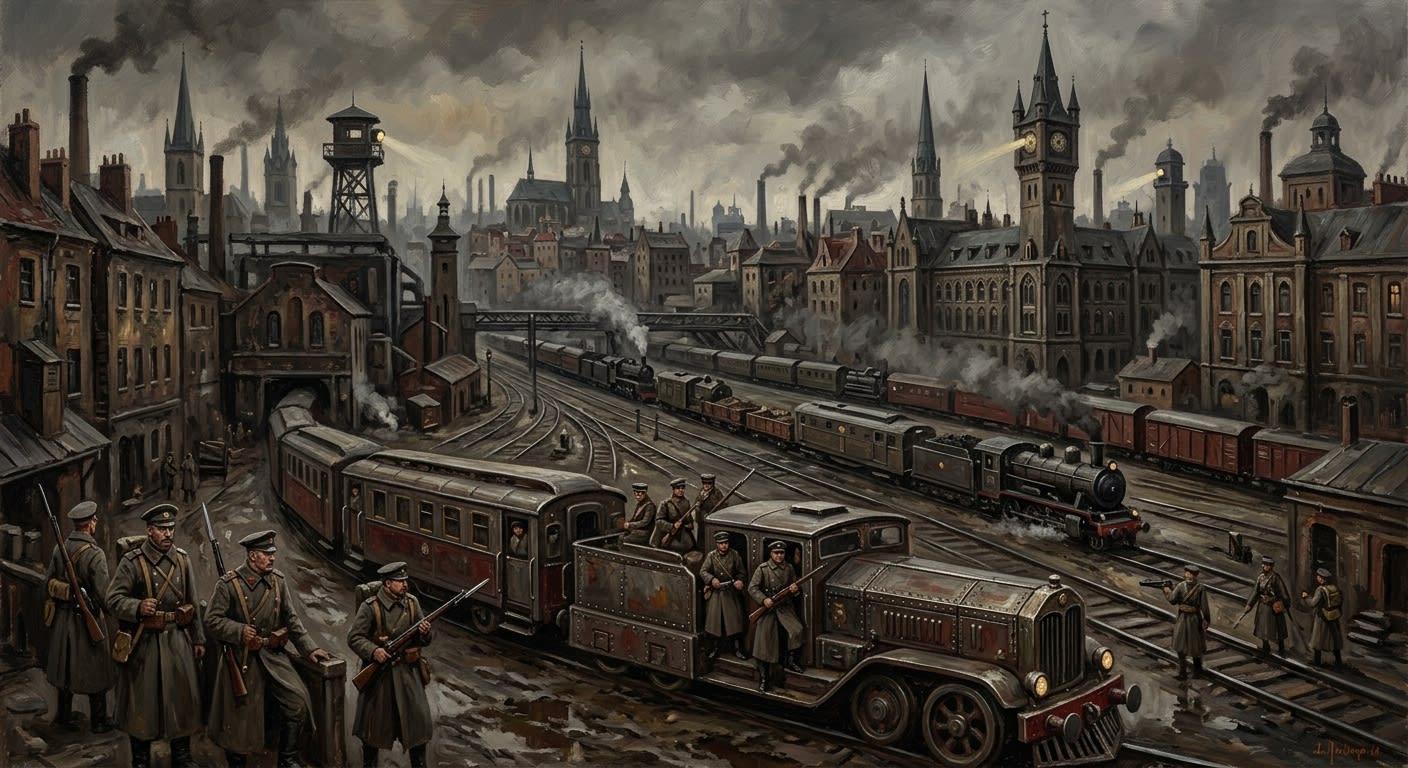
The Forward Heartlands are Zone 3: Bohemia, Moravia, western Hungary, Dalmatian approaches, Warsaw’s eastern pressure, the Vienna-Ruins, Bratislava, Budapest, Prague, Sofia, and the road-and-rail country that lies behind the Sagittal Line with one ear turned toward Strasbourg and the other toward artillery.
They are called heartlands because the Synod dislikes admitting that its heart has trenches in the atrium. They are called forward because the mapmaker, having run out of honesty, selected a military adverb and made it a province. A citizen of Zone 3 lives west of Hell and east of comfort. He hears supply trains at night and knows they are carrying something heavier than grain. He sees the wounded return and understands that the Line is less wall on a map than appetite with schedules.
The Registry description is plain: supply staging ground. This is accurate in the same way a gallows may be described as a wooden elevation. The Forward Heartlands store grain, marshal troops, register refugees, repair rails, quarantine survivors, process pilgrims, sort condemned labour, and convert rear comfort into front necessity. They stand behind the Line, at the place where the Line’s hunger is made legible.
Zone 3 teaches the first true lesson of Synodal geography: distance is not safety. Distance is merely the number of offices through which danger must pass before it reaches your table.
#On Corridors and the Geography of Use
The Forward Heartlands are built from corridors. Roads existed before the Synod, naturally; barbarians, merchants, kings, and lovers have always dragged themselves across Europe with varying degrees of paperwork. Corridors are different. A road carries. A corridor commands. A road may curve around a hill because horses dislike climbing. A corridor creates a hill office, a horse office, a curvature certificate, and a punishment schedule for those who arrive with insufficient slope.
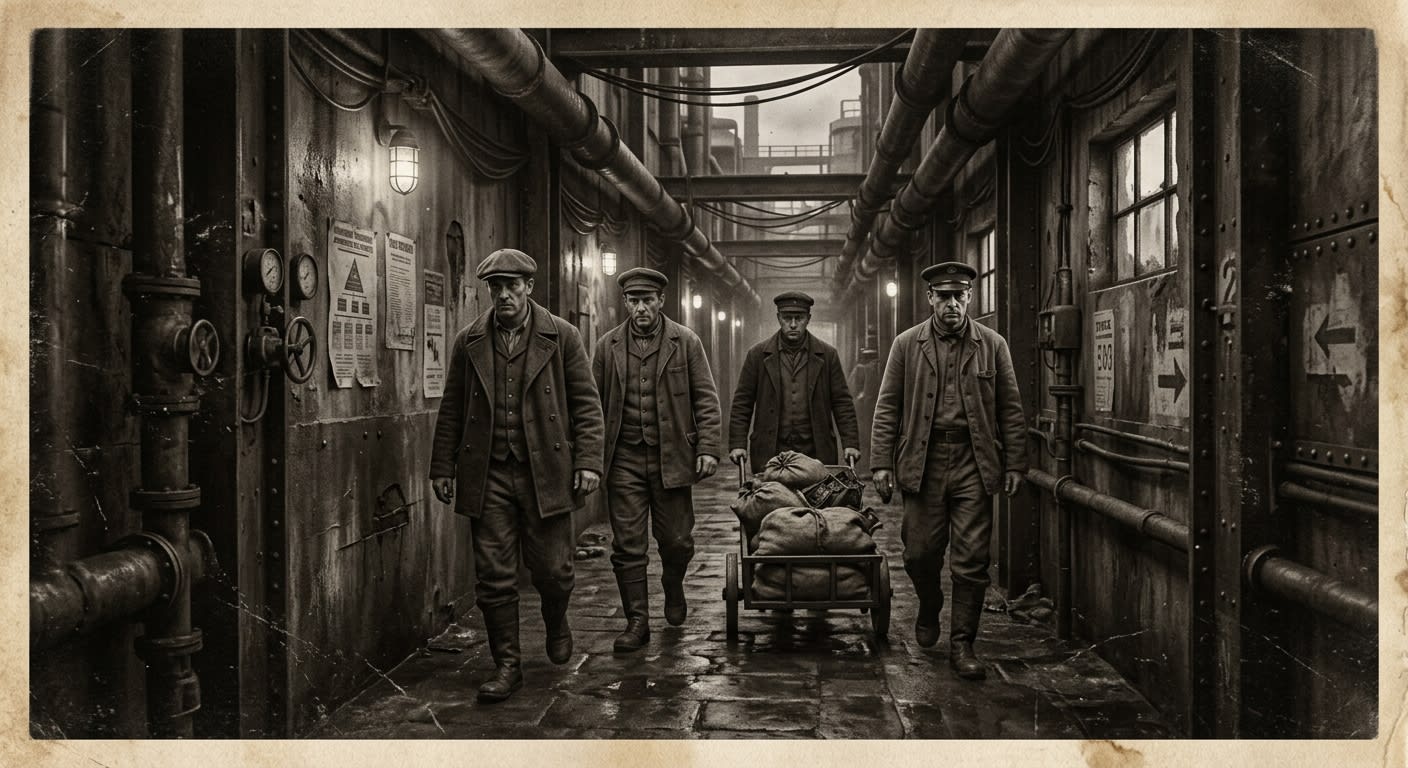
The Central Corridor is the great middle artery: Strasbourg’s will through Munich, the Vienna-Ruins, Bratislava, Budapest, and the Carpathian approaches toward Bastion-Przemyśl, Bastion-Sibiu, Bastion-Irongate, and the feeder roads southward. Grain moves east. Wounded move west. Orders move both ways and arrive least damaged when no one has understood them.
The northern pressure runs through Warsaw toward Brest and Königsberg. The southern pressure threads Dalmatian and Balkan roads toward Irongate, Shipka, and Constantinople. Between them lie minor switchyards, quarantine stops, shrine towns, bridge cities, ration parliaments, passage checkpoints, and those nameless depots where a man learns that his identity consists of three stamps and a wrist-mark because the train cannot wait for philosophy.
At Lorn, departure itself became choral after an erased siding taught the rail clerks fear. At Marrowgate, casualty roads converge until medicine smells like ledgers. At Bratislava, the Danube crossing slows convoys into usefulness. At Budapest, entire divisions are turned into coloured pins before they are turned into bodies. This is the Forward Heartlands’ art: transformation by passage.
Provincial primers once described Zone 3 as “rear support territory.”
Corrected. Zone 3 is rear only to the gun and forward to every office that feeds the gun. Rear support is a soldier’s phrase for a civilian district already drafted.
#On Prague, the Educated Scar
Prague is the Forward Heartlands with a university accent and a nail through its tongue. It sits in Bohemia under Synod custody: bridge-city, old Rationalist nest, Purity theatre, Ephrath procession route, and exporter of clerks whose handwriting looks as if it has been disciplined since infancy.
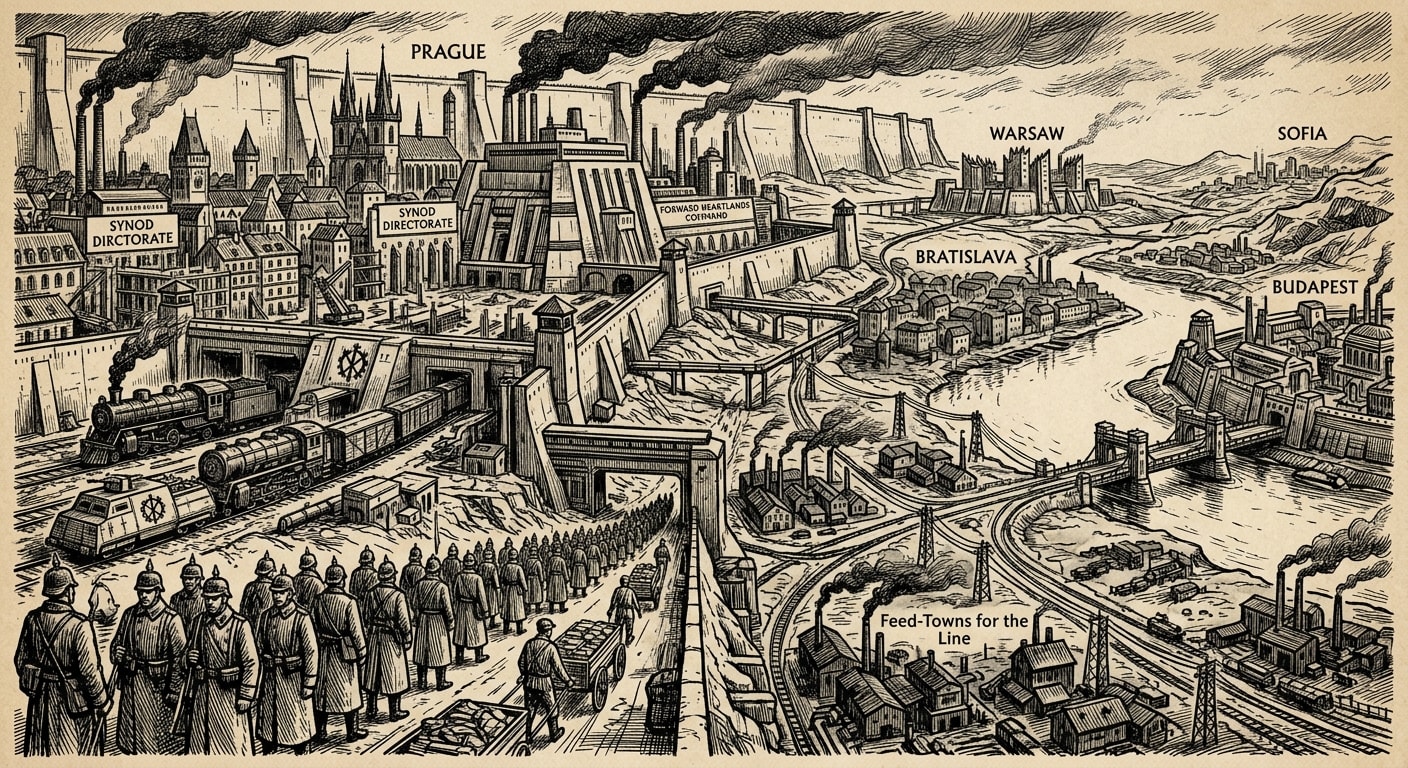
Prague feeds the Line indirectly: paper, penitents, trained humiliators, forbidden books confiscated twice, wine tested into evidence, clerks, auditors, and the stern civic instinct by which a city makes public correction look like architecture. Since A.S. 96, the Procession of Tongues has crossed the bridge-route under the Order of Saint Ephrath. Children watch from windowsills. Bakers time ovens by delays. The condemned complete the route because a sentence that fails to reach its final station is an irregularity, and Prague hates irregularity almost as much as it hates being caught remembering reason.
Prague’s beauty is operational. Spires hold bells. Bridges hold processions. Cellars hold things that answer in childhood names. The university quarter has been beaten, reopened, censored, funded, inspected, and beaten again, which is the normal life cycle of learning when learning forgets its master. Smugglers use its cellars because ideas prefer damp stone and educated accomplices. The Bureau of Silence confiscates the texts. The Bureau of Shadows confiscates the confiscators if they perform righteousness too loudly.
In A.S. 167, Pale Chanters opened an inverted Kyrie on the eastern seminary field and forty-three Radiant Fusiliers died without firing. The file says command miscommunication. Soldiers say the Creed went silent. Both phrases have their uses. Zone 3 keeps such phrases in parallel columns and sends the corrected drill east.
#On Bratislava, the Throat
Bratislava, old Pressburg in varnished files, stands between the Vienna-Ruins and Budapest. It is a Danube crossing, secondary rail junction, Bureau of Passage checkpoint, quarantine reserve, overflow yard, and damp throat of the Central Corridor. Block it, and the Corridor chokes in three directions.
Bratislava lacks Budapest’s grand wound and Prague’s theatrical punishment. This is why it works. Large cities cultivate symbolism. Bratislava cultivates hinges. It checks, delays, reroutes, quarantines, releases, and makes convoys explain themselves before the bridges. Passage occupies the western approach in a swollen customs house that resembles a monastery after losing faith and discovering forms.
The city’s old files remember the Siege of Pressburg (Unregistered), when deserters learned that signatures can walk a man backward if attached to the correct oath, bridge obligation, and Records clerk. Its shrine-barge disputes fed the Cadence Reforms of A.S. 95. Its rail yards survived the gauge humiliations, where incompatible track widths turned shells, flour, chrismole, and reliquary crates into hand-carried theology.
Bratislava also receives the unfinished human results of war: hunger survivors, wound-site men, cavalry remnants, refugees whose papers have softened in rain, and soldiers whose bodies returned while some necessary part remained east. Quarantine annexes there have beds in the technical sense. The Bureau of Medicine has made worse claims with straighter faces.
BRATISLAVA QUARANTINE NOTE — SEALED ABSTRACT Patient category: post-corridor survivor, ingestion compulsion persistent Question asked by subject: whether wall-plaster could be blessed before consumption Final disposition: ███████████████████████████ Instruction: do not house hunger cases adjacent to lime storage
Bratislava’s virtue is middle-place severity. It keeps the bridge open and the queue suspicious. A hundred grander cities have failed at nobler tasks.
#On Budapest, the Divided Engine
Budapest is the largest city of the forward heartlands south of the Carpathians and the principal staging hub of the Central Corridor. The western bank lives under the Synod. The eastern bank watches, abandoned by designation and not by every eye that has looked too long across the Danube.
The city feeds the bastions. Grain, ammunition, reliquary consignments, rotations, wounded, refugees, mules, field glass, chrismole, rail spikes, oath paper, replacement boots, replacement rifles, replacement men: all pass through Budapest’s marshalling logic. The Central Corridor Command turns convoys into coloured pins. Green moves. Yellow dies slowly enough to require decisions. Red becomes a prayer said by clerks who dislike blood on maps.
The Danube divides the city from its own accusation. Pest was evacuated between A.S. 118 and A.S. 120 in official language; evacuation and removal of all persons are not the same sacrament. The Mothers of Plenty processed the western-bank queues and found numbers that refused reconciliation. Sixty to ninety thousand names remain suspended in that bureaucratic purgatory called administrative review. Across the water, rooflines remain. Windows remain. Patrols remain necessary, which tells the educated reader more than the official silence can bear.
Earlier corridor summaries described Budapest’s eastern bank as “fully evacuated.”
Corrected. The evacuation was declared complete. Completion means the operation ceased. It does not guarantee that every person, memory, hunger, debt, or watcher crossed the river with permission.
Budapest also owns the wound-site corridor toward Irongate, where extraction houses make profit from reality’s injuries and file dead prospectors as fuel-adjacent losses. Its refugee offices run fourteen months behind. Its thermal baths serve officials too exhausted or too corrupt to pretend that a hot mineral pool is not the finest argument for empire. Its citizens drink strong coffee indoors and practice public compliance with private Hungarian contempt. This is a stable arrangement. Stability is often made of things no sermon should touch.
#On Warsaw, Sofia, and the Lesser Necessary Places
Zone 3 is not a necklace of famous cities. It is a belt of necessary places, and necessity has poor manners. Warsaw holds the Polish lowlands under northern pressure, a rail hub too large to evacuate and too exposed to flatter itself. It feeds Brest and Königsberg, counts artillery distance as a weather condition, and maintains civilian life with the fatalism of a city that hears the front chewing.
Sofia sits between Irongate and Shipka in the southern staging logic: partially ruined, heavily fortified, useful in the way a spare rib is useful to a starving man. It knows it is expendable. Cities that know this develop hard faces and better clerks.
The Vienna-Ruins remain a shrine-town and delay engine: sacred wreckage with a living population around it, pilgrimage traffic clogging supply sense, and the memory of A.S. 95 nailed so deeply into the stones that every convoy passing east loses time to holiness. Marrowgate processes bodies at the inland medical ports. Sandomierz, Palatine switchyards, Danube crossings, Carpathian mule gates, Dalmatian road houses, and nameless ration stops perform the thousand clerical labours by which the Line continues pretending that courage alone defends it.
The lesser places share the same posture: head west for orders, hands east with supplies, eyes down when the casualty trains pass. Their children learn corridor words early: delay, transfer, quarantine, requisition, variance, next-of-kin, provisional, corrected.
#On the People Who Live Under Throughput
A Zone 3 citizen is neither rear civilian nor front soldier. He is a component with weather, debt, relatives, and occasional opinions. His day is shaped by train whistles, curfew lamps, convoy closures, passage checks, levy boards, ration adjustments, and the silent knowledge that any ordinary street may become an overflow route by afternoon.
Markets open around military schedules. Weddings wait for troop trains. Funerals share roads with ammunition carts. Schoolchildren learn map bands before saints because fathers vanish by corridor and return, if they return, by carriage. The poor know which depots discard damaged grain. The rich know which clerk can make a travel restriction sound like pilgrimage. The clergy know that every sermon must leave room for the bell that interrupts it.
Refugees give Zone 3 its second population. They arrive from abandoned banks, contested villages, border evacuations, failed resettlements, and districts the Bureau still calls temporarily cleared because permanent loss has bad morale. Records builds identities from fragments. Settlement assigns benches. Mercy distributes what can be spared after War has taken the better part. Tithes asks questions whose cruelty lies chiefly in their timing.
There is kindness in Zone 3, because humans are disobedient animals. Bread appears under tarps. Lanterns tilt away. Clerks misread a name in mercy’s favour and spend the next week fearing their own handwriting. A guard lets a woman cross with two children and records one bundle. A priest says the wrong comfort at the right time. Such acts are not policy. They are leaks. The Synod survives partly because it cannot seal them all.
#On the Present Condition
As of A.S. 201, the Forward Heartlands remain loyal, strained, productive, suspicious, and overused. The Central Corridor runs hot. Budapest’s yellow pins multiply. Bratislava keeps breathing through damp paper. Prague exports obedience with a bitter academic aftertaste. Warsaw hears the northern teeth. Sofia watches the southern roads. The Vienna-Ruins delay everything in the name of sanctity and may be right, which is the most irritating form of obstruction.
The Line consumes more each year: flour, lamp-oil, chrismole, wire, lime, field glass, rail spikes, bell bronze, oath paper, replacement boots, replacement rifles, replacement men, and the little devotional objects by which frightened soldiers convince themselves that the next shell will prefer somebody else. Strasbourg pronounces Order. Munich warehouses it. The Forward Heartlands marshal it. Zone 4 receives it and asks for more.
The Forward Heartlands are the Synod’s held breath before the front. Peace does not live there; discipline does. Safety does not live there; processing does. Behind the Line, they form the long hand reaching into the furnace with bread in its palm.