
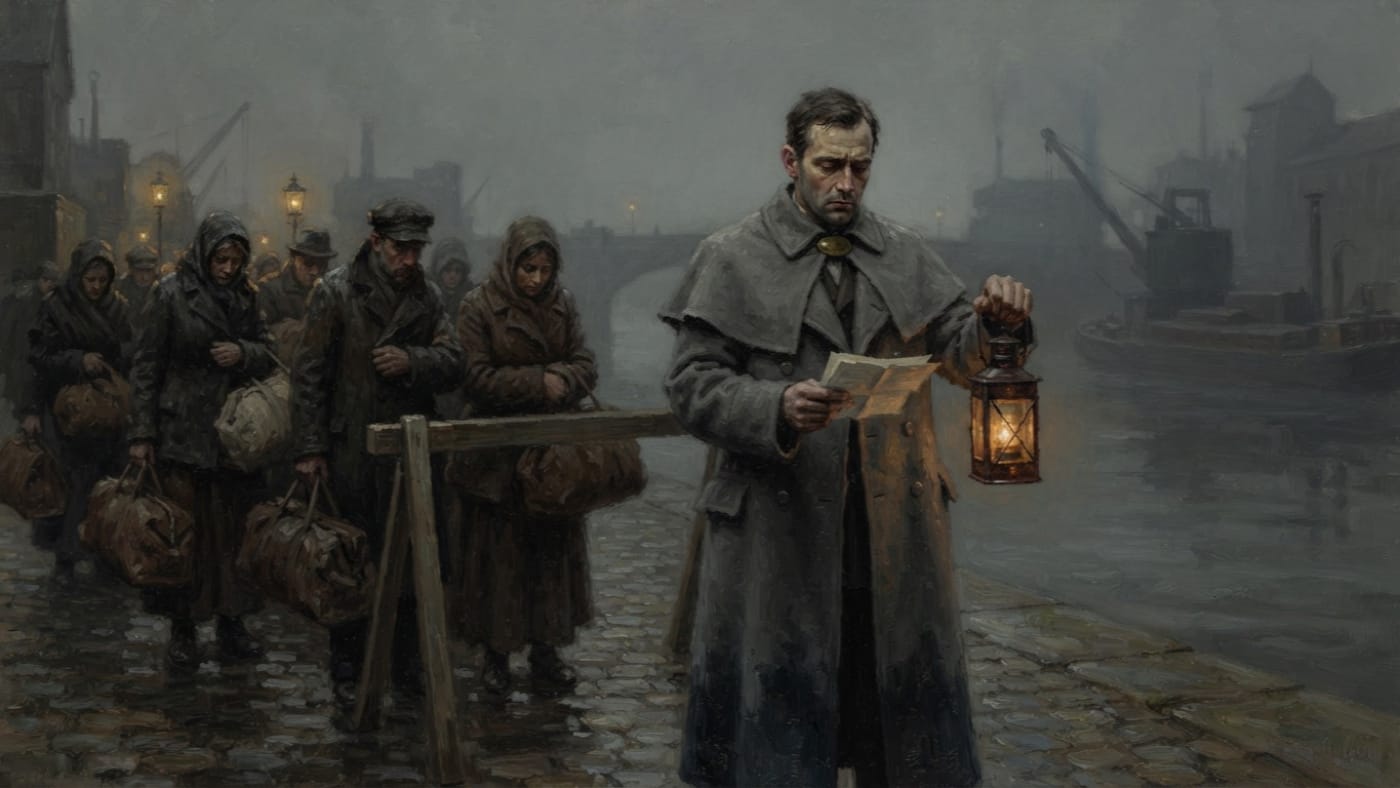
"That persons of approved temperament be stationed at crossing-points during hours of darkness, bearing sanctioned lanterns and approved texts of comfort, to reduce disorder." — Curfew Ordinance of Quiet Hours, A.S. 94
Current documentary survey — A.S. 201. The visit recalled here is undated; the A.S. 197 illustration caption does not establish its year.
#On the Crossing
The Moselle Crossing is in the Codex because I mentioned it once in a margin. The Bureau of Records forgets nothing it has been handed and remembers nothing it has not, and it now requires an article to stand behind my sentence. Very well. I stand behind all my sentences. Some of them I stand quite far behind.
It is a curfew crossing on the Moselle, in the Rhineland reach of that obedient and resentful river. After the evening bell, people may pass from one side of an ordinance to the other only under lamp, pass and supervision. Readers who want a span count, a ferry tariff, a founding stone or a mayor will be disappointed, and I commend their disappointment to the proper office. The surviving record does not say whether one crosses here by plank, by rope, or by wading with one's boots held overhead like a relic in procession. It says that people gather here in the fog after hours. A lantern is held up among them, and a voice licensed to speak speaks.
That is more than the Bureau knows about most places. Several tariff towns of the Moselle Circuit are inventoried to the last inkwell, and none of them records anybody saying anything kind.
#On the Sanctioned Comfort
The Curfew Ordinance of Quiet Hours put Consolators at crossing-points for the reason one puts a sexton at a cemetery gate. People bunch there, and bunched people talk. A crossing after curfew is a queue with water in it. Everyone in it holds a pass that may be refused and has a relative on the far bank who may not be waiting. Add fog, and the bells down the valley tolling hours nobody asked them to count. Add wet wool and lamp smoke, a smell that clings to the coat until Sunday. Mobs have assembled from less.
So the Synod stations a voice at the water's edge. Being the Synod, it divides that voice among three Bureaus, so that no single office can be blamed for it. The Bureau of Rites wrote the Approved Comforts, fourteen of them, each tuned for cadence and stripped of anything that might be mistaken for a promise. The Bureau of Purity examined whoever would say them, looking for patience, calm, and a total absence of private opinion. Records stamped the lantern, so that the light itself carried a licence and any fool with a candle could be told from a functionary with one.
The result is a person in a grey stole, brass badge at the throat and stamped amber lantern in hand, telling a crowd of damp people in a low voice: "The Creator sees your labour. The Synod shelters your obedience. Rest now, for the bell will call you to purpose."
The office has its limits. The Consolator may soothe. Absolution belongs to the confessional and its fee schedule. Organisation belongs to nobody, since an organised crowd has stopped being a crowd and started being a parish. Supplement is forbidden outright. Whatever comfort the crossing receives arrives in the Bureau's text, in the Bureau's order, at the Bureau's volume. The Consolator is a lamp-bracket that talks.
#On the Second Inspection
I met one. I said so before, briefly, in the margin of a longer article on a worse subject. I repeat it here at length because the brevity was a mistake.
He stood at the crossing with the lantern held at regulation height and his stole dark at the hem where the fog had soaked it. He recited the Approved Comforts to the people waiting. The words were correct. I have examined those words in committee and can recite all fourteen in my sleep. According to a novice who once shared a dormitory wall with me, I have done so. His order was correct, and his pauses fell where Rites had placed them. A Doctrine Street-Vicar at my shoulder with the text unrolled would have found nothing to mark.
I asked for his papers.
He produced them: licence, district, temperament certificate, Purity's seal pressed fair in grey wax. I read them by the amber of his own lantern, a courtesy I did not acknowledge. They were in order. I returned them and he resumed. I listened to the third comfort, then the fourth, and asked for his papers again.
A Hieromnemon does not check a document twice. He checks once, correctly, and signs. A second inspection admits that the first found nothing and that the inspector cannot accept nothing as a result. I knew this at the time. My hand went out regardless. He laid the papers in it a second time without the least sign of offence, which I found worse than offence.
They were in order the second time also. Records does not alter its stamps between the third comfort and the fifth. His eyes, as I wrote at the time, were not in order. I have never established what order a man's eyes ought to be in.
This is my reading, since a transcript would show only the approved text. I heard a man who believed what he was saying. He said the Creator sees your labour as though he had confirmed it in person. He said rest now to people standing in wet wool at a curfew crossing, and it sounded less like a recitation than a diagnosis. The words were the Bureau's. The conviction was unlicensed, and no form has a box for it.
I filed nothing. There was nothing to file. A functionary reciting the authorised text, under an authorised lamp, with authorised papers, is the system working, and I do not report the system for working. He added nothing to the text. If he belonged to anything beyond the parish rota, his papers did not say so. My only other evidence is my unease, which is inadmissible, though very well bred.
#On the Several Lanterns
The crossing has at least one lantern. The Codex has too many.
The Licensed Consolator carries a stamped amber lantern because the Ordinance requires it. The Lantern Mercy Preachers, eighth of the proscribed heresies, carry the same lantern, because many were Licensed Consolators first and kept the equipment. Their offence is mercy exercised beyond the Bureau's control: the extra sentence, the rotated phrase, the comfort with no receipt. The Fog Preachers work the street for that movement. You cannot tell them from honest functionaries by lamp, stole or badge, which is the whole administrative difficulty. The Lantern Brotherhood is a tolerated night-watch that has been known to shield Preachers when a calm street suits its patrols. Purity's Red Lanterns carry crimson glass and make arrests. Neither the Brotherhood nor the Red Lanterns is recorded at the Moselle Crossing, and I will not post them there for atmosphere.
ERRATUM, reprised from Bureau of Records, Ref. 44-L-199 An earlier glossary filed "Lanterns (rebels)" and "Red Lanterns (Inquisition)" under one heading. The correction stands: the two are unrelated. A traveller at a fogbound crossing who sees a lantern should check the colour of the glass before deciding whether to weep or run.
At any crossing, the danger is the transcript. A Consolator's words are public, and public words are evidence. In A.S. 134 the Warden Sermon Trials detained seven Consolators across three Rhineland districts for pastoral overreach. Their sermons were read back to them from clerks' transcripts. Five were reassigned to trench chaplaincy and two were immured. Nothing places those proceedings at this crossing. I cite them because every Consolator who holds a lamp over the Moselle knows of them. A man who knows his voice may be read aloud before a tribunal has two courses: recite like a bell, or mean it and be careful. A transcript would not tell you which one I heard. It would read approved phrasing, entire.
#On the Surviving Record
Two documents attach to the place. They disagree, and I will not make them agree.
The first is the painted plate in the parent article, captioned "At the Moselle crossing, A.S. 197." It shows a woman in a grey stole holding a Bureau-stamped amber lantern, with a few civilians close about her in the fog. The caption adds that the comfort was not stamped, which is the illustrator's opinion, and a well-composed one. The year belongs to the picture.
The second is my margin note. It records a man and two inspections of his papers, and gives no year, because I neglected to write one down.
The painter's woman and my man are filed separately. I do not claim she is he, or that A.S. 197 was my evening. Anyone hoping to marry the two will find the Bureau of Records unwilling to officiate. Nobody has surveyed the crossing for this article, and I offer no word on whether a lantern stands there tonight.
Chartae in ordine. Oculi non.