
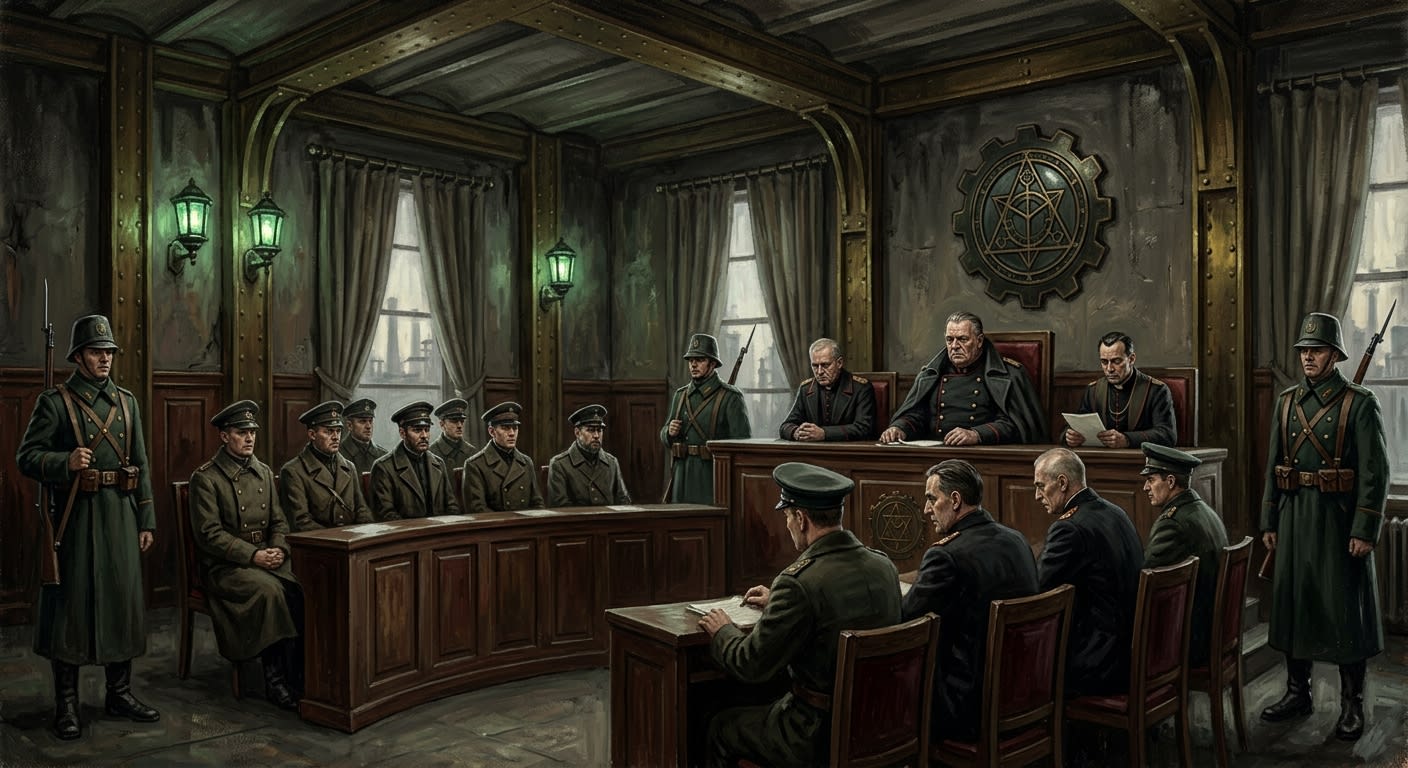
#On the Charge Called Pastoral Overreach
“Weeping is received. Weeping is entered. Weeping is no defence.” — Tribunal note, Rhineland, A.S. 134.
The Warden Sermon Trials of A.S. 134 began with seven Licensed Consolators and one phrase the Bureau of Rites had not approved. The charge was pastoral overreach, a classification invented for the occasion with the limp elegance of a new glove placed over a fist. Seven grey-stoled comforters from three Rhineland districts were detained by the Bureau of Purity, tried before a sealed tribunal, and made to listen while their own sermons were read aloud by men whose vocation consisted of removing warmth from words.
The street calls them martyrs. Purity calls them corrected personnel. The Lantern Mercy Preachers call them precedent, which is the most dangerous name of all.
The seven had held lawful badges. They had carried lawful lanterns. They had recited lawful comforts beneath lawful curfew bells. Their offence lay in the supplemental sentence: small, soft, variable, lodged after the approved blessing like a sliver under a fingernail. “Obedience and love are not the same word” appears in one transcript. Two other transcripts record variants too cautious to convict and too tender to excuse. The Bureau, being blessed with instincts finer than its vocabulary, smelled the heresy before it could name the grammar.
#On the Capture of the Sermons
The sermons did not arrive at tribunal by miracle. They arrived through plainclothes Confessor-Booth Clerks, the species of witness every soft heresy deserves and every soft heretic forgets to fear. A White-Mantled Inquisitor announces a room’s danger by entering it. A Red Lantern announces it by heating glass. A Booth Clerk sits in a doorway with ink under the thumbnail, nods at weather, remembers the third pause, and goes home to write treason in columns.
The seven were watched across twenty-eight dusk stations: ossuary gates, ration queues, bridge stairs, tavern thresholds, and chapel porches where grief had been accumulating in civic quantities. Their approved comforts matched the Rites card. The supplemental phrases did not repeat cleanly. That, according to Purity, proved discipline. The accused were too careful to be innocent.
The captured transcripts preserve the method now called fogwork. Comfort first, crowd stilling second, meaning slipped beneath the hem of liturgy third. No order. No named safe house. No denunciation of the Synod, which would have been vulgar and easy. The Preachers performed a finer sabotage: they made listeners feel accompanied. Authority can punish defiance. Accompaniment requires statistics.
Early Rites summaries described the accused as “excessively consoling.”
Corrected after Purity review. Excess of consolation was insufficiently chargeable. Pastoral overreach was adopted as the standing term because it suggests a hand extended beyond licence, and hands beyond licence are easier to cut.
#On the Hearing Room
The tribunal room was small. Purity understands the theatre of compression. A high hall gives a defendant dreams of history; a small room gives him a table, a lamp, three officials, and the smell of his own sleeves. Each Consolator stood alone. Each heard the transcript read in a flat voice. Each was asked whether the words were hers. Each answered in some version of yes, no, context, mercy, crowd, grief, meaning, please. The Clerk recorded the answers without punctuation.
They wept. This detail survived because the tribunal enjoyed noting it. The official digest says: the accused displayed emotional discharge irrelevant to charge substance. Bureau prose can make tears sound like a drainage problem.
TRIAL ABSTRACT — CONSOLATOR THREE Approved text: Labour and Rest, Variant IX Supplemental phrase: █████████████████████████████ Question: “Did you intend civic redirection?” Answer: “I intended her to breathe.” Notation: evasive. Disposition: █████████████████
The tribunal’s genius lay in refusing martyr language. No public scaffold. No posted heresy sheet. No market-square confession. Five were reassigned to trench chaplaincy at forward bastions, which is the Bureau’s preferred euphemism for a grave that files reports before filling. Two were immured. Their names do not appear in devotional calendars. The Bureau of Mercy sent flowers to the families, as Mercy always does when it has been instructed not to ask questions.
#On the Sentence That Escaped
The Trials were meant to cauterise. They cauterised seven bodies and taught seven hundred mouths better technique.
After A.S. 134, written instructions became poison. Candle-Runners carried fragments rather than orders. Old Faron’s phrase-rotation schools gained the authority of fear. The Soft Insurgents later called the Trials a victory with the insolence proper to men not seated before the lamp. Their arithmetic was ugly and correct: seven taken, seven hundred warned, the method preserved.
The Bureau learned too. Red Lantern instructors began listening for recurrence by meaning rather than wording. Booth Clerks received advisory cards for “supplemental comfort exhibiting civic effect.” District Seven’s (Unregistered) later surveillance reports grew fat with zeroes: 312 sermons, approved phrasing absolute, actionable variance absent, suspicion increased. Perfection became a smell.
A later devotional broadsheet claimed the Warden Sermon Trials acquitted two Consolators after repentance.
False. No acquittals entered the sealed digest. Two were immured. If repentance occurred, the wall received it.
#On the Trial’s Present Use
The Warden Sermon Trials now sit inside Lantern training, Purity training, Booth Clerk caution, and the private dread of every Consolator whose tongue still possesses warmth. The Red Lanterns cite them as warrant for early branding. Codex Doubt Auditors cite them as proof that crowd calm may conceal drift. Fog Preachers cite them by silence, which remains the finest citation when every spoken source is waiting to become evidence.
Their legal consequence was Classification Advisory 14-L: the Lanterns named eighth of eight proscribed heresies. Eighth is where the Synod files what it made with its own hands and now resents for having learned to walk sideways. The Licensed Consolator office survived. The approved comforts survived. The lanterns, badges, route sheets, and grey stoles survived. Only innocence was withdrawn from circulation.