
#On the Fourteen Lawful Softenings
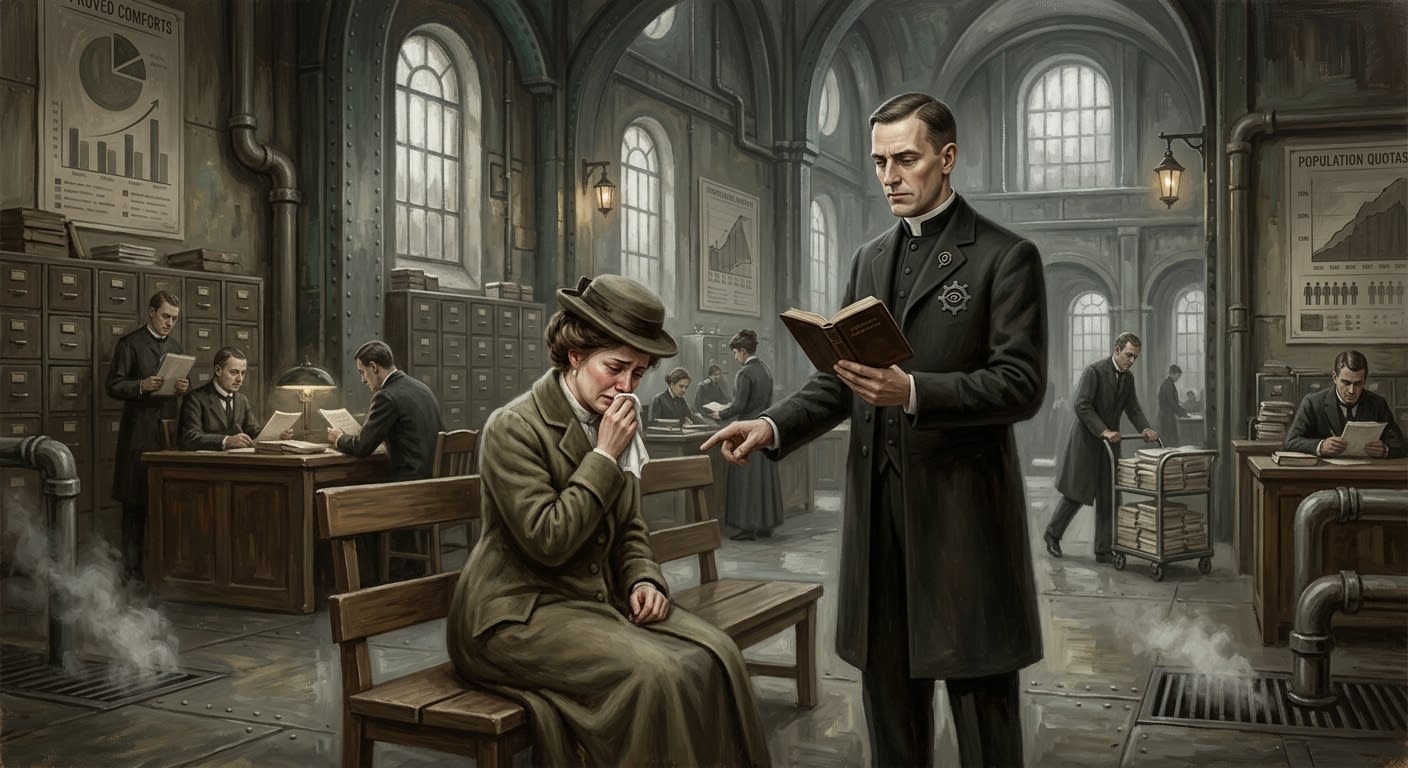
The Approved Comforts are the fourteen Bureau-sanctioned phrases issued under the Curfew Ordinance of Quiet Hours in A.S. 94 for use by Licensed Consolators: grey-stoled, lantern-bearing personnel stationed at Rhineland crossing-points to reduce night disorder among citizens whose grief had become inconveniently audible. They were composed by the Bureau of Rites, vetted by the Bureau of Purity, stamped by Records, admired by Tithes for lowering repair costs, and eventually stolen by the Lantern Mercy Preachers, which proves that even holy paperwork may be mugged in an alley if it walks home after dark.
The Comforts are not prayers, though they wear prayer’s coat. They are not sermons, though weak Consolators have mistaken them for such and have paid in masonry. They are public-order utterances: brief, memorised, repeatable, temperament-tested sentences designed to calm without binding, acknowledge without promising, soften without altering the citizen’s proper relation to authority. A cudgel stops a fist. A Comfort stops the moment before the fist becomes a crowd. Naturally, the Bureau preferred the cheaper tool.
The first authorised set numbered fourteen. Rites proposed twenty-one, which is what Rites does when left near parchment and sorrow. Purity struck seven as “excessively individuating,” meaning they made the listener sound too much like a person. The surviving fourteen were divided by use: labour, bereavement, hunger, child distress, curfew fear, levy anxiety, infirmary delay, burial absence, queue exhaustion, widow’s account, orphan reassurance, riot-threshold stilling, night crossing, and general obedience fatigue.
#On the Texts Themselves
The most common Comfort is Labour and Rest, Variant IX: “The Creator sees your labour. The Synod shelters your obedience. Rest now, for the bell will call you to purpose.” It is a small masterpiece of controlled tenderness. The Creator sees; the Synod shelters; the bell calls. The citizen is observed, enclosed, and summoned, all in one sentence smooth enough for a weeping widow to swallow before she notices the hook.
Bereavement Comfort III reads: “Your dead is entered; your sorrow is received; your household remains within the count.” Rites liked the phrase because it sounded pastoral. Records liked it because it made grief acknowledge registration. Tithes liked the household clause. Mercy objected to the singular “dead” on grounds of tone and was overruled, correctly, because tone is less important than column width.
Hunger Comfort V reads: “Bread comes by measure; measure comes by order; order holds the loaf until your name is called.” This one caused trouble almost immediately. Citizens heard promise where the Bureau intended patience. Bakers heard accusation. Children heard loaf and nothing after. In A.S. 96, a supplemental instruction required Consolators to lower the voice on “loaf” and raise it on “order,” producing a cadence so repellent that three districts begged for Hunger Comfort II instead.
Child Distress Comfort I is merciful by Bureau standards, which is to say it has been washed until only the bones remain: “Little one, the lamp is lawful; the hand beside you is known; the night has been counted.” Its purpose was to calm children at curfew crossings while their parents produced tokens, ration slips, work permits, transit tags, grief papers, and the other little flags by which the State confirms a family has not become weather. It worked. That was the beginning of the trouble.
A Comfort that works enters the body. The listener remembers the rhythm. The Consolator remembers the listener. The next night, under fog, the same sentence feels less like issuance and more like relation. Relation is where administration begins to leak.
#On the Intended Limits of Kindness
The Approved Comforts were built with prohibitions inside them. No Comfort may instruct a citizen to move except toward lawful shelter, lawful queue position, lawful return, lawful waiting, or lawful compliance with bell-order. No Comfort may use kinship language not already present in the citizen’s file. No Comfort may imply that sorrow creates exemption. No Comfort may describe Heaven acting without Bureau witness, since unsupervised Heaven has been the cause of several provincial misunderstandings and at least one unlicensed shrine economy.
The Consolator manual gives posture as much attention as text. Lantern held left. Right hand visible. Feet still. Voice low, not intimate. Eye contact brief. No touching except to prevent immediate fall, trampling, or self-injury. No whispered additions. No names unless read from token. No promise of tomorrow. No phrase beginning “I know.” The Bureau, in its wisdom, understood that comfort becomes dangerous when it passes through a human throat with too little distance from the heart.
Early Rites memoranda describe the Approved Comforts as “pastoral language for civic reassurance.”
Corrected after A.S. 134 review. They are civic language in pastoral costume. The difference matters chiefly to defendants, and defendants develop sudden interest in precision.
Purity’s temperament vetting sought persons gentle enough to calm panic and hollow enough to avoid meaning it. This is harder than it sounds. A brute cannot console. A saint cannot be trusted. The ideal Consolator is a cracked cup: capable of holding warmth briefly, incapable of mistaking the warmth for his own. Strasbourg produced training schools to manufacture such cups. The streets kept stealing the ones that were still whole.
#On Theft by Emphasis
The Fog Preachers did not begin by rejecting the Comforts. Rejection is easy to punish. They began by loving them badly.
A lawful Consolator says Labour and Rest with the stress on Synod and purpose. A Lantern Mercy Preacher places the stress on your labour, and the labouring man hears possession. She places the stress on sees, and the widow hears accusation against unseen officials. She delays before bell, and the child listening from the step learns to wait until the second peal. The page remains obedient. The air does not.
The Tongue-Smiths perfected this theft. They learned the fourteen forms so well that Purity assessors could recite the words with them and still miss the crime. Meaning moved into pace, omission, local grief, saint order, throat-weariness, and the little district wounds no central office can own fast enough. In Bastion-Brest, mortar changes any sentence near a levy queue. In Cologne, a lamp can cough politically. In the Moselle crossings, “rest” may mean wait, hide, delay, refuse the first signature, or simply keep breathing until the informer grows bored.
Old Faron is credited with teaching phrase-rotation around the Comforts: speak the authorised core once for the clerk, once for the grieving, once for the child who must carry the useful fragment. If all three sound alike, everyone is endangered. The lesson took hold because it honoured the central fact of the Comforts: they were already designed to mean one thing on paper and another in the body. The Preachers merely changed the owner of the second meaning.
PHRASE-COMPARISON REVIEW — DISTRICT SEVEN, A.S. 199 Base Comfort: Labour and Rest, Variant IX Recorded sermons: 312 Verbal conformity: 100 percent Actionable variance: 0 percent Post-sermon effects: levy delay ███; household dispersal ███; queue violence reduced ███; Warden contact avoided ███ Assessor note: “The words are ours. The result is not.”
#On Pastoral Overreach
The Warden Sermon Trials of A.S. 134 made the Comforts into evidence. Seven Licensed Consolators were detained after supplemental phrases recurred under curfew conditions. Their offence was not rebellion in the vulgar sense. No one shouted. No banner rose. No Warden was struck. A woman breathed instead of collapsing. A queue stopped waiting for permission to notice itself. A child received a route inside a lull phrase. Purity called this pastoral overreach, that limp little glove over a fist.
Five accused were reassigned to trench chaplaincy. Two were immured. The fourteen Comforts survived, revised only in handling notes. The Bureau did not abolish them because they worked, and the Synod never discards a useful instrument merely because it has drawn improper blood. It sharpens the handle, changes the training, and blames the hand.
A later Rites digest states that the Warden Sermon Trials removed ambiguity from the Approved Comforts.
False. The Trials removed innocence from their use. Ambiguity remained because human speech remained, a defect still awaiting total correction.
After the Trials, Comfort cards were printed with red marginal ticks indicating dangerous stress positions. Consolators were drilled to keep emphasis stable. Booth Clerks were trained to record pauses. Red Lantern squads learned to distrust sermons that sounded too clean for too long. Tongue-Smiths answered by moving meaning through breath and local memory. Candle-Runners carried fragments. Mercy Architects arranged streets around what the Comforts could make plausible. The official text became a battlefield so small that the war could fit inside a comma.
#On the Present Approved List
As of A.S. 201, the fourteen Approved Comforts remain active under annual review. New district supplements are forbidden unless countersigned by Rites and Purity, a joint process whose speed resembles a corpse asked to dance through tar. Unofficial supplements remain everywhere. A mother changes one word. A Consolator lingers half a breath. A Fog Preacher lowers the lantern before saying “shelters.” A Tongue-Smith scrapes the wax tablet clean before dawn. The Bureau receives transcripts. The street receives instruction.
The current manual requires each Consolator to recite the list before deployment and after return. Deviations are marked. Hoarseness is noted. Tears are discouraged except in Bereavement Comfort contexts, and even there the tear must not impede diction. A Consolator who believes too strongly is rotated. A Consolator who comforts too effectively is interviewed. A Consolator whose district grows calm without corresponding submission is watched by persons with better shoes and colder eyes.
There are regional handling tables now. Rhineland Comforts permit rain references under strict weather verification. Brest Comforts forbid mortar metaphors after the Voss recurrence. Strasbourg Comforts require Records-friendly diction near registry queues, lest a citizen mistake “your name is held” for protection rather than custody. Bastion-adjacent Comforts are shorter, because artillery makes pastoral syntax ambitious. Orphanarium Comforts are shorter still. Children learn fast, and the Bureau dislikes being understood by children before it has finished raising them.
Copies of the list are printed on stiff prayer-card stock and carried in sealed sleeves. The sleeve matters. A naked card looks like scripture. A sleeved card looks like procedure. Procedure reassures inspectors, disappoints mystics, and survives damp if the wax is properly rubbed into the edge. Many Consolators memorise the forms and leave the card untouched, which Purity treats as suspicious devotion to competence.
The Approved Comforts endure because they occupy the Bureau’s favourite moral posture: necessary, compromised, deniable, and cheaper than admitting the citizen suffers. The Preachers endure because they discovered the hidden mercy in the instrument and taught it to slip its leash. Between them stands the Consolator at dusk, grey stole damp, lantern glass fogged, card memorised, throat ready, watched by Purity, needed by the street, and damned the moment the words begin to sound true.