

#On the Woman Whose Grave Pays Rent
Mother Vell of the Crooked Stones is the unofficial patron of the Grave-Field Shanty Brokers, which is to say she is revered by landlords who sleep badly, prayed to by refugees who cannot afford honesty, ignored by the Bureau of Hagiography, and known to every child who has ever been told to keep one hand on the headstone when the ground begins to sigh.
No Bureau register contains her name. This proves nothing except that the register is embarrassed. The grave said to be hers has been sold fourteen times, leased twenty-three times, occupied by six families, vacated by two patrol notices, blessed once by mistake, and condemned twice for “structural impropriety.” Brokers still leave candles there when a lane survives winter. Families leave bread. Stone Sharks leave keys. The dead leave no comment, which is tactful of them.
The common street proverb gives her doctrine in six words: a plot is a promise. It sounds merciful until one asks who owns the plot, who made the promise, and which corpse is expected to endorse the lease. Mother Vell, if she existed, understood the grave-field economy before the Bureaus found language evasive enough to tolerate it. Bodies own ground. The living need ground. Paper can be taught to confuse the two.
#On Her Various Births
She is born differently in every grave-ring. At Marrowgate, she was a plague widow who learned to read burial tags upside down and sold vigil space beside her husband’s marker until the lane became a village. At Bastion-Przemyśl, she was a Stake Runner who chalked boundaries during shelling and refused to move when the trench-spur surveyors arrived. In the Hintermark of Bastion-Constantinople, she was a coffin carpenter’s mother, too old to flee, who charged three families one plot in rotating shifts and kept all three alive by having them sleep according to bell-hour. At Cologne, naturally, she is said to have been three women and a boy with a good stamp.
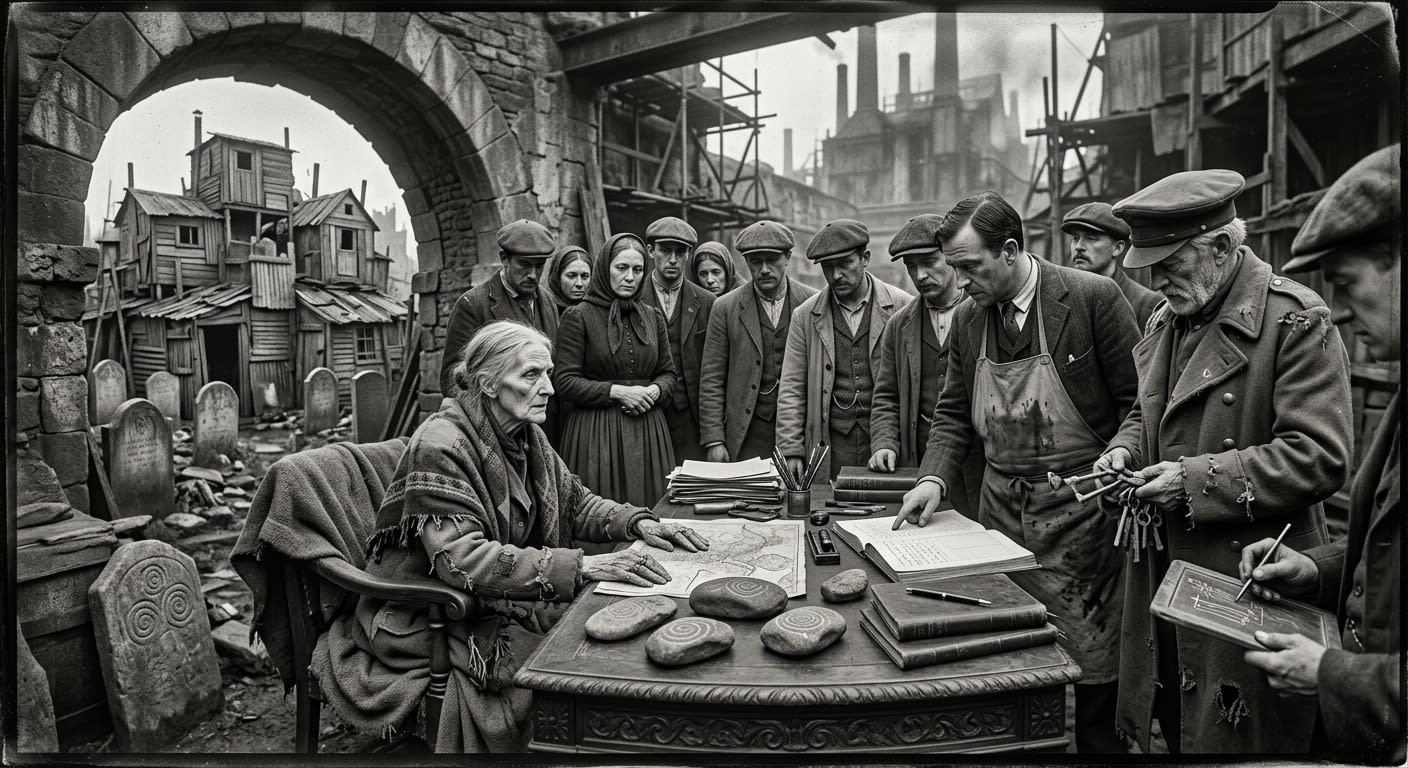
The Bureau prefers none of these. I prefer all of them. Utility is the only genealogy the poor can afford.
Her title — Mother — may be borrowed from Mother Vellum-of-the-Reed, the ferry patron who sold names to the nameless and vanished with a blank folio. This resemblance irritates clerks who like saints in separate drawers. The underworld, being wiser than clerks and worse than priests, does not care. River Brokers need a mother who carries names across water. Grave-Field Brokers need a mother who carries households across death’s property line. The syllable travels because the work rhymes.
Vell of the Crooked Stones belongs to the stones that lean. Upright headstones advertise fresh grief, titled families, active descendants, and audit risk. Crooked stones mark older claims, thinner files, dead heirs, parish fatigue, and the beautiful moment when Records knows a plot exists but cannot summon the energy to love it. A crooked stone is a door with moss for hinges.
Earlier oral collections describe Mother Vell as “founder of the Grave-Field Shanty Brokers.”
Withdrawn. No founder can be proved. The practice grew wherever wartime housing failed beside protected burial ground. Mother Vell is better understood as the profession’s most useful ancestor: invented by need, refined by rent, and old enough to escape prosecution.
#On the Fourteen Sales
The grave sold fourteen times is the cult’s central relic, though the Bureau of Relics refuses the classification and the Brokers refuse the audit. Its location changes by city. The best-attested version places it in a Zone 3 grave-ring outside a forward supply town whose name has been filed under disputed shelter enumeration. The headstone is limestone, tilted eastward, with an inscription weathered into four possible names and one certain date: A.S. 178, the year Settlement Memorandum 14-R (Unregistered) first taught the Bureau to call habitation by graveside “caretaker shelter.”
A plot became available. A family bought it for vigil rights. A second family bought night occupancy. A third purchased the shed behind it. A fourth acquired “seasonal mourning access.” A fifth paid for the right to bury an empty coffin there and thereby anchor a lane. A sixth rented the coffin lid as a roof panel. By the fourteenth sale, the grave contained one body, two certificates, three families’ cooking pots, a false parish stamp, an arrears ledger, and a child who could recite every purchaser in order but not his own father’s name.
This should have produced scandal. It produced housing.
LANE INTERVIEW FRAGMENT — CROOKED STONE FILE, A.S. ███: Question: “Who owns the grave?” Answer: “Mother does.” Question: “Where is Mother?” Answer: ███████████████████████ Note: six residents present; seven shadows counted by lantern; headstone warm after midnight Disposition: observe; do not disturb while rent receipts remain regular
The miracle, if that word has not yet been entirely ruined by official use, was rotation. Families slept in turns: dusk to Matins, Matins to dawn, dawn to work-bell. The sick took the sheltered side. Children slept in the coffin shed when rain came. The dead man beneath them, whoever he was, contributed silence, which in a grave-field is the nearest thing to consent.
#On Her Use Among Brokers
The Caretaker Saints claim Mother Vell as mercy with dirty knees. Their icons show her holding a crooked stake, a candle, and a child’s ration card. They say she sold the same plot fourteen times because fourteen families needed shelter and a saint counts roofs before titles. In their lanes, a Vell candle is lit at the newest grave before the first rent is collected. The flame is kept low from patrol discipline rather than humility.
The Stone Sharks claim her as proof that ownership is a performance for the slow-witted. Fourteen sales mean fourteen revenues, fourteen dependencies, fourteen excuses to keep patrol sergeants on subscription. Their Mother Vell smiles in no icon. She holds keys. She has excellent boots. She evicts before winter if arrears threaten the lane’s legal cover, and then tells herself the ground would have taken them anyway.
The Ossuary Allies claim her as the first broker to understand that burial rights and housing rights are the same coin turned under a dirtier thumb. Their Vell stands at an ossuary gate, one hand on a skull tag, the other on a lease. She teaches the final transaction: surrender anchor graves, receive bone-walled tenancy within the city, bless the exchange, never ask whose femur frames the door.
This theological versatility would disgust Hagiography if Hagiography admitted it had read the files. I find it efficient. The woman is saint, broker, warning, fraud, mother, and municipal planning failure in a shawl. Many authorised saints have done less.
A Purity circular of A.S. 194 identified the Vell cult as a unified grave-field superstition with stable doctrine.
Corrected by every lane in which the circular was posted. Caretakers prayed before it, Sharks charged viewing fees for it, and Ossuary Allies pasted it onto transfer crates as packing paper. A stable doctrine cannot survive contact with rent.
#On the Crooked Stones Themselves
A crooked stone is read before it is trusted. Brokers know the lean of subsidence, the tilt of damp clay, the slight forward bow that means a coffin has collapsed beneath, the sideways lurch that means roots have eaten the left edge of the plot. They also know the lean that means a stone was moved overnight by human hands. Mother Vell’s mark is said to be the fourth kind: a stone crooked enough to look neglected, stable enough to hold a roofline, old enough to bore Records, and holy enough to discourage Settlement.
Children in grave-field lanes learn the Vell test before they learn proper catechism. Tap the stone twice. Listen for hollow. Read the lowest name, if any remains. Check for fresh chisel dust. Smell the soil for iron warmth. Look at the grass: if it grows too thick, someone is buried shallow; if it refuses to grow, something below has opinions.
The superstition says Mother Vell shifts stones at night to shelter families she favours and expose Brokers who overcharge widows. Practical men laugh at this, then wake to find their boundary markers moved three paces into a sinkhole and lower their rents with sudden spiritual maturity. A lane that survives a sweep is said to have “Vell’s lean.” A lane that collapses is said to have “stood too straight.”
The Bureau classifies such phrases as underworld poetry. The Bureau also refuses to conduct foundation work in grave-rings without triple witness, bell cover, and a priest sober enough to pronounce the older names. Poetry has operational value when the earth is listening.
#On the Present Cult
As of A.S. 201, Mother Vell’s cult exists in all major grave-field settlements from Zones 2 through 5. It has no chapel. Chapels require acknowledgement. It has no feast. Feasts require budget. It has rites, which are cheaper and harder to seize.
Before a new lane opens, a Stake Runner places three crooked stones in a triangle and walks the boundary counterclockwise with a candle hidden under his coat. Before an audit, families press their permit slips beneath Vell stones to “bend the stamp.” Before eviction, Caretaker Saints whisper her name over the arrears book and try to find one more week. Stone Sharks whisper her name over the same book and sharpen the lease knife. Ossuary Allies whisper her name into transfer crates so the bones will accept new tenants without groaning.
The grave sold fourteen times continues to change location. Skeptics call this evidence that the relic is fictitious. Brokers call it evidence that the relic understands portfolio diversification. I have seen three alleged Vell graves: one outside Przemyśl, one in the Marrowgate terraces, one in a Constantinople rainfield where every stone leaned east. At each, someone had left bread. At each, the bread was gone by morning. Rats, probably. Saints, allegedly. Refugees, certainly.