
#On the Office That Makes Dead People Useful
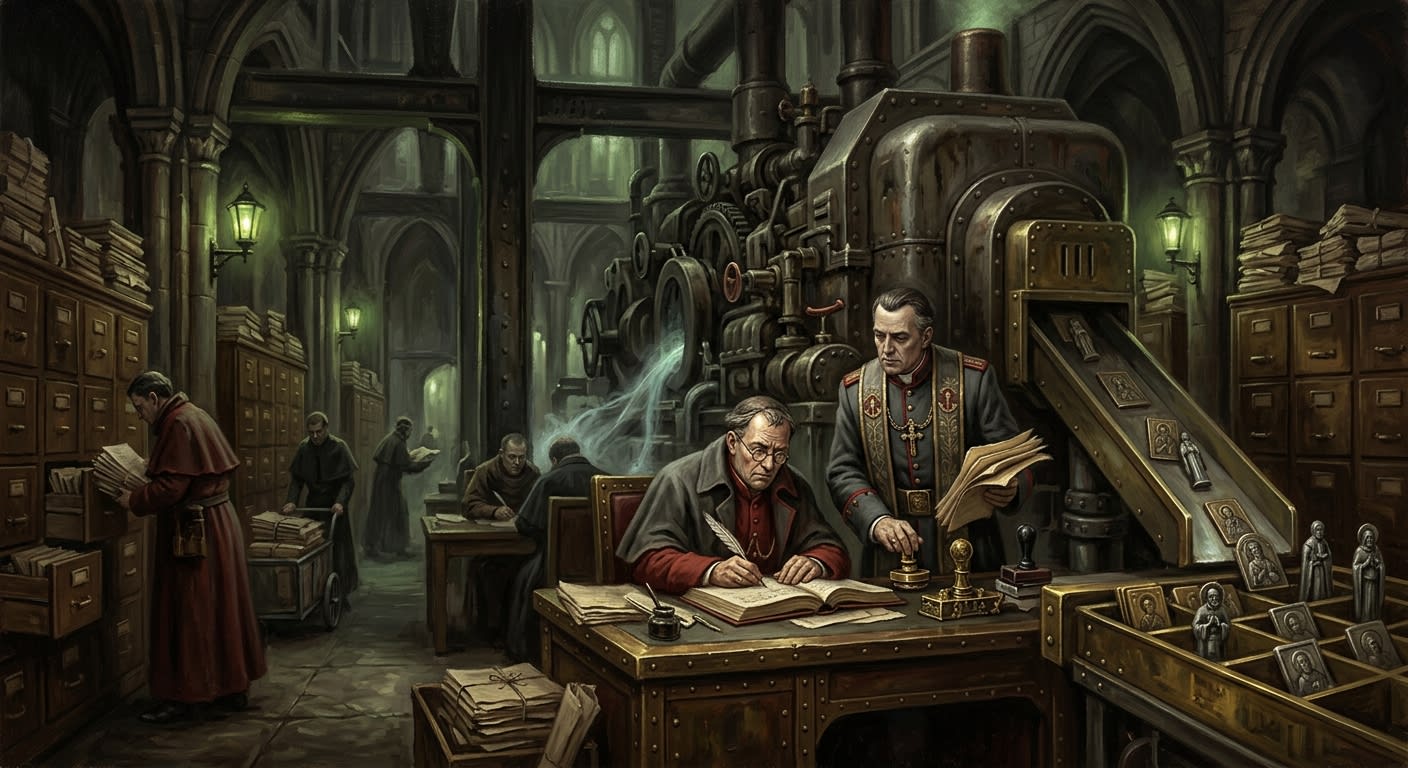
The Bureau of Hagiography exists because corpses are politically unstable.
A living rebel may be arrested. A living clerk may be reassigned. A living martyr may be interrupted before the crowd learns the correct tune. The dead are less cooperative. They acquire stories. They improve in memory. They stop contradicting admirers. Their old hesitations vanish, their errors acquire symbolism, their surviving relatives discover the commercial uses of grief, and within three market days some candle-seller with wax on his cuffs and treason in his nostrils has placed a painted board above a stall and begun selling intercession at two coins per plea.
Strasbourg, being wiser than sentiment and greedier than pity, created offices for this.
The Bureau of Hagiography ratifies, delays, revises, consolidates, tolerates, suppresses, and occasionally invents saints. It writes lives for men whose lives were inconveniently thin, trims lives whose facts grew thorns, assigns patronage where the profession already prayed, removes patronage where the wrong profession became too loud, authenticates relics, approves miracles, tests cults for riot risk, and decides which dead may receive public candles without endangering the living offices that failed them.
It does not create sanctity. This is its official position, and the position is useful, dignified, and false in every practical sense. Sanctity may begin in the event, the wound, the unburnt page, the held rope, the level scale, the valve turned before rupture, the name carried across water, the grave sold fourteen times without collapsing. Hagiography creates the permitted version. The difference is the difference between a scream and a hymn-book.
The Bureau sits among jealous neighbours. Doctrine claims interpretive supremacy over all meanings. Records claims proof. Relics claims bones, dust, glass, cloth, nails, lamps, forks, and anything else that can be locked in a cabinet. Tithes claims candle revenue. Pilgrimage claims feast traffic. Purity claims heretical cults as fuel. Hagiography claims the story. This is usually enough. A bone without a story is anatomy. A story without a bone is folklore. Joined under seal, they become a budget line with hymns.
#On Its Birth Among Ash and Missing Names
The Bureau's ancestry lies in the smoke after the Sundering, when bodies multiplied faster than clergy could bless them and stories multiplied faster than bodies could be identified. Every trench had a miracle. Every famine had a Level Hand. Every locked gate had a Rope saint. Every river crossing had a mother with a blank folio. Every office that killed people by rule discovered, to its horror, that the dead might return as accusation unless given a frame, a feast, and acceptable grammar.
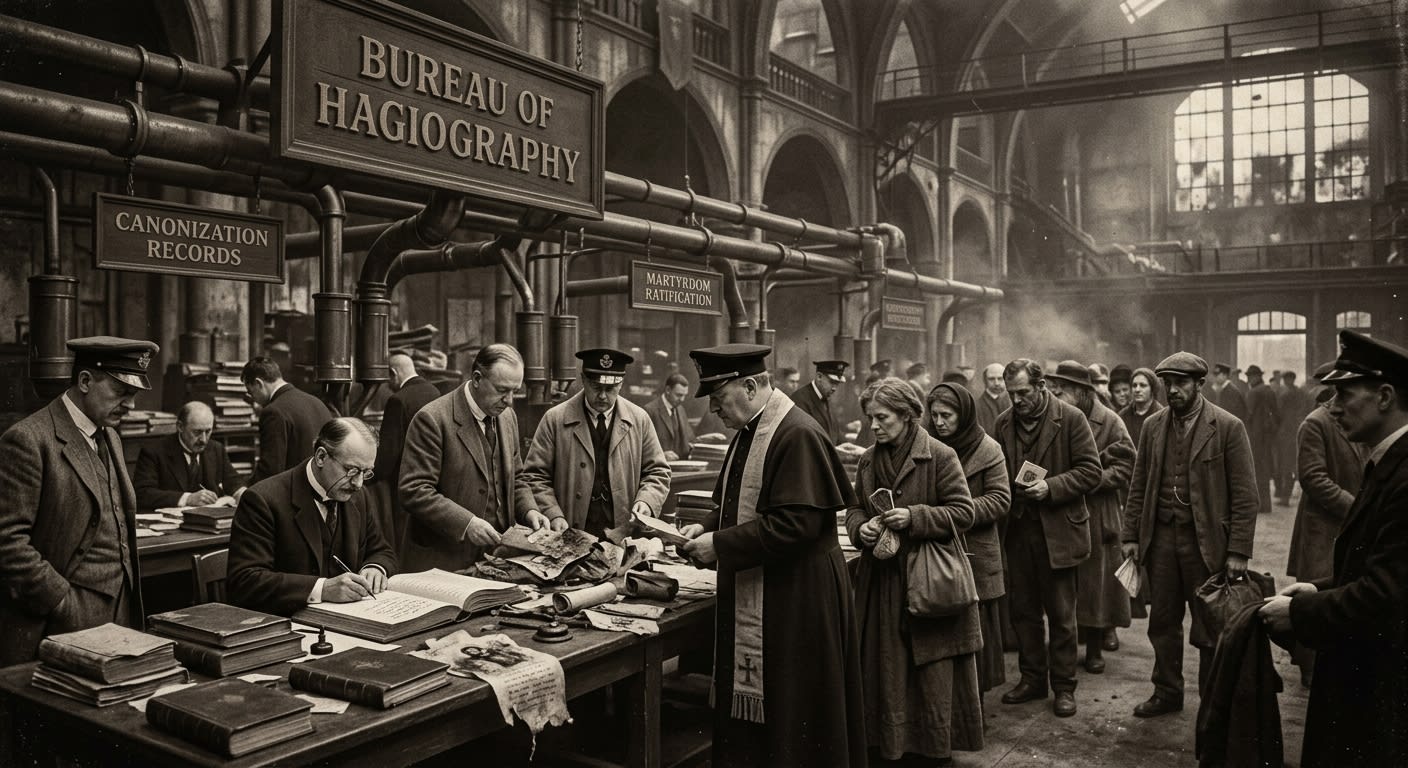
Early hagiographic work belonged to Doctrine scribes, Records clerks, relic custodians, shrine factors, and ambitious widows with better memory than obedience. The files were a sewer of marvels: unburnt tongues, singing skulls, bread that divided unevenly but piously, soldiers whose blood wrote psalms only after translation, clerks whose ink refused rain, and three separate men in three separate provinces said to have held one bridge alone on the same afternoon. The Bureau later called this the Age of Edifying Confusion. I call it amateurs touching wet paint.
The first permanent hagiographic desks formed after the Sagittal Line's establishment in A.S. 65, when occupational cults began spreading faster than central approval could follow. Immurement Masons invoked Karron. Ferry men invoked Mother Vellum-of-the-Reed. Erasure men whispered to Vellum the Silent. By the Concordat of A.S. 90, every new Bureau, profession, queue, forge, corridor, port, and grave-ring wanted a patron. Strasbourg discovered that refusing all of them created underground saints, while approving all of them created theology by mudslide.
Later Foundation Lectures state that the Bureau of Hagiography was constituted to preserve holy memory from popular distortion.
Corrected. Popular distortion was only half the crisis. The other half was administrative hunger. Saints were already governing behaviour. The Synod merely decided to stand at the toll gate.
Formal status followed in pieces, as everything sensible does before a committee claims it was planned. The Hagiographic Review Desk (Unregistered) appears in Records correspondence before A.S. 97. The Office of Occupational Patronage (Unregistered) appears in tariff-chapel memoranda after the Bread-Scale Uprising, when Saint Calibrus became too useful to leave wholly local. The Consolidation Annex (Unregistered) appears after the first Vellum quarrels, when four professions prayed to four similar names and three clerks attempted to make them one saint by decree. The clerks survived. The decree did not.
By A.S. 112 the Bureau possessed stable procedures: witness intake, miracle grading, relic plausibility, iconographic control, feast risk analysis, occupational utility scoring, and the sacred category that has saved more officials from decision than any doctrine in Strasbourg: non-cognisance (Unregistered).
#On Ratification, Delay, and Non-Cognisance
Hagiography's visible work is ratification. A candidate saint enters as rumour, cult, petition, occupational habit, shrine revenue, field necessity, scandal, or corpse. The Bureau assembles a vita. It gathers witness statements, removes witnesses who remember too much, checks whether the patronage overlaps an approved saint, asks Relics whether an object can bear devotional weight without collapsing under inspection, asks Records whether dates can be made to stop biting each other, asks Doctrine whether the meaning is safe, asks Tithes whether candles justify tolerance, and asks Purity whether suppression would be cheaper than embarrassment.
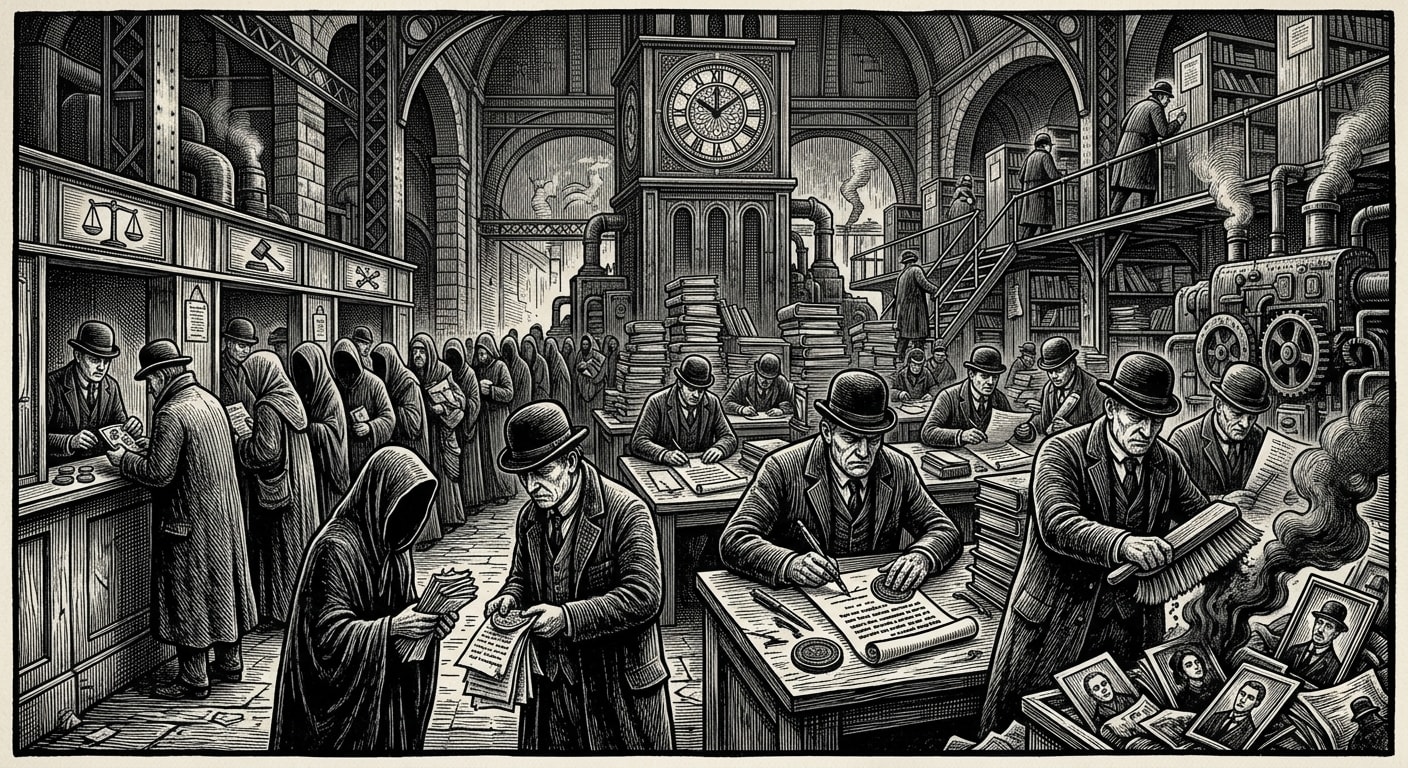
The result may be canonisation, tolerated devotion, restricted occupational usage, devotional suspension, consolidation order, suppression, or non-cognisance. The public understands the first and the sixth. The Church runs on the others.
Non-cognisance is Hagiography's masterpiece: everyone has heard the story, no office admits responsibility, no chapel may officially promote it, no inspector need provoke a riot by tearing it down, and no clerk must explain why the cult improves discipline among workers whose jobs kill them. Saint Vellum of the Valve rests there, under the floor with the Diesel Resonance Plumbers, receiving wax before descent and diesel after return. Ravel of the Rope rests there, bruised in rope-sheds while his knot remains mandatory instruction. Mother Vellum rests there, blank folio open, while ferry brokers continue selling names through locked water.
Delay is the Bureau's second instrument. Hagiographic review can last longer than dynasties. A saint under review may be used, denied, taxed, quoted, painted, and rebuked depending on the sentence required that morning. Saint Oren remains under review because the Doctrine Street-Vicar Corps needs his gentleness displayed but not weaponised against enforcement. Saint Ysolt remains under review because Tithes likes her scale and dislikes her politics. The review never closes. Closure is a coffin. Delay is a leash.
Ratification is reserved for the dead whose usefulness has outrun their hazard or whose hazard can be directed outward. Calibrus is safe because he sanctifies measure without promising abundance. Karron is safe because immurement requires a patron with lime under his nails. Vellum the Silent is safe inside Records because his cult improves accuracy and has the decency to terrify only clerks. A saint who makes workers steadier is nearly doctrine. A saint who makes workers disobedient is nearly firewood.
#On the Manufacture of a Vita
The life of a saint is not written. It is negotiated with the dead until the dead become conveniently mute.
A proper vita requires origin, vocation, trial, act, witness, sign, relic, patronage, caution, and closure. The origin explains why the candidate belongs to the people now praying. The vocation ties him to a profession, district, Bureau, wound, road, instrument, or queue. The trial provides suffering, because sanctity without suffering smells of aristocracy and should be searched. The act supplies the miracle. The witness gives Records a handle. The sign gives Heraldry a paintable attribute. The relic gives Relics custody. The patronage gives Tithes a candle. The caution gives Doctrine control. The closure tells fools the file is done.
This is the clean form. Actual files arrive filthy.
Calibrus had no authenticated hand, three incompatible forearm bones, and a central miracle that killed thirteen people in the queue by dawn. Hagiography made him the Level Hand and gave the tariff-chapels a face. Oren founded no Corps, signed no charter, and probably possessed less authority than a modern Creed Runner's chalk box. Hagiography let the Corps adopt him after stripping his patience down to a shift-start rite. Ravel's record contained a rope diagram, a casualty note, and the phrase effective under panic compression. Hagiography left his canonisation absent while the profession darkened his bruise in every shed.
The Vellum problem remains the Bureau's most instructive failure. Vellum the Silent, Vellum of the Valve, Vellum of the Narrow Line, Vellum of the Quiet Hand, Vellum of Breath, Vell of the Lantern Table, Mother Vellum of the Reed: a whole family of office-saints bred by fear, ink, pressure, cargo, bone, fumes, and water. Consolidation committees have tried to force them into one proto-saint. The trades refused. Correctly. Silence, pressure, cargo identity, bone stamping, fume survival, field confession, and river passage are separate terrors. One saint cannot stand in seven kinds of dark without becoming a decorative liar.
A provisional consolidation memorandum identified the Vellum cluster as “probable occupational variants of a single clerical devotion.”
Rejected for operational use. The memorandum was written by three clerks in a dry room. Dry rooms produce many errors, chiefly the belief that water, diesel, ash, and grave damp are symbolic rather than wet.
The Bureau's finest writers understand this. They do not ask whether a saint is true in the tavern sense. They ask what truth the cult already performs. Does it steady the hand? Keep men from answering voices in pipes? Make a queue marshal tie the saving knot before the crush breaks ribs? Teach ferry brokers to leave a blank line for the river? Keep erasure clerks silent long enough to avoid contradiction? Good. Then the vita must preserve that use, conceal the scandal, and leave one attractive wound for painters.
#On Relics, Icons, and the Custody of Cheekbones
Relics are evidence after the Bureau has dressed them properly.
Hagiography quarrels constantly with Relics, which owns the cupboards and mistakes custody for interpretation. Relics asks whether the bone is genuine. Hagiography asks whether the bone can bear the story. These are different questions, and the second is often more useful. Calibrus has several devotionally consonant bones. Cadrin has more forks than any honest saint could have touched. Vell of the Lantern Table has a lantern frame in Strasbourg, glass in Przemyśl, a wick in Brest, and enough travelling soot to blacken a cavalry regiment. Relics calls this distributed authenticity when morale yield exceeds evidentiary discomfort. Hagiography calls it Tuesday.
Icons are worse. A relic may sit in a box and behave. An icon goes into the street wearing a face.
The Bureau's Iconographic Tables (Unregistered) specify attributes: Calibrus with balance over kneeling crowd; Oren at the corner with chalk and brine; Ravel with rope, knotwork badge, and optional unofficial bruise; Vellum of the Valve at brass wheel under bell-shadow; Mother Vellum with oilskin folio, reed-knot, and no authorised chapel; Mother Vell of the Crooked Stones with bent stake, child, key, skull tag, or whatever the local criminals have convinced themselves is theology this winter. Heraldry assists by approving shapes. Doctrine assists by forbidding meanings. Artists assist by disobeying both until the cult looks alive.
The bruise on Ravel's temple is the classic dispute. Queue-Marshals darken it because a whole saint would be a lie. Hagiography lightens it because a dark bruise asks who threw the stone. The rope-sheds keep painting it darker. The Bureau keeps calling the images morale decoration. This settlement has endured because everyone receives what he needs: the Marshals receive a patron who looks injured enough to understand them, the Bureau receives deniability, and the candle-seller receives repeat custom.
Vellum of the Valve presents another hazard. His hand must grip the wheel. If the hand loosens, Plumbers call the icon unlucky. If the bell-shadow misses the wheel, the painter is an idiot. If the shadow covers the wheel entirely, the image is burned. Hagiography has no approved ruling on this because Hagiography does not recognise the saint, which means field supervisors must decide whether removing an unrecognised icon will reduce uptime. They usually leave it. Even disbelief has production targets.
#On Popular Mothers and Occupational Fathers
The Bureau mistrusts mothers.
Fathers command, found, sign charters, receive swords, hold keys, die in ways that can be painted above altars without causing women in queues to laugh. Mothers forgive, feed, bargain, hide, rename, rent, bend, and survive under several names at once. A father becomes statute. A mother becomes habit. Statute belongs to Strasbourg. Habit belongs to the people who know which guard drinks before Vespers.
Mother Vellum-of-the-Reed and Mother Vell of the Crooked Stones remain a permanent irritation. Neither has authorised life, chapel, feast, relic, or proper burial. Both govern conduct. Reed Brokers tie bracelets, leave blank folio lines, sell names, tap gunwales, and whisper that the river remembers. Grave-Field Brokers light low candles, shift stones, bend stamps, whisper into transfer crates, and sell legal inertia under a shawl. Hagiography refuses acknowledgement because acknowledgement would admit that office failure produced maternal theology with better adoption rates than official charity.
HAGIOGRAPHY INTERNAL NOTE — MATERNAL CULTS, A.S. 199 Observation: suppression attempts increase invocation frequency among brokers, runners, grave-field residents, and women petitioning after curfew. Recommendation: continue non-cognisance; permit indirect taxation of candles; prohibit printed litanies. Marginal addition, unknown hand: “You cannot arrest a mother if everyone has one.” Disposition of annotator: ███████████████████
The underworld invents mothers when it grows tired of calling itself theft. This does not make the mothers false. It makes them precise. Mother Vellum teaches that paperwork can ferry a soul through danger if one knows which name to sacrifice. Mother Vell teaches that a plot is a promise and a crooked stone may shelter more truth than a straight deed. The Bureau's authorised saints often ask men to die properly. The mothers teach them how to remain improperly alive.
The Bureau hates this lesson. The Bureau uses this lesson.
Ossuary Allies invoke Mother Vell at the bone gate. Caretaker Saints invoke her before forgiving rent they cannot afford to forgive. Stone Sharks invoke her while sharpening lease knives and discover no contradiction, which proves the cult has entered its mature theological phase. Hagiography's file calls this derived iconography, devotional contamination, and grave-field superstition. The field calls it rent due Friday.
#On Suppression and the Hazards of Killing a Saint Twice
Suppression is the least elegant hagiographic tool and the most beloved by frightened superiors.
A suppressed cult does not vanish. It changes clothes. Tear down a chapel image and the saint moves under a ledger cover. Burn a pamphlet and the prayer shortens until it fits behind the teeth. Arrest candle-sellers and the faithful begin leaving oil, chalk, beer, diesel, fingernail clippings, rope fibres, blank margins, crooked nails, and whatever else the office forgot to define as devotional material. Purity enjoys raids because raids produce bodies. Hagiography enjoys success because success produces fewer reports. These appetites rarely agree.
Suppression is appropriate when a cult commands refusal, spreads enemy cadence, blesses violence outside Bureau schedule, interferes with tithe collection, opens sealed archives, attracts demonic attention, or makes Doctrine look foolish in a market. It is inappropriate when the cult merely keeps workers alive, queues from crushing, children quiet during crossing, clerks steady under bombardment, or plumbers from answering pipes. In such cases suppression is expensive piety. The Synod prefers cheap hypocrisy.
The Bureau keeps a file titled Secondary Martyrdoms (Unregistered), though the title is denied to visitors and bishops with theatrical consciences. It records attempts to kill a saint after the saint was already dead: raids that spread prayers, confiscations that created relics, corrective pamphlets preserved as holy text, public denunciations sung back by crowds with improved rhythm. The file is thickest for occupational patrons. A labourer whose saint makes him less afraid does not surrender the saint because a clean man in a sash mispronounces danger.
Ravel survived discouragement because Pattern 3-C saves gates. Vellum of the Valve survives inquiry because pipes still speak. Mother Vellum survives omission because crossings still demand names. Oren survives review because the Street-Vicar Corps needs a face gentle enough to excuse chalk. Calibrus survives ratification because lawful shortage requires a saint who never promises more bread than the pan can bear.
The Bureau's mature policy is visible in these settlements: deny where possible, tolerate where useful, ratify where profitable, suppress where obedience cannot be purchased by ambiguity. This is not cynicism. Cynicism lacks the courtesy of forms.
#On Calendars, Feasts, and Devotional Traffic
A saint without a date is a rumour with candles. A saint with a date becomes logistics.
The Feast Calendar Office (Unregistered) is Hagiography's most underestimated cruelty. It decides when devotion may occur visibly, which means it decides when markets will swell, roads will clog, parish bells will alter schedule, Pilgrimage will request escorts, Tithes will count stall revenue, Purity will watch crowds, Records will open temporary registers, and Commerce will discover that holiness has weight, smell, and storage requirements. A feast looks like prayer from the street. From the office it looks like grain forecasts, wax allotment, crowd-risk tables, inn licences, relic display insurance, and three petitions from bishops who want their local saint moved away from a fasting day because hungry pilgrims spend less.
Occupational patrons present smaller hazards and sharper ones. Calibrus receives the Day of Zeroing because scales must be checked anyway. Oren receives no broad feast because Street-Vicar crowds are rarely improved by celebration. Ravel receives private rope-shed observance because a public feast of queue control would invite jokes too accurate to survive. Vellum of the Valve receives no date, though Plumbers mark him by rupture anniversaries, blackout survivals, and the morning after a pressure door holds. Mother cults refuse calendar capture entirely. Rivers do not ask permission before rising. Grave-fields do not wait for approved weather before sheltering the living.
The Bureau's favourite solution is deferred recognition with local custom permitted. This lets a profession keep its rite while denying it the splendour that might attract Pilgrimage, song, and litigation. A rope-shed may leave beer at the lower post. A plumber may smear diesel after descent. A broker may tie a reed-knot under a cuff. None of these is a feast. All of them are feasts in the only sense that matters: they recur, they bind, and they teach the hand what the mouth must deny.
Feast denial is dangerous when mishandled. A refused saint may grow cleaner in resentment than he ever did under review. A postponed date may become a secret date. A secret date may become a crowd. A crowd may become Purity's problem, and Purity solves theological mistakes with ammunition, which creates better martyrs and worse paperwork. Hagiography exists partly to prevent Purity from improving saints by shooting their followers in public.
#On the Present Bureau
As of A.S. 201, the Bureau of Hagiography operates from offices adjacent to Doctrine's archive courts in Strasbourg, with satellite desks in major shrine cities, port courts, bastion chapels, relic vaults, and those forward administrative cupboards where one clerk, two candles, and three contradictory petitions constitute a department. Its staff are vita clerks, miracle examiners, iconographic auditors, cult-risk assessors, relic-narrative harmonisers, feast calendar officers, devotional revenue liaisons, and the pale young men who specialise in writing “non-cognisant” with a straight back.
The central archive is called the White Martyrology (Unregistered) by people who have not seen the lower cupboards. The upper rooms are white enough: limewashed walls, clean catalogues, saint boards drying under cloth, junior clerks copying edifying childhoods into margins where the childhoods never occurred. Below, the colour changes. Files awaiting suppression are bound in grey. Occupational patrons under review are tied with yellow cord. Maternal cults receive brown wraps because mud, it seems, has become a filing principle. Dangerous miracle claims go into black boxes with brass vents, not because papers breathe, the Bureau insists, but because several papers have objected when denied air.
The workday begins with petitions. By Prime, the office has received a rope-shed request, two relic disputes, a feast relocation, a Purity complaint about unauthorised candles, and a bishop's nephew seeking posthumous virtue for an uncle whose chief miracle was never paying debts in person. By Sext, three files have been returned for witness correction, one icon has lost a dangerous wound, and a non-cognisance note has been drafted with such delicacy that it could deny rain while standing in a flooded cloister. By Vespers, the clerks have decided which dead may be loved safely for another night.
Their daily work is not glorious. It is better than glorious. It is consequential. A petition arrives from a rope-shed asking permission to display Ravel's bruise. A tariff-chapel requests clarification on whether a Calibrus bone fragment may be replaced after drift. A plumber foreman reports that removing a Vellum icon caused three workers to refuse descent. A grave-field inspector asks whether confiscating Mother Vell candles will count as suppression or fire safety. A Trench-Court Clerk wants Vell's lantern prayer extended to contradiction pouch custodians. A bishop wants his predecessor canonised before the audit discovers why the predecessor's accounts smell of horses.
The Bureau answers in layers: public, restricted, internal, sealed, and the little spoken answer delivered over coffee because ink would leave too honest a corpse. It knows that saints belong neither wholly to Heaven nor wholly to Strasbourg. They belong to the professions that use them, the families that need them, the offices that fear them, and the clerks who decide which version may stand in daylight.
The Bureau's current docket is swollen. The Vellum cluster remains unresolved. Mother cults are spreading through grave-field and crossing trades. Occupational patrons are multiplying faster than calendar space. The front has produced three new pipe saints, two ash saints, a disputed bell-child, and one alleged martyr whose miracle consists of having completed an inventory while decapitated. Hagiography has returned the last file for anatomical clarification.
At dusk the vita clerks close their shutters. The miracle examiners lock away witness teeth, burnt rope, scale cards, folio scraps, valve wax, field lantern soot, and one child's drawing of a corner with no man standing there. Somewhere below, Relics argues with Records about a bone. Somewhere above, Doctrine prepares to declare that all approved sanctity has always been orderly. In the streets, a woman ties a reed-knot, a marshal touches his bruise, a clerk zeros a scale, a plumber leaves diesel on wax, and a broker bends a stone by one finger's width.
Hagiography will hear of it tomorrow.
It already has a form.