
#On the Brokers at the Bone Gate
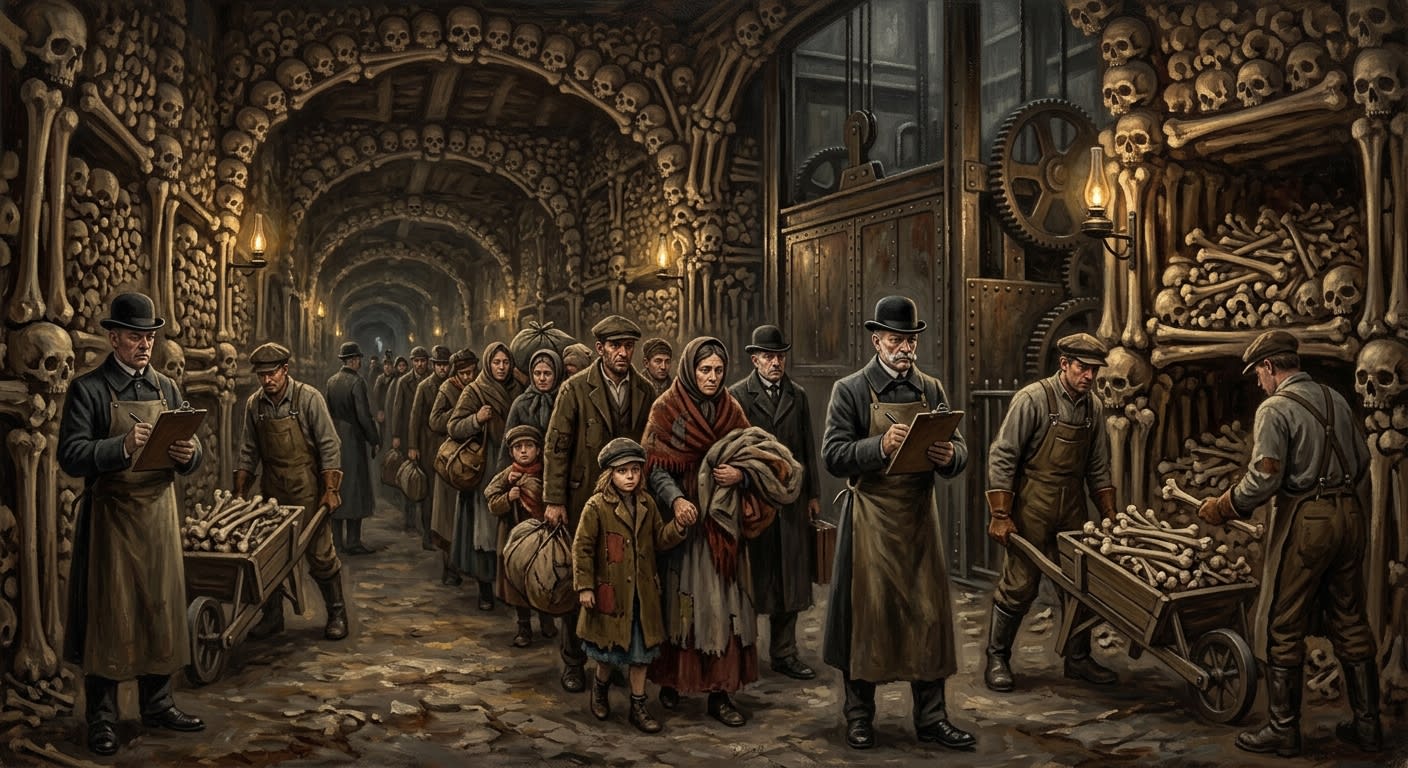
The Ossuary Allies are the lime-white faction of the Grave-Field Shanty Broker trade: Lane Brokers who dine with Dead-Goods Tariffers, transfer clerks who know which skull tags can be persuaded to travel, bone-lime factors with clean cuffs, and grave-field landlords who have learned that a poor family’s last valuable property is rarely its pot, blanket, or ration card. It is the grave beneath the floor.
They stand where two economies kiss and bite. Outside the wall, families cling to grave-field lanes because consecrated ground confuses Settlement and bores Records. Inside the wall, ossuary tenements offer dry bone, bell cover, ration proximity, and a door whose lock is more convincing than canvas. The Allies sell passage between those conditions. They call it relocation. The families call it surrender when they are honest and blessing when the rain is hard enough.
The Caretaker Saints keep families in place for another winter. The Stone Sharks keep families paying until winter becomes someone else’s arithmetic. The Ossuary Ally keeps the transaction moving after both roof and arrears have failed. He does not evict a family into open weather if he can convert them first. Conversion is gentler. Conversion has forms.
#On the Final Transaction
The Ally’s doctrine is written on no chapel wall because chapel walls can be read by sentimental people. Among Brokers it is spoken plainly enough: burial rights and housing rights are the same coin, provided one is willing to turn it with dirty fingers. A grave-field lane survives by anchor graves — three or four legitimate plots whose stones and certificates make the shacks around them look like caretaker devotion instead of human habitation. A family attached to an anchor grave possesses more than grief. It possesses legal inertia.
Legal inertia can be sold.
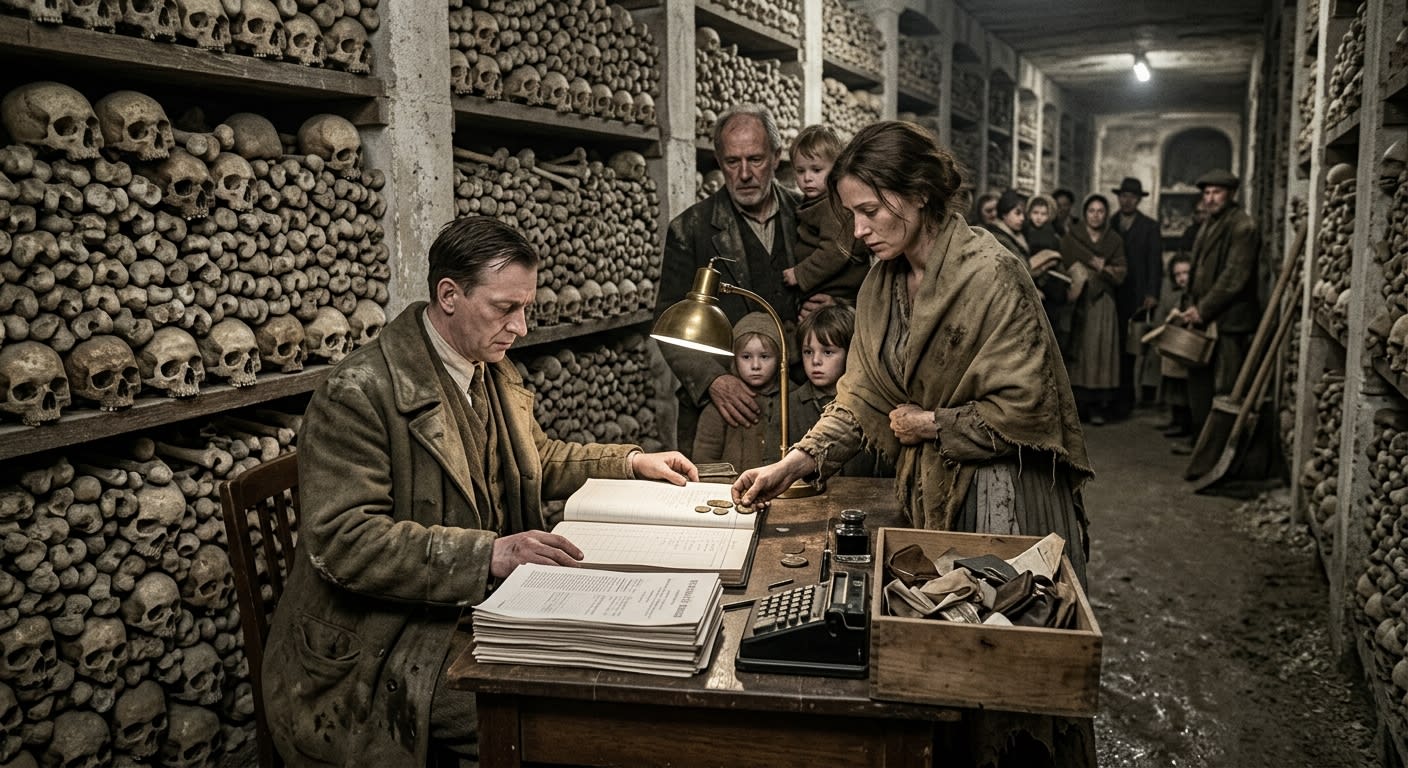
The final transaction begins politely. A Lane Broker has arrears. A child is coughing. A winter sweep is rumoured. A Stone Shark has raised patrol dues. A Caretaker Saint has no more candle money and a saint’s useless conscience. The Ally arrives with an ossuary transfer slip, a Tariffer acquaintance, and a promise of wall-space within bell range. The family surrenders its interment rights to the anchor grave: vigil access, caretaker claim, burial maintenance, any secondary certificates, and the old private nonsense by which human beings pretend the dead still belong to them. In exchange, the family receives an ossuary tenancy — corridor bunk, wall niche, drainage alcove, bone-walled room, or, if fortune is drunk and Tithes inattentive, a Fifth Ring cubby near a warm vent.
The paperwork is exquisite. The grave ceases to be family anchor and becomes transferable interment asset. The lane loses one legal root. The Ally acquires a plot that may anchor another row, justify a new caretaker shelter, feed a Tariff-Chapel ledger, or pass into the bone-lime stream after proper waiting, improper hurry, or a Gray stamp whose ink knows better than to explain itself. The family gains a roof made partly of families who completed similar bargains before them.
Everyone receives something. This is why the transaction is so vile.
Early Settlement abstracts described Ossuary Ally transfers as “voluntary upward relocation from interment-adjacent habitation.”
Corrected. The adjective “voluntary” has been retired to the same drawer as “temporary,” “provisional,” and “adequate.” A starving household may sign neatly. Hunger improves penmanship.
#On the Dead-Goods Friendship
No Ally prospers without friends in the tariff-chapel. The Tariffer decides what the dead become: Burial, Transport, Salvage, Ornamental, Contaminated. The Ally decides how desperate the living must become before the dead can be reclassified without producing knives in the lane. Between these two men lies the beautiful administrative gutter in which the Synod conducts much of its housing policy.
A Tariffer can accelerate an abandoned claim. He can mark remains for Transport when they should remain Burial. He can hold a family certificate until an arrears deadline passes. He can discover contamination in a plot whose heirs are inconvenient, or discover the absence of contamination when a bone-lime crew has a wall quota and no appetite for delay. He can lose a tag, find a tag, split a tag, copy a tag, or remember that the tag was never required because the corpse entered under pre-revision rules. The dead are obedient to paperwork once the living have been frightened away from the desk.
The Ally pays for this friendship in fuel chits, marrow shares, transfer fees, silence, and occasional warnings when Purity inspectors begin sniffing around candle ledgers. Some Allies marry into Tariffer families. Some send sons into chapel intake as Tag Runners and receive them back ten years later with coughs, steady hands, and a professional inability to hear pleading. Some keep a private tariff schedule in their mausoleum offices, listing the market value of grief by category.
At Marrowgate, where the Lime Yards breathe bone dust over the terraces, the friendship is almost official. Salvage-grade remains move by cart at dawn. Transfer crates arrive at the intake bays with family marks scraped thin and new seals cooling in the wax. In Constantinople, the Fifth Ring offices of the Ossuary Housing Allocators conduct their own arithmetic: one surrendered grave-field claim may become half a corridor tenancy, or two seasonal alcove permits, or a temporary wall-space assignment that lasts twelve years because no clerk wishes to descend and revoke it. At Bastion-Przemyśl, where the grave-rings crowd trench-spur surveys until Engineering begins complaining about the dead obstructing war, Allies can make an obstruction disappear by making it useful.
Useful is the Synod’s most generous adjective.
#On Bone-Walled Tenancy
The promised ossuary tenement is real. That must be admitted, because propaganda that refuses reality becomes brittle, and my propaganda is supple as a bishop’s expense account. Families do move inside. Children do sleep dry. Old women do stop coughing blood for a season once the wind is blocked by three feet of mortared skull-course. Bell range matters. Stone matters. The living will forgive nearly any theological insult if it comes with a roof that does not leak.
The tenements are carved from administrative mercy and structural embarrassment: corridors too narrow for processions, alcoves behind archive annexes, drainage galleries abandoned after a better gradient was found, catacomb bunks assigned by measuring rod, and ossuary rooms where the wall’s inhabitants outnumber the room’s inhabitants by a ratio no Bureau has managed to make comforting. A family receives a mark. The mark grants permitted presence. Presence is not residency. Residency creates rights. Rights create committees. Committees require chairs, minutes, and cowardice with ink.
Ossuary tenancy is warmer than grave-field shacks and crueler in different weather. Rent is paid in marrow-shavings, corridor sweeping, candle duty, bone washing, night bell attendance, and the small service of pretending that walls made of the dead are less alarming when polished. The Allies present these obligations as community participation. The Allocators present them as maintenance. The families present them as the cost of not freezing. Each description is accurate enough to be dangerous.
Children raised in ossuary tenements learn to count skull rows before alphabet rows. They know which walls are old and calm, which sweat in fog, which groan before Feast days, which cannot be slept against during Lent. They play in chalk between femur courses and are slapped when they draw faces on blank skulls. They ask whose bones make the ceiling. Their mothers say saints. Their fathers say soldiers. The Allies say structure.
TRANSFER CRATE NOTE — FIFTH RING OUTER OFFICE, A.S. ███ Incoming family: six living Surrendered anchor graves: two confirmed, one disputed Assigned space: Corridor 14-W, alcove under chevron course Maintenance duty: candle replacement, third bell Child complaint: “the wall knows grandmother’s song” Allocator notation: “Acoustic familiarity within expected limits.”
The walls listen poorly or well according to who has paid for inspection. Rites sends priests with incense. Bells sends frequency men with tuning rods. Records sends clerks who count skull stamps and declare the count either complete or morally complete, depending on the hour. The Allies send tenants.
#On Mother Vell at the Ossuary Gate
The Allies claim Mother Vell with the serene shamelessness of professionals who know every cult improves when given an office. Their Vell stands at an ossuary gate, one hand on a skull tag, the other on a lease, lime-white veil drawn over hair that no icon agrees upon. She teaches the final transaction. Surrender anchor graves. Receive bone-walled tenancy. Bless the exchange. Do not ask whose femur frames the door.
Before transfer, an Ally speaks her name low into the crate that will carry the family’s goods: pot, blanket, stamp bundle, old shoes, two candles, a ration card, a child’s stone, the key to a shack already promised to someone else. The low speech is supposed to teach the bones to accept new tenants without groaning. Practical men laugh, then refuse to move crates that have not been spoken over. Practicality is superstition with a better coat.
The Caretaker Saints accuse the Allies of turning Mother Vell into a customs clerk. The Stone Sharks accuse them of leaving money in the ground too long. The Allies reply by pointing toward the wall. Their converts are inside it. Their surrendered graves are paying. Their Tariffer friends are filing. Their ledgers smell of lime and victory.
A Bureau of Hagiography marginal note classified the Ossuary Vell as “derived iconography, devotional contamination from grave-field tenancy.”
Amended after review by no one willing to sign his name. Derived iconography is the normal way poor theology travels. The rich call it tradition after the second generation and charge admission.
Their rites are small and ugly. Lime dust on the threshold. Three taps on the transfer crate. A skull tag tied with grave grass. A candle burned at both addresses for one night: grave-field shack and ossuary alcove, old exposure and new damp. If the candle in the shack goes out first, the family will miss the sky. If the candle in the alcove goes out first, the wall has objections. If both burn clean, the Ally raises rent by winter.
#On the Quarrels of the Three Factions
The Broker trade pretends to divide along moral lines. It does not. It divides along the timing of extraction.
The Saint extracts slowly and calls delay mercy. The Shark extracts directly and calls fear safety. The Ally extracts terminally and calls surrender relocation. Each despises the others because each recognises himself in a cheaper vestment. Saints hate the Allies for interrupting continuity, for taking families who might have survived another winter with enough candle money and luck. Sharks hate the Allies for removing paying tenants before arrears have been fully harvested. Allies hate both for sentimentality: the Saint’s sentimental tenderness, the Shark’s sentimental attachment to cash when rights, remains, and wall-space produce richer ledgers.
During sweeps, the quarrels become trade. A Saint lane about to be raided may send two families to an Ally by night cart, saving bodies while losing anchor claims. A Shark lane may sell its oldest arrears cases in bulk: three families, four graves, two doubtful certificates, one patrol warning included. An Ally may betray either lane to Settlement if the resulting clearance frees enough plots near a productive ossuary route. This is called enforcement cooperation when the report is clean and cannibalism when spoken after midnight.
The internal field note is shorter than the sin it describes: Saints preserve continuity, Sharks preserve revenue, Allies preserve conversion, and all three survive because formal housing provision remains inferior to crime.
The dead do not always approve. Anchor graves surrendered too quickly have been known to slump. Headstones turn inward. Ossuary walls develop damp patches shaped like old family seals. A corridor in Constantinople’s Fifth Ring reportedly rejected three successive transferred families by filling their shoes with grave soil each morning. Settlement called this ventilation failure. The families moved anyway. The fourth family stayed, because the father had no shoes.
#On Present Toleration
As of A.S. 201, Ossuary Allies operate wherever the grave-field touches the ossuary economy: Marrowgate terraces, Przemyśl rings, Constantinople’s Fifth Ring approaches, Cologne cemetery blocks, rail-adjacent plague fields, and the smaller burial towns of Zones Two through Five. They are fewer than Sharks, colder than Saints, and better connected than both. A Shark can buy patrol silence. A Saint can buy love. An Ally can buy a classification.
The Bureau will not suppress them. Suppression would require asking why so many families possess grave rights more valuable than their living tenancy, why ossuary allocations depend on surrendered dead, why Tithes revenue rises after “relocations,” why Settlement estimates remain provisional when every transfer crate carries six seals, and why the walls keep growing in the direction of the hungry. Better to file the Allies under Interment Auxiliary Irregularities and let the lime settle.
Their usefulness is obscene and exact. They reduce open-field exposure. They feed ossuary occupancy. They supply Tariff-Chapels with clean claims and dirty opportunities. They move grief from loose earth into audited corridors. They make the grave-fields slightly emptier and the walls slightly fuller. No Bureau dislikes a full wall.
The Allies continue with transfer slips tucked beneath their coats, lime on their cuffs, Mother Vell spoken into crates, Tariff-Chapel wax cooling under their thumbs. A family signs. A grave changes hands. A corridor gains tenants. A wall receives maintenance. Somewhere in the old lane, a headstone stands straighter than it did yesterday, relieved of ownership or preparing complaint.