

#On the Brokers Who Still Lose Sleep
The Caretaker Saints are the tender infection inside the Grave-Field Shanty Broker trade: Lane Brokers, Stake Runners, parish widows, failed clerks, exhausted fathers, and professional liars who entered the cemetery economy to shelter refugees and made the grave mistake of retaining a conscience. They keep the candles lit. They whisper the names. They charge rent close enough to fair that a family may survive winter without selling a child’s ration card, though the season often requires ingenuity, theft, and the small, daily treasons by which civilisation actually continues.
Do not be misled by the title. The Bureau has canonised no such persons. The word Saint here is street speech, grave-field irony, and accusation. A Stone Shark uses it to mean sentimental fool. A refugee uses it to mean the Broker who did not evict her during fever. A Purity clerk uses it to mark the file for later attention, because compassion outside licence is always suspicious and compassion that succeeds is worse.
They belong to the same legal void that shelters the whole profession. Consecrated burial plots lie under the joint custody of Rites, Records, and Tithes. Settlement has no clean standing there. The living crawl into the dead’s paperwork. The Broker leases the crawlspace. The Caretaker Saint makes the lease survivable.
#On Their Origin in the Cemetery Pressure
The Caretaker Saints arose when grave-field tenancy stopped being an incident and became a city. The first Brokers sold quiet because quiet had value: a plot the bulldozers would skip, a lane the patrol would miss, a headstone old enough to bore Records, a caretaker permit thin enough to pass through the eye of a clerk without catching. Some men saw profit at once and became Stone Sharks. Some saw the ossuary economy’s final arithmetic and became Ossuary Allies. A few saw families sleeping between markers with rain in their blankets and began trimming the rent.
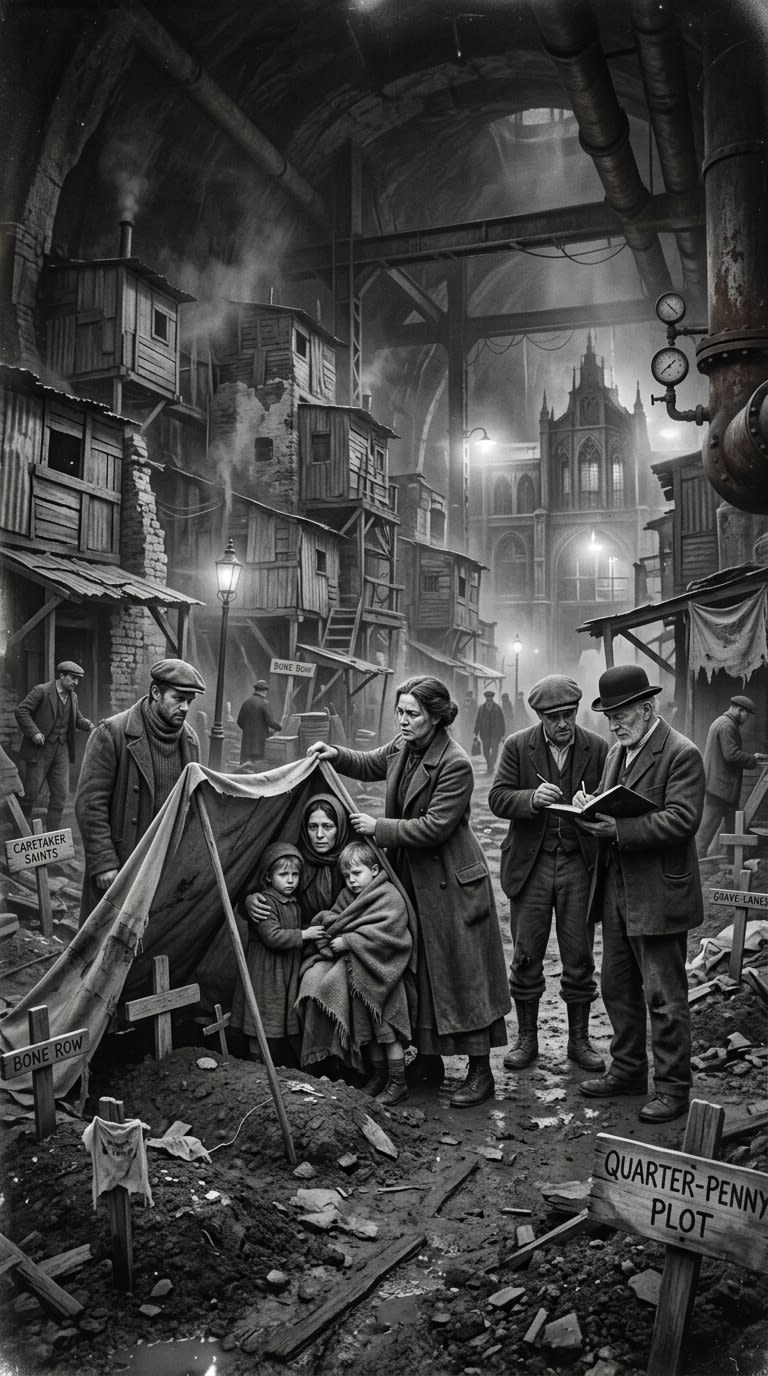
This is how heresies begin: not with a manifesto, but with a woman refusing to throw a child into sleet.
At Marrowgate, the old stories attach the first Saints to the terraces after casualty winters, when medical wagons arrived faster than burial clerks could stamp and refugee tents crept up the ossuary ridges like mould on bread. At Bastion-Przemyśl, they began as Stake Runners who learned which lanes would collapse and moved families before the ground opened. At Constantinople, they grew in the Hintermark among orchards, foundry-towns, levy-villages, and grave-fields that had fed the southern hinge for generations and received, as thanks, more widows than roofs.
The official origin is cleaner. Bureau of Settlement claims the category of “caretaker shelter” produced stable interment maintenance in overcrowded zones. Bureau of Records claims it has no population estimate because no population exists. Bureau of Tithes claims every candle, fuel chit, and rent exchange properly belongs in taxable circulation. Each Bureau tells a portion of the truth and then murders the portion that might inconvenience the others.
Early Settlement notes described Caretaker Saint lanes as “charitable extensions of authorised mourning practice.”
Withdrawn. The lanes were never authorised. Their charity consisted of breaking fewer families than the alternative. This distinction, though morally enormous, is administratively small enough to hide in a footnote.
#On Their Method of Mercy
A Caretaker Saint does the same work as any Broker, only with less appetite. He anchors a lane with legitimate graves. He keeps three or four real death certificates ready for inspection. He bribes the ossuary clerk, pays the parish warden, rotates families before audits, patches roofs after bell-storms, and teaches children which headstones not to touch. His ledger still lies. His stamps are still thin. His permits still call residents “plot-attached mourners” when everyone can see the cooksmoke.
The difference is price, candle, and memory.
Price first. A Caretaker Saint charges what the lane can bear without eating itself. Rent may come in ration chits, work-hours, fence repair, grave washing, soup duty, stitch work, or the old widow’s skill at remembering names nobody else bothered to file. The Saint accepts delay when illness strikes, though delay has claws. A lane behind on its tithe becomes spiritually damp. A patrol sergeant unpaid becomes curious. A curious sergeant grows into a raid with boots.
Candle second. Every new grave receives flame, even when the grave is serving as legal fiction for a row of shacks and the corpse below has been dead since before the Concordat. The candle tells the dead they are still counted. The candle tells Rites the plot is tended. The candle tells the families the lane has not been abandoned to mere rent. It also helps the Broker find the path in fog, which is the part theology forgets to praise.
Memory third. Names are whispered along the lane at dusk: real names, false names, grave names, permit names, names of children who died before Records reached them, names of soldiers whose tags returned without bodies, names of old tenants now relocated to ossuary walls or hunger or the Line. The Saint believes the grave-field notices such things. The Bureau calls this superstition. The Bureau has never slept on wet earth while a mausoleum groaned nearby.
The rites of Mother Vell of the Crooked Stones sit at the centre of this practice. Three crooked stones before a new lane. One hidden candle before rent. A bent stake at the corner that auditors are meant to overlook. A bread scrap left where the oldest grave leans. The Caretaker Saints claim Vell sold the same plot fourteen times because fourteen families needed a roof. This is hagiography, which is to say useful biography after the proof has been mercifully lost.
#On Their Quarrels with the Trade
The Caretaker Saints are despised by their colleagues with the special bitterness reserved for people who make vice look optional. The Stone Sharks hate them because low rent spoils the market. The Ossuary Allies distrust them because tenderness interrupts conversion: grave rights into housing rights, housing rights back into grave rights, family into tenant, tenant into ossuary inventory. A Saint who keeps a family in place for another winter delays profit, and delay is the only sin a true broker never forgives.
The Saints answer badly. They are not rhetoricians. They say the lane will hold if the people trust it. They say evictions attract knives. They say a family that survives winter pays in spring. They say the dead dislike greed. This last point, while theologically unsupported, has practical adherents among men who have watched headstones shift toward a Shark’s office overnight.
The quarrel becomes violent during sweeps. When Settlement, Purity, or a Warden captain needs proof of enforcement, a rival lane may be offered up as sacrifice. Sharks prefer Saint lanes for this purpose because Saint lanes are crowded, beloved, administratively sloppy, and full of witnesses too poor to flee. The raid then discovers expired permits, mismatched tags, unregistered children, and a sack of grain from a Grain Keeper cache tucked under a coffin lid if Providence is feeling theatrical. The report writes itself. Reports love the poor. They are easy to complete.
Saints retaliate with quiet. They warn families before sweeps. They move children through funeral processions. They bribe Night Wagon drivers with borrowed chits. They ask Gate-Carvers for emergency seals. They hide the sick in mausolea and chalk the doors as already inspected. They pass names to Mercy Vicars, bread routes to Mercy Keepers, and burial disputes to whatever clerk still possesses a soul and a stamp on the same day.
SWEEP REPORT — RING SEVEN, MARROWGATE TERRACES, A.S. ███ Official count: forty-two unauthorised sleepers removed Unofficial count recovered from burned lane book: ███████████████████ Children relocated through funeral cart: eleven Anchor graves disturbed: none Filed conclusion: “caretaker irregularity corrected” Marginal note, unidentified hand: “They sang the names after we left.”
#On the Dead They Tend and the Living They Charge
Their mercy is never clean. The Caretaker Saint still collects rent. He still decides which family gets the dry wall, which fever patient moves nearer the ossuary vent, which widow may remain after arrears, which boy is old enough to carry bribes through fog. His kindness has columns. His conscience has a key-ring. If he gives too much, the lane fails and everyone freezes. If he gives too little, he becomes a Shark with sad eyes.
This is why the Saints age badly. They begin as rescuers and become judges of small survivals. A child coughs: move him or risk the row. A mother cannot pay: forgive her or lose the sergeant’s fee. A grave starts seeping warm iron water: abandon the hut or tell the tenant the damp is ordinary. Every decision is smaller than murder and larger than comfort.
The grave-fields sharpen such arithmetic. The dead below have claims: tithe, candle, name, boundary, stone. The living above have claims: roof, food, quiet, time. The Saint’s office is usually a mausoleum cupboard or a candle-shack with permits pinned to the wall and a kettle that tastes of lime. Families come there carrying what they possess. Wedding rings. Fuel scrip. A soldier’s boot. A rosary. A confession they think has value. The Saint prices each item and hates himself according to the day’s weather.
Popular grave-field chapbooks describe Caretaker Saints as brokers who “take no profit.”
Corrected. They take profit or die. Their distinction lies in how much blood they wring from the coin before placing it in the drawer.
The Bureau prefers this ambiguity. A pure charity could become a cult. A pure criminal can be hanged. The Caretaker Saint is neither tidy enough for praise nor vile enough for easy spectacle. He is useful, and usefulness is the strongest armour a sinner may wear under Synod law.
#On Their Present Toleration
As of A.S. 201, Caretaker Saint lanes exist in every major grave-field settlement known to Brokers and in several the Bureau still enjoys pretending not to have counted. Zones 2 through 5 contain the densest runs: the medical terraces of Marrowgate, the overloaded rings behind Przemyśl, the grave-field sprawl of Constantinople’s Hintermark, the smaller cemetery towns attached to rail junctions, plague fences, pilgrim roads, and ossuary housing queues.
Settlement’s A.S. 200 operational assessment counted forty thousand souls in “informal interment-adjacent habitation structures” and called the estimate provisional. Brokers laughed. The dead may have laughed as well, though that sound was classified as subsidence.
Caretaker Saint practice remains tolerated under the same cold bargain that preserves the Broker trade. The Synod needs refugees out of streets, grave-fields nominally holy, residents thinly taxable, and deniability thick enough to roof a scandal. The Saints provide these with less riot than the Sharks and less ossuary conversion than the Allies. They are inefficient predators. This makes them excellent civic instruments.
Purity keeps lists. Shadows keeps better lists. Settlement denies needing lists. Tithes taxes the candles when it can find a merchant brave enough to admit selling them. Hagiography refuses canonisation because canonising the Saints would require admitting the title came from below, and the Bureau prefers sanctity to descend from committees like mildew from a chapel ceiling.
The lanes continue: candles low, names whispered, rent almost fair, roofs patched with coffin boards, children warned away from stones that answer back. In winter the Saints receive more prayers than the approved chapel down the road. The chapel has clean benches. The Saints have dry corners.