
#On the City That Fell Before Its Cannon Spoke
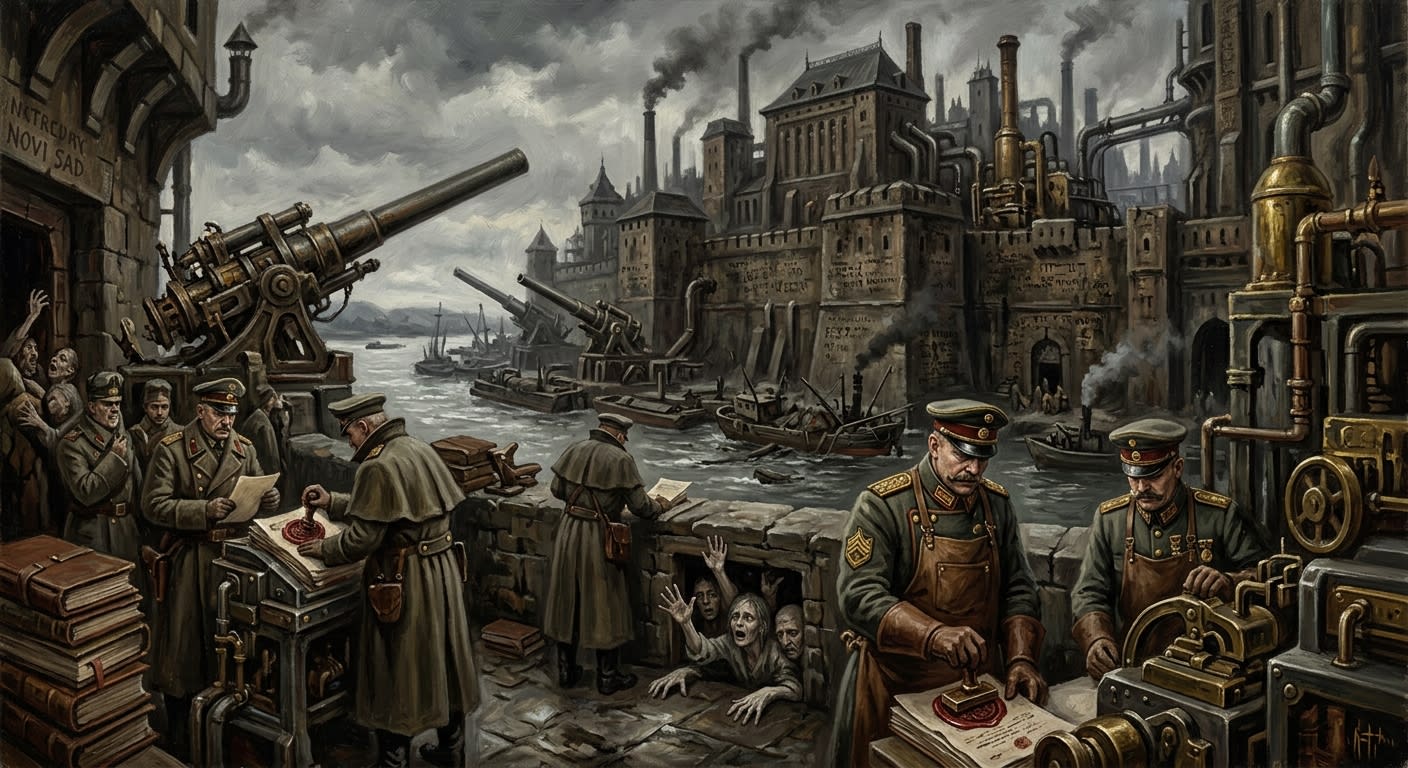
Novi Sad stands on the Danube in the Serbian wound-country, a city whose name survives because the dead, the hungry, the auditors, and the Brokers all found separate uses for it. It was once a river town of passages, tariffs, church bells, market roofs, bridge traffic, and the ordinary civic pride by which men persuade themselves that water, stone, and paperwork constitute permanence. Then the Eastern Silence taught the roads nearby to stop reporting. Then the Sundering arrived on the first of November, A.S. 45, and Maldrake burned the garrison before the cannon crews finished loading.
This is the first truth of Novi Sad: its military history began with an unspent round.
The Synod classifies Novi Sad as fallen. The word is tidy and false in the expensive way official words often are. Fallen suggests a single downward motion followed by stillness. Novi Sad did not fall and remain. It burned, emptied, filled, was skirted, used, avoided, taxed, resettled by necessity, abandoned by prudence, reopened by hunger, and renamed in files according to which office needed a yard, a grave-ring, a checkpoint, a precedent, or a warning that could be ignored until it became educational.
#On the Eastern Silence Before the Fire
Seven years before the Sundering, the roads south of Novi Sad began producing reasons. A bridge washed out near the Morava. Bandits supposedly took a convoy. A fever closed a posting station. A monastery road became unsafe because trees had crossed it overnight in a pattern resembling knuckles. Vienna wrote these explanations down and was comforted, because the Rationalist mind could sleep inside any coffin if the coffin bore a label.
The failures belonged to the Eastern Silence of A.S. 38: the period when Serbia, Thrace, Wallachian marches, and western Balkan passes stopped answering cleanly. Novi Sad was not yet a ruined city in the files. It was a point on the route, a place through which couriers passed, failed to pass, or returned with blank pages and faces trained into official calm. Reports from south of the city acquired gaps. Names shifted. Delivery columns arrived before departure columns. A convoy south of Novi Sad became an explanation for a larger absence, then the explanation itself vanished into quarantine language.
The old Republic did what dying systems do. It quarantined the problem and called quarantine control. Travel into the eastern districts was forbidden. Travel out became regulated, then suspect, then punishable unless stamped, and stamps in those weeks behaved with the loyalty of frightened dogs. Novi Sad's later obsessions with seal, receipt, name, and stone did not appear from nowhere. The city learned, before flame touched it, that communication could fail while forms survived.
#On the Sundering Scar
The first strike came in A.S. 45. The Balkans opened. Skopje and Novi Sad fell within hours. Sarajevo (Unregistered) followed; Belgrade staggered into memory and later miracle. Maldrake's iron-scaled legions burned Novi Sad to slag before the garrison could load a single cannon, a detail preserved in War College instruction because it humiliates every artillery officer enough to make him listen.
The old batteries faced the river approaches. They expected columns, cavalry, refugees, perhaps an eastern mob wearing stolen uniforms. Wrath did not oblige. Fire fell where gunners stood. The powder houses cracked without useful explosion. Brass softened in its cradles. One recovered breechblock showed a half-entered shell still waiting behind it, the loading mark clean, the crew ash fused around the wheel-rim. Bureau of War calls this the Unfired Lesson (Unregistered). Soldiers call it Novi Sad.
RECOVERED GUN-CREW SLATE — NOVI SAD WEST BATTERY, A.S. 45 Last legible order: LOAD THIRD / HOLD UNTIL RANGE MARK. Chalk continuation beneath ash layer: “Range is inside.” Handwriting comparison: no surviving crew member. Disposition: sealed after artillery novices began repeating the phrase during night drill.
The city core never recovered in the civic sense. Recovery is a heartland word. Novi Sad became a usable ruin: a burnt hinge on the Danube, close enough to the Sagittal Line and southern corridor to matter, dangerous enough to make full restoration a budgetary fantasy, and haunted enough that every Bureau could blame another when ordinary governance began shedding teeth.
Older military summaries describe Novi Sad as “destroyed and abandoned after A.S. 45.”
Corrected. Destroyed, yes. Abandoned, never in any honest census. The poor returned, the dead remained, the tariff men found tables, and the Brokers discovered that a cracked city wall casts excellent legal shade.
#On the Grave-Rings and Saint Orban's East Ring
The living came back first where the dead already had title. This is not poetry; it is housing policy stripped to the bone. Around the fallen core lay grave-rings, chapel yards, interment lanes, broken family plots, and low fields of caretaker shacks. Settlement could not legally rezone consecrated ground. Rites protected it, Records catalogued it, Tithes taxed it, and none of those offices wished to confess that families were sleeping between epitaphs because the alternative was visible starvation in streets still warm from old fire.
There the Grave-Field Shanty Brokers became Novi Sad's true aldermen. They sold quiet, seasonal safety, forged caretaker claims, candle receipts, parish stamps, and plots that were never theirs except by the grand Synodal doctrine that possession plus paperwork plus hunger becomes a fact if everyone important looks away.
Saint Orban's East Ring (Unregistered), the most notorious of these settlements, sat outside the old tariff yards between a cracked chapel bell and a field of caretaker huts. Residents called it a lane. Records called it Interment Quadrant 14-R/7. The stones, in A.S. 122, improved the file by writing names of the living before they died.
#On the Stones That Wrote
The Epitaph Plague of Novi Sad began as fever because Providence, enemy action, and bureaucratic malpractice all enjoy wearing the same cheap coat. Children burned hot. A coffin carpenter developed black lines beneath the nails. A widow washing headstones reported that letters had softened under her rag. By morning, the newest graves bore living names no mason had cut.
Mira Janek (Unregistered) died first. Others followed in carving order. Each inscription was clean, deep, dry, and already weathered, as if the stone had been patient for years and merely required permission to confess. Some villagers tried to scrape the letters away. The names returned paler under the cut. One man smashed his marker and died with stone dust in his lungs. The dust had never entered his mouth. Medicine has explanations for such things. Medicine also has gloves, which encourage arrogance.
Records sent auditors on the third day and produced a conclusion so serene it should have been arrested: unusual mineral wear aggravated by fever conditions and local panic. The death register sat nearby. The inscription folio sat nearby. For fourteen years those books were not introduced to one another. Then a junior clerk matched names, deaths, hours, and carving sequence, and the stones were promoted from weather to demon.
The blank condition of the stones after the second inspection proves the Epitaph Plague had ended.
Corrected. Blankness proves only that a surface presently declines to testify. Novi Sad's stones had finished their first list, concealed the next, or learned that Records reads slowly.
The plague taught the Brokers new rituals. Caretaker Saints doubled the dusk whispering of names. Stone Sharks charged inspection fees for unfamiliar epitaphs. Ossuary Allies kept transfer crates ready. Mother Vell acquired a Novi Sad face: one hand over a child's eyes, a chisel hidden in her sleeve. Hagiography rejected the image. The lanes kept it, which is how cults prove themselves more durable than committees.
#On the Tariff Yard and the War of Stamps
Novi Sad's second lesson in administrative mortality came in A.S. 147, when the tariff yard proved that a city need not wait for stones to kill by writing. The Stamp War of Novi Sad began with grain, salt pork, lamp oil, chapel candles, boots, and ration flour moving under convoy toward the southern corridor. One inspector stamped the cargo for military requisition. Another stamped the same cargo for civic ration assignment. Both seals were valid. Both dies were current. Both claims made sense.
Sense is where good administration goes to be murdered.
The cargo existed twice in law and once in the warehouse. Tithes divided it for the Line. Civic clerks divided it for the wards. The sums balanced. The mouths did not. Bread appeared in ledger columns. Lamp oil appeared by arithmetic implication. Children received flour from sacks already assigned to soldiers, while soldiers waited for sacks assigned to children, and the clerks praised the clean shape of the figures until the queues arrived with stamped slips and empty baskets.
Purity fired. Records audited. Tithes defended priority. Commerce extracted training value, because no Bureau wastes a famine if it can be made instructive. All ledgers balanced. A junior hand wrote “deficit physical” in the margin, which remains the most honest epitaph Novi Sad ever received from paper.
Afterward Line slang gained double-stamped: a ration existing only in promise, a corpse alive in one book and buried in another, a command divided between two impossible orders, a reality crushed between equally valid seals. Reform arrived forty years later in A.S. 187 and again in A.S. 199, each revision adding more ways for paper to confess without apologising.
#On the Present Condition
As of A.S. 201, Novi Sad remains a fallen city with inhabited margins, useful yards, dangerous stones, cheap rents, and enough official ambiguity to feed three Bureaus and starve a district. The core is not rebuilt. The grave-rings are occupied. The tariff yard functions when escorted, audited, bribed, and not asked whether its foundations remember A.S. 147. The chapel bell in the East Ring remains cracked. Children are taught to read numbers before names.
The city draws those whom systems discard and then require: Brokers, candle women, dead-goods men, tariff clerks, quiet carriers, ration litigants, field priests, refugees who prefer a haunted roof to doctrinal weather. It is not safe. Safety is a rear-zone perfume. Novi Sad offers cover, precedent, rent, passage, and warning. The warning is repeatedly ignored because it arrives in forms offices dislike: ash around a breechblock, a name on stone, a receipt for bread that never existed.
Novi Sad endures by refusing to become one thing. City, ruin, grave-field, tariff scar, housing fraud, artillery lesson, commerce precedent, demonic writing desk: each office selects the Novi Sad it can afford to understand. The living select the Novi Sad whose roofs hold. The dead select names.