
#On the Grave-Ring That Learned to Write
The Epitaph Plague of Novi Sad began in A.S. 122, in a grave-ring settlement built against a fallen city whose first garrison had been broken in the first hours of the Sundering. Novi Sad was already a place with too many dates. A.S. 45, when Maldrake burned it before the cannon crews finished loading. A.S. 122, when the stones began writing living names. A.S. 136, when Records admitted the first classification had been wrong. A.S. 147, when another Novi Sad office divided one cargo into two famines and called the ledgers balanced.
Some cities attract calamity because of geography. Novi Sad appears to attract clerks.
The affected ring lay outside the old tariff yards, between a chapel whose bell had cracked during the first demonic occupation and a low field of caretaker shacks rented through the usual elegant fraud: dead relatives, forged maintenance claims, candle receipts, parish stamps, and the useful superstition that a plot with a visible mourner is less likely to be noticed by Settlement. The residents called it Saint Orban’s East Ring (Unregistered). Records called it Interment Quadrant 14-R/7. The stones called it a table.
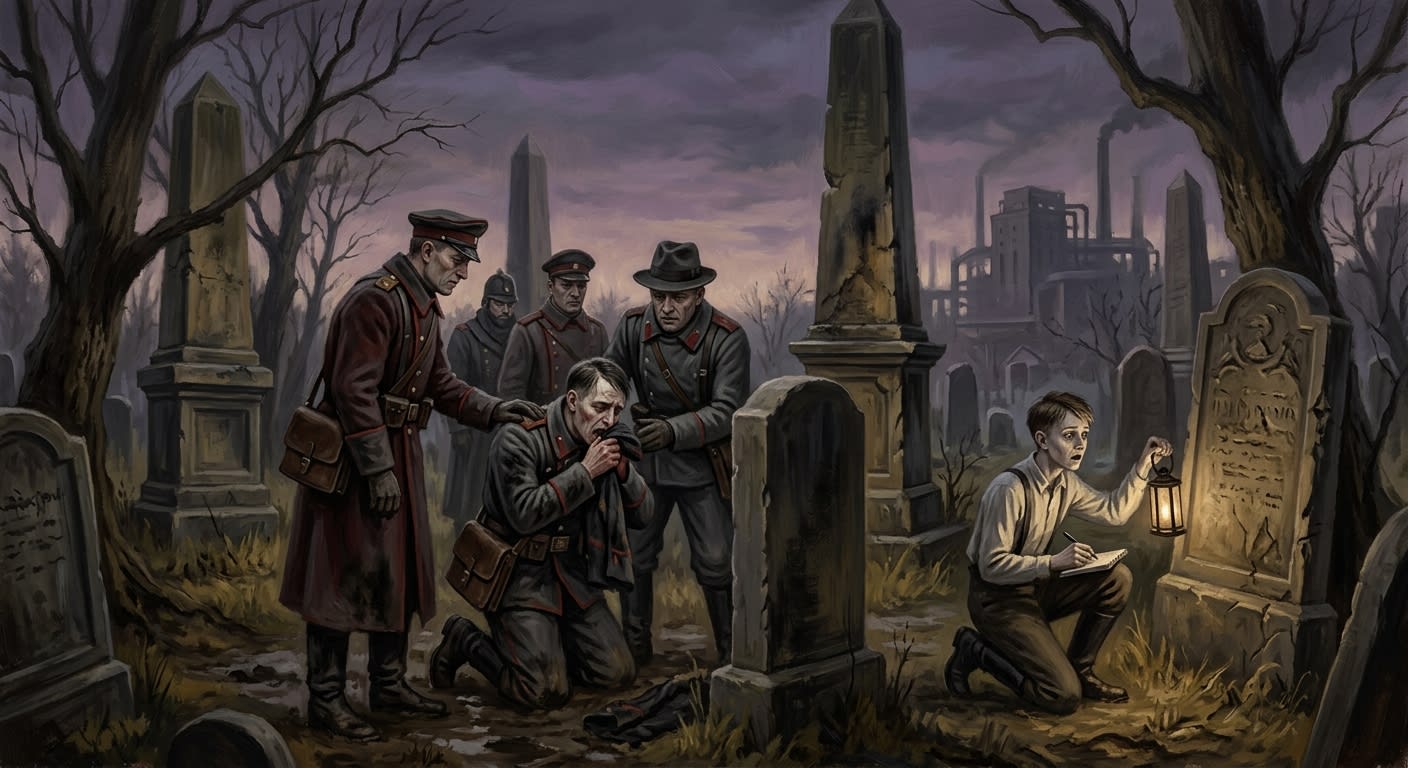
The sickness arrived first as fever, which is how Providence disguises half its indictments and how the Bureau misfiles the rest. Three children in the lower lane burned hot for two days. An old coffin carpenter developed black lines under the nails. A widow who had been hired to wash headstones complained that the letters had softened beneath her rag. By Compline, dogs refused the ring. By Matins, the newest graves carried names no mason had cut.
#On the Names Carved Before Death
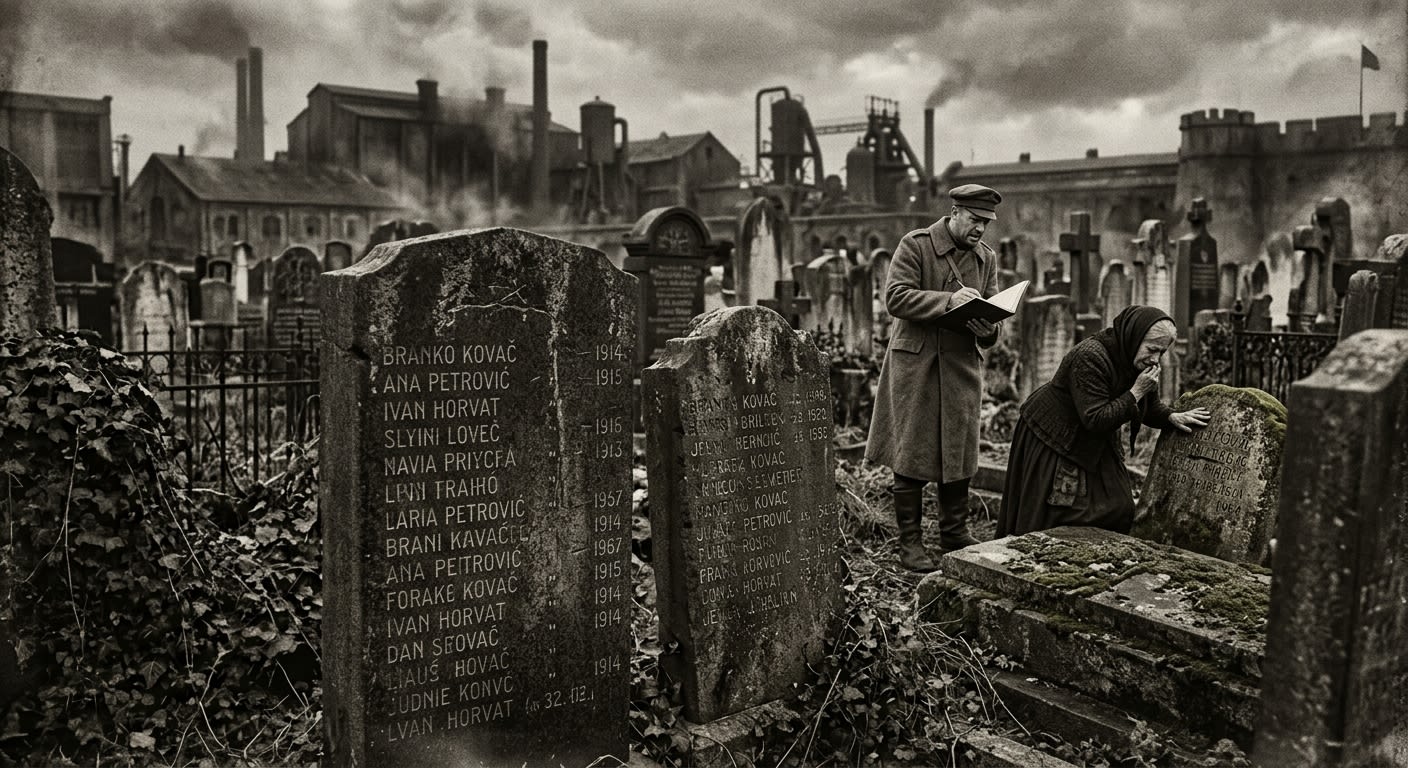
The first rewritten stone belonged to a soldier whose actual name had been lost with his jaw. His grave marker, a cheap slab of lime-streaked river stone, had held a unit number, a partial date, and the phrase KNOWN TO THE LEDGER, which is what the Bureau writes when it has failed the man and wishes to insult him afterward. At dawn the slab bore a woman’s name instead: Mira Janek, soap seller, alive at inspection, resident of the south lane, arrears two weeks.
Mira Janek died before Vespers.
The second stone named a boy. The third named a parish cook. By the fourth bell, thirty-seven stones had changed. By nightfall, sixty-two. Each inscription was clean, deep, and dry, cut in a hand matching no local mason and no authorised cemetery script. No chisel chips lay at the bases. No powder dusted the grass. The letters appeared already weathered, as if they had been waiting years for the surface to admit them.
The named villagers did what villagers do before catastrophe becomes policy: they argued, prayed, blamed neighbours, accused children, cursed Brokers, shook the parish warden, demanded a priest, then began counting. Counting was the fatal act. A named stone gave each living person a number in the queue. Families gathered around markers that now claimed them. Some tried to scratch the letters out. Beneath each scraped name the same name appeared in paler stone. One man smashed his assigned marker with a hammer and died an hour later with stone dust in his lungs, though no dust had entered his mouth.
The fever followed the order of carving. Mira first. The boy second. The cook third. A cartwright fourth. A Warden’s mistress fifth, which gave the Warden temporary moral seriousness and the investigation its first armed men. Each body developed a grey line across the throat shaped like the upper stroke of the first letter on the corresponding stone. Bureau of Medicine would later call this a dermatological coincidence with scribal presentation. Bureau of Medicine has always had priests of its own; they wear gloves instead of vestments.
WITNESS STATEMENT — EAST RING, A.S. 122 “The name on my husband’s stone was not his. It was mine. I told Father Odran the stone had made a mistake. He said stones do not err. At noon he would not look at me. By evening he had written my death hour before I stopped breathing.”
Further testimony sealed after witness identified a second name forming beneath her own: █████████████████████████
#On Records’ First Explanation
The Bureau of Records dispatched auditors on the third day. This was swift by Records standards and glacial by human ones. The first party included two inscription clerks, a ledger harmoniser, a junior cemetery surveyor, one frightened priest assigned by Rites, and a Purity observer who touched nothing except his knife. They found forty-nine dead, thirteen dying, and a ring of stones whose surfaces now displayed the names of every person who had entered the lower lane during the previous week.
The auditors inspected the stones. They measured stroke depth. They compared letter angle. They examined moss. They interviewed two surviving masons, both of whom swore ignorance with the wild sincerity of men who have discovered that ignorance is no protection. The ledger harmoniser asked whether the villagers had renamed themselves after the dead, then wrote nothing when the priest began laughing.
The file was classified Calligraphy — Anomalous, Category Two.
The natural weathering hypothesis deserves its small place in the museum of official cowardice. Rain had softened the upper layer of old epitaphs. Mineral bloom had altered legibility. Fevered villagers, half-mad with disease, had read their own names into damaged carvings and died from panic, contagion, or malnutrition. This explanation had the advantage of requiring no demon, no clerical failure, no grave-field doctrine revision, and no immediate budget.
It also required the auditors to ignore that several stones bore names of infants too young to read, one stone bore a name from a woman who had never seen the marker before that morning, and one mausoleum lintel acquired the names of five men while the auditors were standing beside it. The lintel’s addition was entered as post-inspection deterioration. I confess admiration. A lie that calm deserves a stipend.
The first public memorandum attributed the Novi Sad inscriptions to unusual mineral wear aggravated by fever conditions and local panic.
Withdrawn. Mineral wear does not alphabetise households, select victims by lane order, or carve a Warden’s mistress before touching the Warden. The Bureau of Records maintains that the original conclusion was reasonable under available cowardice.
#On the Fourteen-Year Delay
The death register was in the next room.
This is the whole crime. The auditors copied the inscriptions into Folio 14-R/7 and the parish clerk copied the deaths into the local mortality roll, and those two books sat within shouting distance for fourteen years without being introduced. Novi Sad survived the interval by becoming skilled at not looking directly at its own stones. The grave-ring was resettled twice. Brokers changed. The parish warden died of ordinary causes, a rare mercy in that district. Children grew up learning never to read a fresh epitaph aloud until an adult had checked whether the named person was still breathing.
The junior clerk’s name is sealed. Of course it is. The Bureau conceals competent servants as a miser conceals coin: not from shame, but from the fear that someone will ask to spend them. He found the correspondence during a shelf consolidation ordered after a rat nested in the Stonewear Annex. He matched name to death, death to hour, hour to inscription order, and discovered what the first auditors had declined to see. The stones had not been reporting death. They had been assigning it.
The reclassification came in A.S. 136: Demonic Interference, Passive, Category Four. Passive is a useful word. It means the enemy does not need to raise a claw when our procedures will carry the wound forward in a folder. Category Four admitted intent, agency, and hostile script. It did not admit responsibility, because responsibility is a heavier class of demon than the Bureau is licensed to bind.
#On the Blank Stones
By the time the second inspection arrived, the stones were blank.
This detail has comforted idiots for sixty-five years. Blankness, to the untrained conscience, resembles resolution. The grave-ring had been resettled twice. The lower lane had new shacks, new candle lines, new forged caretaker claims, and new children playing between markers whose elders kept them from reading. The old inscriptions had faded or withdrawn. In several cases the stones appeared freshly dressed, though no quarry mark or mason’s bill could be produced. The Bureau recorded the condition as stabilised.
A blank stone has no innocence. It is waiting without ink.
The new residents reported no fever during inspection week. They reported no fresh names, no throat-lines, no letters in the dew. They also reported that dogs would not cross the lower lane, that the third grave row stayed dry during rain, and that one old marker gave off warmth when a living person lied beside it. The inspectors marked these observations as tenant folklore. Tenant folklore is the great sewer into which the Bureau pours facts that smell of rent.
Later training summaries state that the Epitaph Plague ended when the inscriptions vanished.
Corrected. The inscriptions vanished before the second inspection. No authorised office determined whether the phenomenon ceased, concealed itself, completed its list, or learned better manners.
The Brokers drew their own doctrine. Caretaker Saints doubled dusk name-whispering and insisted that each living resident speak three dead names before sleeping. Stone Sharks forbade tenants to read unfamiliar inscriptions without paying an inspection fee. Ossuary Allies began offering rapid transfer out of “scribally damp” lanes in exchange for anchor-grave rights, because every horror becomes a market as soon as someone finds the correct noun.
Mother Vell acquired a Novi Sad face after A.S. 136: a woman with a hand over a child’s eyes and a chisel hidden in her sleeve. Hagiography rejected the image. The lanes kept it.
#On What the Plague Proved
The plague proved that grave-fields read back.
Doctrine had long taught that every headstone sanctifies its plot. Pilgrim lore muttered that faded names betray. Records had already filed suburbs relocated after tombs began speaking. Bureau Resolution gave the compromise with the usual odor of damp vellum: grave-fields are holy while tithed, damnable when neglected. Novi Sad sharpened that sentence. A neglected grave may speak. A hungry grave may accuse. A captured grave, surrounded by the living who use its silence as shelter, may decide that the simplest way to restore order is to write vacancies in advance.
This interpretation remains unofficial, which is how one knows it still frightens the correct people.
The plague also exposed the legal disease beneath grave-field habitation. Families slept beneath epitaphs because the living had no roof and the dead had title. The Brokers sold quiet between those claims. Settlement denied residency. Records catalogued stone. Rites protected consecration. Tithes counted candles. Nobody owned the fact that a child could learn his letters from a grave that might one day learn him in return.
A.S. 122 taught fear. A.S. 136 taught filing. A.S. 147, in the same cursed locality, taught that Novi Sad’s ledgers could kill without stones at all. The city is a schoolhouse for administrative mortality, and Strasbourg continues sending students.
The field instruction now pinned in certain grave-ring offices is admirably blunt: if a living name appears on a grave marker, isolate the named, copy the inscription without speaking it aloud, cross-reference death and tenancy rolls at once, suspend Broker transfers, request Rites, Records, Purity, and Bells, and ignore any office advising mineral weathering until the named survive three days.
#On the Present Warning
As of A.S. 201, the Epitaph Plague remains a training incident in Broker circles and an embarrassment in Records manuals. Official instruction reduces it to a classification correction: Category Two to Category Four, fourteen-year delay, all victims deceased, grave-ring resettled, stones blank. The lanes remember more. They remember families scratching at slabs until their fingernails lifted. They remember the priest who would not read names after noon. They remember dogs at the boundary with their bellies to the mud. They remember that the second inspection found blank stones because the stones had finished speaking.
The East Ring is occupied. Of course it is. Empty ground near a wall offends the living more than haunted ground alarms them. There are shacks between the older markers, low candle racks, laundry lines tied to stones whose faces have been turned inward, and a Broker’s hut roofed with two coffin lids and one stolen chapel door. Rent is cheaper there. Cheap rent is theology with hunger behind it.
The current Broker keeps a rule scratched above his desk: read no stone before breakfast, read no new name alone, read no name twice. He claims this is superstition. He also pays a Caretaker Saint to whisper the old victims every dusk and an Ossuary Ally to keep one transfer crate ready by the lane gate. The Stone Sharks refuse the district; they say the margin is poor. This is a lie. The margin is excellent. The stones make them nervous.