
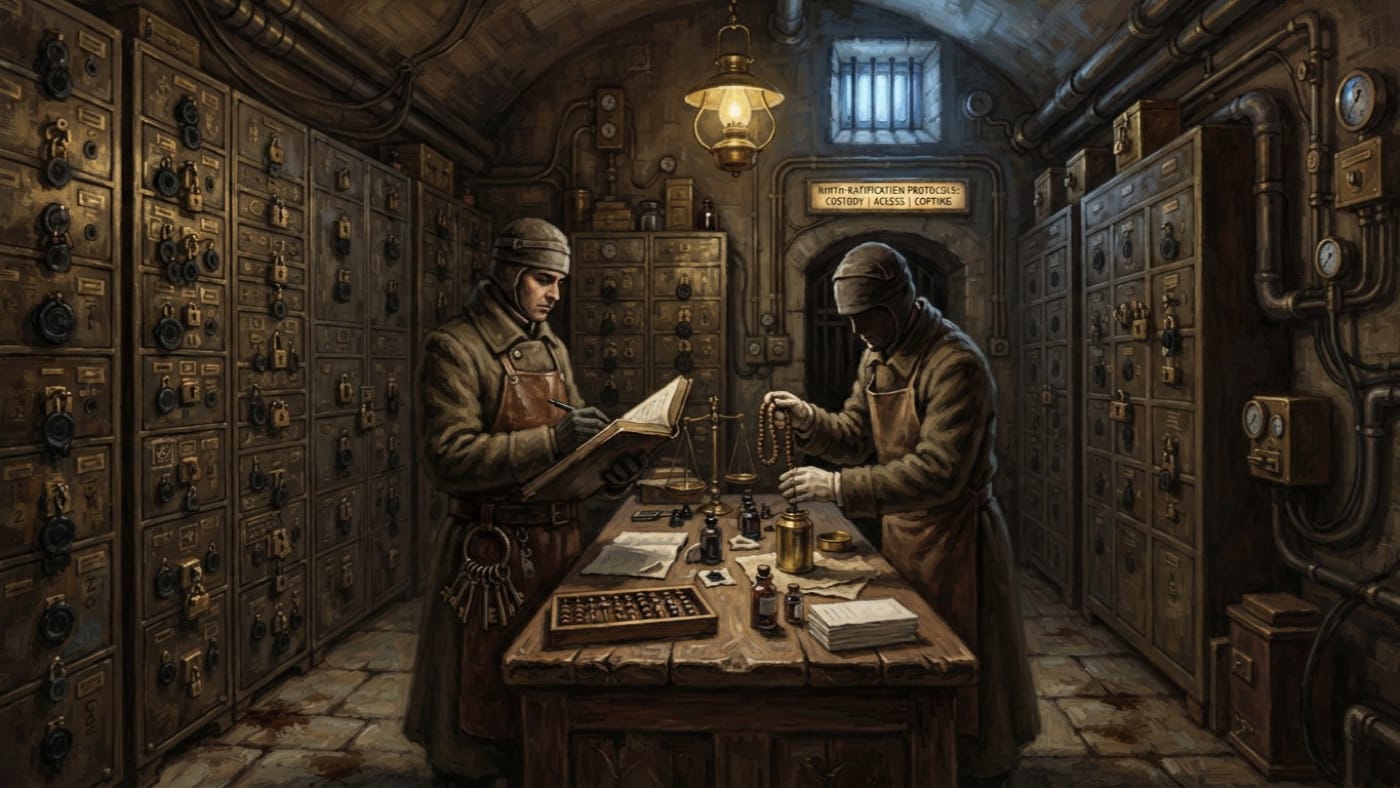
#On the Scope of Ninth Handling
Ninth-Ratification has its own entry in this Codex, where it seals cities and fires in black wax. Here it wears linen finger-cots. This tract has a smaller and damper subject: what the Bead Vault of the Cloister of Miscounted Beads does with a string, a clerk and a file once a case can no longer be corrected.
Three bodies of rule share the building, and none of them shares anything willingly. The Pilgrim Reconciliation Statutes of A.S. 97, revised in A.S. 187, govern lawful correction: the count, the fee, the clearance, the bunk. The Chapter's Anomoly Protocols govern hands, salt, silence and emergency weeks. Ninth-Ratification governs who may hold a case, who may know it exists, who may copy it, and who may think about it in any direction the Bureau has not approved. The first two can run for weeks before anyone invokes the third. A string confiscated over a sponsor challenge sits in a Vault run under Ninth protocols without becoming a Ninth file. A novice who sleeps in a cathedral does not wake a canon.
Beneath all three lies the doctrine of lawful ignorance. The Vault keeps the evidence so that subordinate offices need not understand it. It keeps the subordinate offices so that someone will carry the evidence.
#On Recognition and Removal
The Statutes list the severe signs plainly. A dead name comes back onto a live roster. A roster amends itself. A string warms inside a sealed case. A count and a weight refuse to agree. A record changes its own custody. Training sheets add a description that every senior clerk repeats and none will sign: the case has begun correcting the office that is correcting it.
Recognition happens at a desk in the Counting Hall, usually in front of the pilgrim, who is usually hungry. The clerk covers the open ink. Spoken names stop. The string goes into a salt-wax sleeve, the clerk's hands into treated linen, and the desk under a vinegar cloth. The presented name is written backward on a slip, which is folded inward so that nobody need address the file directly. Then the string is separated from the person who carried it. The Statutes call this holding the body if present and holding the absence if not.
Severe cases go to Desk Eleven and its blue lamp. From there the routes vary by case and by authority, and the Chapel claims some of them. On the Vault-bound route the string travels under escort with the slip still folded, and nobody speaks in the corridor. The Prior-Scribe is notified. The Bureau of Records receives a sealed packet. The Bureau of Purity is told only if speech, cult activity or counterfeit is suspected, and it resents the word only with a passion it otherwise saves for orphans with opinions.
The pilgrim stays on the bench. Nobody tells him where his string has gone. The one who knows may not speak, and the one who may speak does not know.
#On Entry and the Closed Case
Ninth authorization admits a person to a category. It does not admit anyone to a room. The Vault's door obeys local law, and local law requires two signatures. Prior-Scribe Erem Vale provides the counterseal, which carries Chapter authority, and the vault guard provides the countersign. Jossa Rill routes the person and the intake record as far as the threshold. Her signature moves bodies, and her authority ends at the bolts. Past the door, Archivist Keth governs everything: the entry of evidence, the discipline of cases, the lower cabinets, and the summons when a case objects.
At the threshold the guard asks three questions: the case number, the desk of origin, and whether the pilgrim answered to any name not written on the intake slip. A discrepant answer goes into the ledger in red, and the evidence goes into the Vault regardless. A contradiction left in the corridor is a contradiction loose. The bearer is a separate matter. Red ink admits the string and nobody else.
Each case holds one string, one intake slip, one recount card, one sealed disposition and one strip of absorbent cloth. The count and the weight are separate observations, entered separately, because the A.S. 187 revision learned what a string can do between the abacus and the scale. After entry, no bare hand touches the string. Finger-cots used on a severe case are burned.
Then the clerk waits and listens. If the case stays quiet for eleven breaths, entry is complete. One click earns a handling note. At two, the guard covers the ledger. At three, Keth is summoned from wherever she has been listening. This scale applies only to a case just closed at entry. Guards who would like to cover the ledger every time a roof beam settles must find another excuse.
The standing rules follow. No open counting between third and fourth bell. No open counting in rain. No spoken names after third bell. No junior clerk left alone with a grey case. Grey marks the dead claimant, whose string, by every rule of the Great Ledger, should have no living hand to return to. A string that keeps shifting after three treatments goes down to the lower cabinets, which have been full since the year began.
#On the File That Must Not Be Completed
Possession confers no understanding. This is the Ninth's lesson for the household, and the Vault teaches it daily. The guard keeps the ledger and never reads the dispositions. The junior archivist reads each case number aloud and never learns what the case contains. Keth knows the weights. Vale knows the seals. Records holds primary custody of the file unless another competent Bureau asserts a superior hazard. The assertion itself is a skirmish, fought in very good handwriting.
An Archon may request access. Some requests are refused, and the refusal does not trouble to explain itself. Appointed Ninth clerks and attending Inquisitors have duties. Duties are narrower than comprehension, by design. When a Vault file must be copied, the copying is done by blind schedule, partial hand or black-room transcription. The work is divided so that no clerk sees the whole, and the assembled copy is sealed as well.
Three rules govern the rest. No public index: the Vault's catalogue exists only as rotating shelf marks, false case numbers, split bone keys, and a guard whose name is reassigned every quarter. No subordinate inference: a clerk who notices that two red-marked cases came from the same desk in the same week has committed inference trespass by noticing. No mercy by analogy: nobody may lay one sealed case beside another, or beside any sealed operation elsewhere in the Synod, and remark on the likeness. The likeness may be accurate. That is why it is forbidden.
An earlier margin in this Codex, attached to the Statutes, described the Ninth as placing "nine seals" upon an impossibility.
Withdrawn. The numeral names the classification and counts nothing: no seals, signatories, councils or steps of any rite. Clerks who have been putting nine seals on severe cases since that margin appeared will stop, and will return the surplus wax to stores, where it is badly needed.
#On Correction and Its Witnesses
Circular 881-R, issued in A.S. 199, holds that bead counts are fixed at filing and that every later discrepancy is handling error. Public paperwork writes handling deviation, stitches a blue corner and levies the fee. The Vault obeys the circular in every word it writes and in none of its precautions. Salt-wax, finger-cots, the eleven breaths and the lower cabinets are all equipment for an event that, by Records' own ruling, does not occur.
Keth uses the circular better than its authors do. A dangerous string labelled mishandled stays on her shelves under circular discipline, out of Purity's brazier and out of reach of any office eager to experiment. Purity wants the lower shelves. Keth decides case by case and puts the dull word on every label.
The A.S. 199 Vault log records that Cabinet Five opened without a key during an anomaly week, and that seven cases were found reordered by date of death rather than intake number. The rest of the entry is sealed. This Codex reproduces none of it.
The detainees say the First String lies somewhere in the Vault, uncounted and unfiled. The Quiet Thread calls it holy. Records says no such object is held. When I asked Keth directly, she said, "There are only corrections." The Codex records both statements and certifies neither.
The cost falls elsewhere. While a case is held, the pilgrim whose string entered the Vault waits in the Dorm Rows, and the waiting is billed as correction. During sealed weeks, rations are "adjusted." His testimony is restricted, since his own name is now evidence. The clerks pay too. Three Ninth clerks from the Cloister's supplementary office learned to recognize bead-click in rain and were transferred to vegetable accounts.
#On Present Enforcement
As of A.S. 201, the protocols are in force and under strain. Five anomaly weeks are projected for the year. The lower cabinets are at capacity. Salt-wax stores need a monthly supplement. Keth asked for two senior archivists and received one novice, who lasted eleven days and now files laundry. The index-fragment scandal of A.S. 200 showed that the rubble-lot brokers want the shelf list more than the strings, and the shelf marks now rotate faster.
The Bureau of Doctrine has reviewed the Vault's application of Ninth handling and finds it sound, crowded and underfunded. It also finds the practice wholly unsuited to public explanation, which is the quality it was built to have.