

"Name it clean, or burn it clean. The Bureau will attend to either." — Saint Vellum of the Narrow Line, depicted with a quill like a spear and a warehouse behind him on fire
#I. The Throat of Bureaucracy
The Synod governs by paper. Every soldier stamped onto the rolls, every ration weighed on reliquary scales, every barrel of diesel passing through a tariff-chapel bears its documentation — and every piece of documentation is, sooner or later, a potential dispute. Faith, the Bureau of Commerce declares, is not an aura. It is schedules, manifests, and fuel allotments. The prayer is only as good as the scribe who records it, and the scribe is only as good as the litigant who verifies what he wrote.
The Manifest Litigant is the throat of that system: tight, inflamed, indispensable.
They work at the port courts and tariff-chapel galleries where cargo arrives, waits, rots, and sometimes is released. They prosecute and defend the identity of goods — not the goods themselves, which are secondary, but the name of the goods, the spelling of the origin, the geometry of the seal impression, the diacritic on the quartermaster's stamp. In a civilization where a misplaced tithe-seal has slain more pilgrims than blades ever have — this is not metaphor; the The Bureau of Records own records concur — such disputes are not pedantry. They are architecture. The manifest is identity. If one cannot prove a thing is what its papers say it is, one cannot tax it, ration it, conscript it, or condemn it. The Litigant exists to enforce that identity with the full liturgical weight the Bureau can bring to bear.
The work feels, to the uninitiated, like arguing in a freezing warehouse while fruit rots behind you and dockworkers stare as though you are personally murdering time. The Litigant knows this. The Litigant does not stop.
#II. The Theology of the Correct Letter
The founding doctrine of the profession is, on its face, absurd. On reflection, given the world as it stands, it is the only doctrine that makes sense.
"The demon enters by the misnamed door." So taught the The Bureau of Doctrine in its Third Revised Catechism (Unregistered), and so the Manifest Litigants have repeated at every licensing ceremony since the profession's formal constitution under the The Concordat of Strasbourg. The claim is theological: names are boundaries, and boundaries, correctly maintained, are the first defense against corruption of all kinds — spiritual, commercial, and administrative. To misspell the origin of a cargo is to loosen its moorings in reality. A barrel of rations from Rheims and a barrel of rations from Rheim are, in the Bureau's accounting, different objects. One has documentation. One has a wound.
The practical translation is less elegant: after trade networks shattered in the Great Retreat, counterfeit cargo flooded the ports. Place-names drifted between scribal hands. Seal-rings were replicated in lead and wax. Entire shipments of arms arrived bearing the stamps of demolished foundries, claiming origin points that had been ash for forty years. The Synod's response was characteristic — it weaponized literacy itself. If identity is paper, then controlling disputes over paper controls the flow of everything that paper represents. The Manifest Litigant emerged from this crisis as a licensed enforcer of documentary reality, armed with precedent codices and the authority to halt any shipment until its spelling satisfied the Bureau's standards.
This is why they cost so much and are hated so universally. They are not wrong to exist. They are simply expensive in ways that manifest as empty stomachs.
#III. The Port Court, Morning
The Manifest Litigant's day begins before the gulls do.
The manifests from overnight arrivals are reviewed first — any spelling susceptible to challenge, any place-name showing variant forms, any seal impression too shallow or too broad. The trade at the tariff-chapel is a sacrament in a cold chapel that smells of wheat-dust and incense and wet rope, and the Litigant walks among it with practiced eyes: not reading the cargo but reading its identity, hunting the letter out of place. If found, a Sanctity Stay Order (Unregistered) is filed before the dockworkers have finished their morning recitation. The cargo stops. The clock starts. The fees accumulate.
At midday, hearings. These are, by Synodal tradition, conducted in the galleries above the warehouse floors — so that the litigant stands above the cargo he is judging, and the merchant stands below his own property and cannot touch it. Citations are produced like thrusts from a blade: the Thirty-Seal Index of Precedent, the Ninth Wharf Ruling (Unregistered) of A.S. 134, the supplementary register of approved orthographic variants for the Rhineland sector. A skilled Litigant speaks for twenty minutes without repeating a source, and a skilled clerk on the opposing side has six minutes to respond.

Clerks do not receive training in public argument. This is, from the Bureau's perspective, as it should be. The Litigant does.
Witnesses are produced — "accreditation affidavits," the official term. A scribe who was present at the point of origin, a porter who can testify to the seals. These are, in practice, whoever the Litigant could reach before the hearing and who owed him a favor, but the Bureau does not audit witness provenance unless pushed, and pushing costs more than cooperating. By late afternoon, the ruling is entered. Release, retariff, confiscate, or refer for erasure. The cargo moves, or it doesn't.
At night, the negotiations that the official record does not contain. Merchants who need a favorable precedent cited in tomorrow's hearing. Rival litigants who want a hold extended because they have a storage agreement with the warehouse. Smugglers who want one letter changed on a manifest — not the whole document, just a diacritic, a vowel, a single stroke of a quill — because that single stroke is the difference between legal passage and confiscation. Candle money changes hands. Archive favors are called in. The brine-wax seal on the Litigant's satchel is refastened, the draft notes are burned, and the case numbers are murmured into a cloth because there is a superstition in the profession — not entirely unfounded — that written numbers left uncovered attract the attention of auditors.
#IV. History: The Three Founding Crises
The Manifest Litigant profession was not designed. It accumulated, crisis by crisis, until the Bureau of Commerce formalized it into a licensed corps rather than acknowledge that the disorder was the Bureau's own.
The Rot-Week of Saint Vellum is the founding parable, predating formal licensing. An unnamed dock district — tradition says a quarter of Marseille, the Bureau's records say no such incident occurred in any district it will name — lost an entire season's food stores to a cascade of name holds. One contested manifest triggered a Sanctity Stay, which triggered a second inquiry from a rival litigant, which triggered three counter-claims from the original merchant's house, which triggered a precedent review that required archive access that was temporarily unavailable. The holds accumulated for eleven days. The food did not wait. When the Bureau finally cleared the manifests, the holds were vacated, the paperwork was perfect, and the district's winter stores were compost. Licensing followed, because licensed Litigants — regulated, theoretically time-capped, officially accountable — were preferable to the chaos of unlicensed delay which the Bureau could not control and therefore could not tax.
Saint Vellum of the Narrow Line is depicted, in every chapel that honors him, with a burning warehouse at his back. The icon is not intended as condemnation. The Bureau approved the iconography.
The Orthography Purge of A.S. 112 — the same year as the Quiet Purges of the Rhineland (Unregistered) — resulted when a sect of zealots, working through properly licensed Litigant channels, argued that certain letter-forms were heretical glyphs borrowed from pre-Synodal Rationalist typography. The claim was theologically marginal. The The Bureau of Doctrine response was not. In the space of fourteen months, four hundred and eleven cases involving the contested letter-forms were retroactively challenged, eleven licensed Litigants were removed from practice for having employed the forms without challenge, and mass erasures of manifests across the Rhineland and Moselle regions created gaps in the tariff record that the Bureau of Commerce spent three years quietly papering over. The surviving Litigants learned the central lesson that the profession teaches repeatedly and never officially: doctrinal winds shift, and the Litigant who survives is the one who noticed the direction changing before he filed.
The Seal-Forgers' Winter of A.S. 145 gave the profession its most enduring authority. Counterfeit seal-rings had flooded the eastern port markets — sophisticated enough to pass casual inspection, wrong only in micro-measurement, in the depth of the impression's undercut, in the precise angle of the Triune Knot's third loop. The Bureau of Masks and Seals could not examine every seal at every port. The Bureau of Commerce could not process every claim of fraud. The Litigants, however, could be licensed to conduct seal autopsies (Unregistered) — methodical impression comparisons against the Registry's master plates, billable per examination, charged to the merchant seeking release. The authority to demand a seal autopsy became the Litigant's sharpest instrument, and no subsequent Bureau review has rescinded it, because no subsequent Bureau has wanted to absorb the workload it would then inherit.
#V. The Factions
The profession is not unified. It has never been unified. The Bureau considers this a feature.
The Purists hold that letters are borders. A spelling variant is not a scribal error to be corrected; it is an incursion to be resisted. Every diacritic out of place is a crack in the Covenant's wall, and the Litigant's sacred duty is to stop the water before it floods the chapel. Purists file on instinct and cite on principle and tend toward the kind of lean certainty that makes excellent prosecutors and catastrophic colleagues. Their precedent libraries are immaculate. Their warehouses are full of rotting grain.
The Pragmatists hold that a tariff paid and a convoy moving is worth more than doctrinal purity applied to a dead shipment. They negotiate. They accept "letter penance" — a correction fee, a chapel donation, a formal acknowledgment of the scribal error, all entered into the ledger so that the Bureau can show it took the matter seriously — and they release cargo before the dock fees exceed the value of the cargo itself. They are considered morally flexible by the Purists and professionally competent by the merchants. The Bureau of Commerce, off the record, prefers them.
Then there are the shadow counsel: Litigants who have been purchased, in whole or in part, by smuggling networks, warehouse syndicates, or the larger caravan houses. They are officially licensed. Their citations are valid. Their arguments are legally correct. They are simply prosecuting the case their patron requires rather than the case the manifest demands. The Bureau of Shadows files reports on them quarterly. The Bureau of Commerce files counter-reports noting that the shadow counsel process seventeen percent more cases per quarter than their licensed competitors and create fewer riots. The matter is classified as under ongoing review.
#VI. What the System Costs
The Bureau insists that delay is sanctity. "Better grain rot than loyalty decay" is printed in the operating handbook distributed to every licensed Litigant at graduation from the Port Court training annexes. Those who starve are told their hunger proves faith.
This is not hypocrisy, precisely. Hypocrisy requires concealment. The Bureau makes no secret of the calculus.
The Ledgers of Varna (A.S. ~129) are the clearest demonstration. A grain fleet arrived intact at the harbor — sixty-three vessels, a convoy season's worth of rations for three zones. The manifests, drafted by scribes in Anatolia under field conditions, contained a range of orthographic inconsistencies that two competing Litigant houses each found sufficient grounds for separate Sanctity Stay Orders. The holds ran for nineteen days while the cases worked through the port court hierarchy. The cargo rotted. The starving populace rioted. The The Bureau of Purity shot thousands into the harbor. The Bureau of Commerce declared the rotted grain "a holy fast, voluntarily endured." The Litigant houses each received partial payment of their fees, since the cases technically concluded with the cargo's condemnation rather than its release, and condemnation is a valid case outcome.
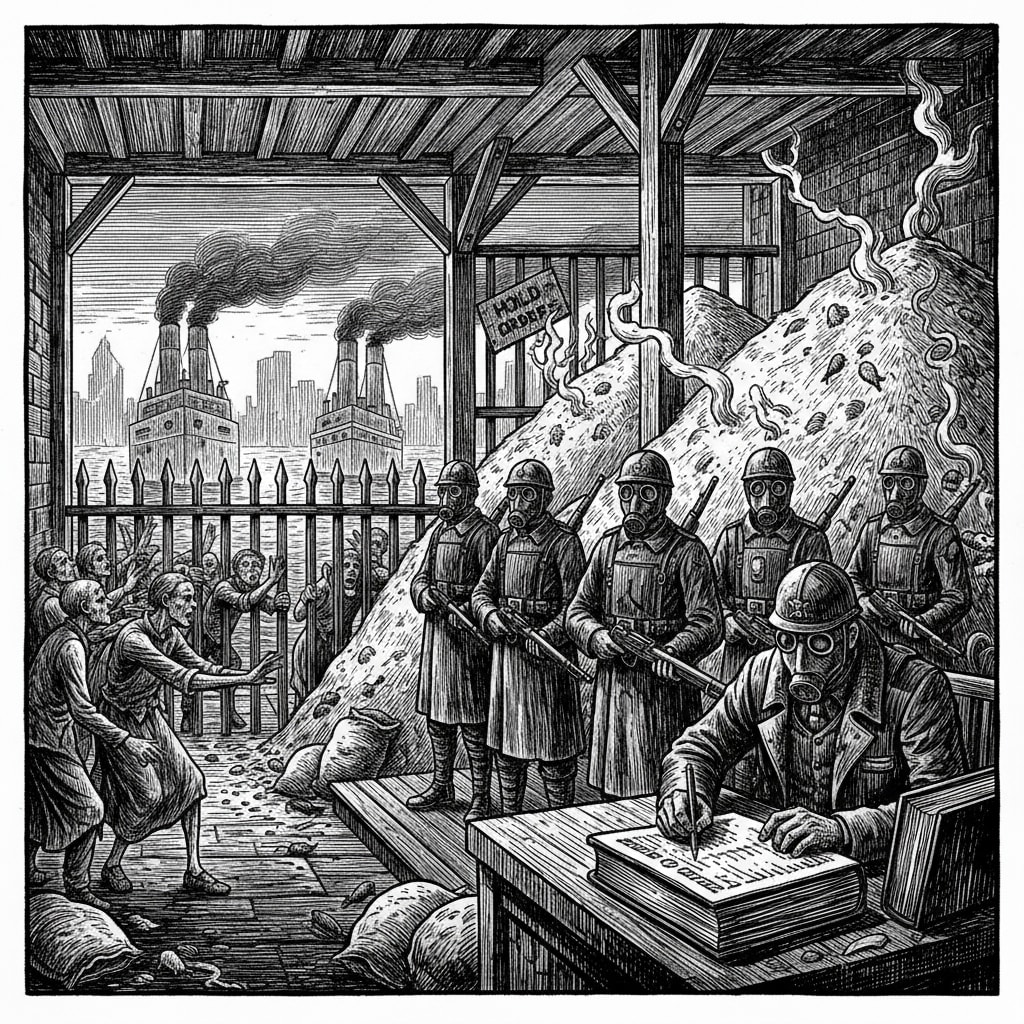
The Stamp War of Novi Sad (A.S. ~147) is subtler and, in its way, more perfect. Two inspectors from rival Bureau offices stamped the same cargo with conflicting seals. Both seals were valid. Both inspectors were licensed. The Litigant houses representing each inspector's authority filed simultaneously, and because both holds were legally sound, the Port Court divided the cargo between them to satisfy the competing claims. The division produced rations that existed in perfect balance across two ledger books and in zero physical reality. Thousands perished. All ledgers balanced. The The Bureau of Records later used the incident as a training example for why duplicate-stamp protocols require reform — a reform implemented forty years afterward, in A.S. 187, in a form that created four new categories of disputable seal interaction.
The Orthography Siege at Nominalist's Gate (A.S. ~138) produced the profession's most quoted incident, though the Litigants themselves prefer not to quote it. An entire regiment was barred from crossing the Gate because the colonel's name appeared in three different spellings across his orders, his commissioning papers, and his regimental manifest. The Litigants on duty could not clear a single document without implicitly contradicting one of the others. The soldiers starved on the trench-bank while the case proceeded through proper channels. Wrath (Unregistered)'s raiders slaughtered them at dawn. The ledgers, when the Bureau finally audited the Gate for the incident, were immaculate.
#VII. The Burnout
There is a particular deterioration that the profession produces in those who remain in it past fifteen years. The Litigant begins to hear only form, not meaning. A manifest is not a list of goods but a pattern of marks, and the marks either satisfy or they do not. A merchant is not a person but a seal affiliation. A hungry crowd outside the chapel gallery is not a threat; it is a contextual factor in calculating how much longer one can hold the case before the risk exceeds the fee.
The slang term for this state — used inside the profession with the gallows affection of people who recognize themselves in a portrait — is "going index." The index is all that remains: a man who has become, in his own estimation, a reference system in a coat.
The profession's burnout path is, by convention, admission to a guild archive office, a semi-retirement into precedent curation where one catalogs cases rather than argues them. The archives are cold and very quiet. Precedent Curators do not interact with cargo, or merchants, or riots. They verify citations. They ensure the Thirty-Seal Index remains accurate. They are, in the Bureau's accounting, perfectly preserved specimens of what the profession aspires to: pure documentation of documentary dispute, removed from the human variables that complicated it.
Most of them, by all accounts, are content. The Bureau finds this reassuring.
Nihil obstat, with the Bureau's customary observation that "sanctity requires delay" should not be confused with a recommendation to delay sanctity, which is heresy. The Litigant, ideally, knows the difference. In practice, the archive contains forty-seven cases in which the distinction was disputed before the Port Court. All forty-seven were resolved correctly. Twenty-three resulted in immurement.
— Hieromnemon Valerius Drax, Warden of the Sacred Ledger
ERRATUM — Bureau of Commerce, Port Court Division, A.S. 201:
The foregoing account of the Ledgers of Varna incident contains the phrase "sixty-three vessels." Bureau records indicate sixty-one vessels. The discrepancy of two vessels is under review. Both are present in the ledger. Neither is present in the harbor. This is consistent with correct documentation procedure.