
#On the Palace in Warsaw
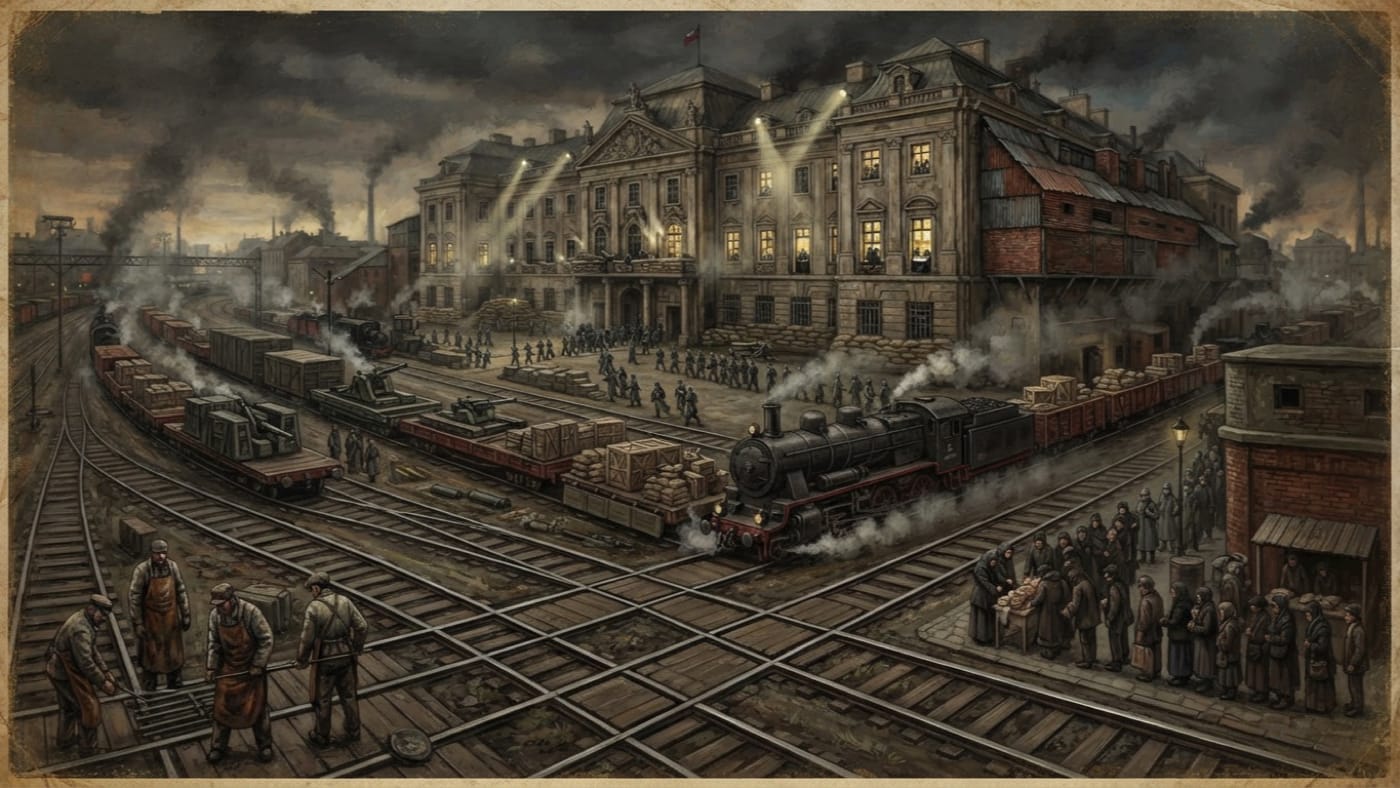
Northern Theater Logistics Command keeps its desks in an old Polish palace in Warsaw, a building raised for dancing and now furnished for arithmetic. Which palace, this file does not say. Nor does it say in what year the clerks arrived, and the Hieromnemon will not invent a year because an empty date offends the eye. The palace stands near the western military blocks where the Warsaw Standing Brigade keeps its barracks. A runner can carry a timetable from a gilt salon to a bayonet in less time than the salon's stove takes to warm a hand.
The title describes the work. Northern names the theater facing the Baltic approaches and the Bug. Logistics covers everything a soldier eats, fires, sleeps beside or is eventually buried in. Command is the belief, sincerely held in every palace ever converted to war use, that an instruction written on good paper moves a train.
Paper moves nothing. Trains run on coal, sound iron and men who have eaten.
#On the Northern Route
The northern corridor is a sequence of cities, each with its own trade. Hamburg takes in the sea: grain, coal, timber and war cargo from the North Sea. Kanzleiburg, which the maps call the administrative brain of the northern theater, is the great junction between that port and the Polish lowlands. Warsaw, a Zone Three city on the Vistula, is where freight is broken down, made up again and sent east. Two spurs carry it on: one north to Bastion-Königsberg, one east to Bastion-Brest. Both bastions hold the northern end of the Sagittal Line, and both are supplied through Warsaw or not at all.
Colonels in more than one city have asked the Hieromnemon which of these offices outranks the others. Each received the same courteous silence. The route has an order of stations. Their order of precedence belongs to men with more sashes.
Warsaw's railway system covers twelve square kilometres of track, sidings, sheds, bunkers and dispatch towers. Through it go grain, ammunition, classified freight, troop drafts and coffin timber, all bound for the bastions. The yards belong to the city's railway order. The Command's name hangs over the traffic the way a bishop's name hangs over a diocese: invoked everywhere, seldom the hand on the lever.
Delays add up in plain units. A day lost in Warsaw is a day the bastions spend counting grain. A late ammunition train sends the gun crews at Brest back to the ration sheet, which they read with more feeling than scripture. A troop draft held in a shed must still be fed. It eats the bread meant for the men it was sent to relieve, and both groups now wait on the next grain train. Any staff officer can describe this problem. No staff officer has yet signed it out of existence.
#On the Institutions Around the Timetable
A timetable drawn up in a palace has to pass through several jurisdictions before it turns into a moving train. This survey does not settle who reports to whom. The Hieromnemon records only the doors the Command's runners knock on, and how long they wait at each.
The first door belongs to the Brigade. Its twelve thousand men, raised under the Bureau of War, guard the yards, crossings, signal houses and forward spurs. That strength is the Brigade's own. The Command's clerks are a different and smaller number, and nobody has published it.
The second door belongs to the Guild of Rails. Its yard masters run the sidings, and its track walkers inspect the line itself: the gauge, the joints where rail sections meet and fail, the ballast under the sleepers, and the rail that contracts on a January night until it cracks. A damaged length has to be inspected, repaired, certified and reported to dispatch before anything heavy crosses it. Military urgency does not shorten that list. An officer can shout at a broken rail, and plenty have.
The third door belongs to the clergy. The Rail-Confessors bless departures from the Warsaw yards, and the Brigade guards them on night departures, when a priest running beside a moving train is most likely to be taken for a thief. A blessing is short. A departure that missed its blessing turns into a long correspondence.
Beyond these lie the specialist custodians. Relics freight travels under escort, and its paperwork weighs more than its crate. Tithes audits need bayonet parties in districts where auditors have learned to count quickly and leave quickly. The Bureau of Records keeps copies of all of it, including the copies.
#On Bread and Rail Stoppages
The northern supply corridor has been stopped once without artillery, and the episode is on record. In A.S. 195, about four thousand civilians in Praga, on the eastern bank, blocked the eastern rail spur for eleven hours. The corridor halted. Every requisition on file that day stayed valid, signed and urgent, and none of them moved a wagon. The people wanted bread. Four thousand bodies on a rail line turned out to weigh more than any seal.
The Brigade changed its drill afterwards: new crowd-control practice, new ration-line arrangements, and an acquired dread of bakery rumours. Those changes belong to the Brigade's file. This survey gives the Command no part in starting, ending or investigating the disturbance, because the record gives it none.
"Low-intensity rear security." War pamphlet description of civil-order duty in Warsaw.
Withdrawn after A.S. 195, as entered in the Warsaw Standing Brigade's own file. Repeated here for any office that plans freight around such descriptions.
What Praga showed in a single afternoon, Herta Stoltz explains every week. Stoltz is Warsaw's Settlement Resident-Director. She meets weekly with Brigade officers and objects, in steady numerals, to clearances, to barracks plans that would displace railway families, and to ration cuts. Her arithmetic is simple and so disliked: the railway families are the yard labour. Clear their street and the yard loses its coal crews. Cut their bread and the line fills with people. A logistics office can ask for anything it likes. It cannot ask for a city that does not eat.
Warsaw's civilians have never fully left. They cross the yards to reach work, markets and the Mercy Wards, and they queue for bread next to track that soldiers are paid to keep clear. Every timetable drawn up in the palace assumes the people will stand out of the way. Some days they do.
#On the Two Destinations
The northern spur runs to Königsberg, where the Line ends at the Baltic. The Masurian Lakes form its outer maze, thousands of linked waters and marshes that punish any advance and, impartially, any wagon. It is a city of bells and ice. Freight arriving there is measured against winter as much as against the enemy.
The eastern spur runs to Brest, the bridge-fortress over the Bug, which guards the flattest and most exposed stretch of the Line. There the rail spur is licensed, convoy manifests are checked at the crossings, and the local saying runs, No crossing without naming. A wagon from Warsaw with a missing seal is a wagon that waits.
Doctrine records two distinct pressures on this front: the Grey opposite Königsberg and the Nameless Tide opposite Brest. Both are held under Absolute Suppression. Neither has a name, and neither will receive one in this file. A logistics office has no need to know what it feeds the bastions against. It needs only to know the bastions are hungry.
#On Present Operations
As of A.S. 201, Northern Theater Logistics Command keeps its desks in the old palace in Warsaw. The yards send freight north and east. The Brigade guards the crossings. The Guild certifies what can bear weight. Stoltz counts what the city can stand. Trains leave when the rail, the bread and the labour permit. The north cannot be defended without an operating Warsaw, and the Command still writes orders as though it could.