
#On the Formation
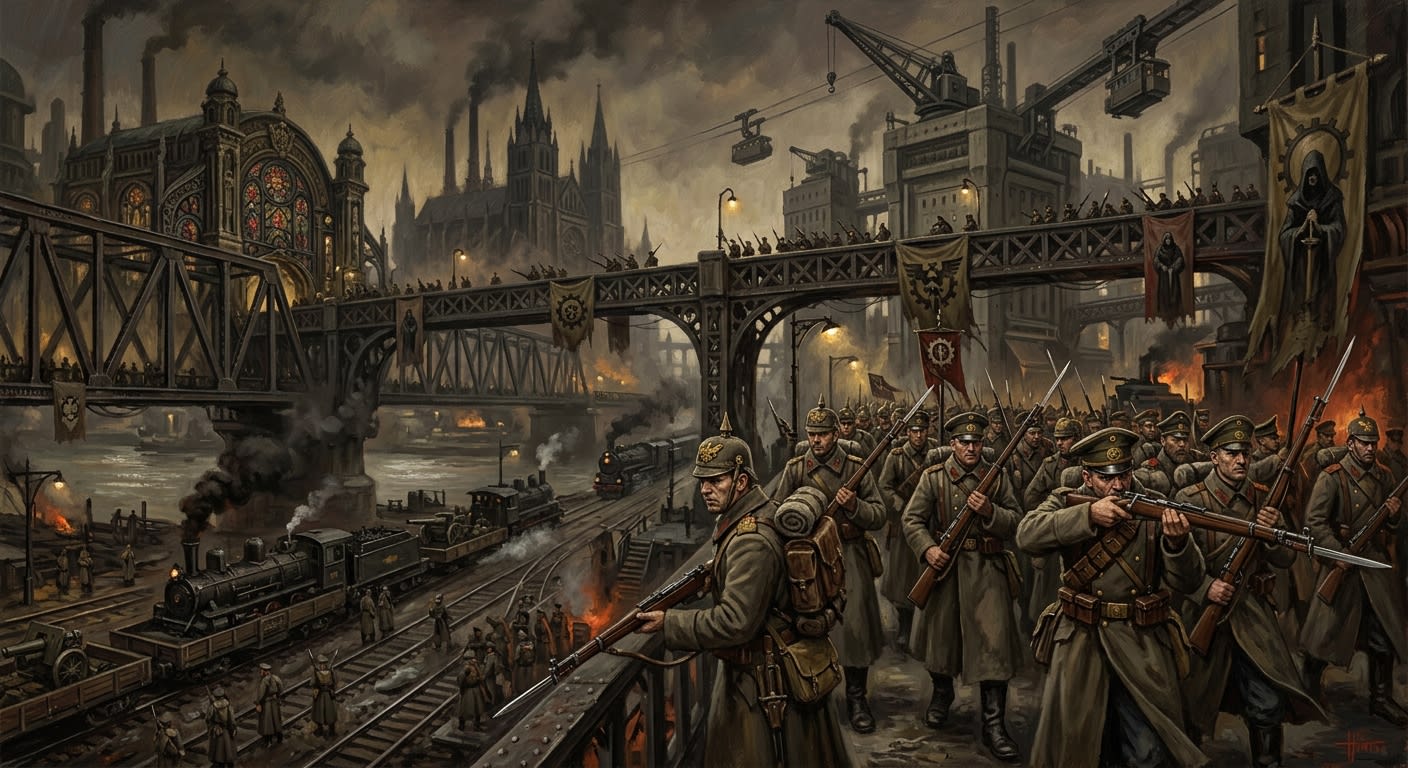
The Warsaw Standing Brigade is a twelve-thousand-man rear-echelon formation equipped and drilled to front-line standard because the Bureau of War has never trusted the word rear. Rear implies safety. Safety breeds opinion. Opinion delays orders. Better to give a man a rifle, a gas mask, two ration cards, three oaths, and the conviction that distance from the Sagittal Line is a clerical fiction subject to revision by artillery.
The Brigade holds Warsaw, though Warsaw prefers the verb “tolerates.” Its barracks occupy the western military blocks near the old Polish palace now used by Northern Theater Logistics Command. Its patrol stations stand at the yards, bridges, signal houses, and eastern districts. Its men know the city by rail whistle, ration queue, tenement cough, and the low percussion from the east that Praga calls the Breathing when Doctrine is not listening.
Its soldiers are drawn from discharged front men too damaged for trench rotation but too useful for release, northern levy companies awaiting reassignment, garrison sons born under the Vistula smoke, and a small number of volunteers whose sanity is treated as pending. They wear the grey-green of War with a narrow black rail stripe on the cuff, granted after three years of petitioning by officers who wanted a distinction and clerks who wanted the petitioning to stop.
#On Rail Security
Warsaw exists because trains leave it. Everything else is civic vanity arranged around a timetable. The Brigade's first charge is to keep the yards functioning: twelve square kilometres of track, siding, engine shed, coal bunker, dispatch tower, storage apron, and prayer booth, sending grain, ammunition, classified freight, troop drafts, and coffin timber toward Bastion-Brest and Bastion-Königsberg.
Rail security is uglier than parade doctrine admits. A sentry at a forward signal house guards more than iron. He guards tempo, ration margin, bastion confidence, the sleep of yard crews, and the delicate fiction that the northern corridor is an artery rather than a throat with hands around it. Sabotage need not be demonic. A missing switch key, a frightened dispatcher, a bad coupling, a hunger riot, a crate mislabelled as candles when it contains detonators: all can stop what shells have failed to stop.
Patrols move in pairs through the eastern yards and in squads along the spurs. The northern spur toward Białystok receives extra men in winter, when frost cracks signal housings and makes every delay look like conspiracy. The Brest spur receives extra men always, because flat country is a gift to speed, raiders, fog, panic, and anything that prefers no hills between itself and dinner.
#On Civil Order
The Brigade's second charge is civil order, which in Warsaw means learning how many hungry people can stand between a train and its departure before the matter changes name. The Bureau of Records prefers categories: queue, assembly, disturbance, riot, insurrection. A sergeant on Praga cobbles has less poetry. He sees faces, hands, sticks, bread tokens, infants, and rails behind him that must remain clear.
This is the Brigade's education: crowd control and trench warfare require the same base virtue. Stand in a line. Hold it while people in front of you explain, with increasing conviction, that your existence is an error.
A War instruction pamphlet described civil-order duty as “low-intensity rear security.”
Corrected after A.S. 195. Four thousand hungry civilians can generate intensity without consulting War pamphlets.
The Praga Ration Disturbance taught the lesson in eleven hours. Four thousand civilians blocked the eastern rail spur with bodies and bread anger. The northern supply corridor halted. No demon breached the gate. No Sin-General issued a proclamation. No heresiarch mounted a pulpit. People wanted bread, and the rail line discovered that want has mass.
WARSAW STANDING BRIGADE — AFTER-ACTION EXTRACT, PRAGA, A.S. 195 Rounds issued: █████. Rounds fired: ███. Bayonet presentation: authorised at █████ bell. Fatalities: █████ civilians, ██ Brigade. Rail stoppage: eleven hours. Public record: ration disturbance; no sedition finding. Recommendation: increase flour allocation before next audit.
Afterward, Praga was reclassified from a sub-district of limited administrative interest to a district of elevated administrative concern, which is how Records says “we noticed the people after they stopped the trains.” The Brigade gained new crowd drill, new shield racks, new ration-line liaison officers, and a permanent distrust of bakery rumours.
#On the Men Who Hold the Line Behind the Line
A Brigade private learns two maps. The first is issued by War: yard sectors, bridge posts, signal stations, armoury locks, barrack gates. The second is acquired by humiliation: which alley empties a crowd behind your cordon, which tavern hides track thieves, which Mercy Ward overflows on fast days, which priest will calm a queue, which priest will make it worse by speaking, which mothers should never be touched unless the officer wishes to write letters until dawn.
The Brigade is commanded by officers who pretend to dislike the Guild of Rails and obey its yard masters whenever the yard masters speak in the tone that means steel will otherwise kill someone. The Brigade guards Rail-Confessors during night departures, escorts Relics freight whose paperwork is heavier than its crate, and provides bayonet parties for Tithes audits in districts where auditors have learned to count quickly and leave quickly.
Its chaplains complain that the soldiers confuse duty with fatigue. Its surgeons complain that they confuse fatigue with virtue. Its quartermasters complain most accurately: boots wear out faster in cities than in trenches because cities make a man stop, start, turn, climb, shove, run, wait, and stand on stone while being cursed by citizens whose curses show excellent local workmanship.
#On Herta Stoltz and Other Civilian Obstacles
The Brigade's officers meet weekly with Herta Stoltz, Warsaw's Settlement Resident-Director, whose principal military virtue is refusing to provide false numbers with such calm that colonels begin to doubt their own maps. She knows which proposed clearances will produce riots, which barracks expansions will displace rail families, which ration cuts will be paid for in stoppages, and which streets cannot be marched through because the last march left teeth in the gutters.
War calls this civilian interference. Stoltz calls it arithmetic. The Brigade, which has stood in Praga with an empty bread cart behind it, increasingly calls it advice.
#On Present Condition
As of A.S. 201, the Warsaw Standing Brigade remains the wall behind the wall: rail guard, queue line, bridge sentry, spur patrol, emergency bayonet reserve, and public evidence that the Synod has not confused Warsaw with the heartlands, whatever the maps imply. It is rear-echelon by distance, front-line by consequence. If it fails, trains stop. If trains stop, the bastions count their grain by days. If the days run out, the east ceases to be east.
A doctrinal broadsheet praised the Brigade as “the quiet sword of domestic peace.”
Withdrawn. No sword in Warsaw is quiet. The cobbles carry sound.