
#On the Second Book
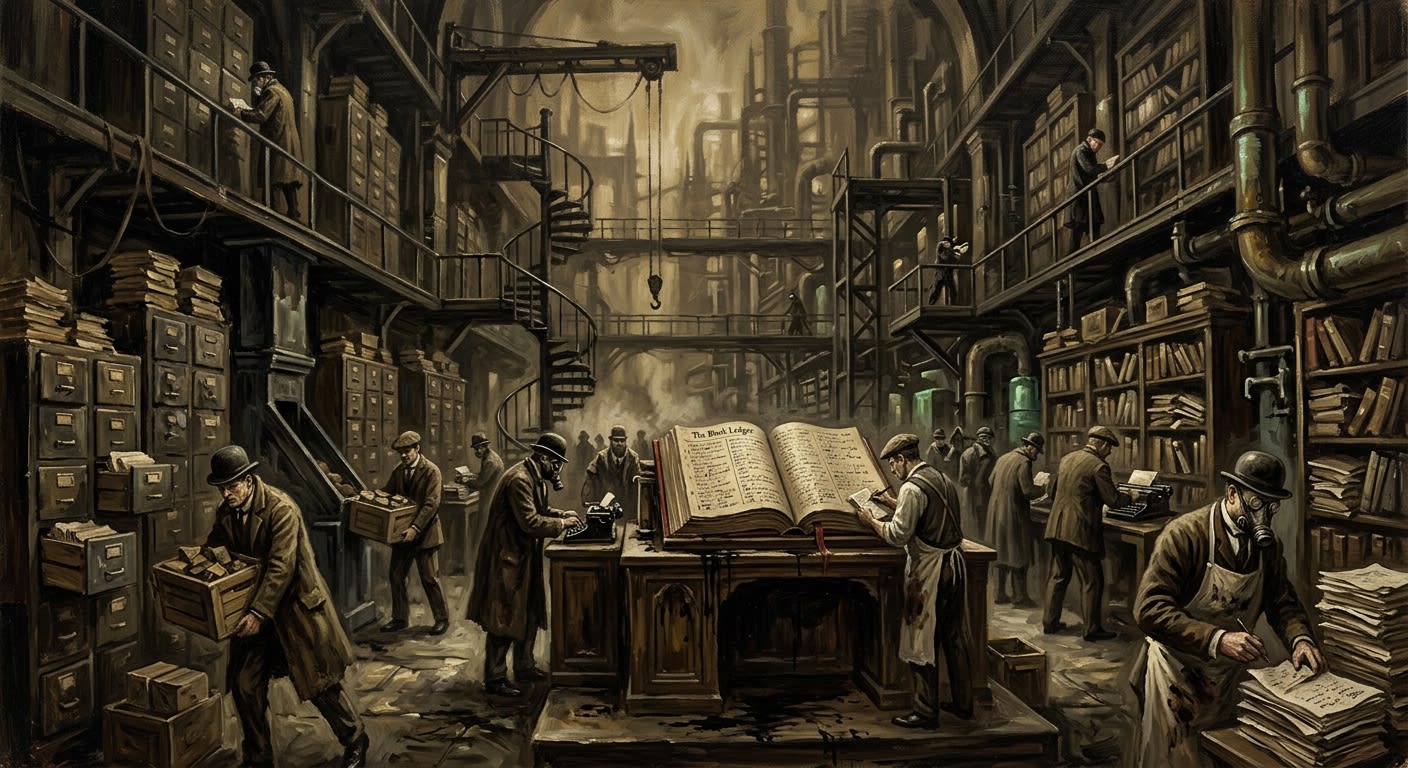
The Black Ledger is what happens when hunger learns bookkeeping.
The Bureau's official classification is Criminal Heretical Network, Category Three. This is accurate, which is irritating. The Ledger steals ration carts, counterfeits seals, shelters condemned persons, murders Wardens, blackmails tithe clerks, sells advance warning of Purity packets, and feeds just enough of the poor to make testimony unreliable. The poor, being poor rather than stupid, know perfectly well that the bread is stolen. They eat it anyway. Theology tastes thin beside a hungry child.
Its name comes from the Black Ledger of Ghent, the blood-stiffened artefact seized in A.S. 159 after a weigh-station fraud ended with one hundred thirty-seven men executed as corrective weight. The modern network took the title because criminals, like saints, understand relics. A Bureau atrocity became a criminal banner. The choice is obscene. It is also good propaganda, and I am professionally obliged to respect competent obscenity.
#On the Ranks of Theft
The Ledger is not a guild. A guild has a charter, dues, patron saint, procedural disputes, and old men who smell of wax and resentment. The Ledger has cells. Strasbourg has three confirmed cells. Cologne two. Ghent four. Marseille two. Constantinople's Warrens hold six to nine, depending on whether the Bureau of Shadows counts children, informants, or the dead, and Shadows counts all three when it suits the estimate.
The ranks are known because captured criminals confess with touching regularity once placed in rooms designed by men who regard architecture as an interrogation method. Runners carry notes, distract queue guards, and learn early that childhood is a resource adults consume. Cutpurses steal stamps, chit-books, purses, and loose proofs of identity. Seal-Swappers work wax and ink, producing ration counter-stamps good enough to pass in a cold queue and bad enough to condemn their holder under laboratory review. Queue-Saints distribute bread in public with clean cuffs and borrowed sorrow. Ledgerwrights keep the second book. Quiet Knives correct accounts that have begun to speak.
The second book is the doctrine. Every gift becomes debt. A loaf becomes silence. A forged permit becomes a cellar key. A rescued brother becomes a future Runner. Gratitude is entered, indexed, aged, and collected. The Ledger does not give alms; it purchases persons in increments small enough to be mistaken for mercy.
Earlier Purity broadsheets described the Ledger as anarchic.
Corrected. The Ledger is offensively orderly. Its order is illicit, predatory, and poisonous, but it is order. The distinction was missed because Purity uses “anarchy” to mean any filing system it cannot subpoena.
#On Keska, Gaps, and Holy Neglect
The Ledger's operating principle is absence. It goes where the Bureaus overlap, quarrel, delay, or look elsewhere.
Keska remains the instructional wound. During the Administrative Redrawing of A.S. 188, the foundry-town fell between old and new zone tables. Eleven months without Settlement oversight. Eleven months without Tithes assessment. Eleven months without Conscription levy, permit renewal, lawful address correction, or any official hand on the town's throat. The Ledger opened a cellar office before the omission had finished drying. By the time Yvette Langres forced the correction in A.S. 189, Keska had lost a third of its population and gained a criminal memory that no retroactive stamp could erase.
The same pattern appears beneath Bastion-Irongate in the Underchords, in Marseille's dock quarter where three Bureaus disagree so vigorously that criminals send thank-you notes, in Hamburg's bonded warehouses, in Warsaw ration districts, and in the Warrens beneath Constantinople where forty thousand souls live in spaces the maps call stone. The Ledger does not need to defeat the Synod. It waits for the Synod to misfile itself.
Intercept, Hintermark route-cell, A.S. 199: “Second bell: flour. Third bell: stamps. The Settlement woman writes too well; do not touch her. If Purity asks about the widow, she is ours, her sons are ours, her dead husband is ours by receipt. ███████████████████████████████████ The second book balances.” Disposition: raid authorised; escort unavailable; file remains active.
#On the Three Heresies Inside the Heresy
The Ledger contains three quarrelling souls, which is at least two more than most criminals manage.
The Theatres believe performance is the weapon: bread under bells, Queue-Saints at dawn, public humiliation of the Bureau enacted with a broken seal and a compassionate face. The Accountants believe the second book is the weapon: no myth, no romance, only obligation measured in meals. The Knives believe all questions eventually become anatomical.
Their quarrel limits them. Their quarrel preserves them. Theatre recruits. Accounting governs. Knives enforce. A cell ruled entirely by one faction becomes either a charity masque, a shadow bureau, or a murder room. The mixed cell survives because it can smile, count, and cut in the same afternoon.
The Bureau hates this resemblance most. The Ledger mirrors us in gutter materials: our stamps as counter-stamps, our ledgers as second books, our saints as Queue-Saints, our corrections as knives. That mirror must be smashed. It must also be studied. Only fools refuse instruction from enemies with good stationery.
This Codex previously advised that the Black Ledger be understood chiefly as banditry.
Corrected. Banditry takes. The Ledger administers taking, records giving, and taxes gratitude under another name. It is a counter-bureaucracy, which is why ordinary police work trims its fingernails and calls the clipping a victory.
#On the Arrangement No One Admits
The Ledger persists because eradication would reveal what the Ledger has been feeding.
Eight to twelve thousand dependents eat by its hand. Remove that hand and the hunger remains, now public, now angry, now counted. Riots cost soldiers. Soldiers cost grain. Grain costs convoys. Convoys attract raiders. Raiders require reports. Reports require committees. A loaf stolen today may prevent six departments from meeting tomorrow. This is not mercy. This is arithmetic wearing a hood.
The Bureau of Purity raids. The Ledger absorbs. The Bureau of Shadows estimates. The Ledger revises. The Bureau of Tithes counts losses. The Ledger counts loyalties. Both sides keep books. One side has nicer ink.