
#On the Present Survey
"A fort is built for soldiers. Everything else turns up uninvited and stays."
This survey is entered in A.S. 201. It is compiled from the files of the Bureau of Settlement and whatever the Bureau of Records holds against them, and it concerns a kind of place, not any one town of that kind. The Bureau of Settlement calls them organic garrison towns. They are civilian communities that grew up around the fortifications of the Synod and have since outgrown them. Their principal documented setting is the Pilgrim's Coast south of Bastion-Constantinople, the shore that sends the southern anchor of the Sagittal Line its grain, its pilgrims and its complaints.
The word organic has alarmed certain readers in the Bureau of Purity, who suspected a growth of the kind they are paid to burn. They may stand down. The word describes how these places grew and says nothing about what they are. Nobody founded them. They built up the way wax builds up beneath a votive rack, one drip at a time, each drip somebody's errand, and the Bureau of Settlement noticed them when the pile was already too large to scrape away.
The administrative question before this survey is easy to state. The Bureau has named these communities. It has not provided for them. Nobody else has agreed to.
#On the Town Around the Fort
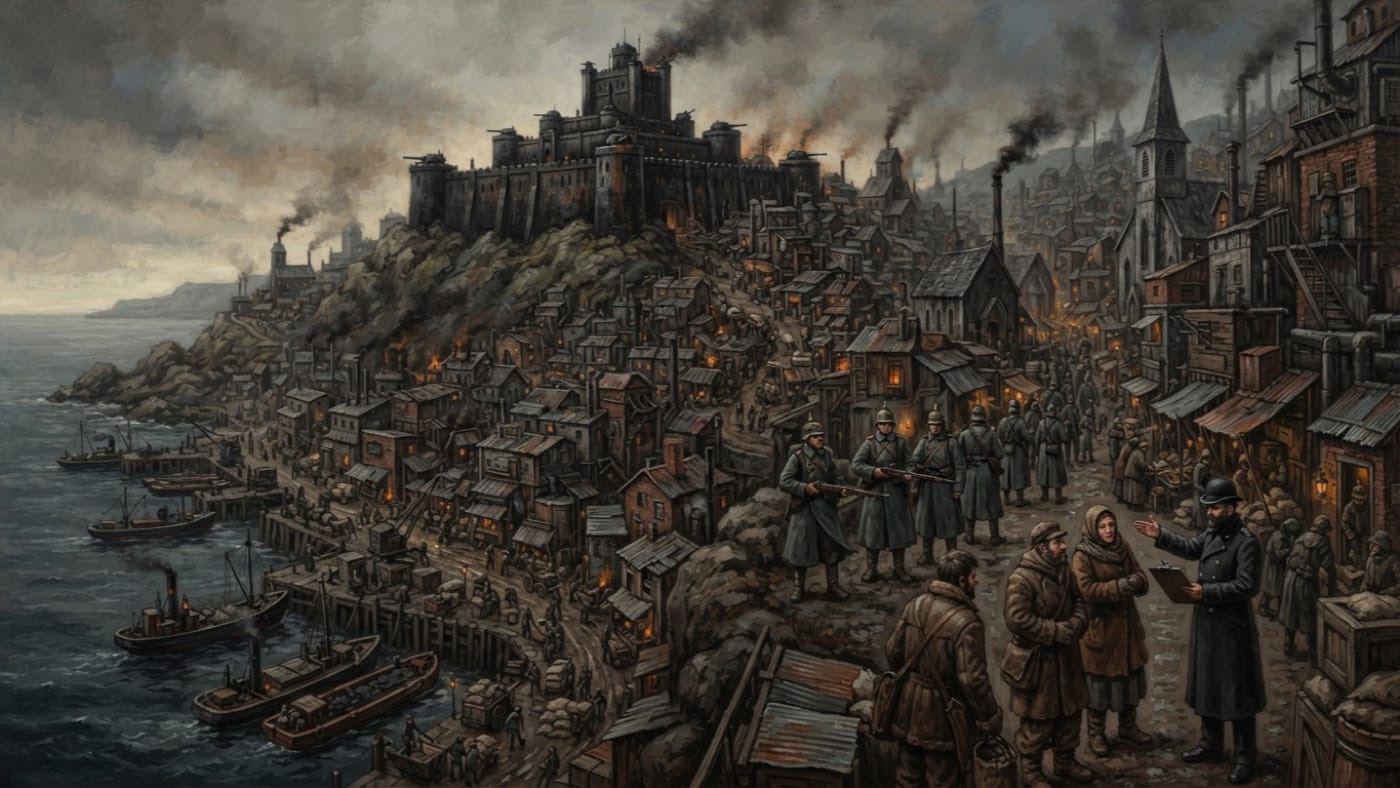
The sequence runs the same way in every file that records it. A fort is raised and a garrison is sent to hold it. Permanent soldiers need bread, boots, lamp-oil, nails, repairs to whatever they break, and somewhere to spend their pay when they get it. Rotating troops need all of the same in surges, and they arrive with fresh coin and no idea of local prices. Someone sells to them. Then someone sells to the sellers, because the man who bakes for the garrison also has to eat. His wife needs a midwife. The midwife needs a roof. The roof was put up by a carpenter who is still owed money and will not leave until he is paid.
Over recent decades, on that coast, the civilian settlement has repeatedly outgrown the installation that drew it there. The fort is still the reason the town exists, but it is no longer the bulk of it.
The Bureau of Settlement's published account gives a comparison: a fort built for a garrison of two hundred that acquires a village of twelve thousand. Readers will want to treat these figures as a census. They are an illustration. They name no town and fix no ratio. They set no threshold at which a village becomes a 3-A, and they should not be copied into any ledger as if someone had counted them. I keep them because they make the proportion visible: a stone keep the size of a parish church, and a town the size of a cathedral city pressed against its walls like penitents at an altar rail.
#On Those Who Supply It
Settlement's account names the inhabitants plainly. They are suppliers, brokers, tavern-keepers, unofficial clergy, and the sort of entrepreneur who does well wherever large numbers of young men with irregular pay live close to death. Each of them trades in a necessity. The supplier trades in flour and leather. The broker trades in the gap between the day a soldier is paid and the day he wants something. The tavern-keeper sells the hours between one bell and the next. The unofficial clergy sell the Creator's attention at rates the Church has never authorized, and I will not pretend their customers are wrong to buy it. A soldier who expects to die on Thursday does not wait for a licensed chaplain on Sunday.
Most of the labour in such a town is hauling. Sacks come off carts and out of ships' holds, crates go up to the fort, and empties come back down. Between those trips the town has to feed, house, clothe and bury itself, because the garrison's supply chain serves the garrison and nobody else. A market forms where the two needs meet. It is a real market, with weighing, haggling and debts, and it is worth taxing. That is where the trouble starts.
#On Three Claims to the Same Ground
The Bureau of Settlement classifies these communities as Administrative Settlements, Category 3-A. The classification records that they exist. It does not give them the permits, the infrastructure or the attention a proper township would receive. A 3-A is a place the Synod has agreed to see and declined to furnish.
Then there is jurisdiction. The garrison belongs to the Bureau of War. War built the fort and mans it, and it treats everything within cannon-shot as a matter of military discretion. The market belongs to the Bureau of Tithes, which treats anything that changes hands as revenue and anything that changes hands without a receipt as a grievance. The permanent population falls, in theory, under the Bureau of Settlement's mandate to assign zones. Of the three, Settlement is the only one that wants the people as people: with addresses, permits and households, each with a line in the Great Ledger of Souls.
Three claims do not make a constitution. No instrument divides the ground among them. Each claim lies over the others like successive seals pressed into a single fold of wax, and none can be lifted without cracking the rest.
Settlement's problem is that its claim has the least behind it in arms and in money. It has no soldiers and no revenue. Its Assignors can assign an address and revoke a permit, but they cannot make anyone move without calling on War. When a Settlement officer stands in War's garrison town with a clipboard, War handles the paperwork at its own pace. To assert authority over a 3-A, Settlement would have to argue with one Bureau that thinks itself supreme there and another that thinks itself indispensable. Settlement is not equipped for that argument. It knows this, and so do the other two.
#On the Places the Inspectors Miss
On the eastern stretches of the coast the files thin out. Settlement's account states that inspectors of the Bureau of Records do not reliably reach these communities. It also states that some of the trading vessels docking at their wharves appear in no harbour master's log, the log at Coastal Station Theron included. To its shame, Records does not dispute the first statement. As for what those vessels carry, the logs cannot say, because nobody ever told them. I will not call every unlogged hull a smuggler, or every unlisted cargo a gift from the Great Deceiver. Most of what moves unrecorded along a supply coast is grain, cloth and drink, sold by people who would rather not pay Tithes for the privilege. That is a fiscal sin. The Church has others to attend to first.
The Bureau's own margin supplies an example. It describes an unnamed settlement about twelve miles from Coastal Station Theron, reported to hold some eight hundred souls, a church, a market, and a working system of justice run by a retired sergeant. It sits on a stretch of coast that the Bureau's map, printed in A.S. 190, marks as rocky shoreline, uninhabitable. By the same account, the church was built in A.S. 184. I give the place as Settlement gives it, without a name. I do not offer its sergeant as the model of justice in a 3-A town. He is the model for one town only.
#On the Request Still Pending
Since A.S. 185 the Bureau of Settlement has filed eighteen reports on the coastal problem. By its own published account, each one was read, stamped, and sent back to the filing room with no action taken. That makes eighteen stamps. I have no quarrel with the stamps, which were correctly applied. The fault is in what a stamp has come to mean here: someone has seen the matter, and nobody is responsible for it.
The Bureau is headed by Sub-Archon Provisional Yvette Langres. Her title has carried the word Provisional since A.S. 194, while the Hierarchy decides whether her office deserves a full Archon or a merger into something it considers more theologically serious. Langres has a request pending for authority to act on these settlements. The files available to this survey do not show its form, its scope or its clauses, and I will not invent them to tidy the paragraph. It is a request, and it has not been granted. It annexes nothing and transfers nothing until someone above her says otherwise.
It sits in the pending tray beside her other petitions: one for thirty more field Assignors, still under budget review, one for census authority, and one for access to the Ledger she is expected to keep accurate without being allowed to read it. Those petitions show how far her office can currently reach. None of them is a claim on any garrison town. They do explain why eighteen reports went nowhere. A Bureau that has to borrow its constables, beg for clerks and petition to see the Ledger is in no position to take a market from Tithes, or a fort's surroundings from War, on the strength of a category.
The towns go on supplying the forts. The forts go on taking their supplies. The market goes on being taxed wherever Tithes can reach it, and the people go on being Settlement's in theory. The eighteen reports sit in Strasbourg in date order, and the nineteenth has not yet been written. Status: acknowledged. Responsibility: unassigned. Referred.