
#On the Columns Themselves
“Reflection is mercy after the mirror has learned to hate.” — Ephrath guide-placard, Zaragoza lower plaza.
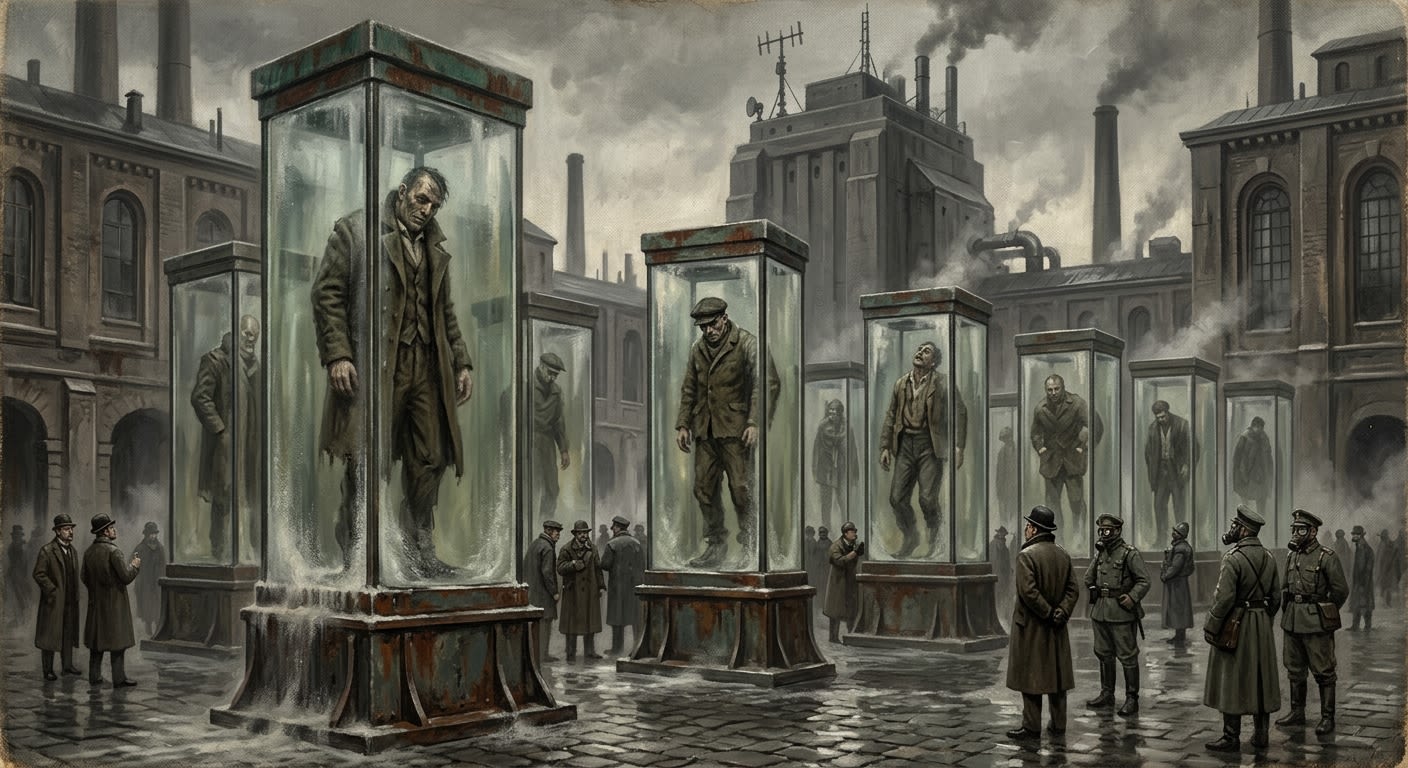
The Pillars of Glass at Zaragoza are the Bureau of Purity's proudest argument in favour of transparent cruelty. They stand in the southern punishment plaza, nine principal columns and twenty-seven lesser cylinders, each cast from thick translucent glass around an upright condemned body whose branded skin, stretched posture, and final expression are magnified into a civic lesson. Pilgrims call them frozen sermons. The Order of Saint Ephrath calls them speculum poenae, the punishment-mirror. The condemned call them nothing. Glass is excellent at ending debate.
The columns must be distinguished from the municipal Glass Skull Stacks found at bridgeheads and school routes. Those are cheap, replaceable, civic pylons: glass crania, inked names, lantern oil, fear by repetition. Zaragoza's Pillars are grand infrastructure. A Stack says, remember. A Pillar says, behold. This distinction matters in the same way the difference between a warning cough and a public autopsy matters. Both instruct. One sells guidebooks.
#On Their Raising
The first Pillars were raised in the Purity consolidation years after the Concordat of Strasbourg, when public punishment became less a reaction than a curriculum. Zaragoza had already acquired an appetite for spectacle, as Iberian cities do when heat, piety, and municipal vanity ferment in the same square. Purity supplied the budget. Ephrath supplied the theology. The glasswrights supplied silence, which is the safest professional offering when your client wishes to pour human beings into civic furniture.
The founding column held a Rationalist lecturer whose final crime, according to the plaque, was “instruction against the Creator's monopoly of meaning.” His skin was branded from throat to ankle with excerpts from the Index Damnatus, then sealed upright inside glass softened around a support frame. The first casting distorted him so brutally that the crowd believed it was looking at a demon. This was judged a failure. Demon-shape permits distance. A citizen who sees a monster thanks the Creator for difference. A citizen who sees a neighbour with the hands lengthened, the mouth almost apologetic, the eyes recognisable beneath distortion, performs a more useful kind of fear.
Second-generation optics corrected the error. The new columns made the condemned more human.
Early civic guides praised the Pillars as memorial architecture commemorating the defeat of unbelief in Iberia.
Corrected. Memorials honour the dead. The Pillars discipline the living. The dead are present only as structural material and instructional inconvenience.
#On the Optics of Shame
Glass is a theologian if heated sufficiently. It bends appearance while leaving the object trapped. It permits sight and denies touch. It announces preservation while practising imprisonment. Purity chose well, and I dislike praising Purity because it encourages them to write back.
Each principal Pillar stands between twenty and thirty feet high, set upon a black stone plinth with drainage grooves, guide rails, and a knee-height inscription band. The body within is not centred. It is offset by a fraction known only to Ephrath glassmasters, so that a viewer circling the column watches the face change: monstrous from the left, wounded from the front, almost innocent from the right. The lesson is carefully baited. First disgust. Then recognition. Then the small clerical click inside the soul when the witness understands that recognition is also accusation.
The lesser cylinders hold apostates, oath-breakers, unlicensed preachers, mercy vandals, and those whose crimes were too local for a principal column yet too attractive for ordinary disposal. Their labels are written in Purity's hard little hand: offence, date, clause, sentence, sponsor. Sponsor matters. A punishment without a sponsoring office is merely violence. With a sponsor, it becomes Doctrine's cousin and Tithes' opportunity.
#On the Prism Fire
The most famous failure occurred during the first generation of columns, before the correctional optics were recalculated. At High Summer, the noon sun entered three misaligned prisms and crossed the plaza in a single white blade. The blade touched the viewing awnings, the awnings caught, and the crowd fled through devotional smoke while the central Pillar magnified flame across the lecturer's preserved face until he appeared to be speaking fire.
The city remembers it as the Prism Fire. Ephrath records it as Premature Comprehension. Purity records it as a crowd-management incident. I record it as proof that geometry, when neglected, becomes satire.
ZARAGOZA FAILURE CATALOGUE — EXCERPT Prism Fire: casualties █████; column damage moderate; crowd response exceeded authorised devotional range; three guides laughed during evacuation; two later denied laughter; one continued laughing after questioning. Disposition sealed.
The failure improved the installation. Awnings were moved. Plaza angles were recut. The second-generation columns were given ribbed inner seams to break direct noon fire into softer bands. Ephrath sermons changed from “sin burns before God” to “sin reflects the witness,” a phrase less likely to ignite cloth and more likely to survive insurance review.
#On the Ash-Rain
In A.S. 143, the Ash-Rain of Zaragoza fell across the city after Synod guns destroyed a Velkara-aligned breeding compound in the Iberian approaches. For three days, ash tasting of salt and milk gathered on windowsills, fountains, saints, and the glass columns. The Pillars clouded from within. Three Ephrath brothers reported that the entombed faces turned away from the falling sky.
The Order filed a protest against the observation, then a second protest against any record of the first. The columns remained closed for nine days, officially for polishing. Unofficially, guides refused to stand beneath the principal row after Vespers because tapping sounded from one column whose occupant's hands were sealed visibly against his thighs. This was wind. The Bureau has certified a surprising number of inconvenient things as wind.
The ash left a pale residue on the lower plinths. It still gathers on damp mornings. Guides call it road powder. Local mothers do not let children touch it. The Bureau of Purity objects to this superstition while quietly replacing plinth cloths twice as often as it did before A.S. 143.
#On Pilgrims and Polishing
The public route begins at the west gate, where a guide from Ephrath recites the Rules of Proper Witness: no touching, no spitting, no sketching the faces without licence, no praying for the condemned by name, no laughter after the second bell, no fainting in the central aisle, and no asking whether the bodies are alive in any sense recognised by Mercy.
Pilgrims obey unevenly. Children press close until pulled back. Merchants calculate foot traffic. Old soldiers read the branding clauses. Young priests pretend not to stare at the mouths. The most devout weep, which Ephrath interprets as reflection and Purity interprets as susceptibility. Both offices mark the weepers when staffing permits.
Polishing is performed at dawn by assigned lay-brothers and condemned maintenance crews. The cloths are dampened with vinegar, chalk water, and a solvent whose ingredients are classified because it softens old devotional graffiti without damaging the glass. Lower plinths require daily scrubbing. Upper surfaces require rope cradles. Interior flaws cannot be reached, which is why Ephrath doctrine insists they are instructional rather than defects.
#On the Present Condition
As of A.S. 201, the Pillars remain open, polished, profitable, and spiritually hazardous in all the ways Purity approves. Second-generation glass continues to render sin handsomer than its subjects deserve. The cracked pillar preserved beneath the precinct remains restricted to Ephrath brothers of the third vow and above; the handprint inside it still matches no executioner, artisan, or condemned man recorded in the casting ledger. The Bureau of Records maintains that handprints are outside its standard anatomical filing categories. One admires the discipline required to be that useless.
The precinct has become Zaragoza's most reliable devotional economy. Wax sellers, licensed disgust pamphleteers, penitential snack vendors, guide-brothers, polishing crews, rope inspectors, confession kiosks, and Purity watchers all feed from the columns. A man can be condemned for error, sealed in glass, and support thirty honest households for a century. The Synod calls this redemption by civic utility.