
#On the Ground Between the Rivers
"Route: Cathedral of Saint-Jean to the Place des Terreaux via the Presqu'île." — Bureau of Festivals, Annual Schedule, Lyon Variant
People remember the start and the end of a route. They remember the altar they left and the square where they were finally allowed to stop. Nobody remembers the eleventh street. The Bureau of Festivals has built a long career on this failure of memory, and on the Presqu'île of Lyon it has made that failure part of the liturgy.
The Presqu'île is the long tongue of city ground between the Rhône and the Saône. The two rivers keep to their own banks along its length and meet below its southern reach. It is made of streets, quays, houses, shopfronts and the ordinary parish churches of a working city, with water on either side. Lyon lies in Zone 1, the western heartlands. It is a major city and a closely watched one. The peninsula is the part of it where the watching has least to do. A district bounded by two rivers has few back doors.
I will not supply a founding date. This ground is older than the Ledger, and it has been rebuilt more often than the Ledger has been rebound. I decline to pretend that some quay was laid in some year just so a clerk has something to underline. What the archive holds is a position. The Cathedral of Saint-Jean stands across the Saône on the western bank. The Place des Terreaux lies at the peninsula's northern end. Between them, in the schedule of the Procession of Tongues, the whole Presqu'île appears as one preposition: via.
A whole district, reduced to one word of Latin. I have seen worse fates. I have filed most of them.
#On the Assigned Passage
The Lyon variant is held every year on the Feast of Saint Sabina, the third Sunday of Septimus. Citizens assemble by parish. Every citizen aged fourteen to sixty within the Third, Fourth and Fifth Wards must take part. They recite the Creed aloud and in unison, and they walk. The schedule sets four hours as the minimum for the whole route. It does not say how those hours are divided between the cathedral, the peninsula and the square. Anyone who tells you the Presqu'île takes two of them is selling a map.
The schedule leaves a great deal out. It names no street, no quay, no crossing and no halt. It does not say how many times the column turns, or whether it ever doubles back. It does not map the Third, Fourth and Fifth Wards onto the peninsula. A Presqu'île household may therefore be marching in the column, or watching it pass, or both, depending on which side of a ward line it sleeps. Ward lines are a matter for the ward registers. I am not inclined to redraw them in a footnote.
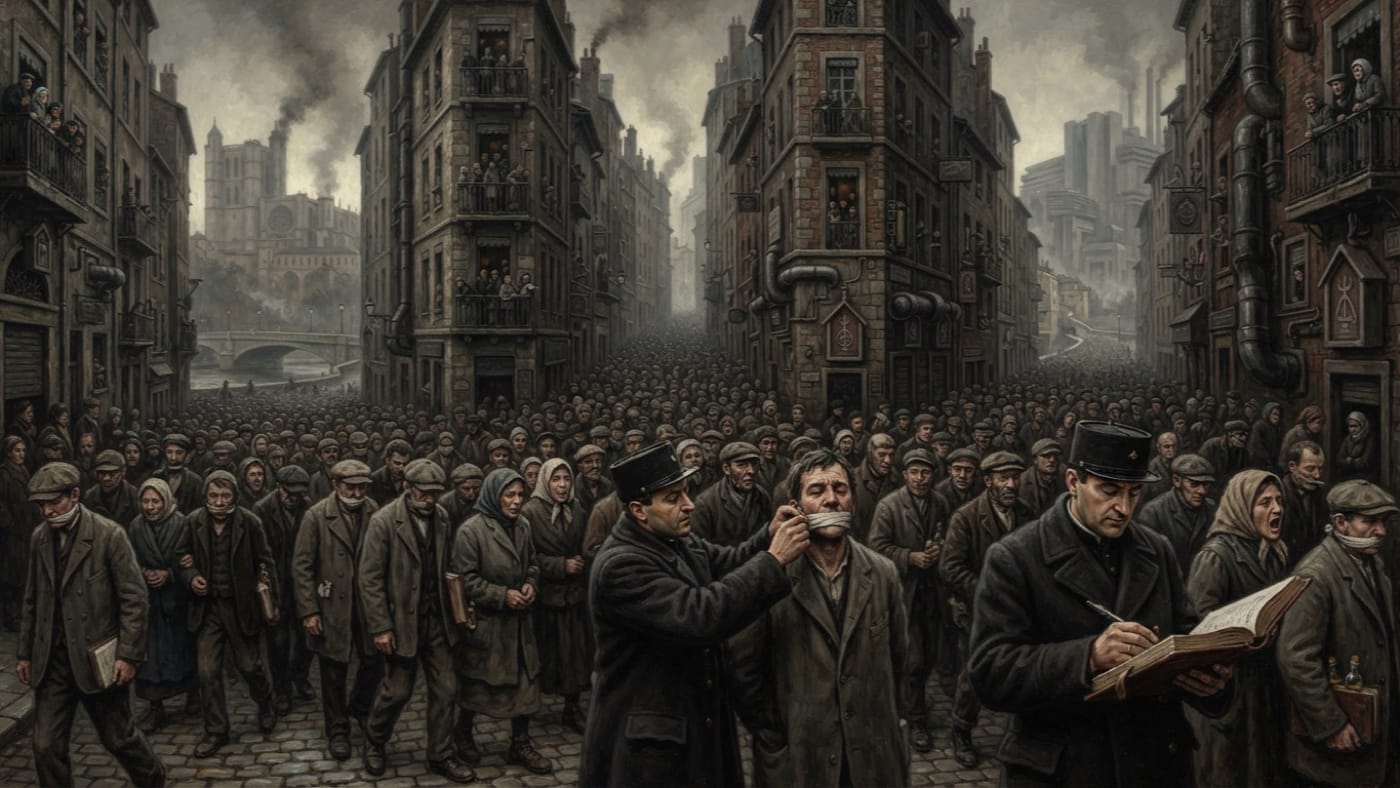
My reading of that silence is my own, and I sign it as such. A cathedral is a place where one expects to pray. A square is a place where one expects to be seen. The streets in between are where one buys bread, owes rent, sets out a stall and quarrels with the cooper about a barrel. On the third Sunday of Septimus the Creed goes down those streets on foot, in the mouths of the people who live on them. Festivals does not have to post a decree on every door. It sends the doctrine past the doors at walking pace, in chorus, for as long as the chorus holds out.
Strasbourg teaches with edicts and Prague with iron. Lyon is taught by the sound of its neighbours walking past its own front step.
#On the Voices in Transit
The column reaches the peninsula chanting. That is all the schedule requires of it, and all I will claim. The schedule does not record how many throats arrived sound at Saint-Jean, and I did not stand at the cathedral steps checking them.
Repetition does the rest. The Creed is recited, then recited again, then again, in the same words and the same order. Unison is a discipline of the lungs before it is a discipline of the soul, and lungs tire first. Voices crack. Throats bleed. Every voice gives out at its own point on the route, and the schedule does not mark any of those points on a corner of the Presqu'île. Neither will I. One person's voice fails within sight of the river. Another's holds all the way to Terreaux. The Bureau records which, not where.
When a voice falters, a Festivals clerk steps in. He carries a linen strip soaked in blessed oil, and he ties it across the faltering mouth. Then he opens his ledger and writes two words: vox defecit, "the voice failed." The entry takes less time than the knot. The participant then walks the rest of the route in silence. The route is not finished, and the route belongs to Festivals, not to the throat.
The clerk walks too. People forget this. The ledger crosses the peninsula with the column, open, inked, ready for the next entry. The ink travels down the same streets as the voices, at the same pace, and gives out no sooner than they do. In a sense the clerk's book is the only participant guaranteed to finish the route in full voice.
So the column moves through the Presqu'île in two kinds of voice. Some participants are still chanting, hoarse and raw. Some walk bound and silent, their mouths shining with oil at the edges of the linen. The schedule does not separate them, and the clerks do not reorder the ranks. A parish marches as a parish. The bound walk beside the hoarse, and the hoarse beside the bound. Each is an example to the other, and neither can do anything for the other.
The houses of the peninsula hear all of it.
#On the Counter-Seal
The authority of Festivals here is ceremonial, and it lasts one day a year. The Bureau holds the licence for the rite: the day, the route, the duration, the wards, and the linen for failed voices. It does not hold title to a single paving stone on the Presqu'île. It does not govern the district on the other Sundays of the year, and the schedule claims nothing of the kind. What Festivals controls is the passage. For one feast day it controls that passage completely.
There is one way out, and it runs through another Bureau.
The Bureau of Mercy holds the counter-seal. Without it, a citizen of the three wards walks the peninsula with everyone else. The timing clause is the masterpiece of the document. An exemption filed after the Procession is not refused. It is reclassified as retroactive cowardice, which turns a medical petition into a moral charge without changing a word of the petition. The schedule does not say what "processed accordingly" means. It doesn't need to. By the time anyone asks, the classification has already done its work.
In practice, the only way to get through the Presqu'île without chanting is to have foreseen, before the feast, the exact moment your throat would fail.
The Bureau of Purity regards all this as dilution. In Prague the full rite, conducted by the Order of Saint Ephrath, marches condemned heretics with their tongues nailed to tablets of doctrine. Lyon marches the faithful with nothing but their own voices and the clerk's linen. Prague punishes the tongue that lied. Lyon exercises the tongue that obeys. Purity calls the second a carnival. Festivals calls the first excessive. I file both opinions and grant neither.
The entry on the Procession of Tongues stated that the Bureau of Purity's formal adoption of the rite in A.S. 94 came "two years after the Bureaus were constituted."
Corrected: the Bureaus were not constituted in a single year. Their offices developed in stages before and after the formal constitution of the Synod in A.S. 90 / 1800 CE. The A.S. 94 adoption date stands, and it applies to Prague alone. No date for the first licensed Lyon variant is held in this archive, and none is supplied here.
#On the Present Condition
This survey is compiled from the published account of A.S. 201, and in that year the schedule is in force as printed. On the third Sunday of Septimus the parishes of the Third, Fourth and Fifth Wards assemble at Saint-Jean, cross onto the Presqu'île, and carry the Creed up to Terreaux for four hours or more. The clerks carry oil, linen and ledgers. Mercy keeps its counter-seal for those who applied in time.
On every other day the peninsula is streets again. Bread is sold, rent is owed and the cooper keeps his barrel. Nothing in the schedule changes that, and nothing in it needs to. A district that hears its own doctrine chanted at walking pace once a year learns the cadence on the other three hundred and sixty-four. The schedule takes no notice of it either way.
The route is fixed at both ends. In between, it runs through every street on the peninsula and names none of them.