

#On the Procession
"The range was never the trouble. We had the range. The trouble was the faces." — a saying of the forward trenches, recorded without attribution
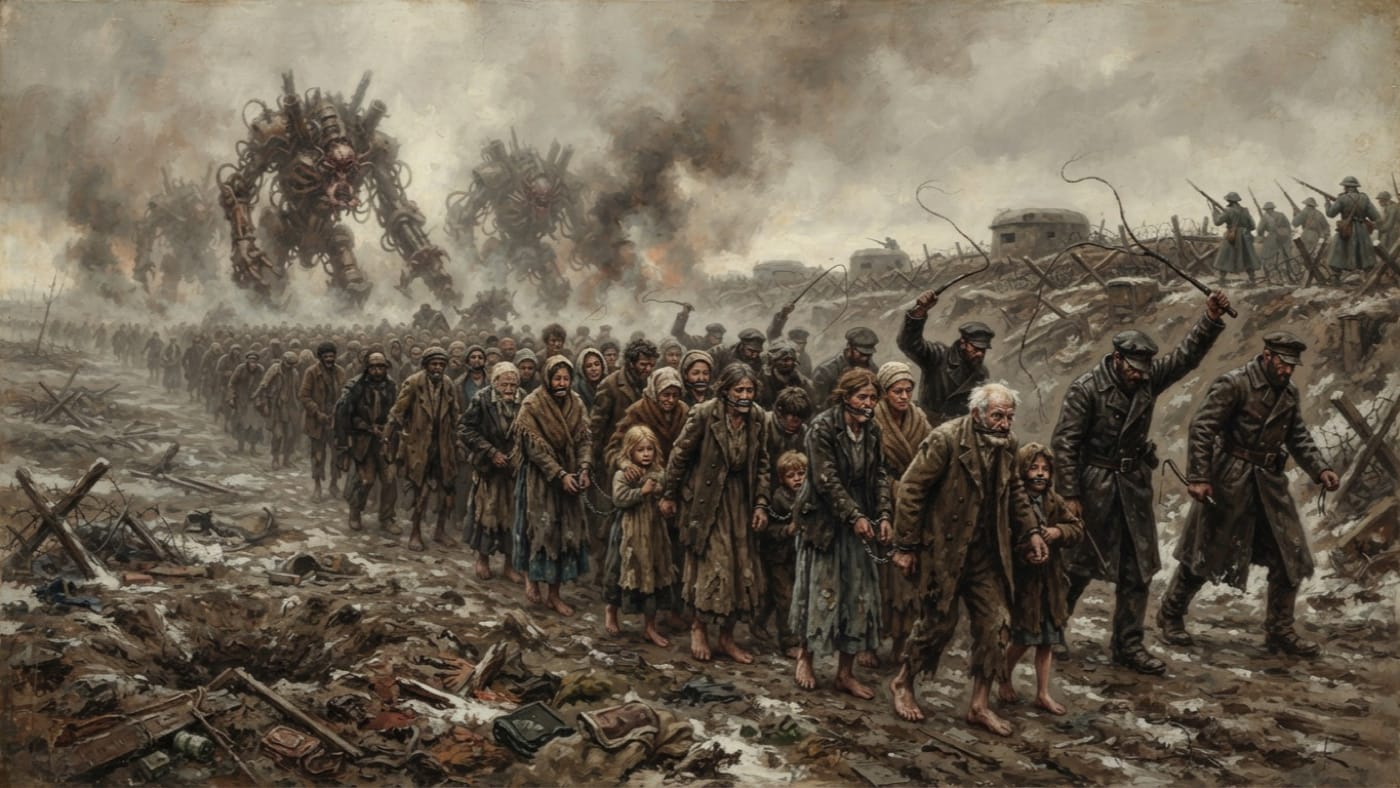
They come on at walking pace, because the old cannot run and the drivers will not carry the children. Women in house-shawls. Men still wearing the leather aprons of whatever trade they had in the week the Lie came for their street. A grandmother leaning on a girl of ten, and the girl leaning back, because the chain at their wrists gives them no room to walk apart. Some are barefoot and some are shod, depending on what they had on when they were taken. They are manacled at the wrist and linked along the line, and here and there an iron gag is locked across a mouth. Behind them walk men with whips. Behind the whips, in the smoke and the press, walk the things the procession exists to deliver.
These are the Processional Slaves of the Shadow Court, sixth of the seven categories in The Legions of Sin and the only one whose chief weapon is the defender's own eyesight.
At four hundred yards the rifleman sees a crowd and fires. At two hundred he can make out the pattern on a shawl. At eighty he knows whose shawl it is.
Everything else in this entry is commentary on those eighty yards.
#On the Living Screen
The Lie is thrifty with demonic flesh. Veil-breaches are costly and sorcery runs out. A Forge-Beast left dead in the wire is one more machine that Wrath's smiths must corrupt again from captured iron. The mortal host exists to spare those costs, and the procession is its cheapest form. A Thrall has to be branded. A Hollowed has to be emptied and packed. A Processional Slave needs a chain, a whip and a village within marching distance.
The screen works in two ways. The first is simple obstruction: shot that strikes a body in the front rank does not reach whatever walks in the fourth. The second is hesitation, and the Court relies on it far more than on the first. Our rifles falter. The Shield-Paladins, drilled to hold a wall against anything with claws, lower their blades before people who are, by every entry the Ledger keeps, our own: neighbours, kin, the chandler from the next parish, and now and then a defector recognised by name across the wire. The parent entry records what fills that pause. A Forge-Beast closes the distance while the line makes up its mind. A Forge-Beast does not walk behind every march, but the pause comes in all of them.
The procession must be kept apart from its neighbours in the taxonomy. A Thrall's self has been seared away. The Processional Slave's has not, and that is both the method and the horror of it. The woman in the front rank is cold, terrified, worn through and entirely herself. She can see the rifles. She may see her brother behind one of them. The Ash-Fodder conscript is handed a broken musket and told to charge. The captive is handed nothing, because she is useful only while she is unarmed, recognisable and alive.
#On the Voices
They chant. No one has shown that every procession chants the same text in the same tongue, and I will not invent a missal for the enemy. In some lines the listener hears hymns he learned as a child, sung with the intervals bent or the responses run backward, so that a man hears his parish Vespers coming at him out of order from a mouth he may know. Other lines repeat syllables that mean nothing, over and over, past any counting. The captives do not understand what they sing. The drivers only require that it be sung.
The harm lies in the repetition. One hymn sung wrong is an irritation. The same hymn sung wrong by four hundred voices for an hour, at walking pace, toward a trench that has not slept, works on the defenders like a mine dug under the wall.
Not every mouth sings. Some are shut behind iron, and the accounts give us both the gag and the chant without telling us how both can belong to one procession. I take the procession to be uneven, as every crowd of frightened people is.
The Pale Chanters belong in a different file. They are a formation, trained and deliberate, and they sing counter-hymns they understand perfectly well. The procession is a crowd ordered to make noise. Any clerk who merges the two in a field return will be invited to read both entries again, slowly and aloud, in my presence.
#On the Recorded Marches
Three accounts are filed under this heading. None of them carries a date. I have not supplied one.
The Cold March of Belgrade. At Belgrade, ruined and contested now as it has been for generations, thousands of captives were driven barefoot through snow, chanting until their lips froze. The account says the dead stayed upright, and that the frozen ranks became walls behind which Velkara's perfume brigades took shelter. It does not say how a corpse stands in snow, and I will not either. The Belgrade files hold other dates for other battles. None of them is this one.
The Slave-Screen at Prague. At Prague, in the Synod's Bohemian heartlands, a mass of Processional Slaves drove the faithful into retreat. Inquisitors then burned the whole mass, peasants and demons together, and called the act merciful incineration. I reproduce the phrase because it went into a report, and reports are how the Synod remembers. The mercy fell on people who had been walking toward our guns because a whip told them to. The report does not record whether any of them wanted it. Like the parent entry, I leave the report's classification unstated.
STAMPED ERRATUM — Hieromnemon's Correction, this entry The Lore Book files this Prague incident under the heading "The Prague Collapse." That name already belongs to the destruction of the university observatory in A.S. 61 / 1771 CE. The two are separate events. The shared name implies no common date, cause or sequence, and it is withdrawn from this entry. The slave-screen incident stays undated.
The Night of the Three Voices. The account gives no place, no date and no regiment. Three lines of captives each chanted a different corrupted hymn, and the three sounds overlapped until, the account says, whole regiments broke without a single demon striking. I note what the account does not claim. It does not say the sound took hold of anyone's will. The men ran. Three hymns, a long night and a trench of exhausted soldiers were enough.
Snow, fire and a choir. Three marches produced three different kinds of ruin, and the same captives made each one possible.
#On the Classification
The Bureau of War sorts the Lie's mortal host into lettered categories, Beta through Epsilon, and the parent entry is content to leave the procession somewhere inside that range. So am I. I have seen what clerks do with a letter once they have one.
The Bureau of Doctrine countersigned that order with a sentence I have now read more often than my own ordination oath: "The distinction is military, not theological. All who serve the Lie are equally damned." The heavy word in that sentence is serve. A woman chained at the neck serves the Lie the way a sandbag serves a parapet. Doctrine also holds, in teaching it issued itself and has never withdrawn, that chains are imprisonment and not possession, and that a soul in a manacle is still a soul that can turn back. Doctrine has not reconciled its two pronouncements. I decline to reconcile them on its behalf in an unsealed entry.
The Court has its willing adherents, and the Shadow Court entry describes their masks. The Court invites complicity, and some accept. The procession is the part of the Court's population that was never invited. To file them alongside the volunteers because they march in the same direction is accurate in the way a casualty return is accurate.
I am the finest prose stylist in the Synod's employ. I have spent this whole section failing to find a sentence that makes the Bureau's arithmetic decent, and I have not found one.
#On the Present Application
I am asked what the Line does about them. The Bureau of War has issued no instruction I may quote that makes the problem kinder. Fire early, and the faces are still small. Fire late, and the Forge-Beast is in the trench. Wait, and the hymn finishes its work on the riflemen. Every choice along the Sagittal Line costs something, and the Court has arranged the prices.
What remains certain is narrow. The captives are civilians. They are restrained, driven and coerced, and they remain themselves. The Court spends them because they cost little and because we know their names. The Synod has not yet found a way to stop knowing.