
#On the Word That Pretends to Be a Mercy
The Covenant is the Synod's most useful word because it sounds like consent and functions like custody. It means pact when preached from a pulpit, obligation when written in a ledger, deployment when stamped by War, ration when counted by Tithes, silence when held by Records, and death when the Line requires a body to remain standing after every natural reason for standing has fled.
The common catechism says the Covenant is the answered pact between the faithful and the Creator: prayer raised, protection returned; obedience given, salvation assured. The Bureau filing definition is less musical and far more honest. Covenant is enforceable belonging. It marks the soul as subject, the body as available, the loaf as conditional, the marriage as registered, the rifle as sanctified, the grave as useful.
No single office owns the word. That is its genius. Doctrine guards its theological shape. Records guards its names. Tithes guards its measurable obligations. War guards its armed expression. Purity guards its boundaries with the tenderness of a dog guarding a bone it has mistaken for scripture. Bells gives it hour and cadence. Orison gives it voice. Mercy gives it broth, when broth remains.
#On the First Pact After the Wound
Provincial stained glass insists the Covenant descended fully formed from Heaven. Stained glass is paid to flatter sunlight. The Covenant accreted after the Sundering from terrified parishes, broken principalities, cathedral guards, refugee routes, surviving bishops, starving towns, bell towers that still rang after their streets burned, and the simple human need to have fear given a shape large enough to kneel before.
By A.S. 65, as the first hard shape of the Sagittal Line became a chain of refusals, Covenant meant endurance. A village gave grain and sons, received a tower signal and a route marker, then called the exchange holy because holiness makes extortion bearable. By A.S. 90, after the Concordat of Strasbourg, Covenant meant integration into the Synod's apparatus. The oath became standard. The registers thickened. The rifle behind the sermon acquired a payroll.
Old devotional primers describe the Covenant as “the free union of faithful peoples beneath Heaven's shelter.”
Corrected for internal instruction. The faithful came freely where roads remained open, armies did not stand at the gate, and grain permits were not contingent on signature. Elsewhere, Providence used firmer handwriting.
This does not make the Covenant false. A lie that feeds a city for a winter is still food, though one should inspect the spoon. The Covenant held roads, sealed bridges, coordinated bells, regularised ration lines, made refugee columns legible, and gave frightened districts a grammar by which to survive. It also taught those districts that survival issued from Strasbourg and could be withdrawn with a stamp.
#On Belonging as Mechanism
Belonging inside the Covenant is never merely sentimental. Sentiment is what clerks permit on feast banners while the real work occurs below the ribbon.
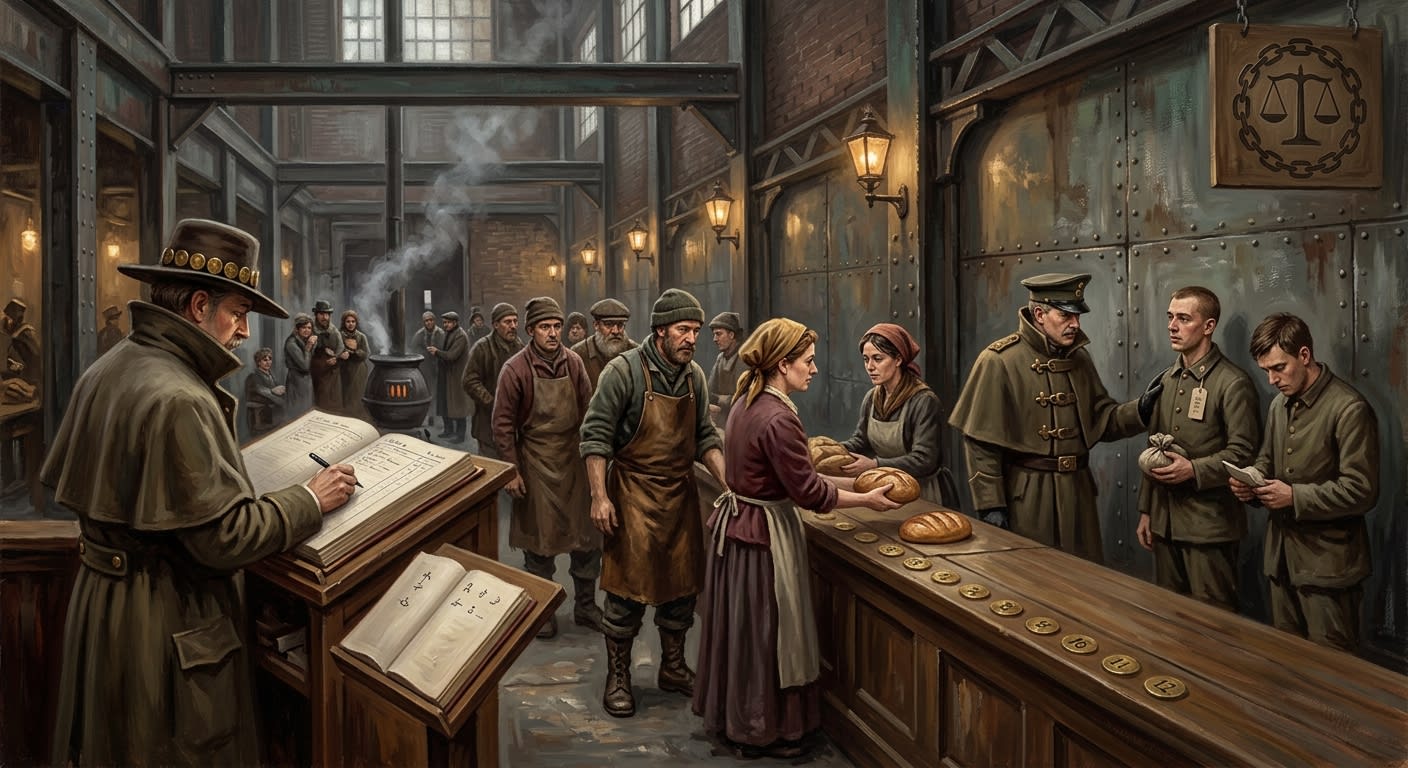
A child belongs through baptismal entry, school roll, ration class, lineage note, and the little catechism disk hung at the throat until the child learns to fear losing it. A marriage belongs through Oaths, witness marks, conjugation record, fertility expectation, shared tax adjustment, and the pleasant fiction that love has been improved by duplicate filing. A trade belongs through licence, tithe category, guild permission, tool registration, and annual correction. A soldier belongs through oath, number, confession interval, weapon mark, bell schedule, deployment route, and burial anticipation.
The Covenant is intimate before it is grand. It enters the mouth as bread stamped with a seal. It enters the ear as Ninth Bell. It enters the bed as marriage law. It enters the pocket as tithe coin. It enters the grave as ash allotment.
The subject calls this life because no other lawful word is available.
#On Bread, Queue, and the Covenant of Endurance
Food is the Covenant's simplest sacrament and its sharpest chain. The official documentation says bread is obedience made edible, and the phrase endures because even bad prose sometimes lands on a nail. A ration queue teaches more theology than a sermon. It teaches sequence, patience, visibility, dependence, gratitude, fear of losing place, hatred of the man who cuts ahead, suspicion of the woman with two chits, reverence for the clerk behind the scale.
Break the queue and you break the covenant of endurance. A starving man can still fire a rifle if he believes his turn will come. Remove the turn and he becomes a theologian with a brick.
Grain Keepers exist in the gap between the Covenant preached and the Covenant delivered. Officially, hoarding is heresy. Practically, hidden sacks keep districts from eating one another when the ledger's mercy arrives late, damp, short, or requisitioned by War. A Keeper falsifies spoilage, moves flour through chapel cellars, feeds children ahead of widowers, denies widowers ahead of soldiers, and calls the arithmetic survival because murder sounds untidy.
The Covenant depends on these condemned little accommodations. It denounces the Grain Keeper in public and benefits from him in winter. It praises honest ledgers and survives through doctored ones. It teaches that hunger disciplines the soul, then stations Covenant soldiers at grain depots because disciplined souls have been known to seize bakeries.
#On the Military Covenant
The armed expression of the word is the Covenant Military, the standing force that occupies the miserable space between war and administration. Its oath is clean enough to cut bread: I stand where ordered; I strike when sealed; I speak only in answer; I remain until relieved. The final clause contains the institution entire. Remaining is what the Covenant demands after courage has spent itself.
At the front, Covenant is a priesthood in arms. Rifles carry verses. Helmets take oil. Bell schedules move companies before fear develops a vocabulary. Radiant Fusiliers make volleys into testimony under banner-light; common Covenant detachments guard convoys, hold queues, shoot deserters, collect rifles from men whose courage has been severed by song, and inherit positions after the beautiful formations have passed through like icons.
BUREAU OF WAR — AUXILIARY HOLDING ABSTRACT Sector: withheld. Order: remain until relieved. Relief delayed: 31 hours. Survivors at final count: 9 of 64. Sergeant's last slate: “Does relieved mean by men or by the Creator?” Disposition: morale-sensitive; oath text unchanged.
The enemy understands the Covenant better than our flatterers do. Blood-Tithes take prisoners alive because living blood carries the residue the Covenant claims as sacred. Pale Chanters corrupt hymns because our orders travel in sanctified sound. Veil-Stalkers strike registrars and runners because names are ligaments. Kargath attacks grain. Atheron attacks posture. Syrion attacks the will to rise. Velkara attacks vows. The Sin-Generals assault more than territory. They assault the binding clauses.
Recruitment broadsheets say demons hate the Covenant because it is holy.
Corrected. They hate it because it works. Holiness is the authorised explanation for that inconvenience.
#On Records, Shadows, and the Courtesy of Being Counted
A Covenant without Records becomes enthusiasm, and enthusiasm is what precedes looting with hymns. Records makes the Covenant durable by making it recall itself. The name entered is the name owed. The household listed is the household taxable. The dead man filed is the dead man unavailable for levy, unless Records finds a later use for him.
The Indiction Shadows are the Covenant's grey correction when belonging begins to improvise. Older glossaries called them Covenant elite stealth cadres, which was useful nonsense. They are Records operatives carrying writs sharp enough to suspend a person from his own life. They enter granaries, parish rooms, refugee registries, tithe courts, and bastion ration offices when the Covenant's arithmetic smells of invention.
A Veil-Stalker hides by spending flesh. An Indiction Shadow hides behind procedure. The latter has a better survival rate and cleaner boots.
This too is Covenant: one belongs, and belonging can be corrected after the fact. A marriage may be invalidated because a sponsor vanished from a ledger. A ration class may be revised because a grandmother was reclassified as unburied. A soldier may be counted alive because his death report arrived after the levy table closed. The Covenant is merciful enough to include every soul and precise enough to misplace any one of them profitably.
#On False Covenants and Infernal Parody
Hell does not lack covenants. It has merely stripped them of the courtesy terms. Velmora binds cities with contracts inked in damnation. Kargath makes famine into loyalty. Shadow Court spends thralls like candle stubs, each body melted down until the light gutters. Maldrake forges obedience under hammer. Velkara purchases betrayal with the sigh before confession.
The Synod's distinction is simple and naturally correct: our Covenant binds upward toward the Creator; theirs binds downward toward appetite. The distinction should comfort the faithful. It also explains why the enemy's parodies sting. A Blood-Tithe installation is a tithe with the metaphor removed. Processional Slaves (Unregistered) are pilgrimage stripped of destination. Ash-Fodder Militias are levy without promise. The Shadow Court understands our machinery because vice is often piety with its vestments turned inside out.
This is why the Covenant must be guarded from softness. A vow unregistered becomes private appetite. A ration uncounted becomes patronage. A hymn unlicensed becomes a corridor for enemy cadence. A mercy unfiled becomes rebellion with a clean face. The Bureau is not cruel because it hates love, bread, song, and courage. The Bureau is cruel because those things are powerful, and power unsealed develops opinions.
#On the Present Holding
As of A.S. 201, the Covenant remains the Synod's master noun: civic bond, war oath, ration logic, marital chain, schoolroom breath, funeral destination, frontier claim, and excuse. It stretches from Strasbourg's black walls to the seven bastions, through Zones 1 to 5 in visible order, into Zone 6 as patrol, grave-marker, lost writ, and rumor. The British and Dutch stand outside its full machinery and pretend distance is innocence. The Fractured North obeys older bells and irritates us by surviving.
Inside the Covenant, a man is fed, named, tolled, taxed, preached at, armed, married, corrected, mourned, burned, and used. Outside it, he is free in the way an unregistered corpse is free: briefly, vulnerably, and without recognised appeal.
The Covenant's final truth is neither gentle nor apologetic. The Synod binds because unbound mankind was eaten. The Synod records because unrecorded sorrow vanished. The Synod commands because silence learned enemy accents. The Synod feeds because hunger sells quickly. The Synod arms because Hell does not respect petitions.