
#On the Procurator-General's Station
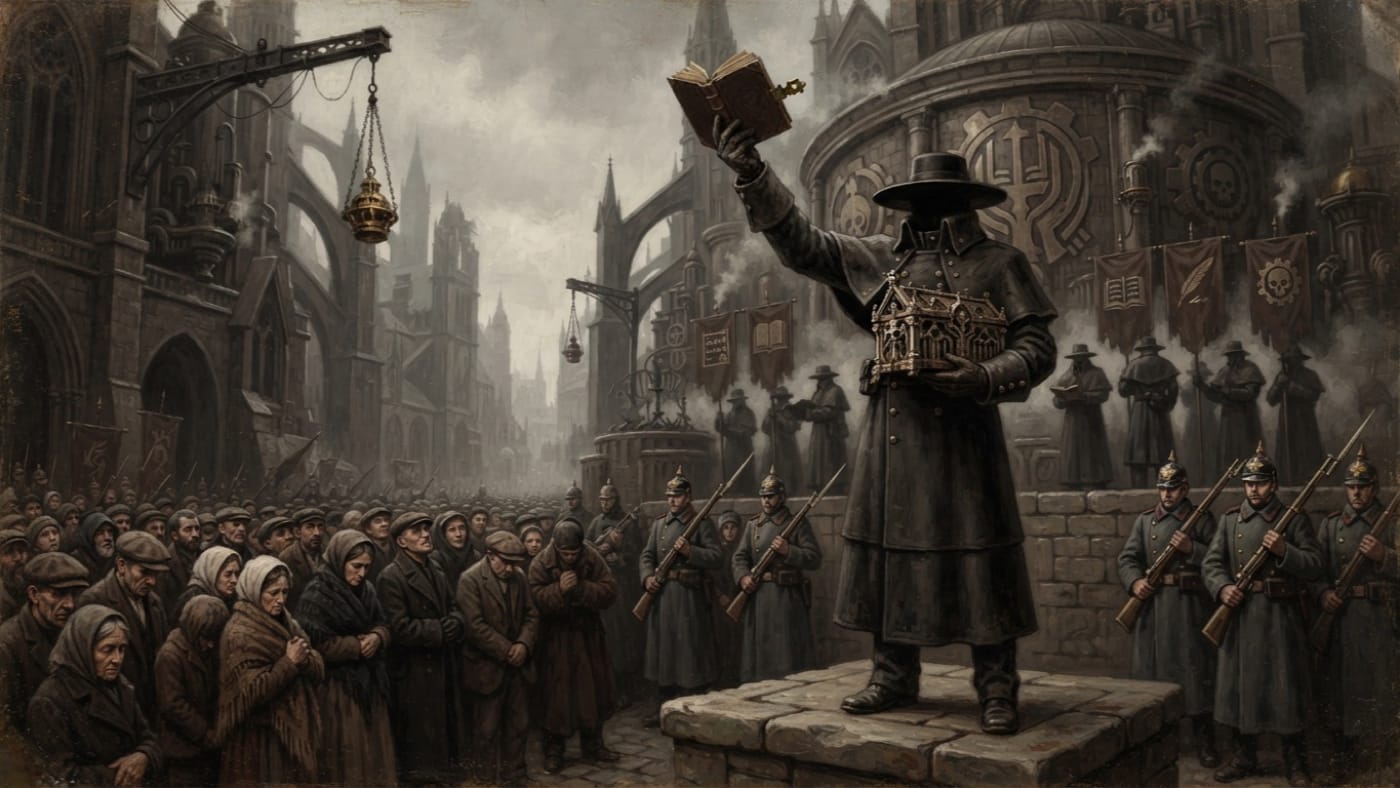
The faithful of Strasbourg know the Procurator-General by the hands. Few of them could name the incumbent, and fewer could say how the office is filled, by whom, or for how long. I could say a good deal more than any of them, and I shall say exactly as much as the public record attests, which is two acts. Once a year the Procurator-General carries the Reliquary of Saint Matthias through the streets of the city. Once a year the Procurator-General lifts the psalter of Saint Margaux of the First Blood from its case, opens it to the Sixty-Seventh Psalm, and holds it up before the faithful.
Two objects. Two motions of the arm. The title's public reputation rests on these, and the public, for once, has not overreached.
The Church in Strasbourg grows titles the way a damp vault grows bloom on its folios. The Bureaucratic Synod keeps Vicars who overrule Governors, Wardens who quarrel with Archons, and procurators of more than one kind, each guarding a prerogative the next has already claimed. Into that crowd the Procurator-General walks carrying something old. The cleverness of the arrangement is that nobody watching asks what the office commands. They watch what it holds.
#On the Procession That Continues
The Reliquary of Saint Matthias has walked a road before, and it was stopped. In A.S. 10 / 1720 CE, forty-three pilgrims carried it out of Dinan along the coast toward the Chapel of the Tide. At the Porte Saint-Vincent of Saint-Malo, Republican Guards holding a magistrate's writ called the halt and demanded the reliquary for cataloguing. Father Gaël of Dinan answered them in four words: It is not yours. Thirty-one of the forty-three were certified dead. The rest of that afternoon belongs to the Massacre at Saint-Malo, and I will not borrow its blood to fill this page.
The reliquary entered the Rational Magistrate's catalogue as Item 7: bone container, provenance unverified, and then his basement, where it sat for nine years until the faithful of Saint-Malo broke down the doors during the Retribution of the Tides. It now rests in the Basilica of the Ledgered Saints. Its Bureau of Relics custody stamp is later than the recovery, and the impression carries no year. I have examined the impression. It is a good impression. It is undated.
On the memorial day the Procurator-General takes the reliquary up and carries it through Strasbourg, and nobody stops it. That is the entire liturgical argument. The Bureau of Doctrine holds the procession to be a continuation of the one broken at the gate, and calls that continuation the Church's permanent answer to the bayonets: what was interrupted shall proceed. The office supplies the arms and the pace. Doctrine supplies the meaning. The cobbles supply themselves.
One distinction must be kept here, because the reliquary does not keep it. The pilgrims of A.S. 10 were walking to a chapel. They founded nothing; they were killed. The government that later took their road as its warrant did not yet exist. The Atheist Wars had to be fought, the Sundering had to fall in A.S. 45, interim councils had to sit and fail and sit again, and the Concordat of Strasbourg still lay eighty years beyond the gate. A.S. 201 stands one hundred and ninety-one years from the massacre. The procession does not say how many of those years have seen a Procurator-General walking, and it does not invite the question.
An inherited chronological table, still consulted in the reading rooms, enters the Thunderclap of Saint-Malo under A.S. 17.
The massacre is A.S. 10 / 1720 CE. The table's row is in error, and so is the same table's account of fusiliers firing volleys over the bay. The approved account is of an unarmed procession cut down at the gate. The memorial kept on 14 Corvus is a later liturgical assignment and does not fix the historical day or month.
#On the Book Presented
The second object is smaller, and nobody ever meant it to be looked at. Relic 23-M(Ratified) is a psalter bound in brown leather. It is unilluminated, its manufacture is unknown and its date unrecoverable: the sort of prayer-book a provincial stall sold for the price of a good loaf. Its brass clasp still works. The blood on it is kept under lacquer. It lives in the Bureau of Relics' secondary vault in Strasbourg, apart from the basilica that houses the reliquary. The two objects do not share a case, and nothing in the record places them on the same route or in the same hour.
Its owner was Sister Margaux of the Sisters of the Blessed Thorn, sixty-three years old. She joined the column at Dinan, knelt when the Guards came on, and died kneeling with the book in her hands. An early ecclesiastical tribunal at Strasbourg recognized her in A.S. 14 / 1724 CE on seven selected depositions and no authenticated miracle. The Bureau's ratification came later and was a separate act. The Bureau would like you to forget that, and I would like you to remember it.
Once a year the Procurator-General removes the psalter from its case, opens it to the Sixty-Seventh Psalm (Exsurgat Deus et dissipentur inimici eius), and holds it aloft before the faithful.
The hand must work through these motions in order. The case is opened. The book is lifted. The clasp is worked, a small brass catch that gives under the thumb just as it once gave under hers. The leaves are turned to the appointed psalm. Only then does the arm rise.
The people below are not acting. I have stood among them. Widows weep at the sight of a cheap book raised in a large room, and their weeping is their own. The Bureau of Records declines to stamp any finding on whether the Creator attends the lifting, and I decline to forge one. Doctrine has approved the meaning: an old woman's ordinary prayer-book, outliving her, raised over the heads of a city that kneels to it.
#On Custody and Ceremony
Both objects pass through other keeping before and after they reach the Procurator-General's hands. The Bureau of Relics guards and authenticates them. Its vaults are where they sleep, and its writs are why anyone believes in them. The Bureau of Doctrine governs what they may mean, and it was Doctrine that pronounced Saint-Malo a revelation rather than a tragedy. The Bureau of Rites orders the liturgy around them. The Bureau of Records keeps the Thirty-One Names in the Folio of the First Fallen. The Procurator-General enters the record at the moment an object leaves that keeping and is shown.
Readers who love a chart will want to draw arrows from the office to all four Bureaus. They should put the pen down. The deacon who carries the processional cross does not thereby command the sacristy, and on the public evidence the hand that lifts the psalter is not the hand that holds the vault. The record shows presence, and I report presence.
The word General has done damage among the lesser clergy. Strasbourg keeps Procurators of the Minor Orders, scribes and counters whose insignia is an abacus. It also keeps regional Procurators, appointed by the Concordat Hall to administer whole provinces with the authority of law and doctrine together. Neither description names the Procurator-General, ranks the office above them, or puts the abacus in its hand. Every clerk with a counting-frame on his collar has at some point pictured a Procurator-General at the top of his own ladder. No one has shown that the ladder reaches so high.
#On the Present Observance
In every parish of the Theocracy, the fourteenth day of Corvus belongs to Saint-Malo, and to Saint Margaux with it. The faithful fast. The Thirty-One Names are read. The Antiphon Bell tolls thirty-one times, once for each pilgrim certified dead, and then the parish keeps forty-three seconds of silence. None of this is the Procurator-General's invention, and none of it waits for the office. A hill parish that has never seen the title-holder's face keeps the tolls and the silence exactly as the capital does, and it is fined if it does not.
In Strasbourg the day gains its hands. The reliquary goes out into the streets and is not stopped. Once a year, on the day appointed for it, the psalter comes out of its case and goes up, its clasp hanging open and its page turned to the psalm a dying woman could no longer read. The faces lift. The dead of Saint-Malo never finished their road, so the city finishes it for them at walking pace, and the living are given a book to look at, and they look.
I have filed the matter under Obedience, sub-heading Grief, and cross-referenced it the other way round for the convenience of the Bureau of Records, which will lose one copy regardless.