
#On the Chapel That Received the Dead by Refusal
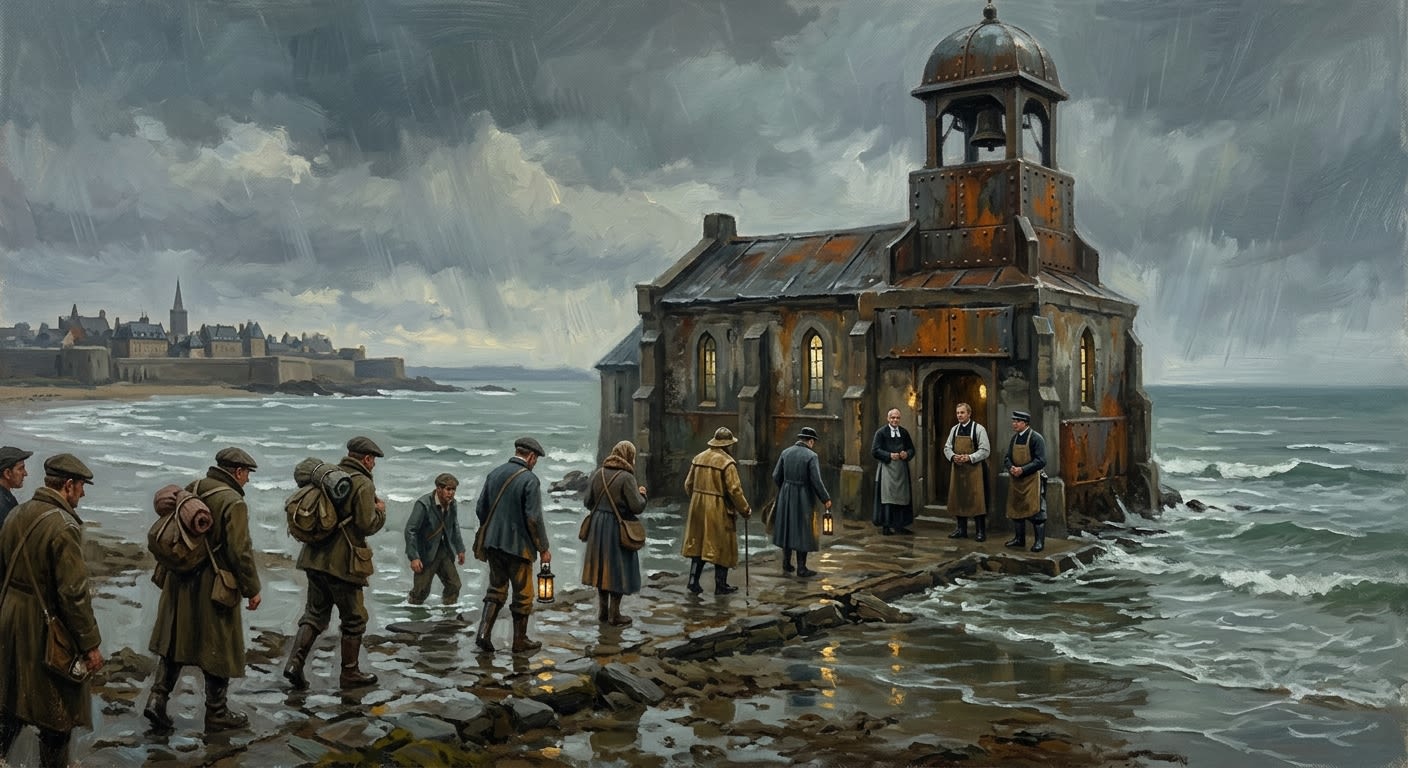
The Chapel of the Tide stands beyond Saint-Malo, on the Breton road where salt marsh, thorn hedge, old pilgrim stone, and sea wind conspire to make every boot confess. It was the destination of the forty-three pilgrims who walked from Dinan in A.S. 10 bearing the Reliquary of Saint Matthias, the banner of Saint Hermas, the psalter of Sister Margaux, the bandage cloth of Sabina of Ghent, and the catastrophic confidence that a road used for three hundred years still belonged to the Creator.
They did not reach it.
That failure is the chapel's true architecture. Stones are incidental. Roof, altar, tide-step, shell wall, west door, candle niche, reliquary rail: these are merely the surfaces on which absence performs its office. The chapel matters because forty-three pilgrims were denied arrival by Republican Guards at the Porte Saint-Vincent, and because the Bureau, being wise enough to milk grief before it curdles, made the place they failed to enter into the most obedient empty room in Brittany.
The public devotional line calls it the shrine of Saint Clement of Brittany, patron of interrupted journeys, failed arrivals, delayed petitions, sea roads, blue thread, and the class of misery produced when weather, war, law, or the Bureau of Pilgrimage prevents a soul from standing where it has paid to stand. The local fishermen call it the Tide Chapel. The route masters call it Endpoint Grey-Clement-43. The Bureau of Pilgrimage calls it a licensed terminal shrine. The Bureau of Tithes calls it productive. Tithes is vulgar, as usual, and near the bone.
It is a small chapel. This must be understood at once, lest some painter inflate it into a marble lie. Whitewashed stone, sea-facing west wall, low bell cote, timber roof with tarred seams, shells pressed into old mortar, a tide-step cut below the rear door, and a narrow altar whose cloth is changed according to sea height rather than season. The place smells of salt, wet wool, tallow, iron key, bruised kelp, candle smoke, and that old Breton poverty which can make an offering bowl look accusatory when empty and smug when full.
A grand shrine instructs the pilgrim upward. The Chapel of the Tide instructs him sideways: toward water, toward the road behind him, toward the gate where others fell, toward the vacancy between purpose and arrival. One approaches expecting consolation and finds an audit of distance.
#On the Older Clement Road
Before Saint-Malo made it famous, the Chapel of the Tide belonged to a minor Breton coastal cult, stubborn, damp, underfunded, and spiritually durable in the way of poor things too useful to die. Clement was remembered as a shore-priest of the old abbey roads, confessor to fishermen, salt-cutters, widows, failed ferrymen, shell-gatherers, and men whose boats returned with fewer names than oars. He blessed nets, heard storm confessions, and kept a drowned-list in wax because parchment rotted beside the sea.
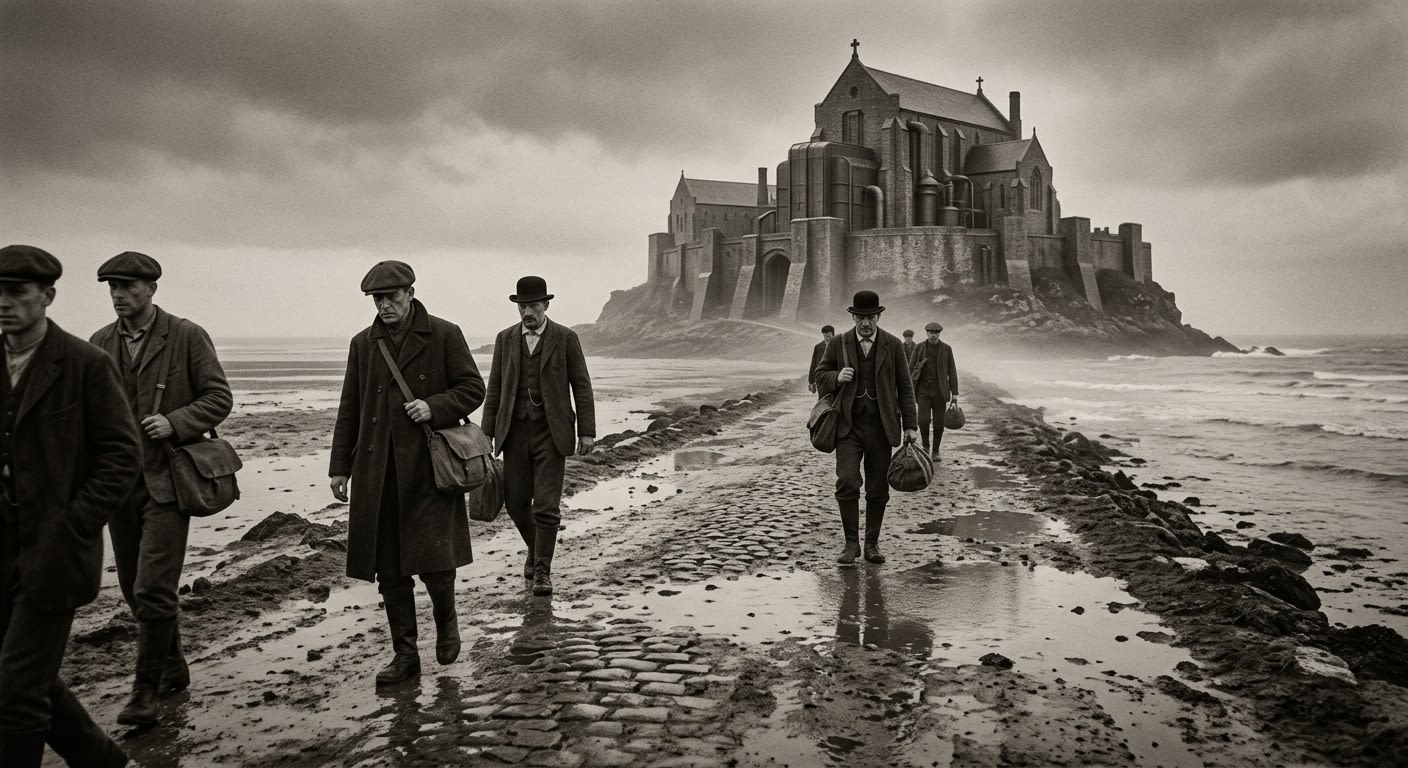
The chapel sat where the road from Dinan turned toward the marsh path and the sound of breakers grew louder than conversation. Pilgrims came with blue thread tied around wrists, chipped shells in pockets, and tin wave-discs stamped with crozier and fishbone. Mothers left knots for sons taking boats. Fishermen left hooks straightened by wreck. Widows left coins too small for pride. Children left stones with names scratched badly into them, which the old chapel clerk accepted because bad writing, like grief, remains valid when sincere.
The Rationalist inspectors who stripped Breton shrines in A.S. 5 treated the chapel as a provincial superstition-site of low military value and moderate civic nuisance. They catalogued shells, thread-racks, votive net weights, two cracked statues, three rusted crutches, a disputed tooth of Clement, one bell of uncertain alloy, and a tide ledger whose entries included names, water heights, and remarks on fish behaviour. The inspectors removed the bell clapper, sealed the reliquary niche, and left the tide ledger because its handwriting annoyed them.
That ledger survived. Naturally. The important things often survive because fools find them too ugly to steal.
Rationalist gazette notices described the Chapel of the Tide as “an abandoned maritime superstition-shed frequented by peasants and salt women.”
Corrected. It was active, poor, locally governed, and well attended by those whose lives depended on weather more than theory. “Peasants and salt women” is not a dismissal. It is a witness list.
The old rite was simple. A pilgrim arrived at low tide, touched the west wall, tied blue thread on the rack, placed one foot on the tide-step, and asked Clement to carry what the road could not. The answer, if answer came, was rarely spectacular. A boat returned. A fever broke. A petition reached its addressee after three lost months. A husband drowned in sight of shore rather than vanishing, which the widow classified as mercy and Doctrine, after review, allowed.
This was the chapel's first theology: arrival is a grace, and grace may consist only in knowing where the body lies.
#On the Procession That Made It Empty
The A.S. 10 procession did not set out to create a founding wound. It set out, like most devout disasters, to complete an annual office. Forty-three pilgrims left Dinan under grey cloaks, moving toward Saint-Malo, then beyond it, toward Clement's chapel by the marsh road. Father Gaël of Dinan led as prior and reliquary custodian. Hermas of Dinan and his brother bore the banner. Margaux walked slowly, carrying the common psalter that would become Relic 23-M(Ratified). Sabina carried bandages badly, which proved sufficient when the world became worse.
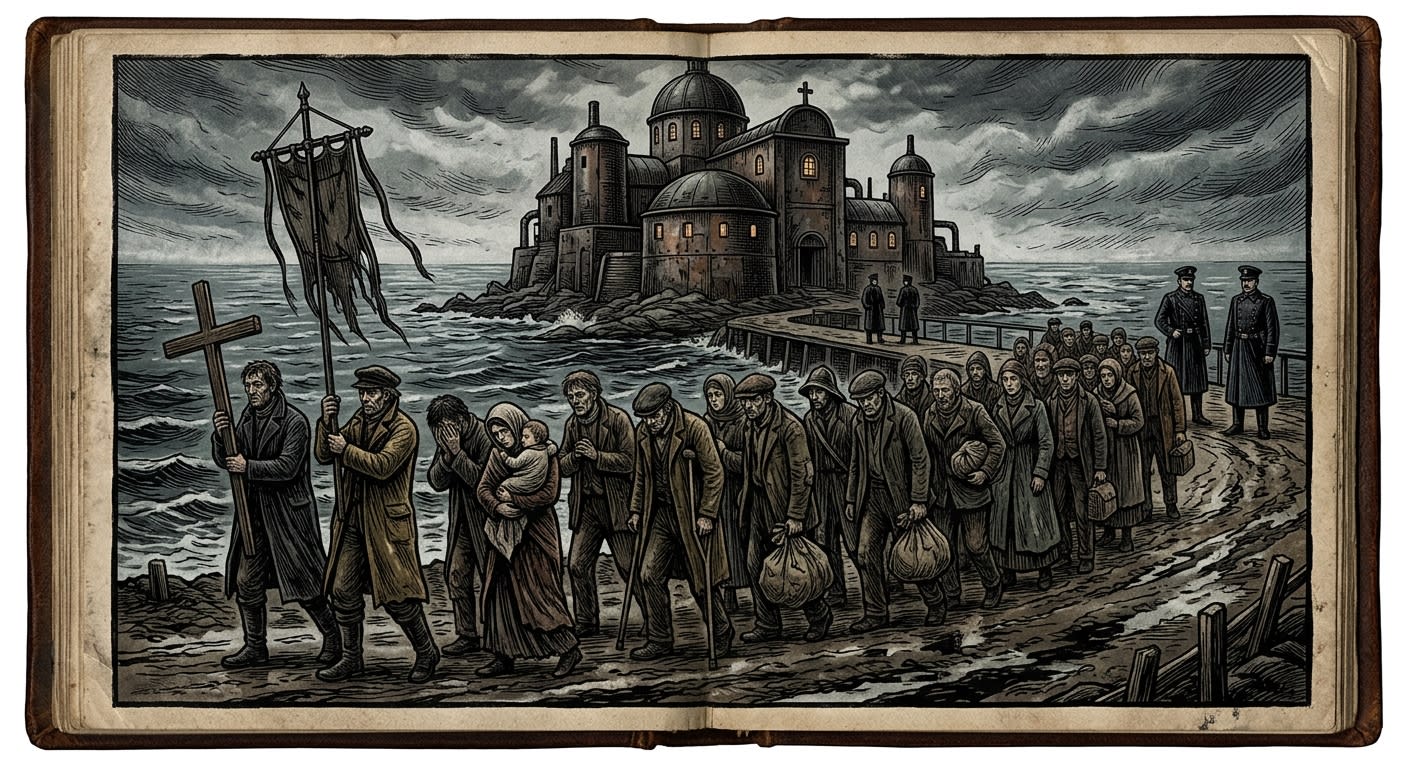
The column's destination matters. The Massacre at Saint-Malo was not merely slaughter at a gate. It was interrupted pilgrimage. The road had a terminus. The reliquary had an altar awaiting it. The banner had hooks prepared. Clement's chapel had been swept, poorly, by a boy named Loïc in the tide ledger and by two aunties in oral testimony, both of whom object to the word poorly with the solemn ferocity of the dead.
The Secular Gatherings Act turned the procession into arithmetic. More than seven persons in religious motion became public devotional assembly. A reliquary without civic inventory mark became seizable. Kneeling could become resistance if a magistrate needed the street cleared before supper. At the Porte Saint-Vincent the Republican Guard sergeant demanded dispersal, then surrender of the reliquary for cataloguing. Gaël answered with four words: “It is not yours.” The line advanced.
At the chapel, the tide came in.
This is not pious embroidery. Three independent later testimonies claim that the chapel floor was wet before anyone brought news from Saint-Malo. The tide-step overflowed on a moderate sea. Blue threads on the rack darkened as if dipped. The altar cloth showed forty-three small stains, each round, each salt-rimmed, though the door was locked and the boy Loïc, who had the key, was still on the road halfway to the gate when the bayonets fell. Records accepts the wet floor as plausible, rejects the stain count as devotional inflation, and files Loïc under Minor Witness, Key Custody, Annoyingly Consistent.
The pilgrims' bodies did not arrive. The reliquary did not arrive. The banner did not arrive whole. Margaux's psalter went into Corentin Madec's attic for fourteen years. Sabina lived three weeks. Hermas disappeared beneath cloth. Gaël entered red ink. The chapel received wetness, absence, and eventually a queue.
#On the Empty Arrival
The Empty Arrival is the chapel's principal rite and the Bureau's finest proof that absence, when regularised, can carry more bodies than any relic cart.
It is observed on the eve of the Saint-Malo office, after the road from Sainte-Claire-des-Landes has emptied its last licensed pilgrims toward the coast and before the fourteenth day of Corvus begins its tolls. Forty-three hooks are fixed behind the altar on a whitewashed board. Each hook receives one grey pilgrim token stamped with wave, crozier, and the number forty-three. No token bears a personal name. Names belong to the Martyrology. The chapel keeps the number.
At low tide, the route marshal unlocks the west door. Children from registered Dinan families carry the tokens in a shallow wooden tray. The oldest child hangs the first for Father Gaël, though his name is not spoken. The youngest hangs the last for the five consumed absences, though there are five and only one final hook, a compression that has produced commentary, complaint, and profit. The priest recites Clement's office for failed arrival. The congregation answers with the Antiphon of Safe Passage cut short before its final line.
Then the door is left open until the tide touches the step.
The silence lasts forty-three seconds at Saint-Malo. At the Chapel of the Tide, the silence lasts until the first water crosses the mark. In dry years this produces awkward waiting, coughing, and the shuffling misery of pilgrims who have paid for solemnity and received weather. In storm years the water comes like a tax collector, fast, cold, and with no interest in excuses. The tokens sway. The children cry. The route marshal pretends the schedule anticipated everything.
After the water touches the step, a shell is struck once against the altar stone. No bell. The bell's clapper, removed by Rationalist inspectors in A.S. 5 and later replaced, remains silent during Empty Arrival. Bells belong to Saint-Malo's tolls. The Chapel answers with shell, water, and open door.
Early postwar hymnals state that the forty-three pilgrims “arrived in spirit” at the Chapel of the Tide after death.
Corrected. Doctrine permits the phrase in poetry and forbids it in teaching. Arrival is precisely what was denied. To pretend completion is to blunt the wound, and the wound is the instrument by which the faithful are instructed.
The rite was yoked to the Saint-Malo office in A.S. 14, during the same fever of canonisation that elevated Margaux and made the Breton road blaze with prints, candles, authorized tears, and unauthorized commerce. By A.S. 38, six years after the Year Without Dawn, the five consumed absences were added to the closing antiphon. By A.S. 90, after the Concordat, interpretive authority passed to Strasbourg. The local custodians surrendered the rite voluntarily, in the strict sense that a man with a boot on his neck may voluntarily stop singing.
#On Stone, Salt, and the Tide-Step
The Chapel's body is older than its fame and poorer than its revenue. The west wall faces the marsh road, though the sea presses from the lower side, as if the building distrusts both approaches and has chosen to offend orientation itself. Its foundation stones are granite mixed with sea-boulders, patched in chalk-lime, tar, shell mortar, and the occasional improper brick supplied by donors whose names remain hidden beneath plaster because visible generosity encourages imitators.
The tide-step is the oldest feature. Three worn steps descend from the rear door toward a narrow gut of water that fills and empties with the tide. The lowest step is slick, green, and treated by pilgrims as a relic despite five posted warnings and one annual sermon on the difference between sanctity and algae. Mothers touch infants' heels to the second step. Fishermen press thumbprints to the side stone before sailing. Petitioners denied permits stand ankle-deep and ask Clement to hurry clerks, a devotion I find both impudent and theologically sound.
Inside, the chapel is narrow enough that processions must become files, which makes every pilgrim feel counted. The left wall holds shell niches for votives. The right wall holds the blue-thread rack, renewed after every Corvus because grieving hands pull harder than carpenters anticipate. The altar is plain stone, tidal-stained halfway up the base from the A.S. 112 surge that flooded the chapel during a clear night and left a line of fish scales on the Gospel book. Records classified the incident as storm residue. There was no storm. Records then classified the absence of storm as meteorological insufficiency and closed the file.
Above the altar hangs the Board of Hooks. Forty-three brass hooks, replaced in A.S. 92 under Pilgrimage standardisation, though local testimony insists the old iron hooks were better because they rusted like honest things. The brass shines too much. Pilgrims complain, then buy polished hook charms outside.
The sacristy contains the locked tide ledger, three official copies of the Empty Arrival office, seven unauthorized variants confiscated from local singers, a wooden tray for the grey tokens, a chest of blue thread, and a sealed niche said to contain the original clapper removed in A.S. 5. The Bureau has opened the niche twice. The first time, it found salt. The second time, more salt. A third inspection is scheduled whenever Courage becomes a budget category.
#On Custody, Revenue, and the Bureau's Wet Hands
Custody of the chapel is divided with the delicacy of wolves around a lamb. Pilgrimage owns the route schedule, tokens, queue order, foot-washing permissions, arrival certificates, marsh crossing bands, and licensed guide patter. Records owns the tide ledger copies, visitor rolls, witness extracts, hook counts, and disputes over whether a token fell because of wind, fraud, or saintly irritation. Doctrine owns interpretation. Tithes owns candles, charms, thread, shell certificates, and the correction fee assessed when pilgrims tie unauthorized colours to the rack.
The local Clement custodians own the keys. This enrages everyone.
The key office is hereditary in practice, elective in paperwork, devotional in sermons, and political at every meal. The present key-keeper, Maël Ruzic, is a narrow man with sea-bleached hair, a limp acquired from a pilgrim cart, and the Breton talent of answering direct questions as if they were weather. He opens the chapel at dawn, closes it at tide, refuses to let Tithes install a coin gate at the west door, and has thrice corrected Pilgrimage marshals for placing visitors inside the old flood line during spring water. He is, according to Concord's local report, “cooperative within traditional limits.” That means no.
Revenue is obscene. One may say this because obscenity underwrites half the liturgical calendar. Pilgrims buy blue thread, shell tokens, waxed road cards, tide-step water in sealed vials, Clement wave-discs, Margaux psalter scraps of no relation to the psalter, Hermas banner-ribbons of no relation to the banner, Sabina linen squares of no relation to her habit, and printed copies of Father Gaël's four words in red ink. The chapel itself sells less than the road leading to it; the road, being longer, offers more opportunities for sanctified purchase.
The Bureau defends the commerce as devotional infrastructure. Candles pay for roof tar. Tokens pay for marsh maintenance. Guide fees pay for safety ropes. Thread fees pay for thread inspections. Shell certificates pay for the office that certifies shells unworthy of certification unless certified. This is how the Synod improves upon miracle: by making grace itemisable.
The local poor endure the route economy with the sour patience of people whose grief has become someone else's seasonal employment. Some benefit. Some sell bread. Some guide pilgrims through marsh fog. Some rent dry socks. Some move tokens from unauthorized vendors to authorized stalls with a speed that suggests not theft but theological redistribution.
#On the Chapel's Small Miracles and Petty Cruelties
The Chapel of the Tide has never produced the sort of miracle Doctrine prefers: clean, witnessed by respectable persons, difficult to counterfeit, easy to paint. Its signs are small, damp, badly timed, and administratively hostile. Knots untie themselves before drownings. Blue thread bleeds white salt on letters that have not yet been opened. A petition delayed by the Bureau of Pilgrimage arrives folded inside a fisherman's net. The tide covers only thirty-one of forty-three hooks on certain Corvus eves, no matter how high the sea has risen outside.
The Bureau calls these local devotions, atmospheric effects, salt action, clerical exaggeration, or Breton lying. The Bureau also maintains three cabinets of testimony at the Chapel office, sealed in wax and revisited whenever route attendance declines. Prudence wears many cassocks.
One sign has official standing: the Wet Footprint Register. On certain mornings after Empty Arrival, the chapel floor bears prints from the west door to the altar. They vary in size. Some are bare. Some are booted. Some are too small. Some face the wrong direction. The prints dry by Prime. Records requires plaster dust, paper overlay, and two witnesses before recognition. Local custodians require silence and a mop afterward.
WET FOOTPRINT REGISTER — CORVUS EVE, A.S. 189 Prints counted: forty-two. Token hooks disturbed: one, final position. Door status: locked; key under Maël Ruzic's predecessor's pillow. Additional observation: one print contained black sand not native to Brittany. Disposition: sample transferred to Strasbourg; courier arrived with empty vial and saltwater in both boots.
Petty cruelty gathers where pilgrims gather. The Chapel has seen mothers pushing sick children toward the tide-step until the children screamed. Husbands dragging widows to hang tokens for men the widows were relieved to lose. Clerks refusing entry to barefoot penitents lacking the correct route stamp. Rich visitors purchasing private tide-hours while local fishermen waited outside their own chapel. The Bureau condemns abuses annually in language broad enough to strike nothing alive.
Saints attract tenderness. Tenderness attracts management. Management attracts men with fee schedules. Then one morning a fisherman finds the donation box pried open, leaves a sardine in it, and the whole doctrine of sacred order must pause to smell its own consequences.
#On the Present Chapel
As of A.S. 201, the Chapel of the Tide remains active, licensed, damp, profitable, and insufficiently obedient to the offices that profit from it. The Empty Arrival draws crowds beyond the old marsh road's capacity. Pilgrimage has proposed a second approach path. Local custodians object that two roads would make one arrival too many. Tithes supports the second path. Doctrine has requested language that preserves singular absence while permitting doubled foot traffic. Records has asked whether doubled foot traffic requires doubled non-arrival certification. The question is vile, precise, and very Records.
The chapel roof was retarred in A.S. 198 after a winter leak over the Board of Hooks caused three tokens to fall during a private donor office. The donor demanded refund, omen reading, and apology. He received a certificate of devotional participation under adverse conditions. I admire Pilgrimage when it is shameless enough to become art.
The tide-step grows slicker each year. The blue-thread rack splinters every Corvus. The shell niches are full. Maël Ruzic refuses a new brass rail. Children still cry when hanging tokens. The clapper niche sweats salt. On low mornings, when tourist stalls have not yet opened and the road smells only of marsh rather than commerce, the chapel becomes briefly what it was before the Bureau learned to count it: a poor room beside water, waiting for people whose arrival no one can guarantee.
The Chapel of the Tide teaches denial without closure. The pilgrims were stopped at Saint-Malo. Their destination remained. The reliquary went elsewhere. The psalter went to Strasbourg. The banner became cloth cult. Sabina's linen became Mercy's logo. Margaux became face. Gaël became sentence. Hermas became standard. Clement received an empty room and, through that emptiness, a continent's feet.
At dusk on Corvus eve, the west door opens. The children enter. The hooks receive their grey tokens. Outside, the tide gathers itself with the patience of a clerk who has never misplaced a name. The priest cuts the antiphon short. The congregation waits. Water touches stone.
No bell rings.
The chapel has arrived.