

#On the Guild and the Arcade
"Returning people to usefulness." The public profession of the Prosthetics Guild of the Arcade, as entered in the Marrowgate survey.
The Prosthetics Guild of the Arcade is a trade guild of artificers, and all of its territory lies under one covered street in Marrowgate. Its limbs leave the city by the wagon roads alongside the bandages, the disinfectant salts and the bone-lime. Its authority stays under the roof.
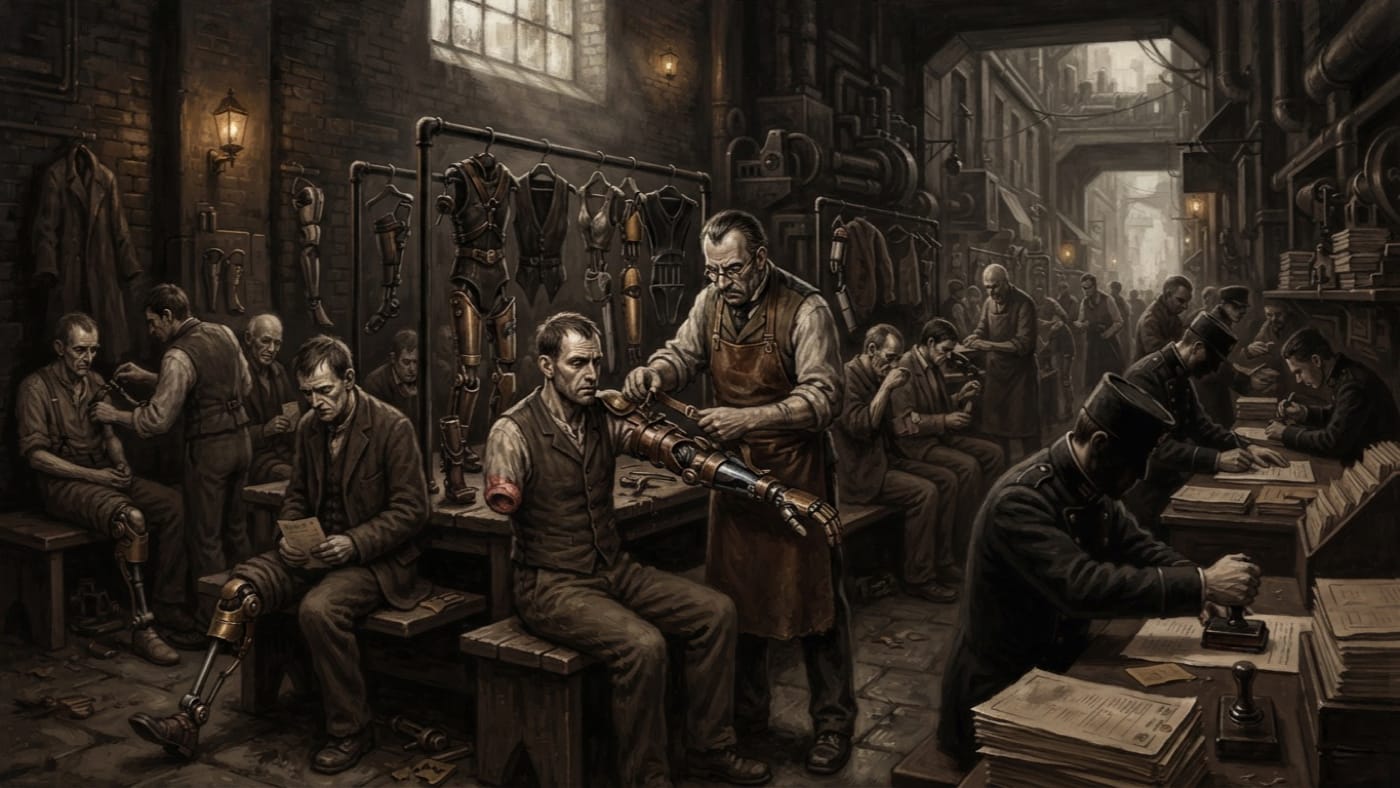
Four trades work there. The artificers shape the limbs. The strap-makers bind them to whatever the saw left. The glass-eye cutters sort their stock by colour in shallow trays, because a man with one brown eye wants a second that will not alarm his creditors. The brace-fitters keep half-spent legs working for another season. The air tastes of leather oil and metal filings. Articulated arms hang in graded sizes on racks above the benches, like vestments laid out for a procession of the mutilated.
The guild's resources are its workshops, its straps, its metal stock and its glass eyes. Its head is Guildmaster Joryn, whom the survey describes as charming and without charity. His dossier is filed separately. Here I observe only that a guild of this kind needs a charming master the way a confessional needs a screen.
I count the motto among the few honest ones in the city. The arms work. A man who comes to the Arcade unable to lift a stretcher can leave able to lift one, and in Marrowgate that is what separates the carrier from the carried. The Creator made the body once. The guild undertakes to keep it in service. That is a lesser office, and it pays better.
I have nothing on the guild's origins worth sealing. The city was laid out about A.S. 72, and the wounded needed arms from the first wagon on. No charter, founding roll or first master has reached my desk, and I will not invent one to make the binder look fuller.
#On the Fitting
Among the wounded of Marrowgate, the fear the city prefers to use is the fear of being unemployable. The survey says the guild's master controls mobility and employability, and that he works on the dread of being unfit for work without an approved limb. Approved is the word that matters. A crutch whittled in the Suture Slums will hold a man upright. It will not get him past a ward foreman, a gate clerk at the white lines or a tribunal reviewing his capacity, because none of them can read a crutch. They can all read a fitting card.
The guild does not amputate. That work belongs to the Sealhands of Notary Row under Chief Sealhand Orin. They take the limb with the saw and the man's former standing with the cut-stamp. By the time a patient reaches the Arcade he is already a revised entry. The guild receives him downstream, measures what is left and fits to it. The Sealhands make the stump legal, and the guild makes it useful again. Each office is careful to point out that it is not the other.
The fitting is the guild's most generous moment, and I record it with respect. The strapwright buckles the arm to the stump and the artificer sets the joint. The patient grips and lifts at the bench while the fitter watches the leather for galling. Strapwright Eda is named among the guild's artisans. In a city where a prosthetic that does not blister counts as wealth, a good strapwright does more for the Arcade's reputation than any sermon could.
Two papers go home with the arm. The first is the fitting card, which certifies a guild limb and therefore a guild customer. The second is the Prosthetic Maintenance Contract. I quote neither. Their wording is the guild's business, and the contract's substance is plain enough from what follows.
An approved limb from the Arcade is within the means of any discharged soldier.
Corrected. The fitting is within his means. The limb is a standing obligation, payable twice a year for as long as he has the use of it. The Bureau regrets the conflation, which was made in good faith and at the guild's own prices.
#On Maintenance and the Work Prescription
The arm needs adjusting every six months. Stumps shrink and swell, leather stretches, and joints work loose under the very labour the arm was bought to do. This is the coldest economy in the arrangement: the harder a man works, the sooner he needs the fitter.
The adjustment must be done by a guild-certified fitter. The fittings are proprietary, and only the guild grants certification. An uncertified hand can tighten a buckle as well as a certified one, but the limb it tightens is no longer approved, and an unapproved limb is a crutch with pretensions. The certified fitter adjusts the arm, takes payment and marks the card. The rite comes round twice a year for the rest of the customer's working life. In Marrowgate that is generally the rest of his life.
Take any customer. He is fitted, he works, and he pays at the first adjustment and at the second. Then comes a ration cut, a fever season, a reopened wound, or a cordon that keeps him from his shift for a month. He misses a payment. The missed payment becomes a debt, an oath-note in the city's word for medical arrears.
The guild holds the debt but does not try it. Marrowgate enforces medical debt with two instruments, and the Arcade owns neither. The first is the work prescription: compulsory labour assigned through the Civic Triage Tribunal and called rehabilitation. The second is what the city calls identity throttling, under which no service is given until the debt is settled. The throttled man keeps his arm and cannot have it adjusted. The prescribed man keeps his arm and uses it on the Tribunal's schedule.
That schedule sends him back to the wards. He washes linen. He carries stretchers, often the same work done by the men who once carried him. Others go down to the Lime Yards on the night shifts of debt labour. The survey sets no single assignment and no fixed term, and I supply none. The Tribunal decides when the debt is finished, and its arithmetic has a talent for finding balances in settled files. All the while the arm still needs adjusting every six months, so the labour that pays off one debt wears out the limb that will generate the next.
The guild has one more instrument, the recall notice, by which fitted limbs can be called back to the Arcade. The survey lists it among the guild's methods and records no particular recall. A right to summon back the arm a man is wearing works perfectly well from a drawer.
#On the Powers Around the Arcade
What the guild wants from the city's two great powers is modest: that both keep casualties moving through its hands. The Sanitation Chapter under Prefect Salvius holds the cordons and the white lines, and so decides who can walk to the Arcade at all. The Tribunal holds the beds, the proceedings and the power to prescribe labour, and so decides whether an unpaid adjustment becomes a working man. The two quarrel over primacy every day. A total quarantine would empty the Arcade of custom. A Tribunal stripped of its prescriptions would make the guild's oath-notes worthless. What suits the guild is for the quarrel to go on, with both parties in office and the wagons queuing at the Quays.
I find no treaty among the three and record none. Appetites that fit together need no minutes.
The survey places the black market beneath the Arcade itself and through the Suture Slums. There the Stitchmarket trades in forged clearances, stolen anaesthetic and illegal surgery. Its position under the guild's floorboards proves proximity and nothing more. The survey alleges no partnership, rivalry or trade in uncertified adjustments. I note only that a cartel dealing in forged papers stands one staircase away from a guild whose whole power is a certificate.
A free-limb propaganda cell works inside the Arcade, under the guild's own roof. The survey names the trigger the guild has most cause to fear: a movement for free prosthetics gaining traction. A free limb would leave the artificer's skill untouched and abolish the contract. The survey records the cell and the threat, and no outcome for either.
#On the Present Application
A.S. 201. The Marrowgate survey reports that the guild's maintenance contracts are rising by two percent a quarter, and that is the whole of its reported scheming. The Chapter angles for permanent lockdown, the Tribunal for legal supremacy, and the Stitchmarket for a flood of forged clearances. The guild raises its rate and waits. Between one adjustment and the next the price goes up twice, and the arm does not improve in between. The survey gives no base tariff and no rule of accrual, and I give neither.
Marrowgate's seals have been under suspicion since the clean paper plague of A.S. 199, when health certificates in perfect order were found on dying men. The Marrowwind, whose classification has been pending review since A.S. 194, is said in the wards to correct ledgers overnight. No one has yet blamed it for a corrected fitting card. I do not intend to be the first.
Of all the city's papers, the fitting card holds up best under audit. Its bearer checks it at the elbow every working hour, and the guild checks it every six months, for a fee.
The Bureau of Doctrine has asked whether the Prosthetics Guild of the Arcade should be classed as a charitable foundation, a trade or a lien. I have recommended trade. Either of the other classifications would oblige it to explain itself.
Filed and sealed with the Bureau of Records.