
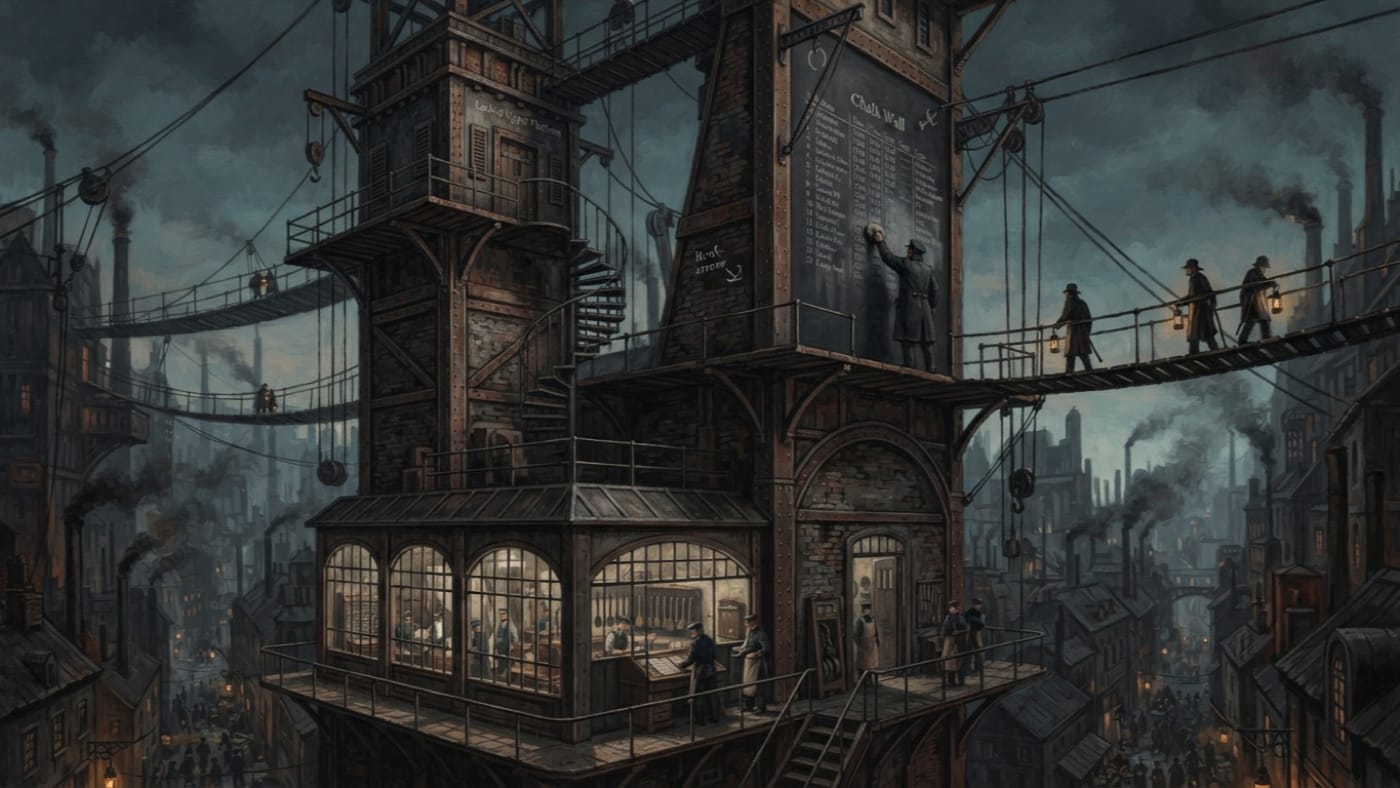
Current documentary survey — A.S. 201. The redacted inspection remains undated; this is not a newly dated visit.
#On the Inspection Post
Pulley Station Hark is a maintenance tower, and it deserves to be described as one before it is described as anything worse. It stands where the rope-roads arrive and depart. Its iron fittings carry an oil film that never quite dries, and its ground floor is given over to the honest business of keeping cordage from killing people. The Circle of Rope-Road Lanterns occupies it. On paper the Circle is merely the tenant of a bridge-inspection post. Paper says many such things.
The furniture of the ground floor is respectable. There is a maintenance ledger, ruled and initialled. There is a rack of authorised tools, each hook painted with the outline of the implement it holds, so that an absence shows at once, like an empty stall in a full choir. There is a pulley-key cabinet. And there are three notices advising every worker that tampering with sanctified cordage carries penalties spiritual, civil, and immediate. I have read all three. The third is the shortest and the most sincere.
None of it is decoration. The lines above carry bread, salt, coffins, post and wounded men, and with them the Brotherhood's opportunities. Whoever holds the pulley keys decides which span runs, which span halts for inspection, and how long a halt can be made to last. A tower that certifies a bridge safe can also certify it unsafe for an evening, and an evening is all a Circle requires.
#On the Locked Platform
Above the tool rack the stair narrows, and the upper platform is locked. The lock is in better repair than the bridge fittings. I record this the way an engineer records a crack.
Behind it the Circle keeps the instruments of its real vocation. There are shutter-lanterns, their hinges oiled until each shutter moves with one dry click. There are grapnels, spare line and rope knives, and sling-cord evidence bags hung in rows like vestments awaiting a feast. Published accounts call the platform the Circle's chapel, counting-house, threat-room and theatre loft. I see no reason to shorten the list.
Then there is the wall. It is chalked, and the dust lies along its foot like the sweepings of a scriptorium. On it the Circle records who crossed, when, with whom, and what they carried. Those four columns are the whole catechism of Hark. A crossing by itself means nothing, since a man may cross between wards for bread. A crossing at the wrong hour, beside the wrong companion, with a parcel heavier than its declaration, becomes a sentence awaiting its verb.
The pressure follows from the record. A merchant learns that his journey is known. A clerk learns that his companion is known. A priest learns that his parcel has been described, accurately, by men who never opened it. Nobody is accused. Everybody is invited to imagine the accusation that might be made, and to pay to keep it hypothetical.
The hook-arrow chalk mark, scratched at a span's anchor, means watch from above. At Hark nobody needs to draw it.
#On the Night's Traffic
Hark keeps its hours as strictly as any cloister, and its office begins at dusk.
At dusk the ropes are inspected. Hands run the length of each line, feeling for fray and slickness. The pulley keys are counted back into their cabinet, and the boot-irons are checked, because a Lanternman who rings on iron at night has announced himself to everyone he meant to surprise. This is noise discipline. It is also real maintenance, and the Circle's defenders never tire of saying so. The ropes are, in fairness, extremely well kept. A torturer keeps his tongs clean.
At curfew, when the Quiet Hours settle over the wards below, the bridge posts are manned. Patrols go out in pairs, each followed by a trailing Spark. The Spark never looks down. He watches behind him: the approach, the stair, and the man who has chosen tonight to settle a grievance with a Lanternman's back. The wider Brotherhood speaks of its Triangle of Witness. The high-walk arrangement belongs to this Circle alone, worked out for places where there is no neighbouring lane for a shadow patrol, only air.
Early night belongs to the sling-crates. Cargo on the lines is stopped and weighed by eye. Some of it is opened and resealed, and some is allowed to travel exactly as far as incrimination requires. Crossings go onto the record. Suspects are fixed by light angles: a shutter clicks open, the lantern throws a man's silhouette against a wall or a cargo net, and the folded paper in his coat appears as a hard rectangle on the plaster for any witness who cares to see it.
Late night is for meetings. The Circle's own phrase for its terms is "pay or your crossing becomes evidence," which has the virtue, rare in commerce, of a complete prospectus.
Before dawn the wall is wiped. The sponge leaves grey streaks. The information leaves by other routes: anonymous tips to the Wardens, rumours let loose in ration queues, private summons written with exquisite courtesy. The Circle of Nine Wicks at least keeps its incriminations in a drawer. By morning Hark holds no evidence at all, only memory and a reputation for using it.
#On Useful Accidents
Midnight on Hark's schedule is the accident window, and the Circle's charter names its two activities plainly: selective drops and selective rescues.
The rescues are easier to admire. A courier who slips on a wet plank and is caught by the collar owes the hand that caught him, and his satchel, searched in the confusion, owes it more. A crate of contraband released over a courtyard lands where Wardens will find it, and the Circle is credited with vigilance. The drops are the other column of the same ledger.
The surrounding spans serve the Circle as a schoolroom. Initiates learn the Drop Test, cutting a weighted pouch from a rope so that it lands in a marked circle below. The records do not say where the Circle holds the rite, and I will not put it on Hark's roof for the sake of a picture. Offenders receive the Rope Lesson, crossing a bridge on their knees under watching eyes, or Netting, a short suspension in a cargo net over a courtyard, which injures no one and persuades nearly everyone.
Intimidation and murder are separate trades. The Circle practises the first nightly, in public. If the charges against it are true, it practises the second on commission.
Rope-road falls during curfew are transport mishaps under adverse height conditions.
Corrected. Rope-road falls during curfew are recorded as transport mishaps. What they actually were remains under review.
#On the Sealed Inspection
Hark has been properly inspected at least once. The account survives undated, in a dossier I am permitted to quote and forbidden to complete.
PULLEY STATION HARK — UPPER PLATFORM INSPECTION, A.S. ███ Inspection team found chalk list of ███████████ names, including two Warden-Captains, one Shrine-Assessor, and a child registered dead in the previous quarter. Team leader ordered temporary sealing. By Matins the wall had been wiped. The team leader later fell from a stair with handrails on both sides.
The report does not say who wiped the wall, or who held the platform key between the sealing and Matins. It records no finding on the fall. It does not say whether the leader lived, and I will not say it on the report's behalf.
The child's entry is recorded and left unexplained. A clerk may register a death in error. A family may cross a bridge under a dead child's name for reasons of ration or escape. Someone who wanted a name to be seen may simply have chalked it there. The dossier chooses none of these, and neither do I.
What the report does establish is simple enough. Two Warden-Captains were on the wall, and Warden-Captains sign the writs that keep the Brotherhood tolerated.
#On Continued Toleration
Hark survives because the high walks must be watched and somebody must keep the ropes in repair. The Circle does both. The Bureau of Shadows values a tower that collects crossings without drawing a salary. The Bureau of Tithes values the interceptions and resents whatever leaks from them. The Bureau of Purity dislikes blackmail as a rival form of confession. The Bureau of Orison and Song, whose hymnals keep pulley crews in rhythm, would rather its cadences were not used to time a drop.
The Lanternmen of Hark hold no Bureau commission, no officer rank, and no power of arrest. Their titles are internal. Their toleration under the Synod is local, revocable and reviewed every quarter, and Standing Order 14-V caps every Circle at thirty licensed operatives. The figure is a ceiling rather than a census, and nobody has given me Hark's.
Routine blackmail endangers individuals, and it is wiped at dawn and rewritten at dusk. The Fall List is a different instrument: a hidden roster of people helped to fall on patrons' orders. The record does not say where it is kept, or by whom. Its existence is alleged, and it has never been exposed. If it ever were, the Wardens would have every reason to erase the Circle before anyone asked who had placed the orders.
So the ropes are inspected at dusk and the keys are counted, and the wall is chalked and wiped again.