
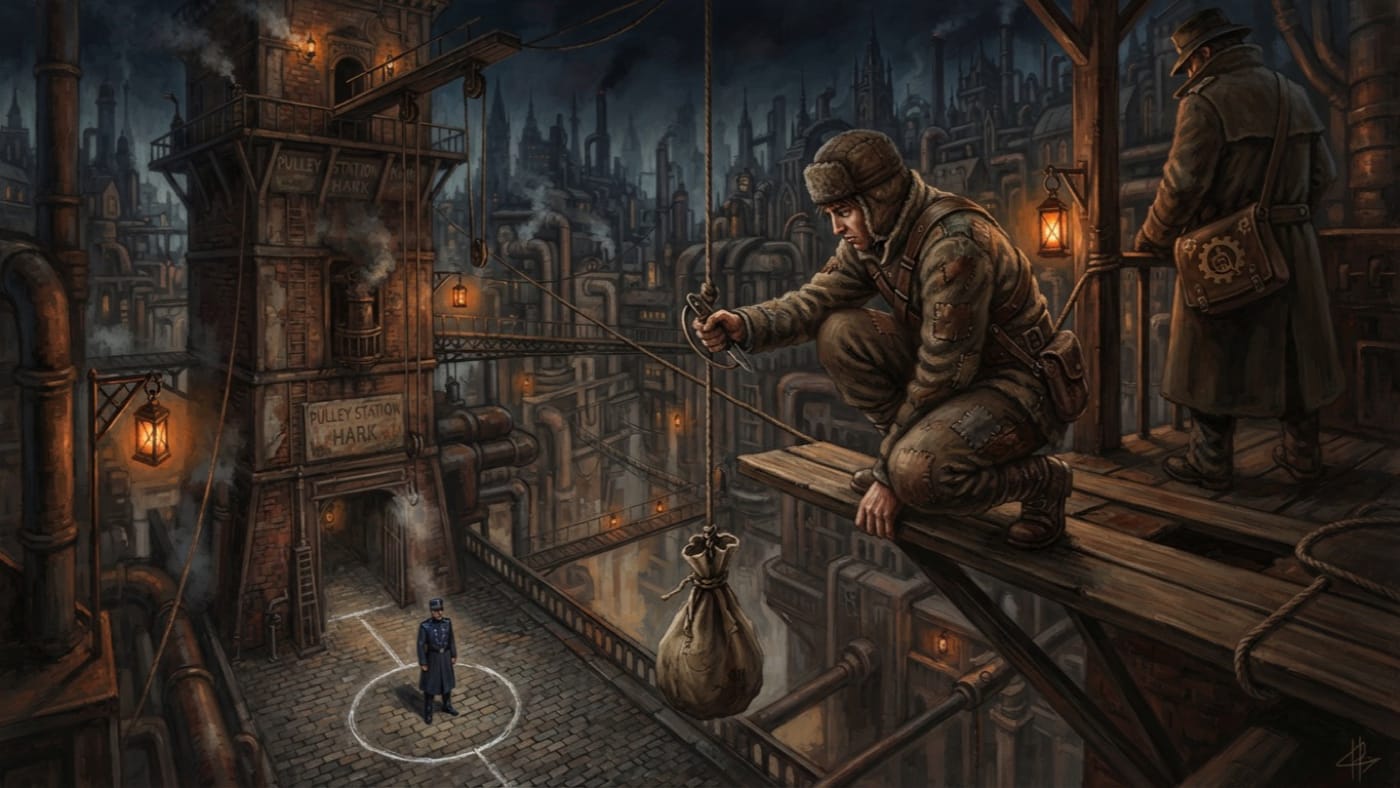
#On the Initiate's Hand
The Drop Test needs a rope, a weighted pouch, a marked circle on the ground below and a candidate holding a knife. The Circle of Rope-Road Lanterns uses it as its initiation variant within the Lantern Brotherhood. The pouch hangs and the candidate cuts it loose. Either it lands inside the circle, or the candidate is invited to try again.
That is the whole procedure as the charter records it. I have read longer liturgies with less in them.
The charter does not describe where everyone stands, and that is where the rite's real content lies. The candidate is above, on plank and cord, holding the blade. The circle is below, on ground that has no vote in the matter. The charter does not say whether the circle is chalked, painted or scratched, and I will not invent an answer. The cut takes an instant. Its consequence takes as long as the fall, and it arrives somewhere the cutter cannot reach, cannot recall and cannot apologise to without first climbing down a ladder. The Circle's whole profession depends on that difference in height. The rite simply makes the candidate stand in it on purpose.
#On the Weighted Pouch
The pouch is the most honest participant in the exercise. It has mass and no opinions. Once released, it does exactly what the Creator's ordinary arrangement of falling things requires, and it lands wherever the moment of release has already decided.
The candidate's whole difficulty is that moment. The charter demands a precise one, which tells the attentive reader that something about the arrangement is moving. A rope-road sways, carries and is hauled. A pouch hung from one does not wait politely over its target. How the rope is rigged, how far the drop is, how wide the circle is and what weather is allowed are not entered in any record I have been permitted to open. The Circle teaches the cut. It has never troubled to write down the geometry, possibly because geometry written down can be produced in evidence.
So the candidate watches the circle, the cord and the knife together, and has to act at the point where all three agree. A hand that hesitates cuts late. A hand that flinches cuts early. Before it can be trusted with the high walks, the hand has to learn to ignore the stomach, which has been shouting about the height since the first rung.
The Circle's own dossier records the remedy for a miss: the candidate repeats the exercise until hunger, terror or aptitude corrects the hand. The dossier sets no number of attempts, and I will not supply one. The Circle has never needed a number when it has the whole night.
The three correctives are less alike than they sound. Hunger makes the candidate want to be finished. Terror makes the candidate want to be anywhere else. Aptitude makes the other two irrelevant. The Circle is not sentimental and accepts whichever arrives first. What the candidate learns from each is the same. Fear has to be set aside on a shelf somewhere behind the eyes, so that the wrist can work while the rest of the body files its objections.
#On the High Walks
The skill is not ornamental. The rope-roads carry coffins next to ration crates, reliquaries next to salt barrels, and parcels whose papers flatter their contents. Crews haul in time to hymnals codified by the Bureau of Orison and Song, because timing on a rope-road is already a sacred matter, whether or not anyone admits it. The Circle's mandate is to control vertical movement and make accidents useful. Both halves of that mandate require someone who knows exactly when to let go.
A Lanternman on a span carries a rope knife and a pulley key. Between them, those two tools decide which sling-crate reaches the far post, which one stops halfway and which one comes down where the Wardens happen to be standing. Shutter-lanterns throw a suspect's silhouette against a wall or a cargo net. A chalk hook-arrow on a post tells the next patrol to watch from above. Where the Triangle of Witness governs the street Circles, the Rope-Road patrol walks as a pair followed by a Spark. The Spark has one office: watch behind and never look down.
The Drop Test trains the opposite discipline, and it does so on purpose. The candidate must look down. The Spark must not. Between those two postures the Circle holds the whole vertical city, with one set of eyes on the drop and another on the knife that might come up the ladder behind.
The Circle keeps its home at Pulley Station Hark, a maintenance tower with a locked upper platform. Officially it is a bridge-inspection post. The knives are stored there, and so is the chalk wall of crossings. The record does not say whether candidates cut their first pouch at Hark. A careful auditor draws no conclusion that cannot be signed.
#On Fate and Useful Accidents
The Circle recites two sayings in its charter. "Height is evidence. The city confesses beneath us." And: "If it falls, it was always falling."
The Bureau of Doctrine could preach the first for an hour. The second deserves closer examination, because it is the only theological position I know of that a person can adopt halfway through committing an act. Before the cut, the pouch is hanging. After the cut, the Circle insists, it was always falling. Somewhere between the two a hand moved, and the saying has been drafted to leave no line in which to enter it.
That is why the charter's lesson matters more than its mechanics: your smallest choice can become someone's fate. The word "fate" is doing clerical work. A fall caused by wind, rot or a drunk porter's boot is misfortune. A fall caused by a trained wrist at the correct instant is also entered as misfortune, and it looks identical from below. The only evidence it leaves is a rope that parted, and ropes part.
At midnight the Circle runs what its own daily order calls the accident window: selective drops and selective rescues. A sling-crate of contraband lands where it can be found. A courier's satchel is searched while the courier hangs in a net, then resealed. Before dawn, the chalk wall at Hark becomes a set of anonymous tips to the Wardens and is wiped clean. None of this requires a single death. All of it requires someone who can make a thing come down exactly where it was meant to and swear afterwards that gravity chose the spot.
Falls from the rope-roads during curfew hours are, without exception, transport mishaps under adverse height conditions.
Corrected to agree with the Circle dossier. Some are. The Bureau no longer certifies which.
The Spine has wind, and its cordage frays. Men slip on fresh pitch and die without anyone's help. I do not claim that every body under a span was put there. The difficulty is that the Circle's best-trained hands produce exactly what wind produces, and wind has never been called to testify.
The pouch has to be kept separate from the people. The pouch's contents are unrecorded, and nobody has ever buried one. The Fall List is a different document. It is a hidden roster of people "helped fall" from the rope-roads on command, for patronage. The Circle prefers to call this vertical removal under civic necessity. The rolls do not show that a candidate who lands the pouch goes on to the List, and the List, being hidden, shows nothing to anyone. I claim only that the List needs hands, and the Circle trains hands.
The Bureaus' opinions follow their usual appetites. The Bureau of Shadows appreciates a Circle whose members can release information or freight with the same practised wrist. The Bureau of Purity dislikes blackmail because it competes with confession. The Bureau of Tithes wants the revenue and resents the leakage, and it has said both in a single memorandum.
#On Present Application
The Circle traces its toleration to the A.S. 94 auxiliary clauses associated with the Curfew Ordinance of Quiet Hours. Who first cut a pouch, and in what year, appears in no record that I can find. The Ledger does not guess. As of A.S. 201 the Circle remains conditionally tolerated under quarterly review, and the Drop Test remains its initiation. The Brotherhood's general rite, the Taking of the Wick, belongs to the order as a whole. The record does not say how the two are sequenced for a Rope-Road candidate, and I decline to draft a sequence for an order that has never asked me for one.
The neighbouring Circles keep their own variants. The Circle of Nine Wicks has a candidate blacken a loaf's crust without letting it catch fire. The Circle of Ashen Steps makes its initiates keep a candle tally. Each rite teaches its Circle's particular sin in miniature. The Rope-Road version has the most fresh air.
Two of the Circle's punishments are routinely confused with the rite, and they should not be. In the Rope Lesson, an offender crosses a bridge on their knees while the city watches. In Netting, an offender hangs in a cargo net over a courtyard, uninjured and fully informed of the distance down. Both teach the offender to fear height. The Drop Test teaches the member to use it.
The Bureau of Records continues its quarterly review of pulley-key custody and accident ledgers. The Wardens can end the Circle's toleration in a single afternoon, and they are fully aware of it.