
#On the Authority of the Flame
"Lime hides, lamp tells." — tariff-chapel saying, attributed to no one, repeated by everyone
At every mortuary counter in the Synod's territories the seal press is inked, the tag has been matched, the family has stopped speaking, and then nothing happens for a while. The Tariffer's hand hangs over the press. The Classification Scribe's pen hangs over the ledger. The family hangs over everything, which is where grief stands once the Bureau owns the furniture. All of them are waiting on a wick.
The purity lamp is issued equipment. It sits on the Dead-Goods Tariffer's counter with the seal press, the tariff codex, the bone calipers, the scales and the lime measures, and it is the least impressive thing on the counter. Nobody kisses it and nobody polishes it for visiting prelates. It is trimmed, fed and watched. When it flickers over a crate, the tariff-chapel goes so quiet that you can hear the flies.
A flicker seals the bay. A runner goes for an officer of the Bureau of Purity. The remains stop being Burial, Transport, Salvage or Ornamental and become a problem with a guard standing over it. That is all the authority the lamp has. It is still more than most bishops hold, because it can stop a stamp.
#On the Examination
A crate comes into Marrowgate by wagon, white with lime, with a tag wired through its handle. A Tag Runner, who is a child more often than the Bureau likes to say, matches the tag against the convoy manifest. If the dead have a record, an Intake Clerk gives them a provisional classification. In this case the word provisional means exactly what it says, which is rare on our forms.
Then comes the Purity Lamp Technician. Either the lamp goes to the remains or the remains come to the lamp. Chapels do it differently, and the manuals I have been allowed to read say nothing about distance, duration or posture. The technician watches the flame. A properly trained technician also watches what the flame cannot report alone: the smell under the incense, the residue on the shroud and the crate boards, and the bell's response wherever the chapel owns a bell. The profession's own sequence names all four checks. It does not say how to weigh one against another. That judgment is left to the technician, at the counter, with the queue coughing behind.
If the flame holds steady, the crate goes on to assessment, where the tariff and the required rites are calculated, and then to the Tariffer's press for a clearance or a hold. Families never believe the next part, so I will put it plainly. The lamp does not know who the dead were. It cannot read a tag or find a kinsman. A Burial application still needs kin verification and a confession receipt from the last attending priest, and the lamp provides neither. A clean reading on remains without a kin mark ends in a hold. Every technician learns the look on the claimant's face at that moment: the look of someone who has decided the lamp was paid off.
Sometimes it was. The profession lists lamp technicians first among the people you pay so that a ruinous signature never reaches you. Payment comes as wax sticks, scoops of grain, pinches of saint-dust, coin and medicine. Junior technicians earn less than the people above them and stand nearer the crate. The Bureau finds both facts unremarkable.
A novice's initiation consists of lamp-checking a crate while a crowd watches, then calling Hold or Clear aloud, knowing which of the two words starts a riot. Nobody tells the novice which word is safer, because neither one is.
#On the Rubric and the Chain
The lamp's movement has to be interpreted before it means anything. The interpretation belongs to the Bureau of Rites, which published its rubric for reading the flame in A.S. 104 and has revised it eleven times since. That rubric sits inside a larger structure. Under the Joint Classification Mandate, the Bureau of Tithes, the Bureau of Rites and the Bureau of Records oversee the classification apparatus together. Tithes takes the levy, Rites names the rites, and Records loses the chain-of-custody papers with perfect consistency.
The mandate is twenty-six years older than the published rubric. The records available to this office do not say whether lamps burned on chapel counters before A.S. 104, or what text they were read against if they did. I have asked. I was told the question was "outside the scope of the current edition."
The chain is long because everyone on it wants a person further down to blame. The technician sees something. The rubric gives it a name. The Tariffer stamps a hold. The Purity officer, who arrives at a pace chosen to look calm and threatening at the same time, decides on quarantine, examination and, when it comes to that, destruction. The lamp decides none of these things. It has never lit a pyre. Whoever claims a lamp condemned a crate has mistaken the instrument for the hand that holds the torch, and in most cases that mistake is deliberate.
When the disputed material may be sacred, the matter goes to the Bureau of Relics as well. Relic Verifiers keep their own lamps under their own procedures. A chapel that treats the two instruments as one ends up generating paperwork in two Bureaus at once.
A steady flame certifies that the remains are free of spiritual contamination. Lime hides; the lamp tells.
CORRECTED by this office, on review of the profession's own record of failures. Unclean remains have passed initial checks and woken later. Over-liming is a known way of hiding the signs, and smell, residue and bell exist as checks because the flame has never been asked to do the job alone. A steady lamp is one observation, made by one technician, under one edition of the rubric. The saying stands as an occupational claim. The certification has been withdrawn.
The profession also says never count alone, and it says so for good reason.
#On the Suspended Check
Every Tariffer is taught that stamping without a lamp check is taboo. For a single year, the Bureau taught the opposite.
In the Plague Winter of A.S. 157, bodies arrived at Marrowgate and the Rhine corridor chapels faster than the chapels could process them. The answer was the Gray Clearance. It cut the five categories down to two, cleared and held, and sent cleared remains straight to the Lime Yards without a lamp check, a caliper reading or kin verification. The wick went untrimmed because nobody needed it. Technicians who had been taught that the flame stood between the chapel and something worse were told to step aside so the carts could get through the doors.
There was a defence, and it was not a foolish one. A full bay breeds disease. Plague is the most certain contamination a tariff-chapel will ever see, and no lamp detects it. The clerks who stamped through that winter did it with masks over their faces and corpses under the awnings, and many of them did not live to be audited.
The Gray Clearance was revoked in A.S. 158, and the revocation formally restored the purity-lamp checks. Its descendants never left. The off-ledger mercy stamp is still for sale to anyone who knows the price and the procedure, and in practice it amounts to a quiet arrangement to skip the lamp. The faction of Mercy Stamp clerks defends throughput. The patrons who buy mercy stamps are not defending anything.
The records available to me name no catastrophe that can be traced to the suspended check. That silence should not be taken for a clean reading.
#On Present Application
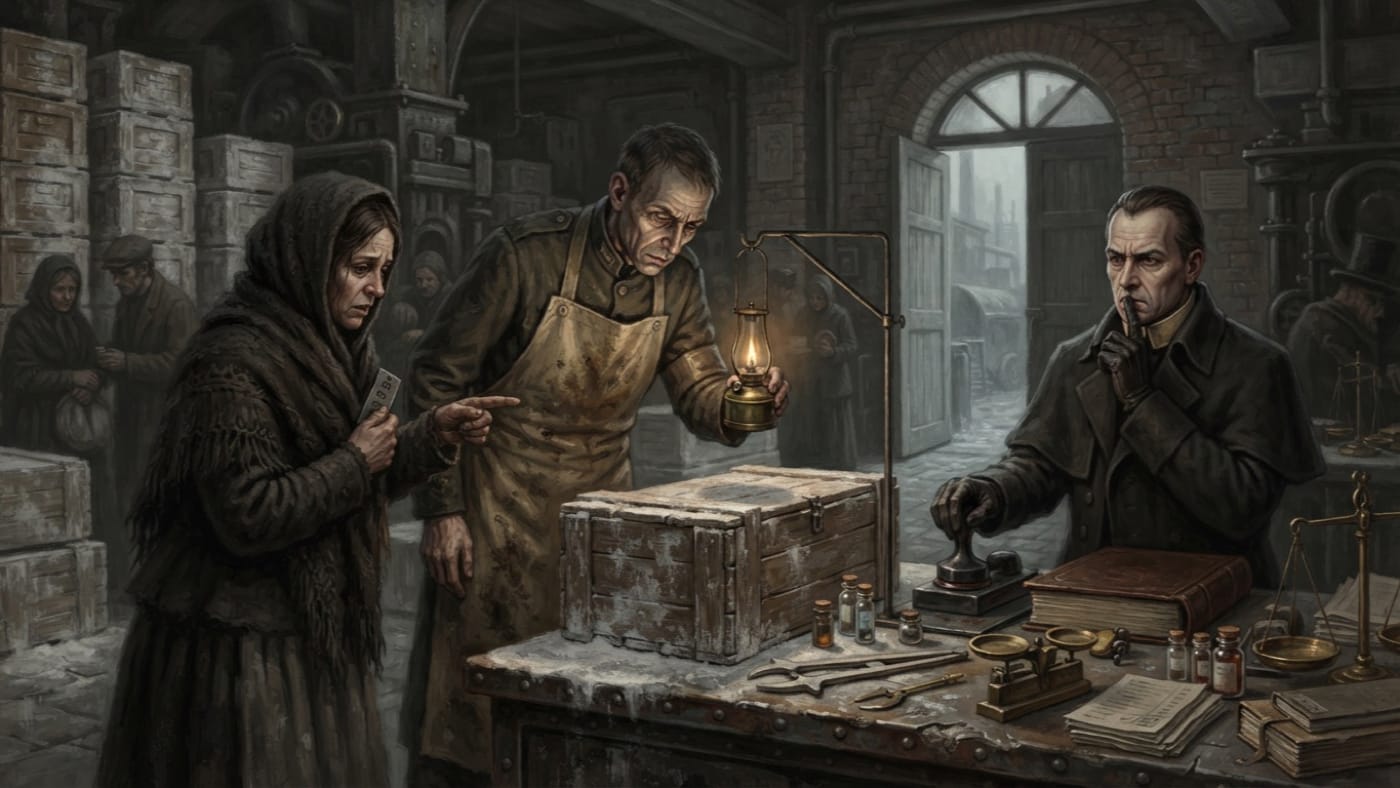
Here is the counter as it stands in A.S. 201, according to the contemporary survey that informs this entry. A technician with lime under the fingernails and wax scars on both wrists lowers the lamp over a small crate. The claimant is a woman holding the intake tag. Behind her the hall door has been propped open against the smell. The flame moves.
She says the draught moved it. The technician says nothing, because speaking now invites trouble. The Tariffer has to sign something. Every possible signature belongs to the Tariffer.
The responsibility comes down to a short list. A Tariffer who knowingly clears unclean remains has committed spiritual treason. A Tariffer who ignores a flicker appears on the audit list of what failure looks like. A Tariffer who holds a crate wrongly faces an angry family, a delay, and auditors from Records who check holds before anything else and ask why each one was delayed. Penalties run from demotion and quarantine duty to public penance, immurement for chain violation, and erasure for anyone who has let unclean remains pass. In every case the punishment falls on the hand that stamped. It never falls on the lamp, the rubric or the Bureau of Rites. In the same survey I counted six chapels at which a grieving family had been called unclean so that an overrun shift could end its paperwork.
The Tariffer touches wax to the lips, as Saint Morin requires of every shift, and says nothing aloud. The bay is sealed. A runner goes out. The woman's hand stays where it was and the tag stays in it.