
#On the Stamp Before the Grave
The Gray Clearance was the Synod's brief admission that the dead could outrun the paperwork.
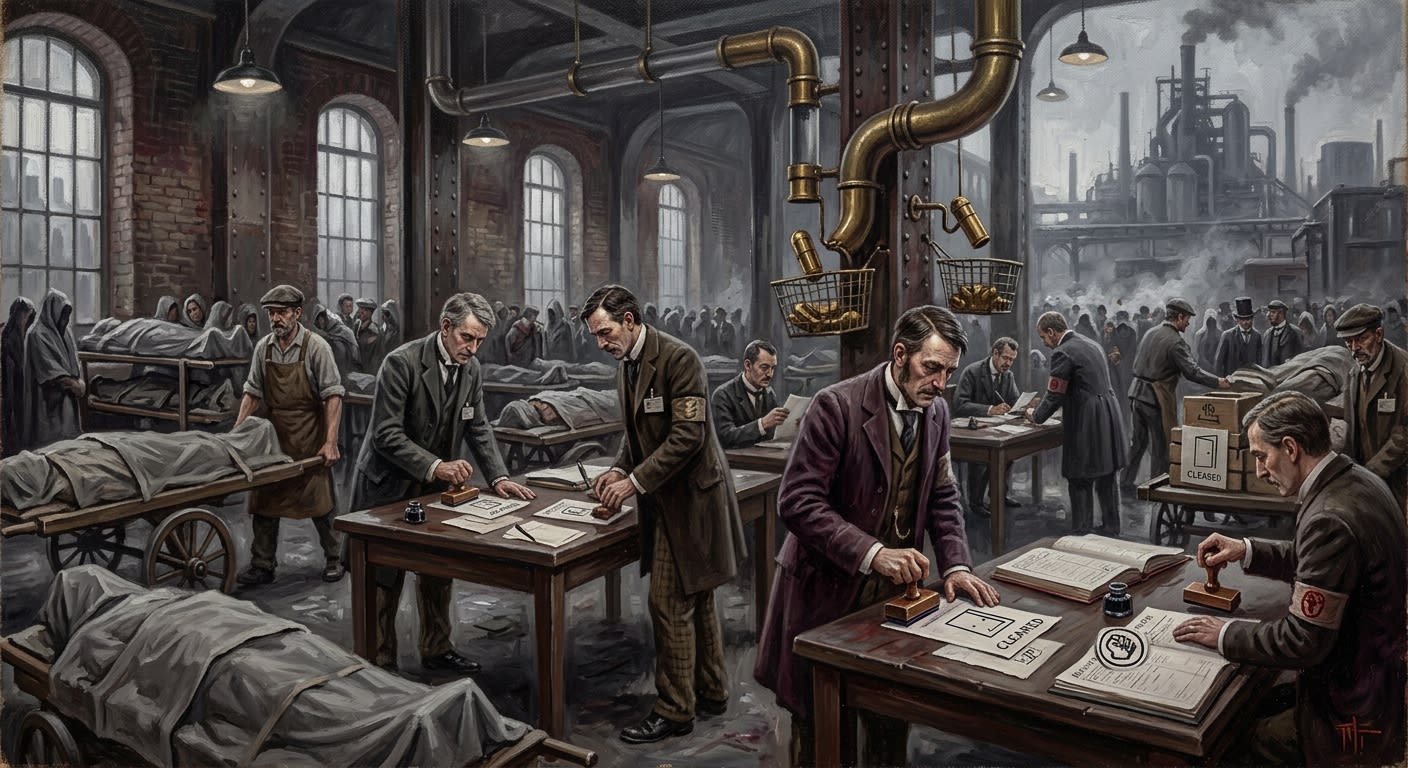
It lasted from A.S. 157 to A.S. 158, which is to say one winter by calendar, one century by professional habit, and forever wherever a Dead-Goods Tariffer lowers his voice before saying cleared. The rule was simple enough for exhausted clerks and plague-blinded families to grasp: the old five categories — Burial, Transport, Salvage, Ornamental, Contaminated — were suspended in emergency practice and replaced by two words. Cleared. Held. The first sent remains onward. The second kept them in the bay until rot, audit, kin, or bribe settled the question.
The Clearance belongs to the Plague Winter (Unregistered) of A.S. 157, the same famine year that revived widow levies, bent western granaries toward the southern theatre, and taught several comfortable offices that hunger travels faster than memoranda. Corpse backlogs struck Marrowgate, Strasbourg, the Rhine corridor, and the bastion intake chapels within a fortnight. Bodies waited in streets outside the tariff-chapels. Families held tags in both hands. Lime crews slept beside their carts. The dead, being numerous and poorly socialised, began to smell.
#On the Plague Winter
A.S. 157 had already made itself vulgar before the bodies started queuing. The Bureau of Tithes revived emergency levies with the gentleness of a taxman prying rings from a widow's hand. The Bureau of Pilgrimage became overwhelmed, which is the approved phrase for pilgrims dying in numbers that complicated route schedules. The Bureau of Agriculture wrote recommendations, then began its stately walk toward dissolution in A.S. 158. A bad year. A profitable one.
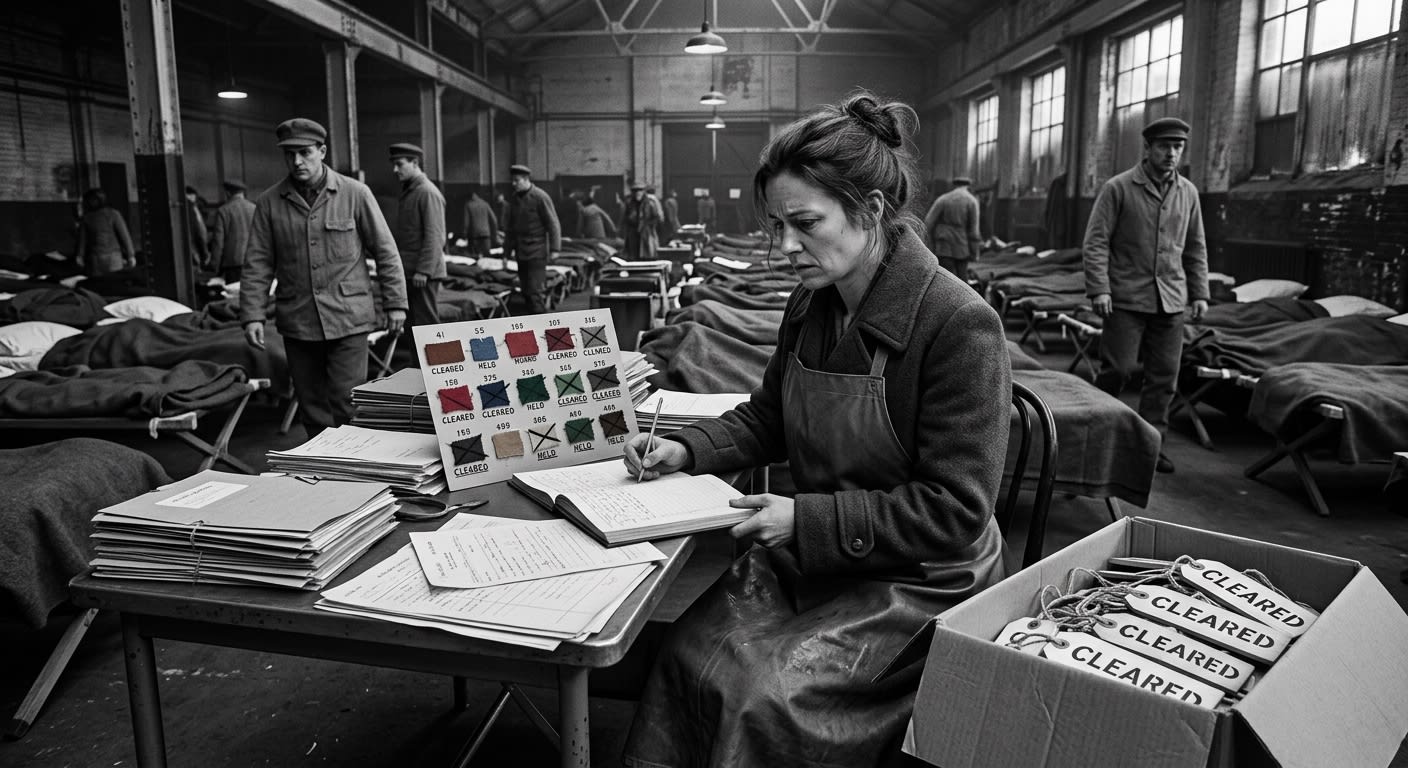
Disease did what disease does in a state that believes all movement should produce a receipt: it followed the roads, found the queues, entered the wards, and waited politely for the clerks to fall behind. In Marrowgate, intake bays filled before Sext. By Vespers, tagged bodies lay under awnings meant for the living. By the next dawn, a purity-lamp crew refused to enter Bay Three without hazard pay, then entered after a Tithes officer explained that hazard pay required a live claimant.
The old procedure broke by exact stages. First, kin verification lagged. Then caliper readings stopped. Then purity-lamp checks were reserved for bodies rich enough to have advocates or strange enough to frighten the room. Classification scribes began marking full categories in pencil, then initials, then slashes, then nothing. A Tariffer at Marrowgate is credited in local vice-books with the first grey mark: a diagonal smear across a burial slip, made with ash-wet thumb, meaning send it. Records later denied the story and preserved the slip. The Bureau's appetite for contradiction is excellent when the contradiction can be archived.
The emergency circular described Gray Clearance as a compassionate acceleration of burial practice.
Corrected in restricted teaching copies. It was a throughput protocol. Compassion stood near the door and was mistaken for a porter.
#On the Two Words
Cleared meant the remains could move.
It did not mean the dead had been identified. It did not mean the kin had been found. It did not mean the lamp had burned steady, the tag had matched, the bones had been counted, the confession receipt had surfaced, or Saint Morin had approved. It meant the bay required space. The stamp fell. The cart departed. The Lime Yards received what the chapel no longer had room to understand.
Held meant everything else.
Held bodies remained behind rope, under canvas, in side niches, in cold corridors, in disputed carts, in chapel corners where families slept sitting up lest their dead be misrouted during the night. Held could mean suspicious flicker. Held could mean missing tag. Held could mean noble claimant. Held could mean bribe pending. Held could mean the clerk had looked at a child's face too long and lost the nerve to send it to lime before Compline.
The Gray stamp itself varied by district. Marrowgate used a rectangular ash mark over the normal clearance seal. Strasbourg used a blank oval. Rheinscarp used grey wax. Some Rhine chapels, lacking wax, used diluted soot and vinegar. One chapel near Metz used bone-lime paste that hardened over the tag and made later reading impossible. Records condemned the practice, then adopted a refined version for confidential obscuration.
The five old categories did not vanish. They waited behind the two words like knives behind a curtain. Cleared remains were later back-classified wherever possible, usually after material use had already occurred. A bone-lime wall does not surrender its contents for better paperwork. A road surface cannot be asked whether it was once Burial or Salvage. The Bureau solved this by ruling that post-use classification attaches to intention. Intention, when declared by an office with enough seals, is stronger than evidence and far easier to transport.
#On Marrowgate's Mercy Line
Marrowgate became the Clearance's school, scandal, and shrine. Its Wagon Quays took the war in by cart; its White Ward lost patients by bell; its Lime Yards burned so hot that winter frost withdrew from the surrounding streets and local children learned to identify kin by tag fibre rather than face.
The Mercy Line formed outside the Tariff-Chapel of Saint Morin during the second week. The name began as mockery. Families whose dead had been held stood along the left-hand rope with slips tucked into sleeves, wax coins in mouths, wedding rings hidden under tongue, saint medals hollowed for salt or silver. A clerk with tired eyes walked the rope at Prime and touched some papers with two fingers. Those bodies cleared before noon. The others remained. By the fourth day, everybody understood the rate.
MARROWGATE SANITATION CHAPTER — INTERNAL BAY NOTE, A.S. 157 Bay Four count: ███ bodies by tag; ███ by head; discrepancy unresolved Gray marks issued: ███ Held appeals: ███ Unclaimed children transferred before kin bell by order of █████ Clerk marginalia: “If they ask, say lime. If they listen, say nothing.”
The official protocol did not authorise payment. The official protocol did not authorise rope-walking clerks, priority ash, kin bypass, or nocturnal transfers to the Lime Yards. The official protocol did not authorise the phrase mercy stamp. This is the splendour of official protocols: they remain pure by failing to describe what everyone is doing with their hands.
Saint Morin's local cult thickened in those weeks. Wax touched lips before every shift. The skull over the intake arch was painted grey. Tariffers began placing small wax plugs on held tags to silence them, as if paper might speak where the dead could not. By A.S. 201, chapels still renew Morin's wax weekly and still deny that the renewal descends from panic. Good. Panic, once admitted, demands reform. Ritual merely demands supplies.
#On Revocation and Survival
The Gray Clearance was formally revoked in A.S. 158. The revocation circular restored the five-category classification system, reaffirmed purity-lamp checks, reinstated kin verification, condemned expedited handling outside written authority, and praised the emergency personnel whose survival made punishment inconvenient.
Nothing ended. The stamp changed name.
The mercy stamp survived because the Gray Clearance had taught families the unforgivable lesson: a line can move faster. Once a mother has seen a held body clear by ash mark, no sermon will persuade her that delay is sacred. Once a clerk has learned that compassion, bribery, fear, fatigue, and throughput can wear the same gesture, no manual will make his hand innocent again. Once a chapel discovers a private rate for speed, slowness becomes policy and speed becomes merchandise.
The Bureau of Tithes understood first. It always does. Unauthorised mercy could be punished, taxed, folded into inspections, sold back to the profession as discipline. The Bureau of Records followed by creating audit categories for irregular acceleration. The Bureau of Rites followed by declaring certain mercy gestures sacramentally reserved. Confessor booths later fought their own mercy-stamp wars under the Mercy Rationing Reform, proving that infection spreads best through paperwork.
Public retrospectives state that Gray Clearance ended with the A.S. 158 revocation.
Clarified. The emergency protocol ended. The habit did not. Habits are laws without the courtesy of publication.
#On the Present Ghost
As of A.S. 201, no licensed Tariffer may issue a Gray Clearance. Every licensed Tariffer knows how. That is the present condition, expressed without the lace shawl of official prose.
In commerce chapels, Mercy Weighers call the lesson cousin-work: shade the rate, move the line, let the Ledger catch up after hunger stops screaming. In mortuary chapels, Mercy Stamp clerks call it survival. Pure Chain clerks call it rot. Pure Chain clerks also use it after midnight, when the bay is full, the lamp oil is low, and the third crate begins tapping from inside.
The Gray Clearance survives in small signs: a second press kept under the left side of the desk; grey wax bought through candle accounts; ash rubbed into seal grooves; a held tag folded corner-up; a clerk saying come back after Vespers with his eyes on the floor; a family that understands and sells its last metal cup before sunset.
It survives in audit language as "irregular acceleration." It survives in chapel slang as the little mercy, the fast ash, the dead man's shortcut, Morin's blink. It survives in nightmares as a line of bodies leaving before their names can catch them.
The final cruelty is that Gray Clearance saved lives among the living. It cleared bays. It reduced street rot. It sent carts moving before plague could educate the neighbourhood. It also misrouted sons, erased mothers, converted unidentified children into whitewash, and taught Europe that grief has an expedited tariff. The Bureau calls this a regrettable emergency measure. I call it one of our most successful doctrines, which is why, officially, it no longer exists.