
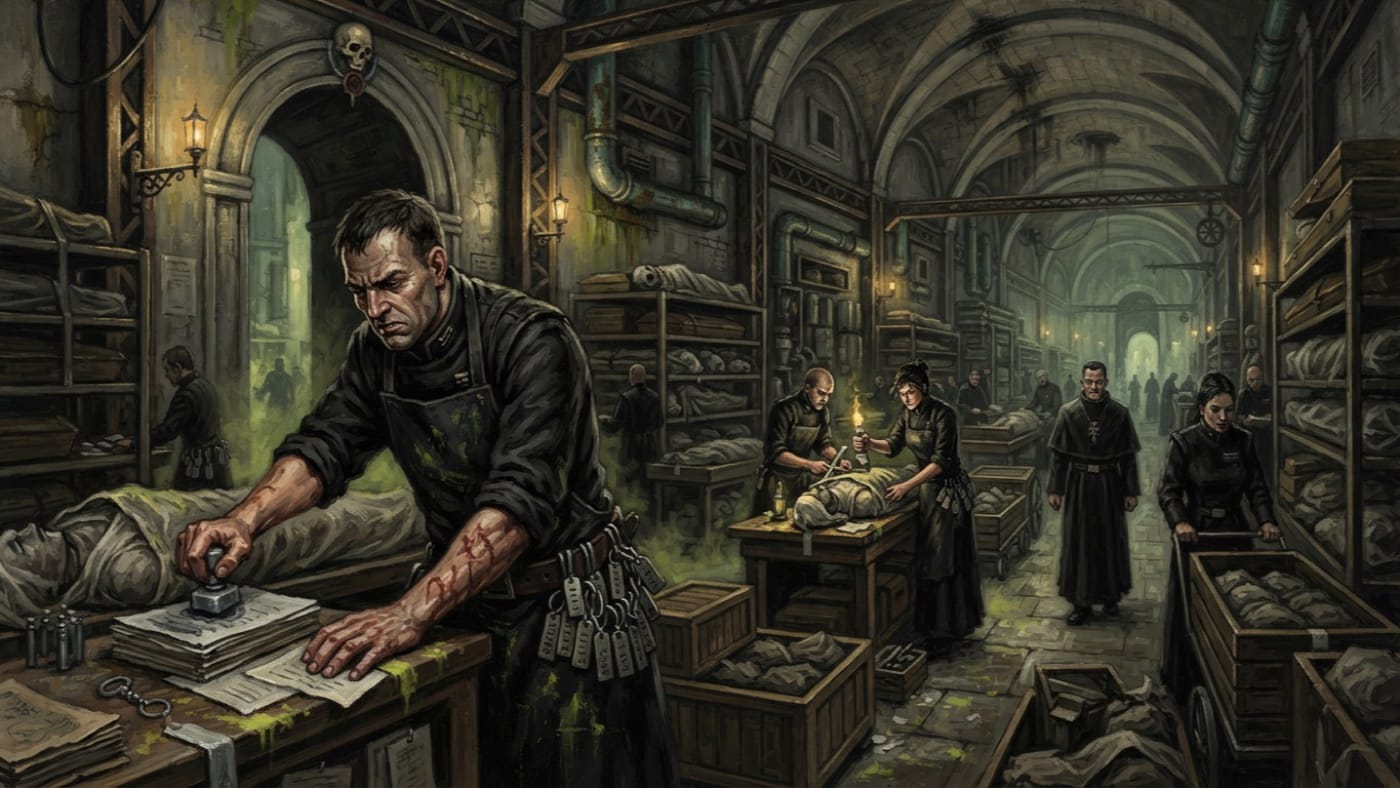
#On the Bodies Behind the Counter
Mercy Stamp clerks are Dead-Goods Tariffers who have counted the bodies waiting behind the counter and concluded that the count is itself a disease. They hold no separate charter. They wear the profession's black apron and lime-stained cuffs, and the same wax burns cross their knuckles. Hold tags click at their belts like the tags of every other clerk. They climb the same ladder from Tag Runner to Tariffer, under the same joint oversight of Records, Rites and Tithes. No office has issued them a badge, and none would dare. A clerk joins the faction by holding an opinion and then acting on it with a seal press.
The opinion is simple. A held body is a public-health hazard aimed at the street. Under the Mandatory Burial Clearance, a hold order often sends the dead home with the family. The body goes into a back room, cooled with whatever ice the season allows, while the children go to an aunt. By the second week the shroud must be changed. By the third the neighbours have opinions, and soon afterwards they have fevers. A Mercy Stamp clerk at a Marrowgate intake hall can point through the window at three such houses before Sext. He will tell you the queue is a clinical fact, and he is correct.
His opponents, the Pure Chain clerks, call the queue morally irrelevant. Their position is that the chain of lamp, caliper, tag and kin mark exists because the dead were once released without it. Both camps work in the same hall and breathe the same lime, and they have spent forty years accusing each other of murder.
#On the Chain and the Rot
The ordinary sequence deserves to be stated, because the exception means nothing without it. A Tag Runner matches the intake tag to the manifest. The remains receive a provisional mark under one of the five classifications: Burial, Transport, Salvage, Ornamental, Contaminated. The purity lamp is read against the Rites rubric, and bone calipers and scales go to work where measurement is required. The Tariffer then assesses rites owed and tariff due. The press comes down on a clearance with sealed tags or on a hold order. Routing follows, to the graveyard, the ossuary, the transport yard, licensed material reuse at the Lime Yards, or quarantine. At day's end the hooked stylus reconciles skulls against coffins against ash sacks.
Cleared and Held are release states, and either may attach to any of the five classifications. Neither is a classification in its own right. Every Mercy Stamp clerk knows this. The faction's weakness is that every Mercy Stamp clerk also remembers a winter when it stopped being true.
Each danger in the hall is real. In A.S. 78 contaminated bone in clean ground produced the First Ossuary Panic, and a body released before the lamp has spoken can still return that panic to a parish. A body held until the lamp is satisfied can meanwhile rot in a tenement until the tenement needs a lamp of its own. The Pure Chain clerk fears the pit that sings. The Mercy Stamp clerk fears the street that coughs. The Bureau has resolved the dispute by employing both.
The Sanitation Chapter belongs in that rubric because Mercy Stamp clerks so often cite it. Sanitation controls cordons and contagion. Its health papers let a porter walk through a white line, and they say nothing about the corpse on his back. A clerk who argues "the Chapter wants the bays empty" is reporting a sentiment. No Chapter seal turns sentiment into clearance.
#On the Winter That Taught the Hand
Fast clearance was sold almost as soon as clearance existed. The retrospective accounts of A.S. 78 already list mercy stamps sold under the table among the profession's first corruptions, alongside burial delays imposed to force fees. These early sales were an antecedent. The faction as it exists today learned its method in a single season.
In the Plague Winter of A.S. 157, the backlogs at Marrowgate, Strasbourg and the Rhine-corridor chapels outgrew their bays within a fortnight. The Gray Clearance answered by letting Cleared and Held displace fuller classification in emergency practice. Cleared remains reached the Lime Yards without the ordinary lamp, caliper and kin checks. Bays emptied and street rot fell. Sons were also misrouted, mothers lost their claims, and material went into walls before the records had caught up with whose material it was. A bone-lime wall cannot be back-classified.
The Mercy Line formed during the second week, a left-hand rope outside the Tariff-Chapel of Saint Morin where families appealed Held dispositions. A clerk walked the rope at Prime and touched some papers. The touch might be an ash mark, a thumb smear, or a crease rubbed with soot. It was distinct from the emergency Gray mark and from ordinary clearance, and it meant this one before noon. No circular authorised a fee or fixed a rate. Wax coins moved bodies. So did silver hidden in saint medals, a widow's pleading, and, the sources allow, the occasional clerk who could not bear a particular face for another hour.
Revocation came in A.S. 158. Full procedure was restored, unauthorised acceleration was prohibited, and the rope came down the same afternoon.
Marrowgate's abolition notices of A.S. 158 declared that held-body appeals would follow restored procedure and that irregular acceleration had ended.
Corrected against the Codex's own present survey. The queue was abolished in law. The practice moved indoors, kept its ritual vocabulary, and still turns up in Records audits as irregular acceleration. The notices described what the Chapter intended. What the Chapter intended has never been admissible as evidence.
The faction did not need the rope. It needed the argument the rope had proved, that a line could move faster and the city would smell less when it did. The faction's founding date appears in no surviving record, which spares everyone a feast day.
#On Who Is Paid by Speed
A Mercy Stamp clerk may hold a lawful post, keep a clean ledger and argue for throughput at every chapter meeting. The argument is permitted. The unofficial mercy clearance has no lawful standing whatever, and neither the faction's name nor any payment grants authority to release remains past a contamination restriction. The professional allegiance and the particular act must be judged separately. Records, to its credit, audits only the act. Records audits everything only the act.
The motives are mixed. The sources record bribery, patronage and off-ledger handling. They also record exhaustion at the end of a double bell, pity for a widow who has kept a tag in her family Bible for nineteen days, and the plain sanitary judgement of a clerk who can smell the third crate through its canvas. A family claim cuts in two directions. Speed can deliver the dead home for burial before the house fills with illness, and it can just as easily deliver them to a Salvage barrel before the second widow arrives at the counter with her better papers.
Then there are the parties downstream.
The Lime Yards receive what the desks release. Their parent account says, with local bitterness, that during the Gray winter Cleared meant the Yards. That held for that winter in that city. Lawful clearance routes the dead to many destinations. Even so, every hurried Salvage mark sends a body to the breaking tables, and the breaking tables feed the kilns. The kilns produce bone-lime, whitewash, road powder and ash-credit. Mercy Stamp clerks credit the Yards with saving Marrowgate from rot. The Bone-Lime Consortium finds Mercy Stamp doctrine very congenial, because its profit depends on bodies that reach the ash ledger as numbers without kin attached. Nothing on file shows the Consortium founding, owning or commanding the faction. It does not need to. Kilnmaster Hark sets the fire schedule, Forewoman Rute collects the bone rent, and Prefect Salvius keeps the cordons tight. None of the three is recorded as a Mercy Stamp leader, and all of them sleep better when the bays are empty.
The reported signs of irregular acceleration are well known. Inspectors have found a second press kept under the left side of a desk, grey wax bought through candle accounts, ash in seal grooves and Held tags folded corner-up. These are indicators only, and no clerk is required to own any of them. A Pure Chain desk has been found with all four after midnight, when the lamp oil ran low.
#On Morin and the Correcting Wind
Both camps keep Saint Morin's wax-sealed skull above the intake arch and touch wax to the lips in silence at shift-start. The Pure Chain clerks read the sealed mouth as discipline: say nothing until the chain closes. The Mercy Stamp clerks read it as discretion: say nothing about the mark you made. Morin's life is disputed and his principal relic is unauthenticated, so neither camp can produce a document in which he takes sides. This has made him the most useful saint in the profession.
The Marrowwind has been less accommodating. Since its first uncontested classification in A.S. 194, the chalk gust from the Yards has left ledger corrections behind it, and the corrections are accurate. Names come back to entries that had been reduced to numbers. Death marks move. A clerk who hurried a body through without its kin may find the kin restored to his ash ledger by morning, in his own hand. Some kiln workers call this testimony. The Chapter classifies it as an atmospheric-scribal anomaly and records only that the corrections are right. For a faction whose case rests on speed, a wind that sends the paperwork back is a hard opponent.