
#On the Licensed Residences
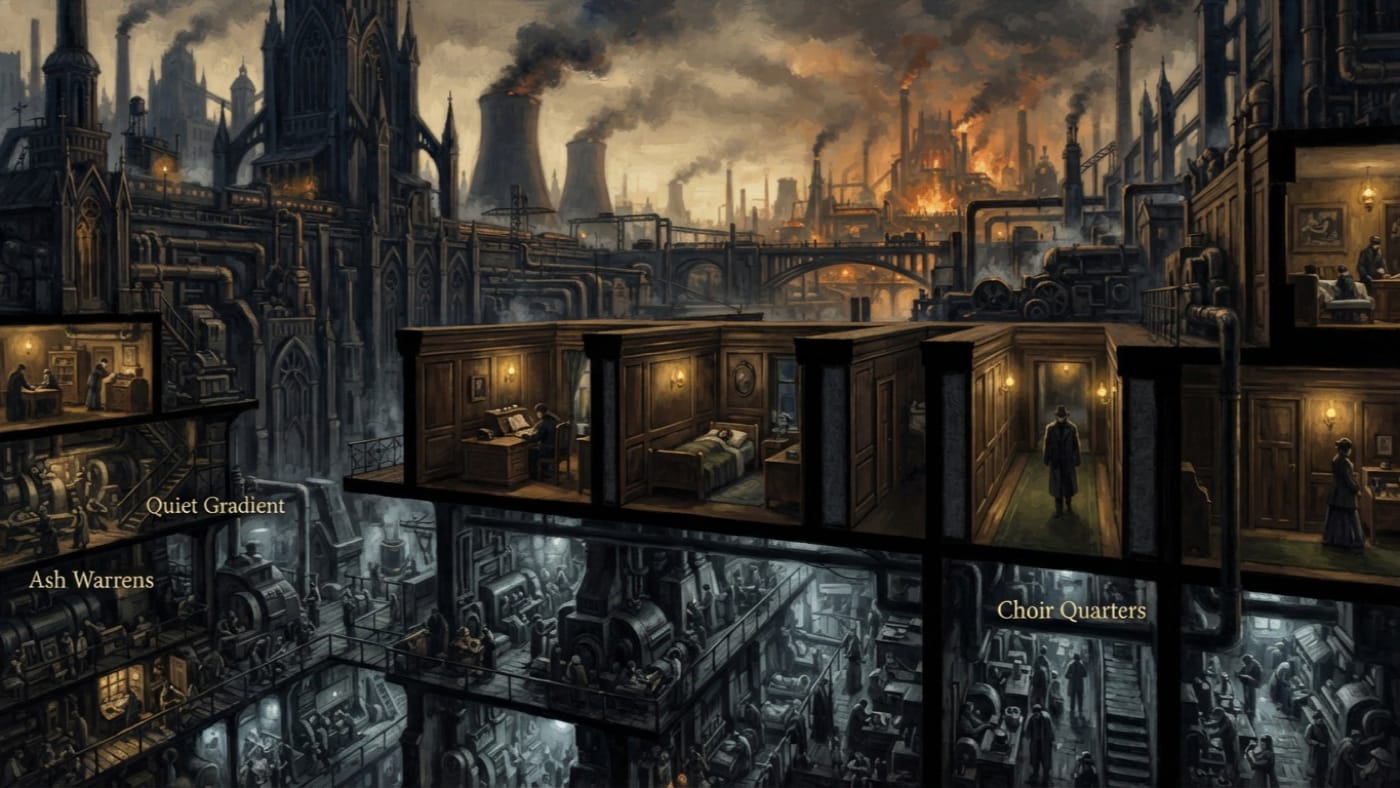
Essen-of-Hymnsteel climbs out of its canalized river fork in terraces, and every terrace pays for its height in a different currency. The Foundry Core pays in lungs. Ledger Row pays in ink and nerves. Above the Row, past the Records spire whose upper windows look up at its betters, lies the Quiet Gradient. It is the city's residential concentration of licensed acoustic comfort: a district of fitted rooms where a citizen of sufficient standing may close a door and hear his own pulse for the first time since arriving in Essen.
I will not pretend the arrangement is a fraud. It works. Walls lined with felted ash and sealed timber take in the peal-bells that govern every shift, the pour-chants from the Hall of Measures and the foundry thunder the rest of the city wears like a second skin, and they give back a murmur. The rooms smell of lavender soap and sealed wood. A guest may speak at the volume of a guest. A man may sleep through First Bell Warming and wake with his ears in the condition the Creator issued them.
Residents call the effect perfect quiet. It is very good joinery. The bells still reach the bedposts as a faint shiver in the frame, and those who sleep with a hand on the headboard can tell the hour by it. The Codex admits testimony about experience. It does not mistake that testimony for a measurement.
The parent entry calls the Gradient the only district in Essen where money buys silence. The certified engineers in their Silent Zones, the selected chapels and the duct-tunnel merchants of "false quiet" rooms would each dispute this, the last of them from hiding. The Gradient is where silence is bought to live in. Elsewhere it is bought by the street, the pew or the hour.
#On the Price of Sleep
A room in the Quiet Gradient costs more than a lockhand earns in a year. The record I hold does not say whether that sum is paid once, by the season or at each renewal of seal. I decline to invent a tariff for the pleasure of being quoted. The comparison is enough. The lockhand hauls gate-chains through a year of groaning water, and at the end of it he could not afford the room.
That figure is the summit. Below it the market slopes as carefully as the terraces. Skilled residents (a senior riveter, a seal clerk with a good hand, a crane driver who has not yet dropped anything consecrated) buy smaller mercies: a modest quiet room, or an extra hour of silence paid in oath-notes. The Gradient is no aristocratic preserve. It admits anyone who can pay, and in Essen that is a narrower door than any pedigree. How many souls sleep behind its felt is unrecorded. Records counts the Warrens. Nobody counts the people who can afford not to be counted.
The Sealed Elite hold the upper rooms, and the Guild treats their homes as its own territory. Their quiet is the kind that comes with safe shifts and a stamp proving they exist.
Below the Gradient entirely are the Choir Quarters, where calibration singers wear out throats that last nine years on average. The felt upstairs is fitted to keep out those very voices. Below them again are the Ash Warrens, where families rent warm floor-space by the vents and go half-deaf by thirty. The Warrens get their silence in the end. They simply never pay for it.
#On the Materials and Their Permissions
The Hushwright Guild supplies the materials and the hands. It is the wealthiest faction in Essen, it holds no seat on the Compact Council, and it has never needed one. Its stock is felted ash, sealed timber and hush-cloth, and its labour is carpenters and sound-baffle artisans. The felt goes behind the boards. The boards are sealed until the grain stops admitting anything, sound included. Hush-cloth, the craft's own textile, goes where a room would otherwise leak.
The people who do this work are Hushwrights, and the city lists their trade among its ordinary occupations, between the lockhand and the scrap broker. They kneel at skirting boards with awls and mallets. They test a doorframe with the flat of a hand. They come back when the felt slumps or a seal lapses, because maintenance belongs to the Guild as completely as installation does. The artisan is a craftsman. The institution is a monopoly. Purity has trouble telling them apart, and so does the occasional customer.
Three papers govern a quiet room, and they are not interchangeable. The occupant holds a Quiet Permit. The material carries a current Hushwright Guild seal. The occupant's identity papers answer to the Bureau of Records, under whose seal every permit and writ in Essen moves. The order of signing, the renewal interval and the fees are not disclosed to this survey. I suspect they are not disclosed to the residents either.
Compact Ordinance 7-C is attested through an advisory of the Bureau of Orison and Song. It holds that unauthorized silence within city limits violates the ordinance, that sound-dampening materials require a current Guild seal, that unlicensed hearing protection is contraband, and that violations are reported to an Orison Provost. Essen's own record adds that silence is licensed, taxed and patrol-checked, and that earplugs are stamped and serialized. The duties are divided. The Guild sells the quiet, Orison under Master-Calibrator Sister Rauth polices it, and Records certifies the sleeper, all under the joint dignity of the Tri-Bureau Compact.
#On the Rooms and Their Customers
A quiet room sells privacy. Most of what the Gradient buys with it is respectable: sleep, arithmetic, marriages conducted below the threshold of the neighbours. A city that presumes privacy to be seditious does not grant the presumption of respectability for long.
Across Essen, hushrooms are rented by the hour for secrets, affairs and heresy, and the felt cannot tell one tenant from another. The Gradient holds the city's finest residences. It also holds rooms where conspiracies meet, and the Gradient is watched. How it is watched, by whom and from which side of the felt, the record does not say. I record the watching and stop there.
The Mirror Choir meets, among other places, in hushrooms rented under false devotional names, and the Codex has already entered the necessary sentence: the Hushwrights rent silence to both sides. That sentence does not put every such meeting in the Gradient. It does not enrol the Guild in the cell. The trigger the Guild dreads, a hushwright design proven to have been built to hide heresy meetings, has not been entered in any record I have read. Knowing that a room was used is one finding. Proving that it was designed for the purpose is another, and Purity has learned to drop the second in a hurry.
The Guild's own methods do it no favours. Its record lists contracts, blackmail and clandestine installation. Those are the methods of an institution. They tell us nothing about the woman who planed the boards.
#On the Silence That Cannot Be Purchased
Licensed quiet is manufactured. It has an invoice. The other silence in Essen has none.
After a Resonance Bloom (the "holy alignment" that the upper terraces call the Wrong Choir), an affected district can lose sound for days. Voices fail to carry. Footsteps make no noise. The walls take in every vibration as though the stone had developed an appetite. Hushwrights cannot reproduce this, and they have no wish to. Felted-ash street lining appears on the list of countermeasures, and nobody has shown that it cures anything. It is on the list because it was available, which is how most things get onto Bureau lists.
The Gradient is neither naturally silent nor proof against the foundations. One deployed account of the incidents of A.S. 199–201 reports that during a night Bloom in the Foundry Core, with no pour scheduled, hushwright panels in the Gradient failed for seven minutes and the rich heard the city they had paid to forget. The district record does not confirm this independently. I enter it as reported. Seven minutes is long enough to learn what a year's wages had been holding back.
The Codex entry on Essen-of-Hymnsteel attributed all Resonance Bloom events to the Mirror Choir heresy, per Compact Report 447-E (A.S. 198).
That attribution is withdrawn here too. Subsequent Bureau of Rites investigation places Bloom activity approximately forty years before the Mirror Choir's earliest documented operations. No reader of this survey should conclude that the Gradient's panels failed because a hymn-thief had rented the room next door.
#On the Present Condition
Strasbourg demands tripled output of hymn-drive siege engines. The Bureau of Orison refuses to quicken the calibration tempo without liturgical stability guarantees. The Bureau of Engines and Furnaces threatens conscription from the Warrens. The Bureau of Records profits from the dispute, as every dispute requires stamps. The Gradient sits above all of it and pays the Guild to keep it out.
What this does to the price of a quiet room, the ledgers do not yet say. It is reasonable to infer that faster pours mean louder nights, and that louder nights flatter whoever sells felt. It is an inference. I have seen no Guild account that proves it, and the Guild does not show its accounts to theologians, however well they sleep.
The Gradient's dependence is total and unspoken. Its residents escape the noise of institutions that pay for their rooms. Their stamps come from Records, their quiet is licensed by Orison, and their comfort is bought with Engines quotas and fitted by a guild that rents the same comfort to the people Purity hunts. Take away the noise and the Gradient has nothing to sell. Take away the felt and its residents rejoin the city they govern, at street volume.