

#On the Harbour and Its Neighbour
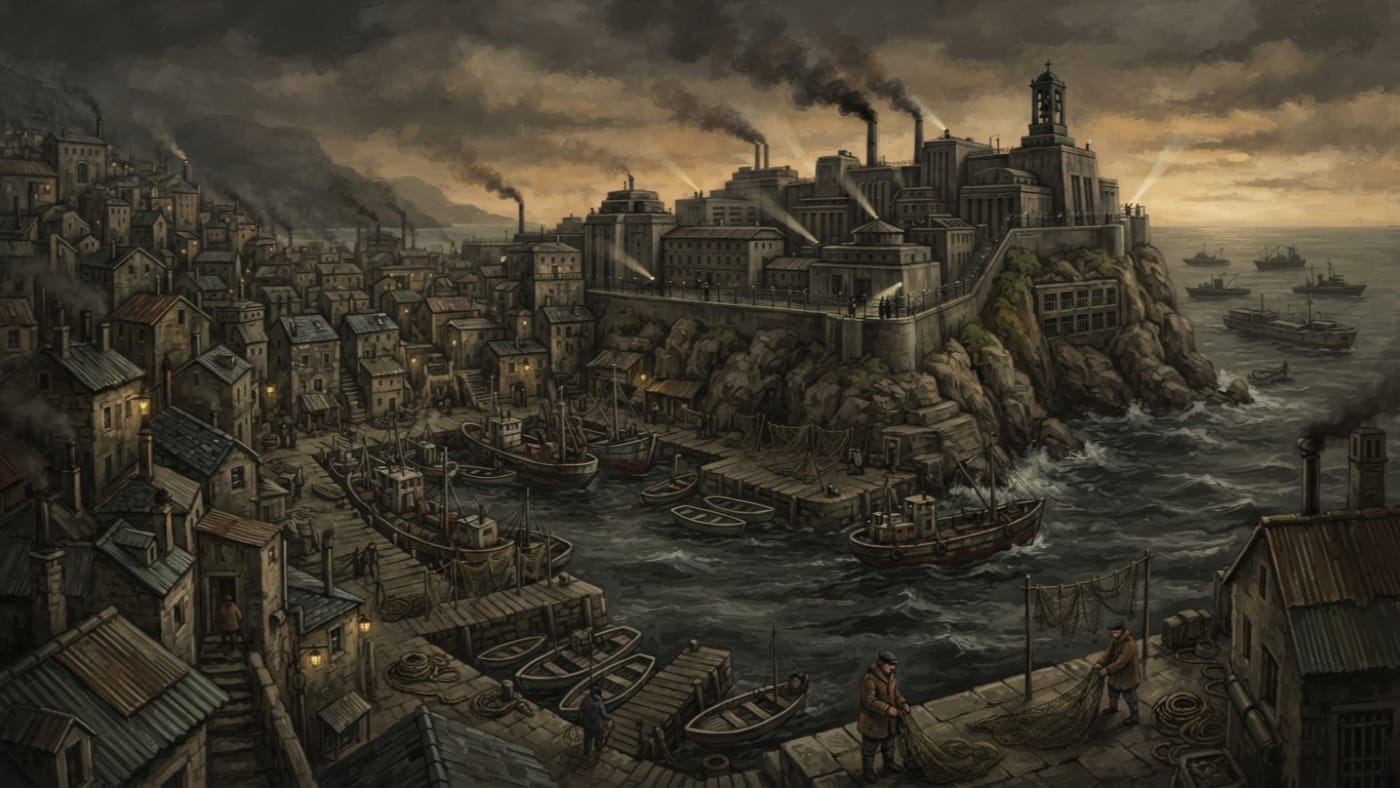
Ragusa stands on the Adriatic below the Dalmatian reaches. It is a stone town, and its approaches come up from the water as walls, steps and quays worn smooth by fishermen's boots. Its harbour holds working boats: nets drying on the moles, tarred hulls hauled up for scraping, courier skiffs sharing the water with whatever the coast has decided to inspect that week. The Adriatic Coast register describes the town by its stone approaches and moves on to more profitable sentences. I mean to stay longer.
The Bureau of Records files the sea in front of the city under Zone 7, the southern coast. The wider Dalmatian country behind it appears on the forward-support maps as Zone 3, the region that feeds the lower Sagittal Line. These are logistical classifications, one for water and one for land. Neither draws a boundary around Ragusa, and I will not draw one for them. Some southern supply passes near its quays. A good deal more goes elsewhere, and any clerk who routes the whole southern war through one fishing harbour has misread his map.
On the neighbouring headland stands Saffron Bastion, designated in A.S. 72. Saffron is a separate installation with its own population, its own offices and its own cliff batteries. It is neither another name for Ragusa nor an eighth bastion of the Line. Ragusans had settled that headland long before any surveyor came. The Synod inherited their harbour, as it inherits most things, and then billed the previous tenants for improvements.
#On the Older Customs
Ragusa's customs are older than the offices that now license customs. The clearest of them survives in the Saffron files, because it was Ragusan practice on the Saffron headland that the surveyors recorded. Around A.S. 68 those surveyors came down the coast. They worked for the provisional authority that the Concordat of A.S. 90 would later make into the formal Synod, and the Synod now counts them as its own. They found a town that already shut sick sailors in clifftop cells. Ships waited offshore, and suspect cargo waited longer.
That was a fishermen's precaution. It had no prefect, no causeway and no yellow cloth over every bollard. The Quarantine Prefecture was constituted at Saffron after the Brine Fever Winter of A.S. 112, and its apparatus belongs to Saffron. I have found no record that Ragusa ever kept a Prefecture of its own, and I will not give it one so that this paragraph can look complete.
The sea prayers are the second inheritance, and the harder one to document. The Ragusans prayed to the water before the Church's licensed hymnals reached the coast. That much is certain, because the prayers survived. Their original wording is unknown. Nobody can show me who composed them or how old they are, and no surviving hymnal holds them in their first form. They come down to us inside other people's songs, which is how old prayers usually travel when no one has given them permission.
#On the Appointed Hour
Every landing on this coast has its bell. The bells call the boats out and call them in, and they mark tide, curfew and ration. These are schedule bells. They govern by habit and by fear of the magistrate, which is how most government works. A fisherman who hears the dawn toll and goes to his nets has made a choice. He made it because the choice is ringing, and because he knows what happens to men who make the other one.
The Lore Book shows what happens. Archon Basilius of Ragusa once sentenced an entire fishing fleet to ten years of penance-labour because its harbour bell was not rung at the appointed hour.
Archons interpret the Synod's decrees and pass judgment on the disputes that follow from them. The office gives one magistrate the power to read a schedule as law and the law as a sentence. The record gives the offence and the penalty and nothing else. It has no year and no tally of boats. It names no defendant, says nothing of where the labour was served, and does not say how many of the men came home after the decade. Whether the case came before or after the present Bell Codex, ratified in A.S. 115, I cannot say either. The file does not record it.
The sentence required no miracle. A bell went unrung, and a magistrate punished a fleet. The Bureau of Bells can command a coast without spending one grain of grace, provided it has enough Archons. It has enough Archons.
#On the Three Bells
At Ragusa, three bells sounded in sequence. The first commanded rise. The second commanded kneel. The third commanded burn. The crowd obeyed each command in turn and set itself aflame. No Warden drew a blade.
That is the record, and it is all of the record. It gives no year and no commander. It names no square and counts no dead. It does not say how the fire was lit, or what offence brought the crowd together, or whether anyone tried to resist. The dedicated survey of Bell-Litanies leaves those columns empty. This entry leaves them empty as well. Nothing in any file makes Archon Basilius the commander of that day, a witness to it, or even a man of the same generation. Ragusa has two bell stories, and nothing joins them except the town.
What separates the two stories is the difference between a schedule and a Litany. Basilius's fleet could have rung its bell and did not, and was punished for the choice. The crowd in the square was given no choice. A Bell-Litany is a licensed technique of miracle, approved through the Bureau of Rites and fitted into the Bureau of Bells' schedule. The body obeys it before the will has been consulted. The Bureau of Orison and Song calls sound the lash of Heaven. At Ragusa the lash went as far as the third bell.
Doctrine, as set out in Miracles and Sorcery, teaches that the faithful pay for grace and pay willingly. Hunger, weariness and lost years are their devotional expenditure, and the world is spared. I have searched the Ragusa file for the expenditure. It does not record who paid it. It might have been the ringers, or the company whose allotment was drawn, or the crowd. It might have been an account no clerk has opened. It records no consent and no waiver. The Bureau of Doctrine classifies the event as miracle because the bell-team held a licence. Doctrine assigns the source. I have no other finding to report, and I will not manufacture one by naming the square's bill as sorcery.
Earlier editions of this Codex described miracles as "not breaking reality at all."
Deprecated pursuant to the Bureau of Records, Fourth Revision. The preferred formula is "breaking without blemish." The Bureau of Doctrine holds that sanctioned fractures heal. It has not specified the healing time for a square.
#On the Prayers Beneath the Words
The Ragusan sea prayers survived the Church's arrival by changing address. Their documented home is the Brine Choir at Saffron, a littoral congregation that sings ankle-deep beneath the quarantine piers and in the tide culverts. Its first reliable mentions come after the Brine Fever Winter of A.S. 112. By A.S. 134 it was a recognizable faction. The fever gave the songs a congregation of widows and ropehands. It did not compose them.
The Choir's oldest antiphons are pre-Synodal. Ragusan sea prayers lie under the later words, and the later Synodal phrases fit the older cadences badly: Quarantine is mercy; salt remembers; the sea keeps count. The Bureau of Purity files the older layer under "foreign residue." I file it as precedence, the one charge antiquity can never answer.
No document shows a Choir congregation meeting at Ragusa itself. No document names a Ragusan founder, preserves an original hymnal, or proves the prayers ever worked. What crossed the headland was the cadence, carried in the mouths of fishing families whom no office had licensed to sing.
On one occasion that cadence entered the official record. In the South-Pier Incident of A.S. 199, at Saffron, a sanctioned lure-line failed and the water rose under the boards. The Choir had gathered illegally beneath the gutting racks. Its cantor, still unidentified, began tide phrases older than the Synod's claim to Ragusa. The water went down. Six men survived. The official report credited "corrected lantern pressure." I can confirm the report's wording. I cannot confirm the mechanism behind any of it.
#On the Present Register
In this survey year, A.S. 201, Ragusa keeps its harbour. Its boats go out on the toll and come in on the toll. The coastal register's summary needs only three words: Ragusa still watches. It watches Saffron's flags on the next headland, the supply traffic it does not control, and its own bells, which ring at their appointed hours with a punctuality the Archons have earned.
The square is not marked on the survey. The prayers are not sung there in any file I can produce. The fleet's decade is served and unrecorded. I have entered the town in the register as a fishing harbour of the southern coast, which it is. The other entries are filed under other slugs, and the clerk tells me the cross-references are complete.