

#On the Fifth Node
"A minute costs a meal." Rope-Ferry Chain proverb
The Ration Slip Market is the fifth of the eight named nodes of the Rope-Ferry Chain. Upstream lie the Quarantine Piers of the Lye Order. Downstream lies the Shoal Ferry, which the crews call the Knee. The Chain works twelve ferries and divides itself into eight nodes. Any clerk who cannot keep the two numbers apart is fit for promotion to a desk far from the river, where the confusion can do less harm.
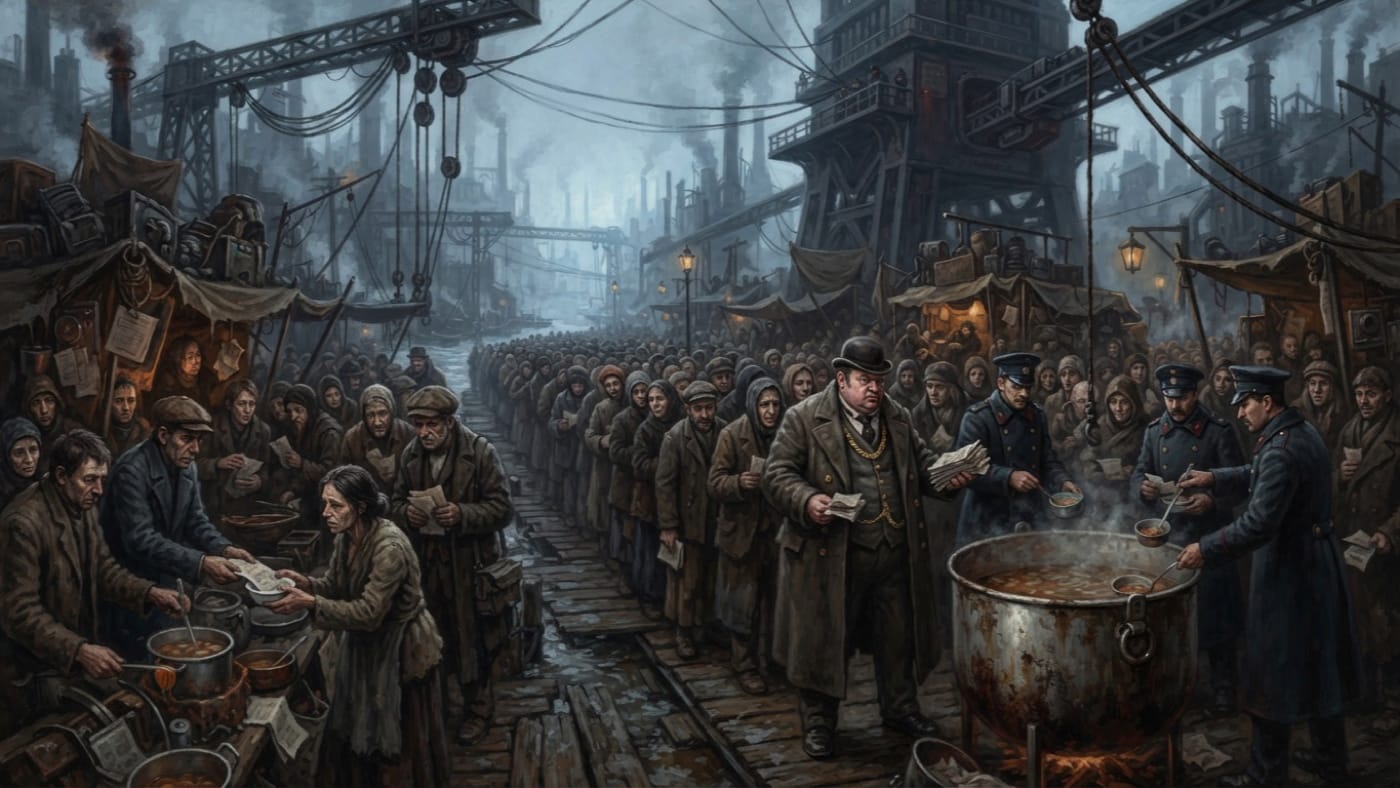
The market is a ward of planks laid over mud, with gantry timber and tarred cable above it and river rot rising from beneath. It opens at dawn. It closes when the food runs out, and the food always runs out before the queue does. Between those two hours the fifth node does one thing, which is food exchange, and gives off one smell, which the Chain's own register lists as broth and panic. The broth steams. The panic needs no heating.
The goods come from the river and the barges: stew fish, hard bread, and greens washed in lye. That is the Chain's general diet, though no auditor has gone stall to stall to confirm it. What waits for those goods is the queue, and the queue holds paper. On the Chain the paper is always damp. Only the ledgers stay dry, at the Transit Office's expense and for the Transit Office's comfort.
#On Slips and Supper
A ration slip is an entitlement written down. It says that the bearer may eat, and with the Synod's usual exactness it says how much and for how long. Once that period ends, the slip expires, and a renewal must be sought before the bearer has any right to eat again. Hunger does not expire with it.
An expired slip is called a dead chit. The name frightens the queue more than it should. It refers to the death of the paper and says nothing of the person who held it. A dead chit is supposed to be void. In the fifth node it circulates. The brokers revive dead chits with forged validation, or they pass them to vendors who know exactly what they are being handed and take it anyway, because a vendor who turns away doubtful paper in a starving ward soon has no customers and a crowd standing too close to her stall.
A ration chit is a different instrument from the minute-blocks issued at Ink Dock. A minute-block buys time in the queue. A chit buys broth. A cargo seal moves a crate, a lye stamp moves a body past Node Four, and a discrepancy confession turns a lost sack into an offering made to Providence. All five are stamped paper. Each grants a different right, and a clerk will refuse one when shown another, however hungry the person holding it.
By the Chain's own reckoning, one minute-block costs about a day's bread ration. The queue-liner therefore faces a sum that requires no arithmetic. Whoever spends the dawn in the market loses a place in the lanes. Whoever keeps that place goes without breakfast. Selling minutes for food buys a meal and loses the morning's crossing, and buying minutes with food wins the crossing on an empty stomach. The proverb above puts it in five words, which is more than the Transit Office has managed in any circular.
#On Those Who Set the Price
The brokers reach the market before the queue-liners do. Prices are settled before the sun clears the gantry towers. By the time the hungry arrive, the morning's price has been fixed with the calm of a well-run siege.
The Ration Slip Brokers are a cartel. They say their purpose is to help families eat, and it is the most dangerous kind of public motto because it is partly true. Families do eat through them, and they can eat no other way. The cartel's real aim is to own the food queue. It works through forged chits, intimidation, and debts structured so that a family repays one breakfast with the next three. The fifth node is its territory, and the cartel claims nothing outside it.
Like every Chain monopoly, it lives on other people's consent. It needs vendors willing to take dead chits and customers who have no alternative. It also needs the Bureau of Records to remain ignorant of how many dead chits are in circulation. That ignorance is ensured by Chain ledgers that report perfect throughput, kept by clerks whose careers depend on that report.
These brokers should not be confused with the Ferry Chokepoint Brokers, who sell passage and the paperwork that comes with it. One trade sells your way across the river and the other sells your meal. A traveller may pay both before noon. They are separate trades all the same.
The formal powers of the Chain Superintendentate reach the market without entering it. Halvick Sorn decides when the barges move and when they stop. Lysa Kett decides whether there is rope to move them on. Merrow Venn decides who gets arrested and what gets confiscated, and the published record shows that what she fears most is a riot at this market, at the hour when the broth runs out before the queue does. Her fear concerns a riot that has not happened yet. Captains of provosts do not station squads against crowds they think imaginary.
#On the Twelve Beneath the Planks
The fifth node holds one incident in the records that no stall ledger contains.
In fog, the wet mainline cables of the Chain darken from within and write. This is the River Ledger, and I have written about its methods elsewhere at a length the Bureau of Doctrine has not yet forgiven. On one occasion the rope wrote the numeral 12 beside the mark that stands for the Ration Slip Market. The writing was on the rope. It was not on a chit, a signboard, or the market floor. The writing was on the hemp, where the Ledger always writes.
The next morning, twelve children were found beneath the market planks.
They were alive. That fact belongs ahead of every other, and I have put it there.
The Reed Mothers claimed the children. The Transit Office claimed the blankets.
The record ends there, and so does what I can lawfully say. It gives no names. It does not say where the children came from, who brought them under the planks, how long they had been there, or what has happened to them since. It does not say whether anyone hid them, kept them, or lost them. Crawlspaces under the dock planks run along the whole Chain and are used for hiding. That is a fact about the Chain. It explains nothing about these twelve, and I will not let it pass for an explanation.
The record also gives no date. The River Ledger has been writing faster since A.S. 199, and in A.S. 200 it wrote fourteen names at Node Seven in a single event. Neither of those dates belongs to the twelve. Any clerk who wants to give the incident a year will have to find one in evidence I do not possess.
My earlier entry called the children unpaid for. I let the phrase stand and decline to improve it. It names no buyer and no sale. It records that the market's ledgers had no column for them.
#On Closures and the Queue
The market's troubles begin elsewhere. When a closure is chalked onto the master slate at Ink Dock, the ration market downstream feels it before anyone else does. Barges that do not cross deliver nothing, and the cartel reprices on a rumour faster than the Transit Office can issue a denial. A Lye Order cordon pushed outward at Node Four holds food and people at the Piers alike. When Kett's rope runs short, crossings are cut and the stew pot is filled to a lower mark. Meanwhile the Queue Road keeps sending more people than the ferries can move, and every one of them arrives hungry, holding paper.
Throughput along the whole route has fallen nine percent over three seasons. That figure measures the Chain from the Upper Splice to the Mouth. It is not a count of market sales, a reckoning of rations issued, or a census of the fifth node, and nobody has measured any of those things. A figure for the whole route says the river carries less. It does not tell anyone how much less reaches a particular bowl.
Throughput on the Rope-Ferry Chain has declined.
Retracted by the Synod Transit Office, A.S. 201, for the entire route. Throughput has been restructured to give doctrinal cargo priority over civilian supply. The nine percent is unchanged. The fifth node lies on the route, and its civilian supply is subject to the restructuring.
Shortage and collapse are different conditions, and any honest survey must keep them apart. Shortage is the present state of the market: dear bread, revived chits, a queue that grows longer while the pot grows shallower. Collapse is what Sorn fears in private. One node breaks, and the hunger spreads downstream to every node below it. The second has not happened. The first happens every morning. The Black Ferrymen do run the river at night, but nothing in the record shows the market being fed by them, and I decline to take their kindness on rumour.
#On the Present Condition
This survey describes the market as it stands in A.S. 201.
The Ration Slip Market is operating. It opens at dawn, the brokers arrive first, and the prices are fixed before the gantry towers throw a shadow. Dead chits change hands. Vendors take paper they know is false because the paper they could honestly refuse would be followed by a crowd. Provost squads keep to the approaches. The food runs out before the queue is served.
Tomorrow's market depends on what crosses tonight and at first light: barges released by the slate, carried on cable that Kett has certified, past cordons that the Lye Order has not yet moved. Nothing is stored in the fifth node. The market can sell only what the river delivered that morning.