

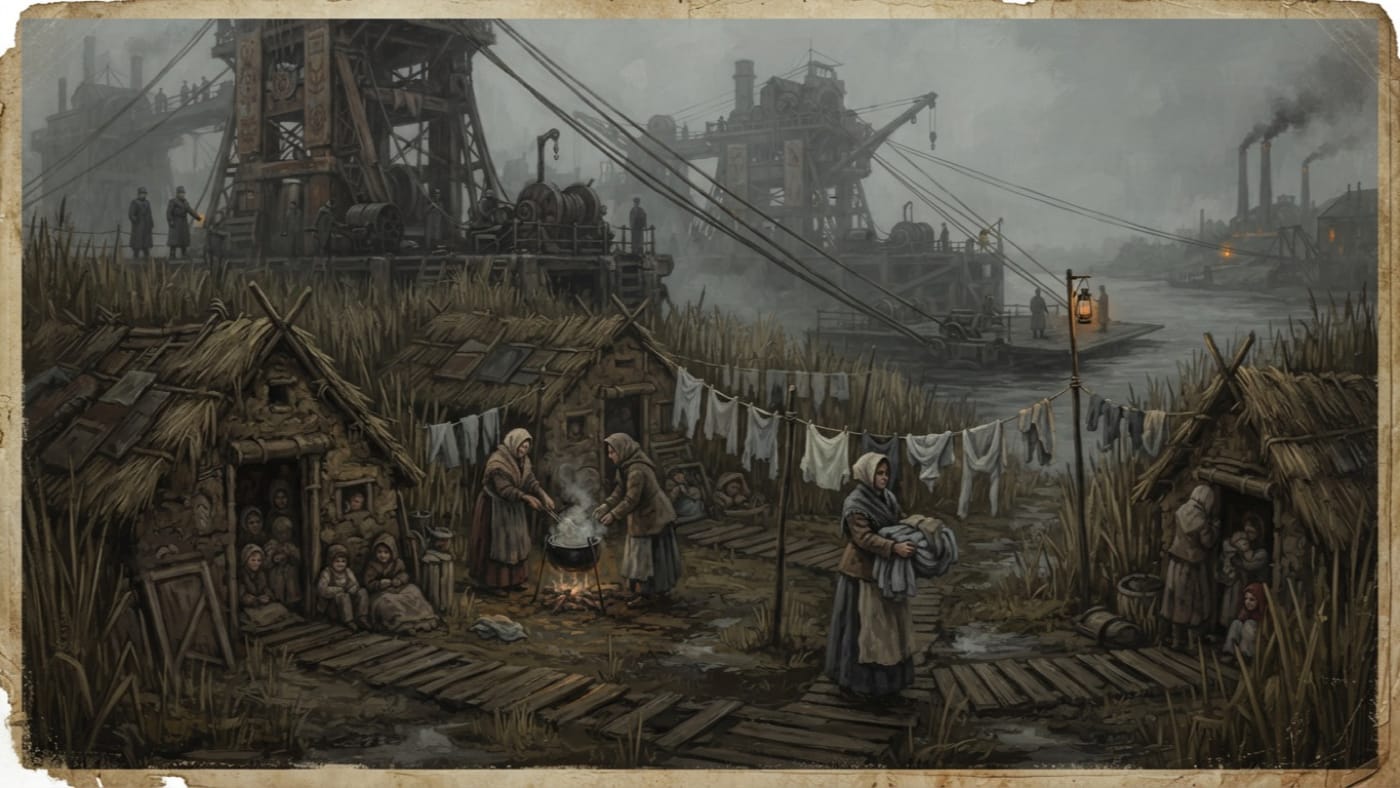
#On Those Left Behind
"Every soul is processed." — standing assurance of the Synod Transit Office
The Rope-Ferry Chain processes everyone. The Synod Transit Office says so in every quarterly return I have read, and the Transit Office does not lie. It files. Every soul who reaches the river is stamped, washed, weighed, queued, crossed or detained, and each season the ledgers close on a balance clean enough to serve communion from.
Behind the Quarantine Piers at Node Four, where the river shallows into marshland, the remainder of that balance is kept in reeds. The Reed Mothers maintain their huts there. They shelter the children of people the press-gangs have taken. They nurse the sick whom quarantine has refused. They hide the people the Chain's registers have decided do not exist. These are three separate labours done for three separate kinds of abandoned person. The Mothers do not confuse them, though the provosts usually do when they raid.
They hold no licence and no sanction. Nobody in my office can name a founder, a foundation year, a superior, a rule or a headcount. I have looked, because a body without a charter is a body I am expected to explain. The title of Mother proves nothing. Some of them are mothers and some are not. The marsh does not ask. On this one point the marsh and the Bureau of Records agree, which is rare.
#On Shelter and Nursing
The huts are low and reed-thatched, set on mud and plankwood, and they smell of boiled cloth. As far as any witness has reported, boiled cloth is their whole pharmacy. The cloth is boiled, wrung and hung, then boiled again and wrapped around a fever or a child or both. They share warmth because there is too little of it to ration. A hut rated for four by inspection standards holds eleven by night. Nobody counts them, which is the point of the hut.
The children of the pressed come without papers, because the press-gang takes the parent's papers along with the parent. The sick come from the Piers with revoked stamps, and on the Chain a revoked stamp is a sentence rather than a diagnosis. The Lye Order washes travellers in lye and turns away those it judges unclean. The refused must go somewhere. The regulations are thorough about refusal and silent about where the refused should go. The Mothers' huts are where they go.
The crews call a hidden shelter a reed-room. The word has spread up and down the Chain. I note with professional envy that a slang term coined by people who cannot read has travelled further than any circular I have ever sealed.
During my second inspection the Mothers asked me to intercede for them with the Bureau of Mercy. My answer was correct. The Bureau's jurisdiction does not extend to unofficial settlements in unlicensed flood zones, and I could quote the principle and very nearly the page. They asked whether mercy itself had a jurisdiction. I did not answer.
#On Laundry and Passage
Paperwork withholds help. Laundry tells people where to find it. The arrangement of cloth on the Mothers' drying lines signals safe passage, danger, a provost patrol or food available. I cannot supply the code. Nobody who knows it has offered it to a Warden of the Sacred Ledger. I am also told that on the reed flats a man who stares at washing for long enough is taken for a provost or a lecher, and neither reputation helps an inquiry.
Under the shelter runs the means of escape. Tunnels through the reed beds connect the huts to culvert mouths that open onto the river upstream of the Piers. I have not walked them and have no survey of them. The Transit Office maps show reeds, and in fairness reeds are what is there.
Where the culverts reach the water, the trade of the Black Ferrymen begins. Their crews run skiffs and hand-lines through the reed channels after curfew, for a fee, for anyone the daytime Chain has shut out. The Mothers do not command the ferrymen, and the ferrymen do not answer to the Mothers. They need each other often enough for crossings to happen and seldom enough that neither side calls it an alliance. Keep the signals apart in your head. The laundry belongs to the Mothers and the changing lantern codes to the ferrymen. The raid warning belongs to neither of them.
#On the Raids
The provosts raid the reed flats twice a year. The squads arrive, break the huts, take what is left and go. Within a week the huts stand again, and then the provosts come back. The arrangement keeps the regularity of a liturgical calendar and offers about as much surprise.
Before each raid a provost lantern shows from the flats: two short flashes, then one long. The Mothers move whatever can be moved. Nobody has shown me an order authorising the lantern. Nobody has shown me one forbidding it either.
The published survey of the Chain ties the warning to Provost-Captain Merrow Venn. She has three children of her own, and she understands that a Chain without the Mothers would be a system without a pressure valve. I add nothing to that account and take nothing from the rest of it. Venn orders the raids. The lantern does not rebuild a hut. It does not return a confiscated blanket or restore a hiding place once a squad has kicked it open. It grants an interval. On a river where minutes are sold by the block, an interval handed out for free is a considerable gift. It is still no charter.
#On the Names in the Rope
Fog wets the mainlines, and the River Ledger writes names, numbers and cage-counts into the hemp before events make them true. Provosts read the rope for leverage and brokers read it for profit. The Mothers read it for instructions.
When a child's name appears, they move the child. When a widow's ration number appears, they hide the chit. When a cage-count appears beside a known deserter, they cut a reed-channel skiff loose and leave the rest to the Black Ferrymen. None of this requires them to understand the rope. Several Bureaus understand it no better and are paid for the attempt.
The rope once wrote "12" beside the mark of the Ration Slip Market. The next morning twelve children were found alive beneath the market's planks. The Mothers claimed the children. The Transit Office claimed the blankets. I have no date for this and no names. I have no account of how the children came to be under the planks and no record of what became of them. The file ends with the blankets, as files generally do.
Transit Office tabulation: recorded successful interventions by unlicensed persons at Node Four, nil. Inference: Reed Mother interventions ineffective; continued tolerance unwarranted.
Withdrawn. The tabulation counts only the interventions the registers recognise, and the registers recognise none. A column that cannot hold a figure proves its own limits, not that the figure is absent. The published account of the River Ledger holds that the Mothers' unofficial effectiveness is why the provosts raid their huts twice a year instead of burning them. That is an assessment. No audited rate exists, and this office will not invent one.
A child the Mothers move is a child who is not where the rope said. Nobody can say whether the rope was wrong, was outwitted or meant some other morning. The Bureau of Alchemical Standards has not ruled on it. The Node Seven substructure file remains under seal, and I have no wish to be the one who opens it.
#On the Present Necessity
It is now A.S. 201. The Ledger has written faster since A.S. 199, and in the winter of A.S. 200 it wrote fourteen names in a single event at Node Seven. The quarantine cordons widen and the rations shrink. The Queue Road sends more bodies than the ferries can process, and every body the Chain cannot process has to stand somewhere. More and more of them stand in the reeds.
The Mothers are more necessary than they were. I cannot certify that they are more numerous, better supplied or more powerful. I also decline to call them a resistance, a government or a holy order, since they hold the paperwork for none of these. What they have is boiled cloth, drying lines, tunnels and the habit of rebuilding. The provosts have the lantern and the raid. Strasbourg has the quarterly return, and the return shows that everyone was processed.