

#On a Name Borrowed Twice
This entry was compiled in A.S. 201 / 1911 CE. The year belongs to the compiling. No register I hold gives the year Red-Three was built, and none explains why it was named.
Red-Three is a housing line and shift block in the Boiler Commons, the worker belt in the second ring out from the Chrismole Crown of Brast. It runs along the lower east heat trunk. The Commons names its pipe-alleys after bell schedules rather than saints: Red-Three, Blue-Six, Kettle Row, Ninth Sleep, Lower Rack. The district account includes Red-Three in that list and says nothing more about the name. A colour and a numeral. Some clerk once knew what they meant. That clerk is not available for comment, and I do not interview the dead without a warrant.
The name has been borrowed twice, and both loans need recording before the address does. In late A.S. 201 Red-Three was one of three districts that sent workers to the wards in the mass fume fever. Since then the canteens have used the block's name as though it were the illness. Separately, the War procurement tables use "Class Red-Three" for a grade of hymnsteel, a metal forged at Essen that has never slept along anyone's heat trunk. This compilation keeps all three in separate drawers.
District register, Boiler Commons, known hazards: "fume fever Red-Three."
Corrected. Red-Three is an address. The fever has its own entry and is filed beside the Gauge Ward and Still-Canal South. An address cannot spread a fever. In Brast it can still be fined.
#On Three Halls and an Arcade
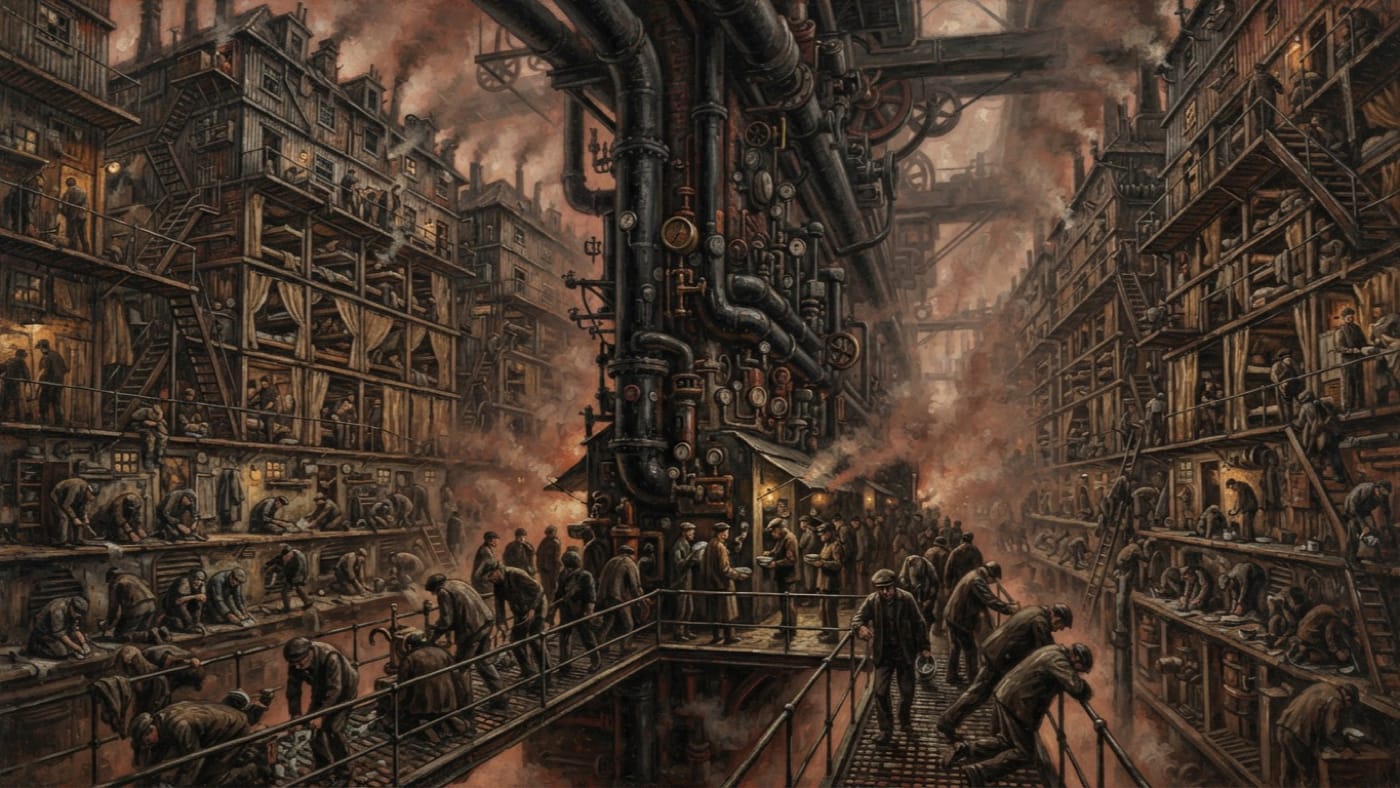
The district account gives Red-Three a small, exact outline: three barrack halls leaning toward a pipe arcade gone black with years of condensation soot. That is the entire architectural record. It gives no plan, no boundary, no rack count, no building date and no headcount. The Commons as a whole is overfilled by every figure the Bureau has issued. I decline to carve a block's population out of the district's numbers and pretend the knife was calibrated.
"Leaning" is the account's word, and a good one. In the Commons a hall leans toward heat the way a petitioner leans toward the magistrate's bench. The arcade carries the warmth and the halls sleep beside it. Whether the lean is in the timber or only in the soot is not recorded. Brast has never asked its carpenters to testify.
The work is recorded precisely. Red-Three workers feed secondary lines, scrape ash from low vents, turn kitchen heat baffles, and do the unnamed maintenance that keeps the great furnaces handsome from a distance. Triumphal engravings show such workers as smoke. From the balconies of the Gauge Ward, smoke is roughly what they look like.
Proximity is the whole argument for the place. The Commons grew along the heat trunks because a feeder who lived near the pipe answered the bell faster, and a feeder who answered the bell faster kept his allotment. Red-Three applies that logic without decoration. The vent-scraper sleeps a short walk from his vent, and the baffle hand's bed is warmed by the line he will turn at the next bell. The job and the bunk share one address. This is efficient for the Ordnance Bureau and unfortunate for any worker who hoped to leave the job at the door. The halls have no door the job respects.
The district account describes racks stacked five high in the older halls and seven high in the newer economy blocks, along with family cubbies walled off by sackcloth and prayer boards. It does not say which kind of hall Red-Three's three are, or who sleeps on which tier. The Commons custom is recorded. Red-Three's own arrangement is not.
#On the Queue and the Column
The district account calls Red-Three a shift block, a housing line, a ration queue and a debt column. That is four nouns, and the Ordnance Bureau holds the pen for every one of them.
The governing machinery belongs to the whole Commons. The Heat Allotment Office, set up in A.S. 118, gives each barrack line a pipe quota according to the value of its shifts. That year marks a milestone for the Commons. It says nothing about Red-Three's age, and nobody should copy it under this heading. Warm chits began as heat-ration markers during the furnace expansion. Since then they have become wage, rent, fine and leash. Each Commons kitchen is assigned to a shift block. Each bowl is marked by heat class, labour class and household debt. If a worker misses a bell, he loses warmth. If he owes warmth, he repays it with overtime, informing or confession, and the heat debt column keeps the arithmetic for his household as well as for him.
Red-Three's own figures are absent: its quota, its kitchen, its ledger. Its rank can be partly inferred. The district scale puts furnace feeders above slag sorters, and Red-Three feeds lines. The account also records a fourth-bell cup of salt-fat given to furnace feeders before deep-heat shifts. In A.S. 190 that cup started the Salt-Fat Panic. A rumour spread that foremen were getting clean marrow while Red-Three feeders were getting rendered boot. The account calls the rumour false in detail. It does not say which details, and nobody in the Commons asked for a correction.
#On the Fever That Passed Through
In late A.S. 201, thirty-seven workers came down the intake road to Ash-Hospice Row within two bells of one another. They came from the Gauge Ward, from Still-Canal South in the Still-Canals, and from Red-Three. The intake desk counted eighty-one by morning and one hundred and twelve by the next pressure cycle. These totals cover the whole cluster. The public accounts give no figure for each district, and anyone who quotes a Red-Three subtotal is quoting broth.
The Sisters' intake columns record what the patients did not share: a meal, a barracks, a foreman. They also record what the patients did share: chrismole exposure, the night roar, and a fourth-bell hymn that the Row's account says had run irregular. Shared exposure and shared timing are the conditions of the whole city. They establish no cause, and this compilation names none. Brast civic notice 201-F called the cluster "seasonal particulate irritation." That phrase belongs to the notice. The Sisters' tract records a second wording, "ventilation recurrence," and reports that their own checks of logs, feedstock, filters, hymn schedules and rosters turned up no ordinary cause that held still long enough to be blamed.
The Row sits in Brast's western arc, downwind of the Crown, where the soot was already going. The Ash-Hospice Sisters took the dishes from the fever beds and reported ash forming names in them. Some names belonged to the dead. One belonged to a man still alive and still assigned to Red-Three. The Sisters moved his bed twice, and by their account the ash spelled him correctly in both beds.
The Sisters' tract says some ash has written since A.S. 199. The Row's account keeps to the late-A.S. 201 cluster. This compilation does not reconcile the two, and Doctrine has not asked it to. The Sisters' Ledger B-19 remains withheld, and its contents stay with it.
The Row records one more relationship, and it concerns the whole Commons. When a man enters the wards, his family inherits his heat debt. The Sisters sit at kitchen tables and explain this slowly, twice. No account documents a particular Red-Three household in that position. The rule needs no particular case to do its work.
#On the Racks Inspected and the Canteen Swept
After the seven sealed drums vanished from the Manifest Court's inventory in A.S. 201, provosts under Commander-Auditor Sorn Vale inspected the Red-Three racks. The district account lists the haul: counterfeit warm chits, three unregistered heat bladders, a false seal press, two quiet hymn slips, and no drums. It adds that the workers watched the provosts take the press and leave the fever behind. That is the account's sentence. I let it stand, because it needs no help from me.
The Boiler Commons canteen sweep is a separate matter, and nobody should stitch the two together into one raid. The sweep came at mid-meal, in a Commons canteen, at some point after the drums were lost. The published record gives no year and does not say which canteen. Its auxiliary filing lists its own inventory, and that inventory differs from the rack list. Two accounts mention two presses. Officially, nobody owns the canteen press. Nothing in either account establishes that the canteen was in Red-Three, or that any press, slip or bladder had anything to do with the fever.
The district account says the Red-Three canteen talks in fragments. "Dish" means a death notice. "Warm" means watched. Those are the account's glosses, and I print them as reported. A worker who calls warmth surveillance has been reading the right ledger.
Cross-reference index: "Red-Three (Boiler Commons): see also Hymnsteel, Class Red-Three."
Struck. Class Red-Three is a War supply classification for hymnsteel produced at Essen. No record links it to the halls on the lower east trunk. Brast and the procurement tables share the name, and nothing else.
#On the Present Condition
As of this A.S. 201 compilation, Red-Three stands where the district account put it: three halls leaning toward a sooted arcade on the lower east trunk. Its workers feed the secondary lines, scrape the low vents and turn the baffles at their bells. The account notes that officials now walk through it more slowly than policy requires. Whether that is caution, ceremony or fear is not recorded. The fever dishes remain in the Sisters' custody. The seven drums are still missing. The man the ash spelled is still assigned to the block, by the last account that names him without naming him.
The Bureau of Doctrine records the address, the work and the sequence. It records no cause, because no account supplies one, and the Bureau does not fill empty columns with whatever is circulating at the back hatch. Red-Three will answer the next bell either way.