

#On What the Ledger Admits
This entry was compiled in A.S. 201 / 1911 CE. That is the only year in it that carries no doubt. Its subject is small and sharp: the Manifest Court of Brast sent its men into a Boiler Commons canteen while the canteen was eating. The published Court account places the sweep after the loss of seven sealed drums. It puts it in the same season of tightening that tripled the witnesses at the eastern gate, reweighed convoys already certified clean, and fitted dispatch cages with bell-hour locks.
Past that placement the Ledger goes quiet. It gives no year for the sweep. It gives no count of those taken, no names, and no account of what became of anyone afterward. I was not in the canteen. I have the account, the registers of the Commons, and a professional appetite for a well-timed intrusion. Appetite is not evidence, and I have kept it at the side of the plate.
#On the Commons and the Price of Heat
The Commons houses the people who feed the furnaces of Brast. It holds barracks stacked against heat their occupants cannot afford, ration kitchens, and canteens where soot bread meets marrow broth and bitter tea. The canteen is one of the few rooms in the district where a shift sits down together. Brast's registers list the Commons canteens among the city's gathering places, beside the Slag Market, the hospice steps and the catwalk shrines. To the worker a gathering place is a comfort. To the auditor it is a census.
Warmth in the Commons has a price, and the price has paper. Ration chits buy the bowl. Warm chits, the district's heat credits, buy the right to be less cold. They pass from hand to hand as money and close around the wrist as obligation. Whoever burns more heat than they have earned falls into heat debt. Brast allows three ways to pay it off: overtime, informing, or confession. Each payment is a column in somebody's ledger, and each makes the debtor easier to read from above.
Seen from a counting house, a canteen at mid-meal looks like this. Every kind of chit circulating in the district passes near those tables. Every debtor in arrears sits fed, still, and unable to be anywhere else. Every quiet bargain over a bowl happens within arm's reach of strangers. None of this proves that anything was wrong in the canteen the Court entered. It proves that the Court chose the one room in Brast where any wrongdoing present would be sitting still.
#On the Seven Drums and the Tightened Count
In spring A.S. 201 / 1911 CE, seven sealed drums of chrismole vanished from the Court's inventory. They had passed double witness. They held enough heat, range and bargaining power to matter in any hands that held them. Commander-Auditor Sorn Vale, whose balcony overlooks the Court floor in the Rail-Manifest Quarter, answered with the instruments he trusts. The wider investigation is recorded in the Missing Drums entry and in the Court's own account. It produced fourteen arrests, three confessions and no recovered fuel.
Those figures belong to the whole response. They are not the canteen's figures. Any clerk who copies them under the canteen's heading will be corrected by me personally, in red, at length.
Custody changed before anyone's supper did. At the eastern gate, where drums leave for the Line, double witness became triple. That meant a third pair of eyes, a third mark in wax, and a third person who could later be asked why they had seen nothing. Convoys already certified clean were pulled for random reweighing, which teaches a handler that a certificate is a loan and can be called in. Dispatch cages received bell-hour locks. The account names the locks and gives no mechanism. The name ties the cages to the Court's bells, and that tie is all I will assert.
All three changes concern fuel in custody. The canteen sweep belongs to the same season of nerves and to a different kind of object. A drum can be reweighed. A hungry district can only be searched.
#On the Interrupted Meal
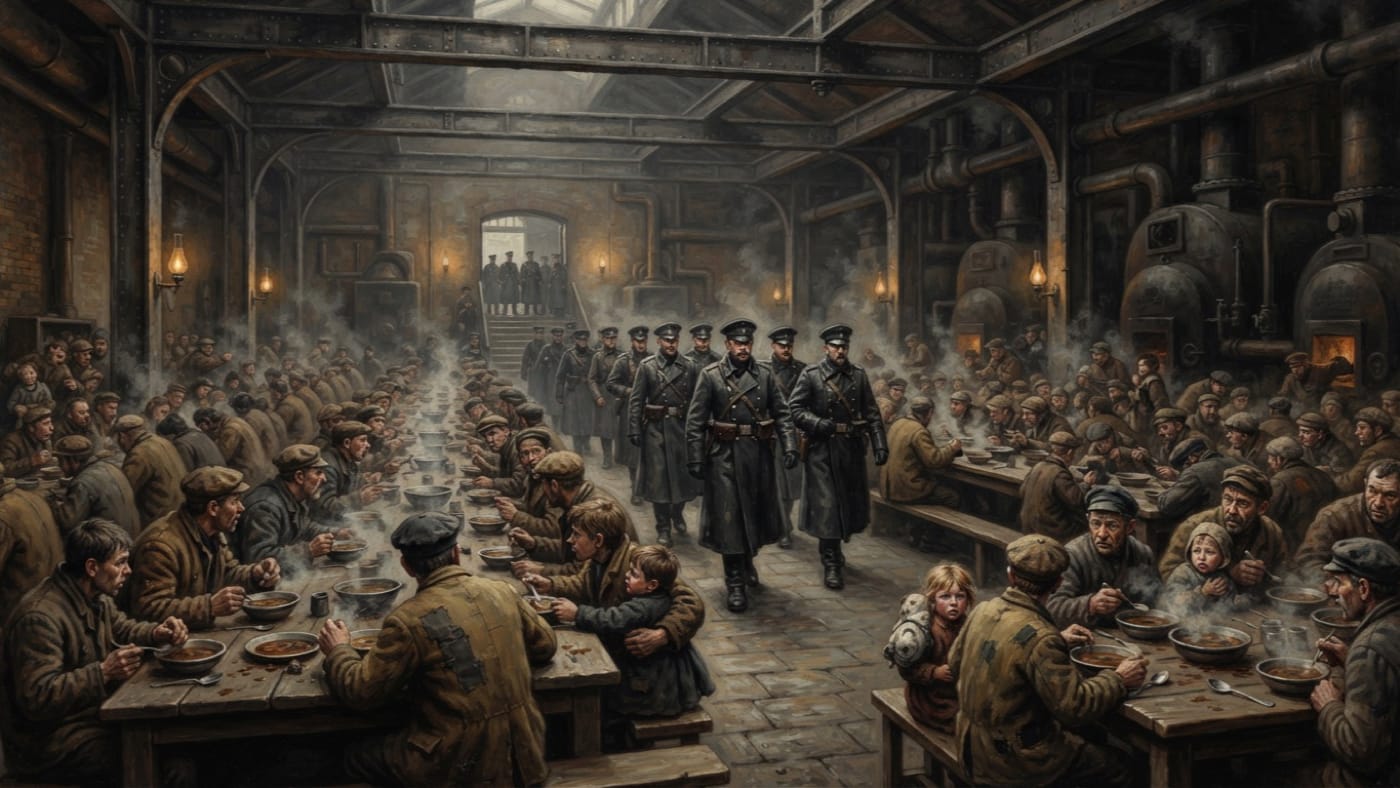
The Court's published account gives the sweep a few lines. It says the sweep came at mid-meal. It observes that full mouths answer badly, that hot bowls prevent graceful escape, and that children become crowd pressure before witnesses can decide whether they are victims. I wrote those lines into the Court's entry myself and admitted there to professional envy. I do not retract the envy. It was a reader's envy. I stood in no doorway.
An auditor reads the timing plainly. A furnace feeder questioned at the bench has hands and story ready, because the bench is where questions are expected. A feeder questioned with broth in the mouth must swallow before lying, and the swallow can be seen. A bowl hot enough to be worth Brast's prices cannot be dropped without scalding someone on the same bench, so the hands holding it stay where they are. Moving becomes costly and speaking becomes slow. The room had been the one place the shift belonged to itself. Between one swallow and the next, it belonged to the Court.
The children are the hardest clause, and the account offers them without commentary. A Commons canteen at mid-meal holds whoever the Commons feeds. Small bodies that no one will question still take up floor. A parent who might have moved will not move without them. The crowd thickens around its own young and, with no order given, becomes its own cordon. The account says nothing of injury, so neither do I. It names no child, no parent, no officer and no door.
Whether Vale came down from his balcony for the occasion is unrecorded. His authority reached the room. His boots may not have.
#On the Limits of the Filing
The Court's entry reproduces, under black bars, an auxiliary filing on the sweep. That filing is a claim, and the Codex prints it as one. It lists minor articles said to have been taken in the Commons. It records under its own heading that no drums were recovered. It leaves one figure blacked out and ends with a disposition declaring order restored. No one has checked its inventory independently, and this compilation does not repeat it as fact. The blacked-out figure stays blacked out.
Its heading also carries a year.
The auxiliary filing reproduced in The Manifest Court heads its entry "MANIFEST COURT AUXILIARY SWEEP — BOILER COMMONS, A.S. 201," and the Boiler Commons entry repeats that year for the canteen sweep.
Corrected. A.S. 201 dates the loss of the drums and the compiling of this entry. The record places the sweep after the loss and gives it no year. A clerk's heading can be confident. Confidence is not a register entry.
The record establishes three things. A sweep entered a Boiler Commons canteen. It came at mid-meal. It came after the drums went missing, alongside the tighter custody at the gate and the cages. The list of what it cannot establish is longer: which canteen, which year, which bell, how many people were seized, what charges were laid, which confessions were given or refused, how each case was settled, and whether anyone the Court removed came back to the bench.
A list of small contraband, however proudly drawn up, does not answer a question about seven drums. A forged warm chit and a sealed drum of chrismole differ greatly in weight and even more in consequence. By the Court's own descriptions, the Warmth Thieves who bleed fuel between the Still-Canals and the Slag Market have the skill to move heat in small measures. Skill is grounds for suspicion. It is not a finding, and nothing in this record turns it into one.
Compliance and recovery are kept in separate columns. A sweep can fill the first to the margin and leave the second blank.
#On the Account Still Open
As of this compilation, the drums are still missing. Nothing in the Court's account relaxes the triple witness at the eastern gate, the random reweighing of certified convoys, or the bell-hour locks on the cages. Whatever the canteen gave up to the Court, it gave up no fuel the Court has announced. The Court announces recoveries with the eagerness other offices save for canonizations.
The Bureau of Records keeps custody of the Court's papers, the auxiliary filing among them. The Bureau of Doctrine witnesses the Court's authority and has found nothing in the sweep to object to. The Commons will sit down at mid-meal again under the same bell, at the same tables. It now knows what the Court wanted it to know about where it is safe to swallow.
The filing's own disposition says order was restored. The drums were not. The Ledger records the first as a statement and the second as a debt.