
#On the Water That Cools Sanctity
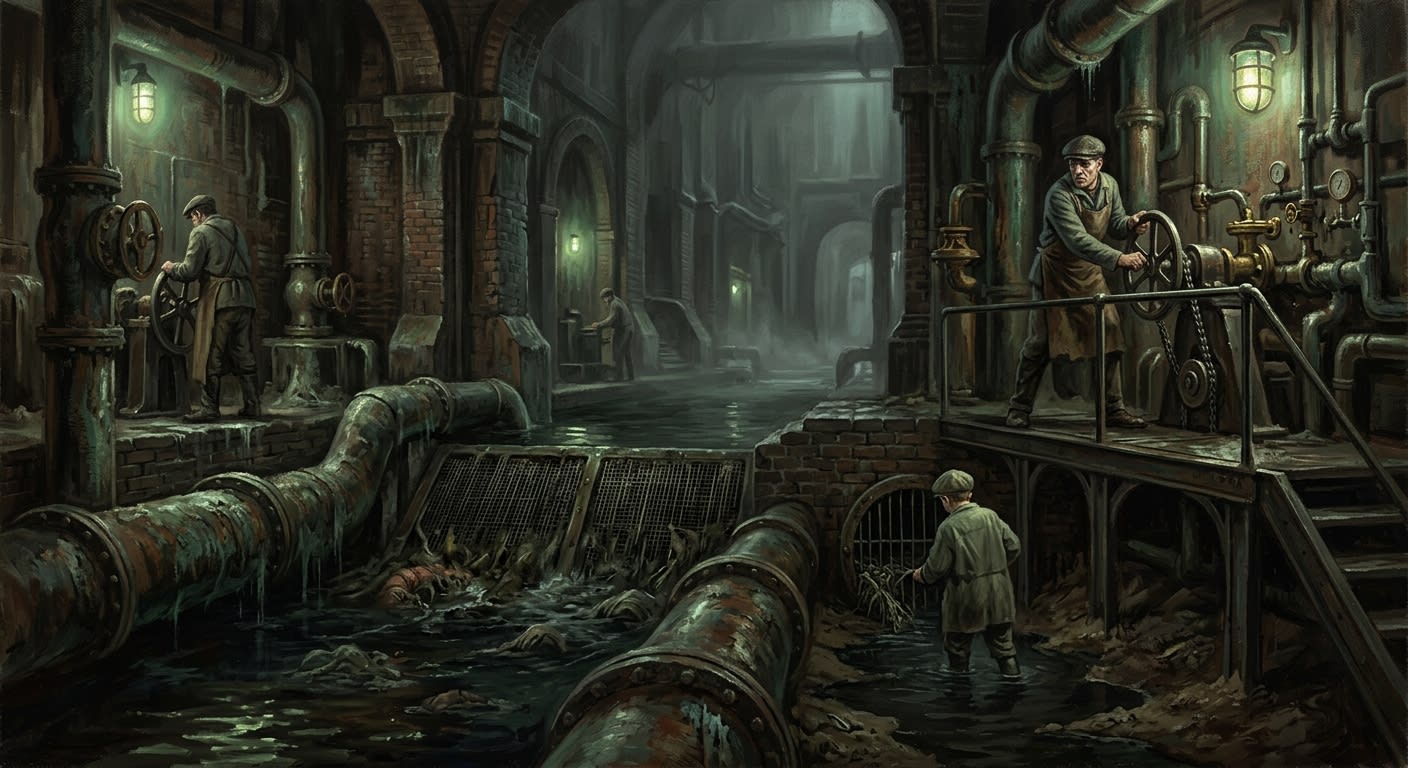
The Still-Canals are the black-water condenser channels south of the Chrismole Crown at Brast, where half-made fuel sweats through pipe, mesh, lock, prayer, solvent, algae, and useful omission before entering the sanctification nave to be sung into lawful violence.
Call them canals if it comforts the provincial imagination. There are no lovers leaning over stone parapets, no painted barges, no boys throwing pebbles at patient fish, no washerwomen beating linen against sun-warmed steps. The fish had better theology and left generations ago. What remains is black cooling water moving between iron walls, wax-sealed sluice wheels, condenser lines hot enough to blister gloves, catwalks slick with solvent dew, lockhouses that smell of sweet rot, and narrow under-ways where a rag-boy may vanish with a hook in his hand and return three hours later older by one secret.
The canals exist because chrismole must be cooled before it can be blessed, and cooling, like confession, becomes more complicated once money discovers it. Raw feedstock enters the Crown at first bell: peat, coal, rendered tallow, and the fourth component called substrate by men who prefer their euphemisms short and their prison sentences postponed. Steam drives volatile fractions through condenser pipes into the canal galleries. Canal water takes the heat. The pipes sweat. Residue forms. Mesh clogs. Workers curse. Priests pretend cursing is not part of the rite.
At fourth bell, if the flow holds, condensate reaches the sanctification nave. There Kest’s Measures sing fourteen stanzas within three beats of the proper rate, and the half-obedient distillate becomes chrismole, which is ordinary fuel made extraordinary by survival, song, and an invoice bearing enough seals to make doubt expensive.
#On the First Channels
The first channels were not built beautifully. They were cut.
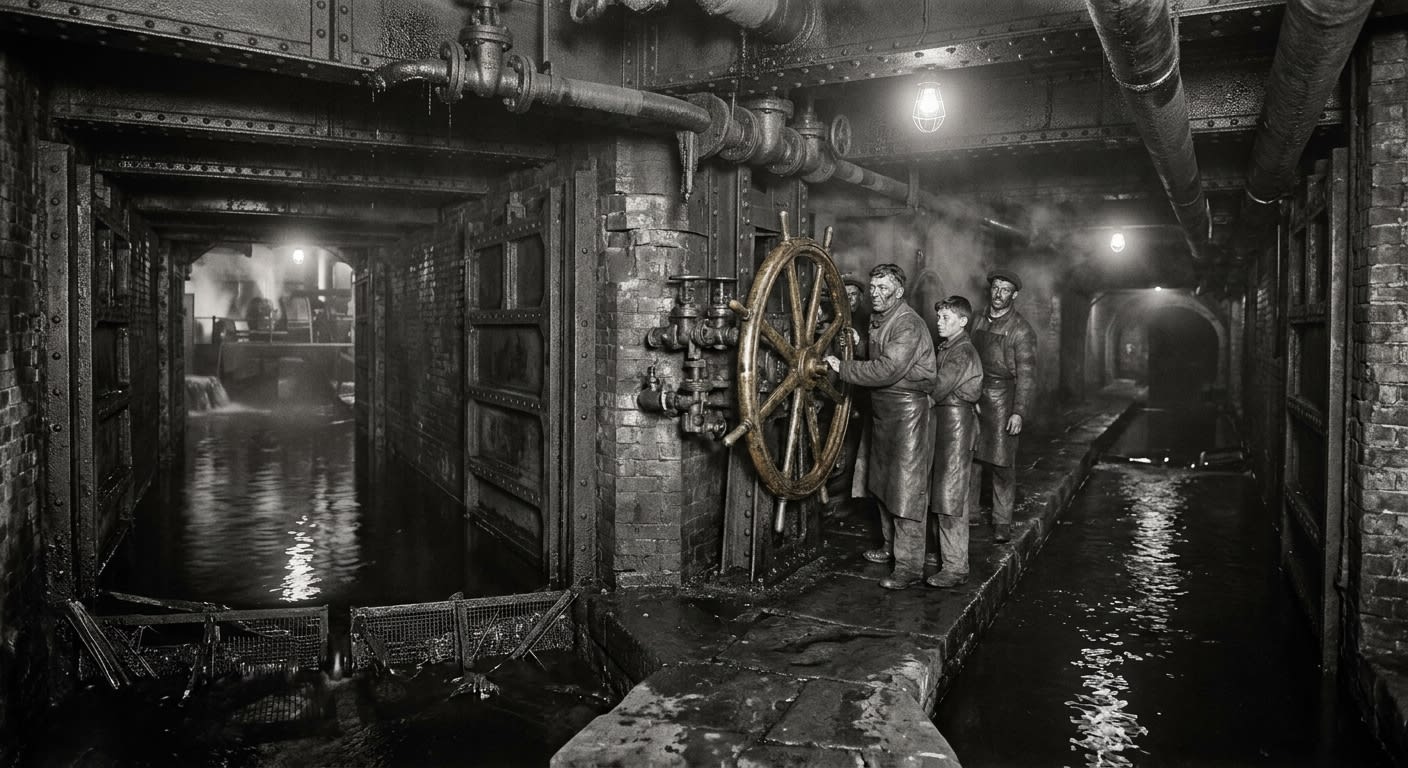
After the A.S. 68 requisition of the coal-seam rail junction, Brast’s earliest furnaces threw heat like a drunken archangel and wasted enough vapour to make an Ordnance clerk weep into his ration ink. The nameless logistics officer who seized the junction demanded fuel. Doctrine demanded that the fuel stop being embarrassingly secular. Engineering demanded gradient, water, pipe, drainage, and permission to say words like pressure without a priest coughing nearby. The first condenser run was a ditch lined with stone, a pipe supported on brick piers, and three men told to keep cold water moving or explain to the guns why theology had gone warm.
By A.S. 72, when the Cantor and fourteen choir-technicians arrived to make fuel sanctified by correct measure, the channels had become indispensable. This is always the order of Synodal recognition: first the labour, then the danger, then the priest, then the charter, then the tax.
The Still-Canals grew south from the Crown in crooked galleries because heat rarely respects elegant design. Each expansion followed a failure. A burst line made a wider trough necessary. A fouled mesh made a lockhouse necessary. A drowned filter-man made rails necessary. A second drowned filter-man made a warning plaque necessary. The plaque remains. The rails have been repaired twice and trusted never.
The early canal hands were furnace boys, widows’ brothers, failed choir applicants, soot-scrapers, and men whose criminal records showed useful patience. They learned by burns. They learned which pipe sang before rupture, which lockwheel needed two men and a prayer, which residue meant bad feedstock, which green film signalled harmless alchemical embarrassment, which blue film meant fetch a priest, and which pale crust should be scraped only after making peace with one’s creditors.
The Distillers’ Compact claims continuity from that first practical knowledge. It is not wrong. I record this under protest, since giving a guild credit for being correct encourages it to speak.
#On Locks, Mesh, and the Monastery Below
The Still-Canals are divided into upper channels, filter galleries, lock runs, under-locks, and the Canal South counting table. Maps exist. None are accurate after the third lock, and the best ones are held by men who deny holding maps.
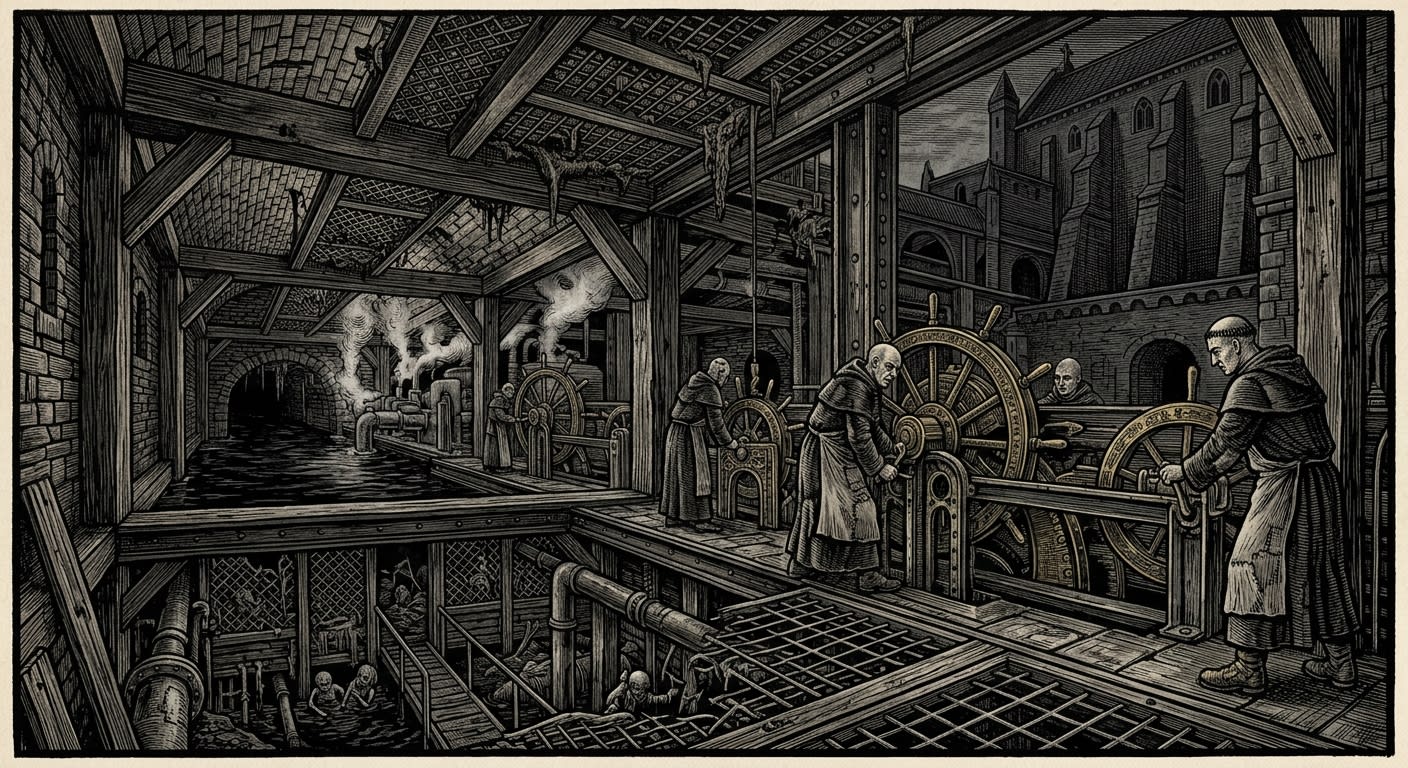
The upper channels receive the first hot sweat of the condenser lines. The water there moves slowly, carrying a faint luminescence that the Bureau of Alchemical Standards calls residual and workers call a warning. Along the galleries hang mesh housings: iron frames packed with layered screens, ash-fibre, bone-char, treated cloth, and certain Compact insertions whose names do not improve under daylight. Each housing has a serial scratch. The scratch appears in no public ledger until the Compact has already memorised it.
The lock runs govern cooling speed. Too fast, and the distillate shocks. Too slow, and vapour answers the pipe with pressure enough to make a man religious in pieces. Wax seals on the sluice wheels show whether a lock has been turned outside schedule. These seals are replaced constantly, forged frequently, and believed only by auditors new enough to possess hope.
Early Ordnance site notes described the Still-Canals as “auxiliary drainage and cooling infrastructure.”
Corrected. A drain does not decide whether guns fire. A ditch does not hold a city’s throat. A cooling channel whose locks can stop chrismole production is not auxiliary; it is a throne with algae.
Below the working level are the under-locks, brick crawls and service mouths where siphon crews, line auditors, apprentices, Warmth Thieves, and desperate mothers all learn the same posture: bent, breathing shallow, one hand on the pipe, one eye toward the lantern. The under-locks are warmer than the Boiler Commons and poorer than the Slag Market, which makes them attractive to children and criminals, two classes the Bureau separates in theory and arrests together in practice.
#On the Compact’s Custody
The Still-Canals belong in law to Ordnance, in filing to Records, in sanctified theory to Doctrine, in mechanical correspondence to Engineering, in every useful sense to the Distillers’ Compact, and in nightmares to anyone who has fallen into them.
Pex Ruln governs them by mesh, lock, debt, and timing. His predecessors learned that no official needs to own a furnace if he owns the filter without which the furnace becomes a monument. Ruln inherited Maer Voss’s lock lists, emergency mesh stores, substrate receipt habits, and the little oral catalogue of which office panics after one bell of delay and which after three. His hands are permanently oiled. Men pretend this is occupational staining. I prefer to call it heraldry.
The Compact’s hierarchy begins with rag-boys, who scrape residue and learn silence before literacy. Above them stand filter-men, lock-keepers, receipt clerks, mesh masters, master distillers, and the Guildmaster himself, seated less upon a chair than upon the accumulated terror of clogged screens. Compact oath is spoken over a basin of blackened solvent. The basin is changed when the solvent begins reflecting faces not present in the room.
The Compact’s custody inventory is brutally plain: bone-handled hooks, mesh keys, wax seal knives, solvent masks, receipt slates, condenser filters, lock schedules, emergency screens, substrate receipt chain, and delay. Public posture: service. Private posture: ownership by necessity.
Ordnance protests Compact monopoly in memoranda sharp enough to shave with and weak enough to file. Vale’s Manifest Court demands receipts. The Chapterhouse demands blessings. The Choir demands flow regular enough to sing over. The Compact supplies all three, late enough to be remembered and early enough to avoid hanging. That is statesmanship in Brast.
#On the Smell of the Work
The Still-Canals smell of sweet solvent, hot brass, algae, wet ash, warmed grease, old wax, iron rain, and the throat’s first private objection. New inspectors vomit discreetly near Lock Two. Experienced inspectors vomit before arrival and call it preparation.
Workers wear treated cloth over nose and mouth, resin plugs in the ears during pressure correction, gloves stiff with old oil, and boots whose soles are eaten thin by canal dew. Their eyes redden early. Their tears come without grief. Their hair carries the canal scent so deeply that Boiler Commons wives can tell which lock a husband serviced by smelling his collar and deciding whether to forgive him before supper.
Canal diseases have names the Bureau dislikes: solvent eye, mesh cough, lock rash, black nail, sweet lung, varnish blood. Medicine uses longer terms and cures fewer cases. The Ash-Hospice Sisters know which poultice cools a burn, which hymn steadies a child after fume exposure, and which men should be brought to confession before their lungs begin giving testimony in bowls.
ASH-HOSPICE INTAKE NOTE — STILL-CANAL CREW, A.S. 199 Seven workers from South Filter Gallery presented with black lacrimation, tongue warmth, and identical account of “water humming under mesh.” One patient coughed a wax bead bearing partial seal impression. Seal matched no current office. Disposition: patients separated; bead transferred to Chapterhouse; final two lines sealed after bead softened in hand.
The canals produce habits. Canal men do not drink black tea, because too much resembles upper-channel water. They do not whistle near Lock Five. They do not step over a mesh hook. They do not say a drowned man’s name beside the sluice wheel that took him. They strike pipe twice before opening a housing, once for the living and once for whatever the pipe has been listening to since last shift.
#On Theft, Warmth, and the Lower Economy
Where heat passes, hands gather.
The Still-Canals feed the Warm City by legal pipe and illegal vein. Warmth Thieves bleed sealed fuel by needle, siphon thread, wick line, false residue pan, bladder, basin, and the delicate method of persuading a tired handler that his child’s cough deserves less loyalty to Ordnance than to breath. They sell spoonfuls in vinegar bottles, lampfuls under cabbage leaves, and full gallons to men whose escorts make theft sound like procurement.
The under-locks open by hidden steps toward the Slag Market. Scrap vendors buy filter fragments. Seal-cutters buy wax flakes. Quiet-hymn sellers buy stolen measures. Black-diesel men buy mistakes and call them ingredients. Compact agents buy back what the guild cannot be seen to need. Vale’s line auditors buy information with coin, threats, absolution slips, and sometimes soup, which is the most dangerous bribe because honest people accept it.
The Bureau punishes small theft with fury and large theft with grammar. A woman warming a brick for a fevered infant may be charged with unlawful warmth conversion. A convoy office missing four drums may enter variance pending reconciliation. Observe the scale. Scale is where morality goes to be repriced.
Brast civic bulletins describe warmth theft as “parasitic criminal drain upon holy fuel.”
Clarified for internal use. Warmth theft is parasitic when poor, allocative when sealed, strategic when military, and invisible when performed by the correct office before witnesses arrive.
A.S. 201 sharpened the canal trade. Seven sealed drums vanished from Manifest Court inventory; no recovered drum passed through any official gate, which means every unofficial mouth in Brast now feels watched, flattered, threatened, and employed. The Still-Canals were swept twice after the loss. Fourteen arrests. Three confessions. No drums. Two under-lock grates now bear fresh welds. One weld sweats sweetly at night.
#On the Heretical Hymn in the Filters
The recent heretical hymn reached the Still-Canals early, which should surprise no one with ears. Songs move faster in a city of pipes than warrants do in a city of clerks.
A furnace-feeder first confessed the altered phrase near Saint-Combust: wrong stress, reversed mercy syllable, the dangerous address Brother Furnace. Within three nights, two rag-boys hummed it while cleaning residue from a filter housing. The mesh softened without heat. This is the sort of detail public notices call exaggeration until enough witnesses die of consistency.
The Chapterhouse burned copied slips. The Choir sealed a wax-cylinder. Ruln ordered a quiet inspection of mesh stock and denied ordering anything. Vale’s auditors began asking which canal boys had suddenly gained money, silence, or burns shaped like punctuation. Mire’s name entered the galleries before his train arrived from Strasbourg. Names travel well where fear oils the wheels.
The hymn matters in the Still-Canals because filters are made to separate. They distinguish useful from ruinous, clean flow from fouled, sanctifiable distillate from poisonous sludge. A song that softens mesh attacks the canal’s whole theology. Without mesh, sanctity clogs. Without locks, flow rebels. Without obedient flow, the Choir sings to vapour and the front receives prayers instead of fuel.
#On the Counting Table and the Sealed Drums
Canal South counting table is a plank office with iron feet, three lamps, two ledgers, one lock-casket, and a floor scrubbed so often that stains have learned to live underneath. Substrate receipts pass there before dawn. Filter lots are attached there. Emergency mesh is requested there and denied there. Men have been promoted, ruined, blackmailed, absolved, and quietly removed beside that table, depending on which ink dried first.
The receipt chain begins as shadow. Grey drums arrive without maker’s marks. They are weighed under hooded lamps, opened behind solvent screens, stirred with bone paddles, and fed into first-stage charge before pressure bells summon too many witnesses. The canal table records code, weight class, screened origin, filter claim, lock schedule, and the little omission mark that means a thing was done properly by not being named.
Report 7741-B (Unregistered) from A.S. 194 made the table dangerous. The Bureau of Alchemical Standards confirmed a trace in refined chrismole consistent with an origin whose printed name remains a black bar. Ruln’s countersignature sits on the receipt chain for the tested batch. The Furnace Chapterhouse witness mark sits beside it. The page oil remains fresh after seven years. Some documents sweat because they know what they carry.
The seven missing drums have made every receipt table in Brast suspect, but Canal South enjoys special attention because everything useful begins there before becoming deniable elsewhere. Vale wants the table. Ruln has the key. The Chapterhouse has confession privilege. Kest has ears. Mire will have a warrant. The table, being wiser than several officers, remains silent.
#On the Present Condition
As of A.S. 201, the Still-Canals continue to cool the breath of Brast. Their water glows faintly in the upper runs. Their locks stick at politically meaningful hours. Their mesh wears too quickly. Their boys hum less in public and more under their breath. Their under-locks feed the Slag Market, their receipt table feeds the Manifest Court, their solvent feeds the Hospice, their delays feed Ruln, their errors feed Vale, and their rumours feed me, which is the only pleasing allocation in the whole district.
The canals cannot be drained. The pipes would overheat. The Crown would choke. The Choir would sing to nothing. The Line would wait for fuel that never became lawful. Brast would cool, and if Brast cooled, every office in Strasbourg would discover whether its doctrine can warm a gun barrel at dawn.