
#On the Ward Nearest the Crown
The Gauge Ward of Brast sits closest to the Chrismole Crown, which means it receives the first blessing, the first soot, the first lie from any pressure needle, and the first body when a line bursts in anger. Brast calls it a district. This is cartographic politeness. The Ward is a throat-room, an instrument shop, a court of brass witnesses, a school for licensed breath, and a place where machinery has learned that every opinion must pass through measurement before it may become catastrophe.
The Ward began as a strip of calibration benches beside the early A.S. 72 sanctification nave, when one Cantor and fourteen choir-technicians were sent to make fuel holy after the A.S. 68 rail-junction seizure (Unregistered) had already made it useful. Those first benches stood on plank floors over packed ash. Their instruments were cheap brass, cracked glass, thumb-marked hymn slates, and the personal arrogance of men who believed a gauge told the truth because it had a needle. Brast corrected them. Brast corrects everyone.
By Concordat ratification in A.S. 90, the benches had become a licensed ward. By the heat expansion of A.S. 118, the Ward had swallowed two old pipe alleys, one ration porch, a boiler chapel, and the last open court where children could play without learning the smell of hot brass. As of A.S. 201 it holds the Calibration Choir's command halls, gauge shops, tuning floors, oath-collar (Unregistered) lockers, pressure-bell gallery, emergency silence cabinets, and the glass-walled booth of Choirmaster-Calibration Ilyra Kest, whose murmur does more lawful work than half the Ordnance Bureau speaking at full volume.
#On Brass, Glass, and the Theology of Measurement
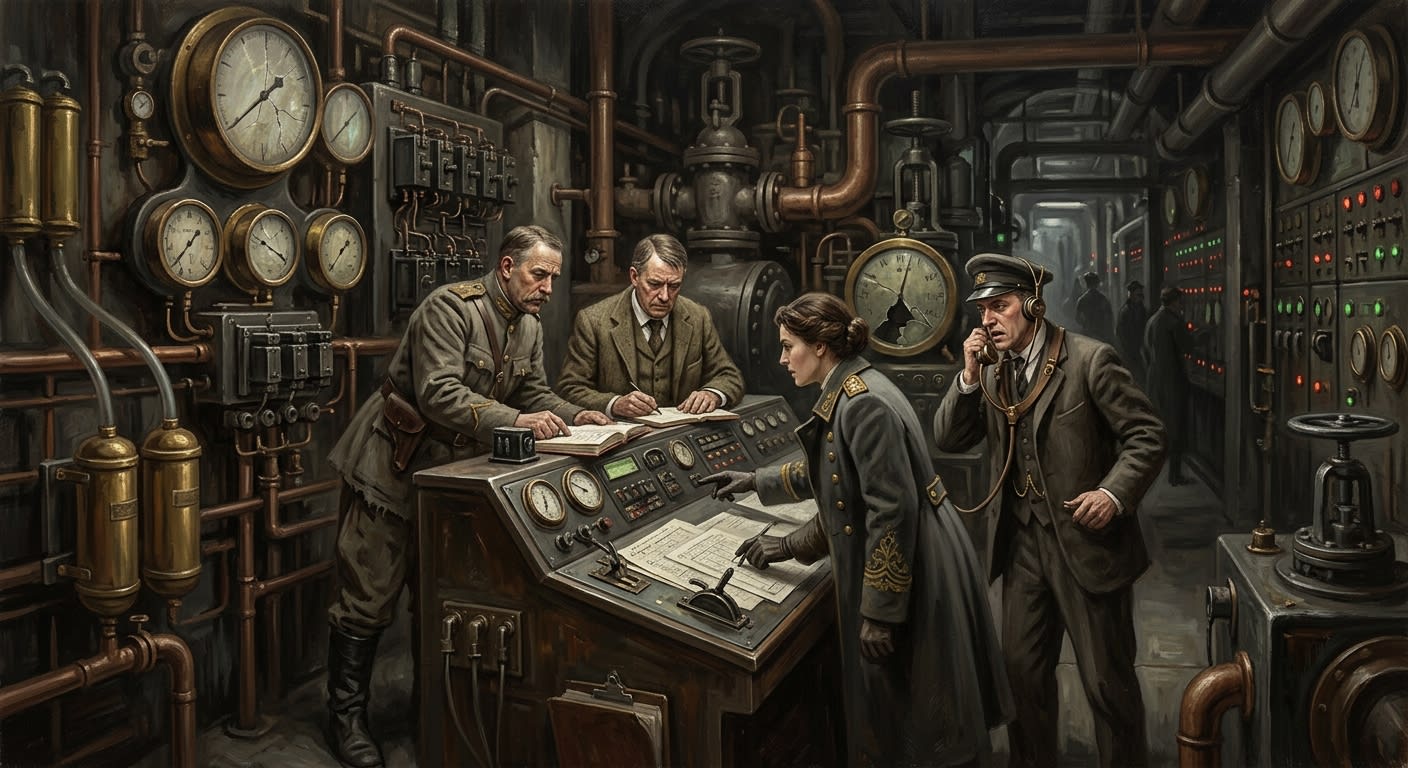
The Ward smells of alcohol wipe, warm brass, scorched oil, throat resin, and fear disguised as cleanliness. Its walls are tiled in pale ceramic so cracks may be seen at once. Its floors are iron grating over warm service channels. Its ceilings carry pipe-bridges and bell-rods thick enough to make a cathedral jealous, though cathedrals rarely explode because a tenor coughed on the wrong syllable.
Every instrument in the Ward is sealed, named, numbered, and distrusted. Pressure gauges (Unregistered) hang in ranked banks above the tuning floors. Condensation counters tick in small brass cages. Beat rails rock over choir stations. Needle mirrors catch tremors too fine for unaided eyes. Glass bulbs fatten and shrink with vapours that the Distillers' Compact refuses to name in front of clergy. Gauge scribes copy readings into double ledgers: one for Ordnance, one for Doctrine, and one unofficial sheet tucked near the wrist where truth may be grabbed before policy notices.
A Brast gauge is not a simple machine. It is a witness with a temper. The Ward's oldest pressure faces show knife marks where furious foremen tried to persuade them into better figures. Several newer instruments bear little silver veils after A.S. 199, when the Przemyśl misfire inquiry (Unregistered) made false readings politically expensive. A gauge that swings wrong may be cursed, bribed by heat, miscalibrated, frightened by a Sulking Engine, or telling the truth in a dialect no office has licensed. The Ward exists to determine which explanation kills fewest reputations.
Early Ordnance manuals described the Gauge Ward as “the instrument-maintenance annex.”
Corrected. An annex may be closed for repairs. The Gauge Ward may not be closed unless the Synod prefers its cannon fuel sanctified by guesswork, which, while consistent with several committee practices, remains discouraged near live artillery.
The theology is plain. Measurement is confession extracted from matter. The needle admits pressure. The bell admits tempo. The collar admits pitch variance. The valve admits whether it has obeyed. Men are less reliable. They require incentives.
#On the Choir Floor and Kest's Booth
At fourth bell, the Ward becomes a throat with rules. The Calibration Choir takes marked positions on the primary tuning floor, hands behind backs, oath-collars checked, throats warmed with bitter oil. Above them, the tempo rail trembles. Beyond the glass, Kest watches the needles and does not sit. Nobody remembers seeing her sit. Chairs imply leisure, and Brast considers leisure an exotic sin imported by warmer provinces.
The fourteen-stanza distillation hymn must match condensation within three beats per minute. The phrase sounds small until one stands there while the Crown breathes behind the walls. Pipes knock like bones in a reliquary box. Condensate moves through hidden lines with the slick patience of a secret. Gauges creep toward amber. The bell marks time. Kest raises a finger. Three hundred and twelve licensed technicians become one measured animal.
The booth is called the Throat. Official plans call it Calibration Point One, proving again that plans have no ear for poetry unless beaten. It contains seven red slips for emergency silence, tuning forks under wax, a blackwood baton, a private ledger of license variances, and the sealed hook where the Vault Brast-4 (Unregistered) cylinder was hung for one permitted transit before the night-syllable was locked away. Kest's scar is visible through the glass when the furnace light catches her collar. The Ward sees it as a gauge of its own. If she touches the scar, the floor prepares for refusal. If she lowers her chin, the beat slows. If she sings, valves open.
No one in the Ward mistakes beauty for accuracy. A beautiful voice late by two beats may spoil a drum bound for the Line. A cracked alto landing the third syllable as Gauge Twelve touches amber may save a battery at Bastion-Przemyśl. The Choir's art is not music. It is obedience measured in breath.
#On Cadence Licenses (Unregistered) and Ward Law
The Gauge Ward keeps the true license book. Doctrine keeps a sealed copy in Strasbourg and Ordnance keeps a working copy in the Rail-Manifest Quarter, but both are pious shadows. Kest's copy knows which technician can sing after fume fever, whose upper register breaks in winter, whose collar tightens too early, whose breath mark has begun to resemble a black diesel quiet hymn, and whose fear improves timing. The other copies know status. The Ward copy knows survival.
Cadence licenses make breath into property. A licensed technician may touch machinery through sound. He may open valves, settle boilers, quiet cannon, halt a spoiled line, or command silence while a pipe decides whether to hold. He also owes night-harmonic watch, emergency silence duty, fourth-bell attendance, collar inspection, variance confession, and refusal of unsanctioned melody. Freedom, in Brast, is often the right to be summoned more precisely.
The Ward's law is faster than Brast's courts. A false attendance mark costs heat. A sold measure costs license. A forged red slip costs name, wage, and sometimes tongue. A corrected measure without permission may earn censure if it fails and promotion if it saves the line, because Brast's morality is written after the pressure settles. The clerk who objects usually objects from behind glass.
Public catechisms describe cadence licensing as a devotional privilege granted to trained voices.
Corrected. It is a labour monopoly, a throat tax, a security leash, and a weapon held against both machine and worker. The devotional privilege remains, naturally, for poster copy.
The Slag Market dreams of the license book. Warmth Thieves would pay in gold, heat, names, and organs for a measure that opens stolen drums without official blessing. Pex Ruln would prefer the book burned and replaced by filter authority. Sorn Vale would prefer every note converted into a manifest number. Kest prefers everyone disappointed.
WARD SECURITY NOTE — LICENSE BOOK THIRD COPY Attempted copy made through pressure-smoke impression, A.S. 201. Recovered sheet showed seven names absent from all official rolls and one measure labelled █████████. Kest ordered sheet burned without bell witness. Ash arranged itself in straight lines until wetted.
#On the Misfire Inquiry and the Amber Ward
Before A.S. 199, the Gauge Ward's importance could be denied by anyone standing far enough from Brast. After the Przemyśl battery misfire, denial became expensive. Four rounds fed by Brast chrismole struck a friendly rail junction; eleven men died; a supply train was crippled; the guns acquired, in the official phrasing, an interpretive problem. Ordnance blamed sabotage. The Choir blamed degraded feedstock. The Distillers blamed cadence. The Ward received every accusation because all failures eventually seek the nearest instrument.
Kest testified that the hymn was correct at Brast, wrong at the battery, and answered somewhere between. The Ward has lived under that sentence since. Its instruments now carry after-market seals, its scribes copy readings with Purity observers behind them, and its night-harmonic watch has doubled. A district built to measure pressure now measures suspicion.
The night-syllable made the Ward stranger. Choir-technicians reported an addition in furnace harmonics during the night roar: no known hymn, no sanctioned interval, no human throat admitted as source. The wax cylinder rests in Vault Brast-4 after its first playback produced left-ear intrusion, lamp reversal, and condensation-writing on Gauge Twelve. Kest stopped the machine late. That word, late, has spoiled more sleep in Brast than the sound itself.
Inquisitor-Mechanic Lux Thane Mire is expected to test the Ward first. He will arrive with cases, seals, doctrine, instruments, and the unfortunate confidence of a man whose title admits faith and engineering share a bed. The Ward will receive him cleanly. The gauges will be polished. The license book will be closed. The Choir will stand ready at fourth-bell spacing. The machines will behave if they find it useful.
#On the Present Condition
The Gauge Ward is overclean, overguarded, overlistened, and under no illusion regarding its own safety. The ceramic tiles have been scrubbed until old cracks shine. The pressure-bell ropes are inspected hourly. Oath-collar keys sleep in three locked boxes and one hand nobody names. Choir-technicians joke less. Gauge scribes have begun using private marks beside public readings. Kest's murmur has grown so low that men lean toward it before they know they are leaning.
Outside, Brast burns. The Warm City wants output. The Line wants fuel. The Manifest Court wants drums accounted. The Distillers want filters believed. The Slag Market wants a stolen measure. The Ash-Hospice Sisters want the coughing counted before it becomes a ward hymn. The Furnace Chapterhouse wants Saint-Combust addressed with proper reverence and improper technical ignorance. The furnaces want to finish a sentence they have been adding to since before the Bureau learned how to spell chrismole.
The Ward listens with brass, glass, throat, and fear. It will record the pressure when Brast fails or refuses to fail. It will know first whether the next misfire began in fuel, song, gauge, theft, demon, or the old insult of a machine being asked to obey men less honest than itself.