

#On the Dial at the North End
This entry is a documentary compilation made in A.S. 201 / 1911 CE from the holdings of Brast and the published accounts of the Codex. It records no inspection and dates no visit. Its dateline marks the compiling and nothing else. The office it describes is a good deal older than the compiler's patience.
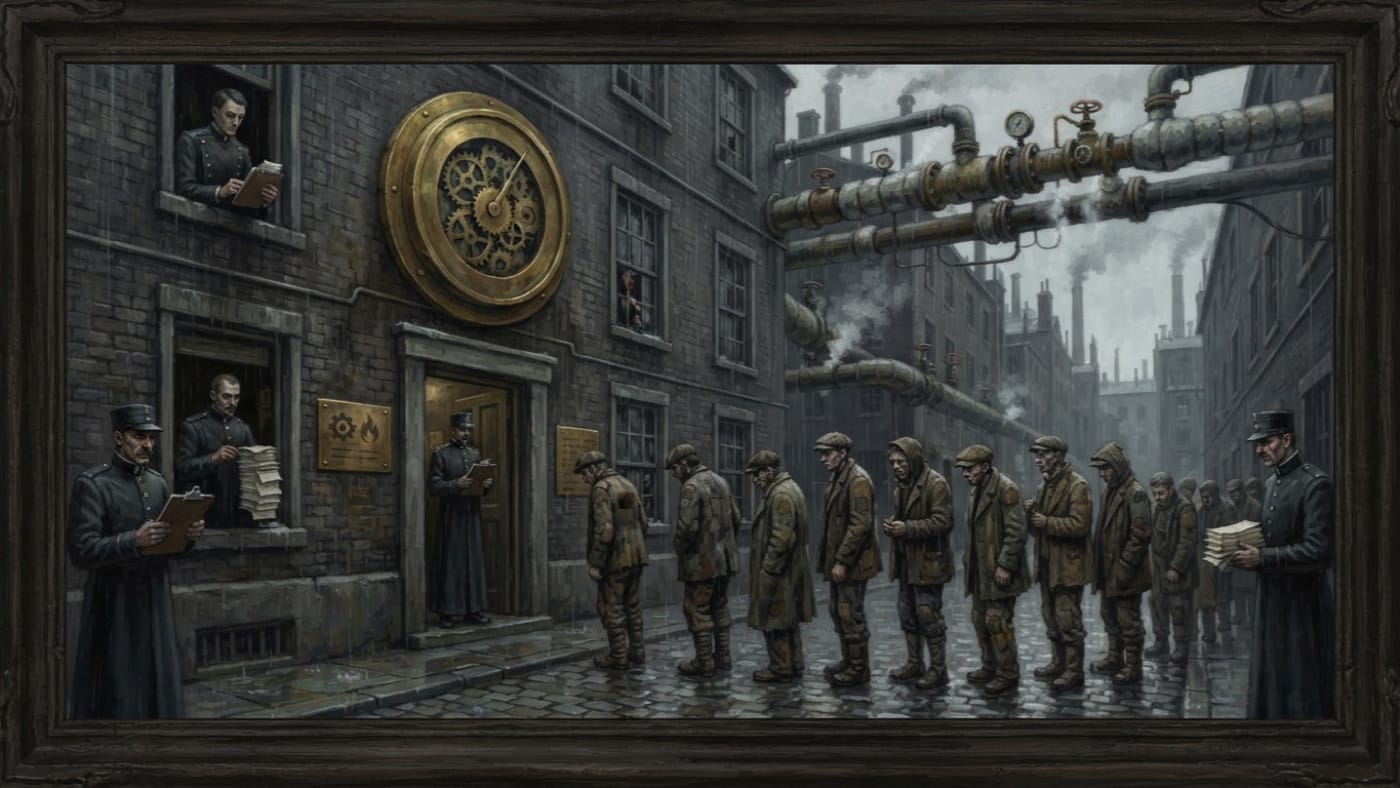
The Heat Allotment Office stands at the north end of the Boiler Commons, the worker district in the second ring outward from the Chrismole Crown. A brass dial hangs above its modest frontage. Provincial visitors take it for a thermometer. It shows entitlement. Every account agrees on that much and declines everything further. The registers I consulted give no graduations, drive, settings or tie to the valves beneath the street, so I give none either. Nobody needs the gearing of a brass face to read what it tells a family it is owed.
The subject is narrow. The office administers the allotment of heat to the workers of the Commons, and through it the debt that grows wherever an allotment falls short. A household meets it first as arithmetic: a rack nearer the pipe or farther from it, a ladle that reaches the bowl or stops at the queue, a widow's shelf inheriting a column of arrears.
#On Halls Before an Office
The Commons began without an office. Timber halls went up behind Kiln Five during the winter expansion of A.S. 91 / 1801 CE, a year after the Strasbourg settlement gave the Synod its formal shape. Proximity was the whole argument. A feeder who slept near the heat trunk answered the bell faster, and a man who answered faster kept his warmth. Kitchens followed the bodies, clerks followed the kitchens, and debt followed the clerks like a hound that has once been fed.
Recognition came twenty-seven years later. In A.S. 118 / 1828 CE the district was recognized and the Heat Allotment Office established with it. By that stage the district account also records three ration courts. Nothing I can certify gives their names, their founding years or how they stand toward the office. I will not file them beneath it as subordinates, and I will not seat the office above them as their judge. The record places the four in the same district at the same stage, and the record stops there.
The Warmth Thieves entry names the office in its compressed tale of Brast's first winters, set beside events of A.S. 68–90. Heat was taxed and rationed in Brast long before 118, and the misery in that passage is sound. The office's name in it runs ahead of the registers. Its establishment belongs to A.S. 118.
#On Quotas and Paper Warmth
Allotment begins at the barrack line, and each line receives a pipe quota by shift value. Furnace feeders receive more than slag sorters. Choir technicians receive warmth in private rooms and call it housing. The Commons account records these as practices. It never sets out a full code they descend from, and this compilation will not forge one. In Brast, eligibility is known the way a congregation knows its pews: by who sits where, and who gets moved.
The warm chit is the instrument. It began as a heat ration marker and now circulates as wage, rent, fine, bribe, and settlement of debts the Ledger prefers to leave unnamed. Ordnance prints the chits and shift foremen distribute them. The office administers the allotment the chits represent. The registers do not say whether it prints any, counts any by hand or presides over any exchange.
One chit buys an hour beside a heat pipe. That rate appears in the Commons account and again in the Still-Alleys survey, and it is the only rate this entry repeats. Larger purchases quoted elsewhere were local bargains struck in particular winters. Nail them to the office door as a tariff and the next frost will strip them off.
Heat rank follows the chit into kitchen and dormitory. Commons bowls are marked by heat class, labor class and household debt. Racks are assigned by warmth, rank, shift and debt together. No register makes the office the owner of every kitchen or the keeper of every rack. Its allotment is one of the figures the ladle consults.
The allotment can only promise what other hands let into the trunk. Pex Ruln holds the filters and canal locks through the Distillers' Compact. Ilyra Kest holds the licensed measures through the Calibration Choir. Neither is attested as the office's master. Both are its weather.
#On Arrears
Debt is where allotment bites. The Commons account names the deductions: a missed bell, lateness, a failed inspection. Each one costs warmth. The Brast holdings name the means of repayment: overtime, informing, confession. No register I consulted gives thresholds, accrual, interest or any appeal. I note the gap without regret. A debtor who knew the formula might argue with it.
The household consequence follows directly from the listed practices. A man late to the bell because his child was fevered loses warmth for being late, and the fever stays. Soot over a shift stamp fails inspection. The stamp was there, and the warmth goes anyway. A worker in debt pays in hours he did not have when he fell behind, or in names, or in a confession he may need to revise when the room gets colder. Survival rests on three conditions at once: labor the furnaces value, an entitlement entered in the proper column, and a debt small enough that the ladle still reaches the bowl. That is my reading of the practices. No charter states it.
The Commons account records two cases in which the column outlasts the debtor. Hospice-bound workers receive warmth in arrears when their cough is certified useful to an inquiry. Widows inherit debt before blankets. The account gives no case files for either, and I have invented none. It does not say how a cough of no use to an inquiry is warmed. The reader may ask the bell the sick man can no longer answer. The Ash-Hospice Sisters receive what is left.
Heat allotment renewal is among the common forms of Brast, filed beside the accident confession slip and the audit summons. The holdings name the form. They give no schedule, no signatory and no penalty for a late filing, and I have left those lines blank.
Early Brast civic notices, as quoted in the Boiler Commons entry, describe warm chits as "supplementary comfort credits for industrial households."
Corrected here, as it was corrected there. This compilation has not examined the notices themselves and repeats the phrase only through that published account. The attested uses of the chit are wage, rent, fine and bribe. Comfort is not among them.
#On Counterfeits, Thieves and the Court's Hand
Every allotment that falls short makes a customer. Counterfeit chits answer the paper, and the Warmth Thieves answer the pipe. By the Commons account, a passable forgery needs the Ordnance border, the heat-rank numeral, the pressure-bell watermark, and a faint scent of tallow wax and furnace ash. At the north end, authentication counts for more than temperature. The office allots warmth by document, and anyone with wax and nerve can make a document.
The Thieves are dispersed crews and networks. They supply households, kitchens, foremen and hospice wards, and their ranks include profiteers who hold a family's chit book against its debts. The work burns hands, fouls lungs and drops men from pipe bridges. A clumsy tap blisters the wall of a family that had no part in it. In the Still-Alleys a tenant pays for heat twice: once to the office in paper and obedience, and once to the crews in coin or spoons.
Enforcement lives elsewhere. The Commons holding names Ordnance, the Heat Allotment Office and Manifest Court auxiliary jurisdiction together as the district's authorities, and supplies no chart of rank among them. The Court holds audit authority over fuel and the power of summary execution for diverting it, under Sorn Vale. Vale uses heat debt as a chain, and the office keeps the columns the links are counted from. The smith is not the gaoler, though both are paid from the same fire.
In the Commons account's telling of the canteen sweep, provosts called heat-debt numbers from a ledger on the serving plank. Older accounts dated the sweep A.S. 201 and listed seizures. The dedicated compilation places it after the loss of the drums, assigns it no year and treats the seizure list as unverified. I keep its caution.
#On the Present Allotment
At the time of compiling, the Commons holds about twenty-six thousand on ordinary nights against a rated eighteen thousand, and the allotment is spread across bodies no plan foresaw. Since the Przemyśl misfire of A.S. 199 / 1909 CE, Brast has distrusted its own fuel. In spring A.S. 201, seven sealed drums of finished chrismole disappeared from Manifest Court inventory. The fourteen arrests and three confessions belong to that wider inquiry. No drums have been recovered, and responsibility is unresolved. Mire has been dispatched from Strasbourg and is expected.
The office's dependence is unchanged. The furnaces need feeders warm enough to feed them and scrapers whose hands still close. The office works between two requirements: enough heat that labor reaches the bell, and enough want that the bell is never optional. The dial records the balance hourly and calls it entitlement.