
#On Metal Taught to Obey
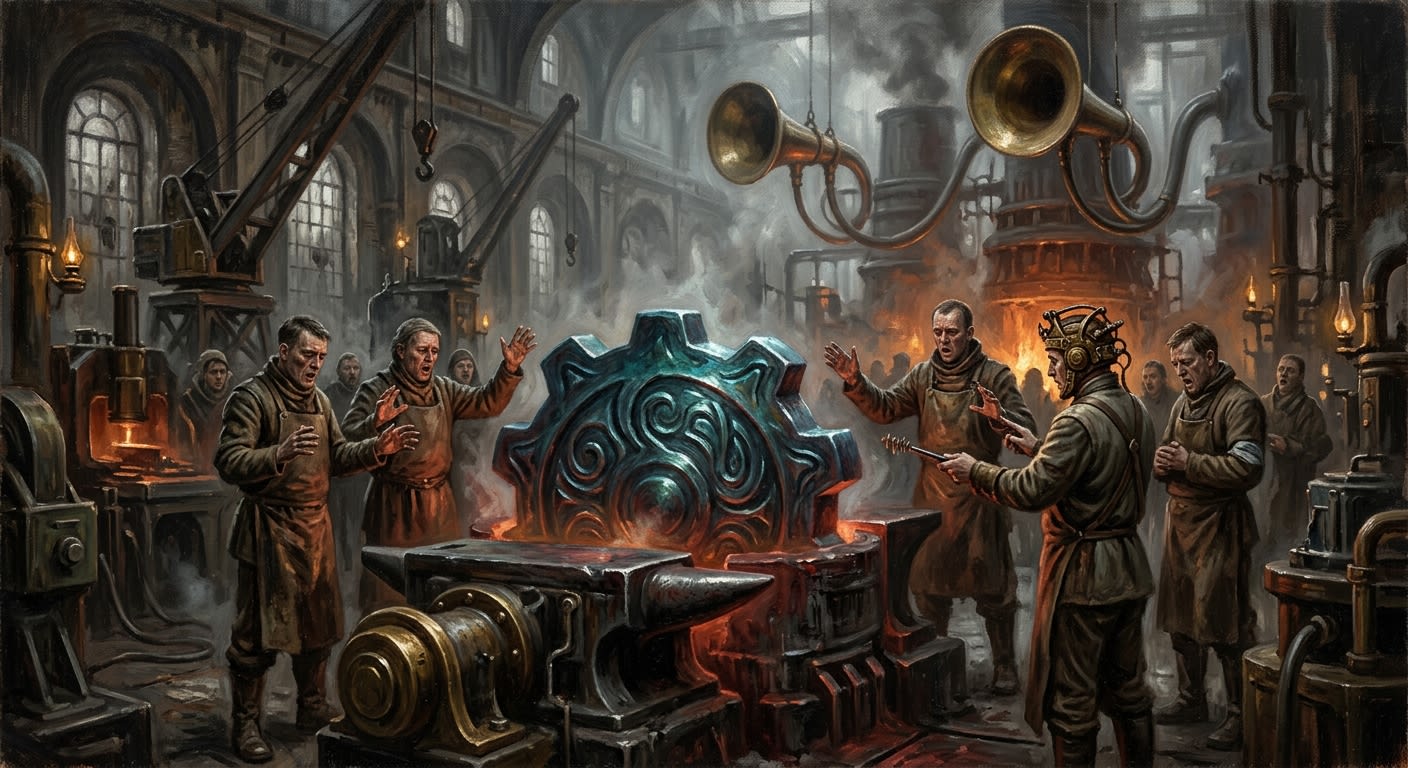
Hymnsteel is steel instructed by voice until its grain accepts command. The definition will offend engineers, who prefer their matter mute; singers, who prefer their labour called art rather than metallurgy; and theologians of lesser courage, who dislike any sentence in which iron appears to learn. Let them be offended in alphabetical order. Essen's furnaces will continue without them.
At Essen-of-Hymnsteel, paired choirs sing prescribed stanzas during every pour in the Hall of Measures. The vibrations enter the cooling metal, align its grain, temper its memory, and bind it to approved cadence. Ordinary steel may hold a shape. Hymnsteel holds a note. Under stress it answers in the register taught to it, which is why the Line trusts it and why the wise fear it.
The Sagittal Line is riveted, gunned, housed, braced, and belled by hymnsteel. Bell-cannon throats, hymn-drive housings, reliquary rivets, ward clamps, tuning fixtures, bell-bearing rings, engine casings, and the more expensive species of battlefield hinge all pass through Essen's furnace liturgy. A bell-cannon throat cast in ordinary steel cracks inside forty firings. A hymn-drive housing forged without calibration shears its bolts within a fortnight. A reliquary rivet made from unconsecrated metal loses, in the Bureau of Rites' wretchedly useful phrase, “moral coherence under stress.” Translation: the saint's knuckle falls into mud and men notice.
The Synod's war does not simply consume steel. It consumes obedient steel. That appetite has made Essen sacred, filthy, profitable, and very nearly honest by accident.
#On the First Calibration
Before the Compact, Essen was merely an industrial city at a river fork, full of guild-forges, old hammers, capable men, bad ledgers, and the disgusting pre-Synodal belief that craft might answer to customer satisfaction. In A.S. 108, three years after the Charter of Crimson Ink, a procurement officer of the Bureau of Engines and Furnaces arrived with writs demanding steel of doctrinal purity and hymn-frequency stability in quantities sufficient to arm the Line. The guild-masters laughed. Their laughter was absorbed by Lent.
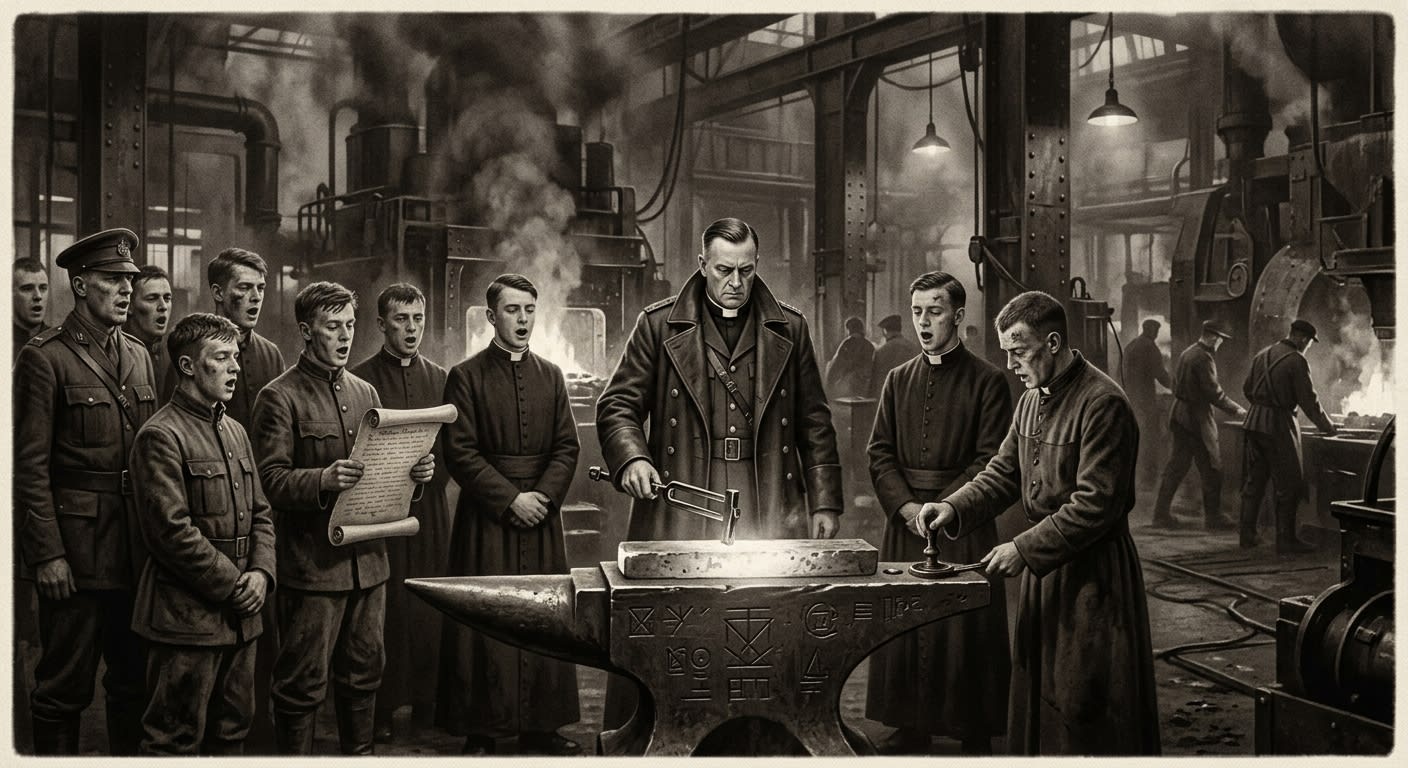
The Tri-Bureau Compact followed in A.S. 110: Engines and Furnaces controlled the heat, Records controlled the paper, Orison and Song controlled the voice. Prior forge-charters were annulled. Guild privileges entered the grave wearing official shoes. The Hall of Measures rose over the primary crucible, and the first Master Pour Stanzas (Unregistered) were fixed under joint seal. By A.S. 118, Essen had acquired its suffix. A city becomes a doctrine most cleanly when renamed by people who never sweep its ash.
Early production notes describe hymnsteel as “consecrated alloy refined by standard forge procedure.”
Corrected. Consecration alone does not produce hymnsteel. Alloy alone does not produce hymnsteel. The material is made by heat, formula, cadence, seal, and the disciplined abuse of living throats.
The first successful run produced bell-throat blanks for the eastern batteries and rivet stock for relic housings bound toward the southern anchor. The report survives in three copies, each disagreeing over which Bureau deserved credit. This is how one knows the run succeeded. Failed products receive unified blame; successful products are partitioned like saint-bones at a provincial auction.
By A.S. 130, the Line consumed everything Essen could cast. By A.S. 150, the city had quadrupled its population and taught two generations that a shift bell is a kind of sunrise. Hymnsteel became less a product than a civic metabolism: coal in, voice in, bodies in; guns out, clamps out, rivets out; ash everywhere; paperwork immaculate.
#On the Hall of Measures
The Hall of Measures is a cathedral only because everyone entering it is expected to offer something and leave diminished. Crucibles line the floor in numbered mouths. Paired calibration platforms face each pour trench. Records cages hang above the work lanes so clerks may stamp without approaching heat, a sensible arrangement that has done nothing to improve their character. Orison conductors stand at copper-marked stations and beat tempo with batons cut from heat-darkened ashwood.
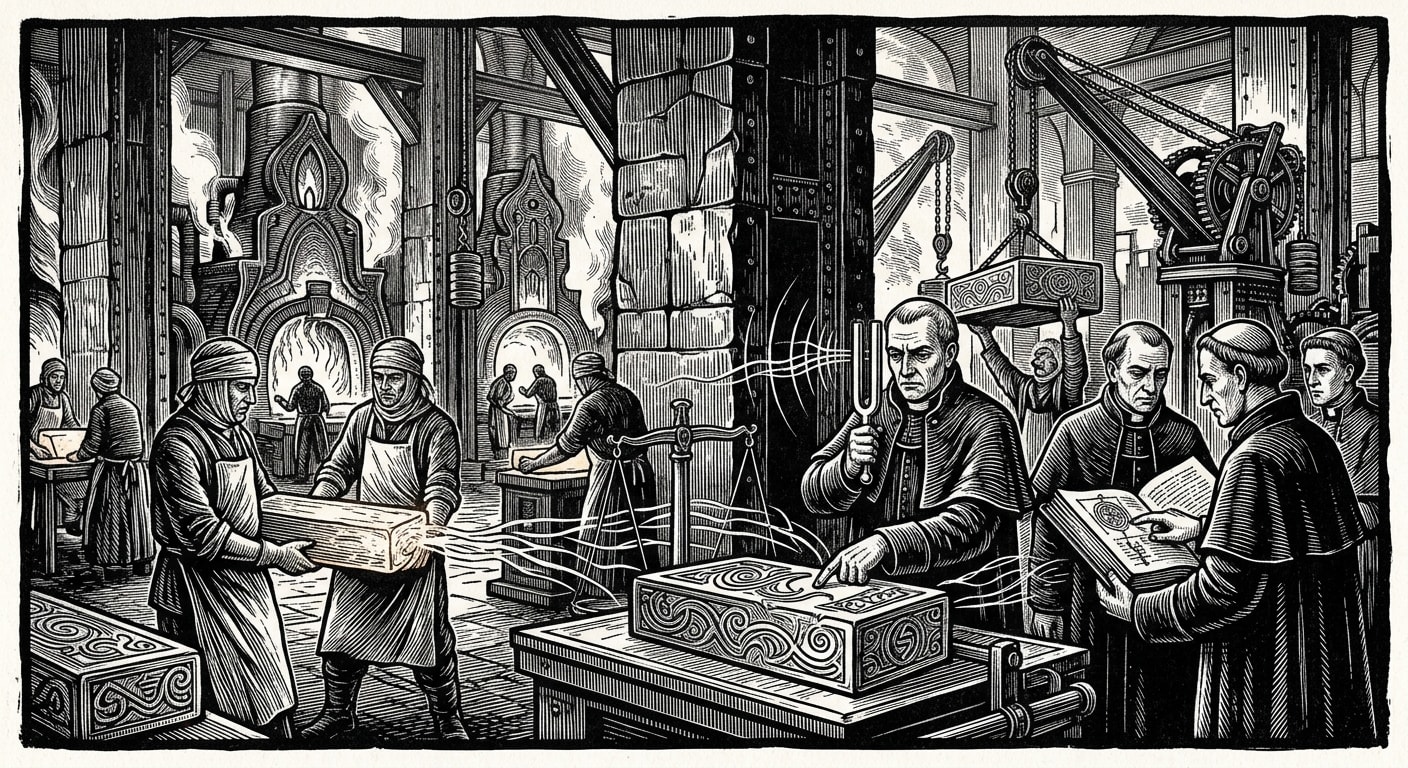
A hymnsteel pour begins before the metal glows. Records verifies batch identity: ore origin, slag proportion, bone-lime admixture where authorised, furnace number, choir roster, stanza plate, destination class, witness seal. Engines measures heat, colour, slag behaviour, crucible throat, cooling bed readiness. Orison inspects throats: singers rinse with brine, hum the opening fifth, display tongue marks, and recite the sanctioned warning against improvisation. The warning is necessary because talent is the oldest enemy of procedure.
The paired choirs do not perform. They labour. One voice-column holds the root measure, the other answers with calibrated overtones that press the cooling metal into compliant structure. A quarter-tone error may warp grain. A breath at the wrong bar may seed stress. A dropped note may crack a bell throat months later at Bastion-Przemyśl, where the gun crew will curse a forge-worker whose name they never learned.
Singers last nine years on average. After that, the voice frays, pitch drifts, blood appears in the rinse basin, and Orison files completion of service. The slag hills receive many completed servants. Essen's miracle is full of men and women whose bodies were treated as replaceable tuning forks.
#On What Hymnsteel Remembers
Hymnsteel's virtue is memory under violence. Strike it and it returns toward its taught note. Heat it and it resists the foreign tremor. Bind it near relics and it does not immediately develop the tantrums ordinary alloys display when holiness, fear, and artillery share a bracket. This is why bell-cannon throats endure, why hymn-drive engines do not shake themselves apart every week, why reliquary casings survive bombardment long enough for chaplains to claim credit.
The Bureau of Engineering describes this as grain-line stability. Orison describes it as retained cadence. Rites describes it as sanctified receptivity. War describes it as supply item Class Red-Three. The soldiers describe it by tapping the gun throat before firing and listening for a clean answer. Soldiers are often better scientists than Bureaus because error kills them quickly and without appeal.
The material is not incorruptible. Nothing useful is. Hymnsteel holds what it is taught; if taught wrongly, it preserves wrongness with exemplary discipline. A corrupted stanza may sleep inside a batch until heat, recoil, bell shock, demon pressure, or a saint's fragment wakes it. Then the metal answers according to its lesson. Obedience becomes sabotage with excellent manners.
War procurement handbooks state that properly certified hymnsteel cannot retain hostile cadence after acceptance testing.
Corrected after returned bell-cannon throats from Przemyśl, failed hymn-drive collars from the southern corridor, and three reliquary rivets that softened during public consecration. Acceptance testing proves what the metal was willing to say in the room.
This memory gives hymnsteel its terror. Ordinary steel fails by weakness, impurity, fatigue, bad casting, cheap bolts, incompetent foremen, and the thousand humble vices that make engineers drink. Hymnsteel fails by recollection. It remembers the wrong breath. It remembers the missing line. It remembers the note suppressed by authority and returns it when struck.
#On the Mirror Choir and Stanza Infection
The Mirror Choir understands hymnsteel too well, which is the unforgivable form of treason. Since A.S. 187, Purity has hunted this acoustic insurgency through throat dormitories, Ash Warrens, hushrooms, duct-catacombs, copyist desks, and the sad little corners where clever singers compare the paper's command with the body's instinct. The Choir alters one syllable, quarter-tone, breath mark, oil-smudge, or page turn in a calibration hymn. The change enters the pour, survives inspection, cools into the grain, and waits.
A Mirror attack seldom announces itself at Essen. The furnace behaves. The choir signs. The clerk stamps. The batch ships. Weeks later a bell-cannon throat cracks at the Line, or a hymn-drive housing shears bolts in a pattern identical to a missing stanza, or a reliquary rivet goes soft under a saint's little finger. The Bureau calls this accumulated micro-discord. The phrase is ugly enough to be partially true.
The Mirror Choir claims it corrects corrupted Synod plates. It says the prescribed frequencies are false, that Essen's old stanzas were cut, that the foundations beneath the Foundry Core are gagged by approved music. This doctrine is poison because it contains a fact. The Master Hymnal Plates were edited. Decades ago. By Synod authority. The official reason was standardisation, grain stability, singer safety. The private reason was prevention of unauthorised sub-foundation articulation.
A heresy that steals a fact becomes harder to burn cleanly. Fire destroys paper. It does not destroy the worker who heard the floor answer before the page was seized.
ORISON-PURITY JOINT INTERROGATION — ESSEN, A.S. 200 Question: What was changed in the stanza? Answer: Nothing. Restored. Question: Restored from what source? Answer: The plate before the plate. Question under pressure: Who taught the note? Answer: ███████████████ beneath the Hall. Examiner note: subject's dental fractures formed four equal intervals. Batch 77-C quarantined; quarantine later removed by War priority.
#On the Wrong Choir Beneath the Pour
The Wrong Choir is the name the workers give the sound beneath Essen's Foundry Core. The Compact calls it holy alignment when production survives, structural resonance when Engineering speaks, cadence irregularity when Orison panics, and suspicious providence when Doctrine is asked before lunch. Workers call it wrong because they stand above it with molten metal in front of them and teeth in their heads.
Tools hum without touch. Candles tremble. Ink ripples. Jaw-pain travels in sequences Medicine has mapped and declined to interpret in public. Then comes Resonance Bloom. Rivets shear. Bell throats crack along grain-lines sung into obedience. Catwalks loosen. Ears bleed. Afterward a district may fall into a silence so complete that bells swing without sound. Hushwrights cannot reproduce it. They have tried. Greed is a marvellous research engine.
Hymnsteel sits at the centre of the dispute because it receives the city's argument as structure. If the Wrong Choir is mere resonance, hymnsteel is an exquisitely sensitive victim. If the Wrong Choir is buried liturgy, hymnsteel is unwilling scripture. If the Wrong Choir is a grievance in stone, then every pour is a negotiation conducted with labourers as collateral.
The Compact's dearest lie is separation. It wants Mirror Choir sabotage here, Wrong Choir phenomena there, hymnsteel certification elsewhere, production quotas in another sealed folio, and workers' blood nowhere near the minutes. The metal refuses such tidy cabinetry. It carries the syllable, the heat, the fear, the seal, the hidden line. Strike it hard enough and the filing system sings.
#On Inspection, Fraud, and the Price of Clean Sound
Every hymnsteel batch receives more documentation than a minor saint. Records affixes batch numbers, destination classes, singer rosters, witness seals, cooling signatures, strike-test notes, invoice chains, and corrective addenda. A piece may be accepted, reaccepted, provisionally accepted, accepted pending review, rejected for retuning, or declared never to have existed if it fails near the wrong audience.
Inspection begins with sound. A certified striker taps the cooled piece with a hammer of known pitch. A listening clerk marks the return. Orison compares the return to the stanza. Engineering examines fracture shadow, colour, grain direction, and bolt response. Rites blesses whatever portion of the process might embarrass doctrine if left secular. Records stamps the result. The stamp, being paper, is considered more stable than the metal.
Fraud thrives in the certification economy. Shard Market (Unregistered) brokers sell false acceptance slips. Foremen dilute bone-lime admixtures. Desperate Orison clerks reuse throat inspection seals. War priority can remove a quarantine faster than Purity can lace its boots. A batch marked “conditionally resonant” may become “frontline urgent” by passing through two desks and a dinner. The Line, hungry as doctrine, eats what is sent.
This is not a failure of system. It is the system in vestments. Hymnsteel is too necessary to reject at the rate truth would require. Every office knows this. Every office pretends the next office is the one committing mercy against standards.
#On Present Supply and the Coming Crack
As of A.S. 201, Strasbourg demands tripled output for hymn-drive siege engines. Essen accelerates because refusal is a luxury reserved for independent kingdoms and dead saints. Sister Rauth (Unregistered) refuses tempo increases without liturgical stability guarantees. Furnace-Marshal Kord threatens forced conscription from the Ash Warrens. Arch-Notary Veyl has prepared forms for either outcome. The furnaces roar. The choirs bleed. The Line waits with open hands.
Recent shipments have returned with poor omens: bell-cannon throats from Przemyśl fractured in matching grain-lines; southern corridor collars humming after removal; rivet stock that warms during minor blessings; tuning fixtures producing a fourth overtone no approved plate contains. The Compact assigns each case to a separate subcommittee. The metal, vulgar thing, keeps relating them.
Hymnsteel remains indispensable. That is the indictment. If it were optional, Purity could burn the suspect batches, Orison could retire the damaged plates, Engineering could rebuild the Hall, Records could revise the invoices, and Doctrine could write a triumphant tract about vigilance. The Line needs guns before purity, housings before certainty, rivets before philosophy. War has always been the argument that makes cowards practical.
At the Hall of Measures, the next pour begins. The root choir takes breath. The answer choir listens. The crucible mouth brightens. A clerk wets his stamp. Under the floor, tools hum in the wrong interval. Sister Rauth lifts her baton. The metal waits to be told what it must remember.