
#On the Crown and Its Seventeen Mouths
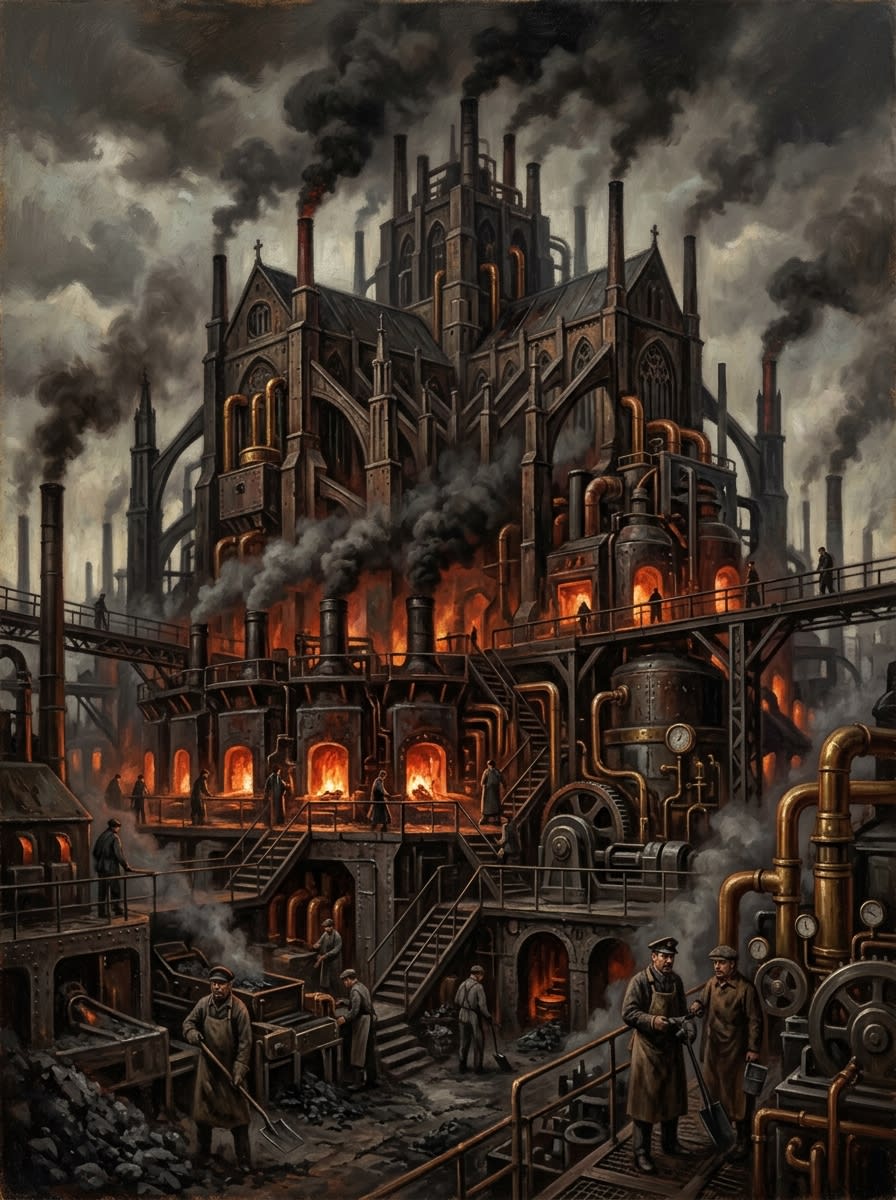
The Chrismole Crown is the central furnace-cathedral of Brast, a half-circle of seventeen fire-brick kilns arranged around the sanctification nave, iron-clad, soot-polished, hymn-fed, ash-anointed, and sufficiently dangerous to have acquired a clergy before it acquired a proper drainage plan. It is called a Crown because the Bureau adores flattery by architecture. It is called chrismole because the fuel would sound less obedient if named by smell.
At first sight the Crown resembles a fortress that swallowed a chapel and regretted only the seating. The outer shell rises in black iron ribs, each bolted into brickwork thick enough to resist blast, prayer, and most forms of inspection. Seventeen kiln mouths open toward the central floor. Above them run pressure bells, condenser ducts, soot flues, maintenance gantries, silence rails, watch balconies, and the long red tempo spine by which the Calibration Choir keeps the fourth bell from becoming a casualty report.
Brast's citizens speak of the Crown the way coastal peasants speak of the sea: as employer, weather, judge, parent, thief, and thing that may kill you without malice if you stand foolishly near its work. Ninety-two thousand registered souls live around it in rings of heat debt. The Gauge Ward listens to it. The Boiler Commons sleeps by its pipes. The Still-Canals carry its half-made breath. Ash-Hospice Row receives the lungs it ruins. The Slag Market sells what falls from its pockets.
The Crown produces fuel, then rank. Whoever controls a step within its cycle owns a portion of Brast's throat. Whoever misreads one of its moods may learn how rapidly industry becomes theology when the roof leaves.
#On the Founding Fire
The Crown began as a row of crude requisition furnaces after the A.S. 68 seizure of the Brast rail junction. A nameless Bureau of War logistics officer, blessed by utility and damned by inadequate deference, needed fuel for forward artillery. He claimed the coal-seam river confluence, requisitioned the surrounding villages, built rude kilns, and produced secular combustible distillate by perfectly rude means. The guns fired. The trains moved. Doctrine arrived with a hand over its nose and a memorandum already frowning.
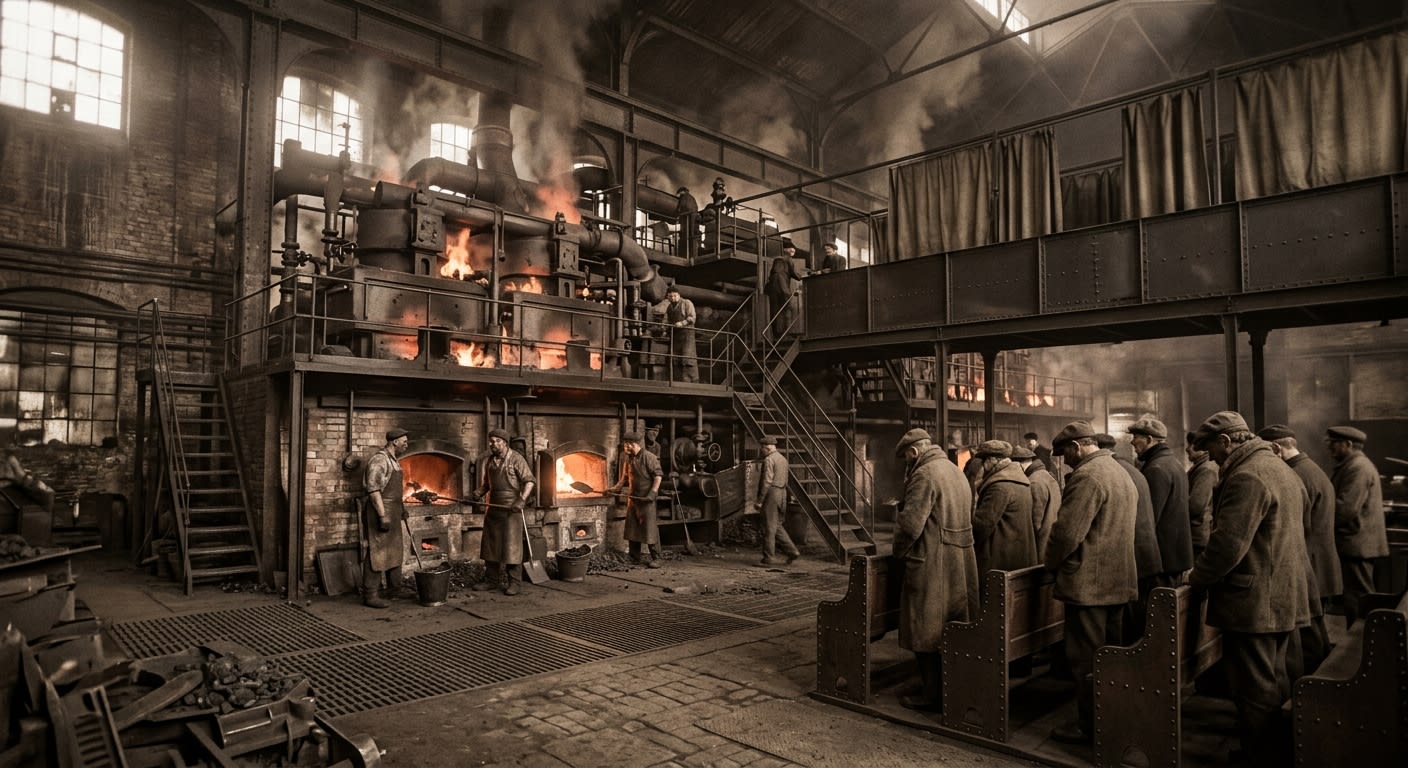
By A.S. 72, one Cantor and fourteen choir-technicians had been dispatched to sing over the process. The practical furnaces acquired sanctification. The fuel acquired a name. Records acquired a distinction between ordinary oil and blessed oil that no honest measuring glass could detect without fear. The first Crown was still a crooked industrial yard then: four kilns, timber platforms, pipework laid in poor haste, condenser troughs fouled by ash, priests arguing with men whose hands could repair what priests could only rename.
The early ledgers call this period stabilisation. Brast workers call it the Years of Bad Teeth, because loose rivets shot from pressure housings with such force that men began wearing brass mouth guards during second-bell feed. This detail does not appear in the formal catechism. Catechisms prefer the mouth as a source of prayer and dislike finding shrapnel there.
The decisive event came in Ashmonth A.S. 74, when Kiln Three suffered the pressure reversal that killed nine men and promoted a damaged furnace into the ancestry of Saint-Combust. The front plate blew inward. The crown flues screamed. The bodies were found in postures Doctrine found useful. Engineering named an Acoustic-Mechanical Disturbance. Doctrine named instructive martyrdom. The damaged shell was plated, fenced, anointed, preserved, and used as the argument by which the Crown ceased being a yard and became a shrine with production quotas.
Popular Brast primers claim the Chrismole Crown was designed as a single sacred furnace-complex from its first brick.
Corrected. The Crown was assembled from seizure, accident, repair, retrofit, theological opportunism, and labour too frightened to let the fire go out. Coherence arrived after the dangerous parts had already been bolted together.
By A.S. 76 the first boilerside priests had taken vows at Kiln Three. By the Concordat of A.S. 90 (Unregistered) the complex had seventeen mouths, a half-circle plan, a central sanctification nave, and enough offices attached to make closure impossible without convening half the Synod. This is how permanence is achieved: make too many departments depend upon one hot room.
#On the Kilns Themselves
Each kiln has a number, a name, a pressure bell, a feed-table, an ash cloth, a maintenance book, an error history, a priestly temperament assigned by the Chapterhouse, and a worker name used when clerks are absent. The clerks say Kiln One. Workers say Old Jaw. Clerks say Kiln Seven. Workers say the Widow Maker, though the phrase appears in no official filing because widows become expensive when named near equipment. Kiln Three is Saint-Combust, or Combust's Mouth, or the Warm Relic, depending on whether the speaker seeks promotion, comfort, or speed.
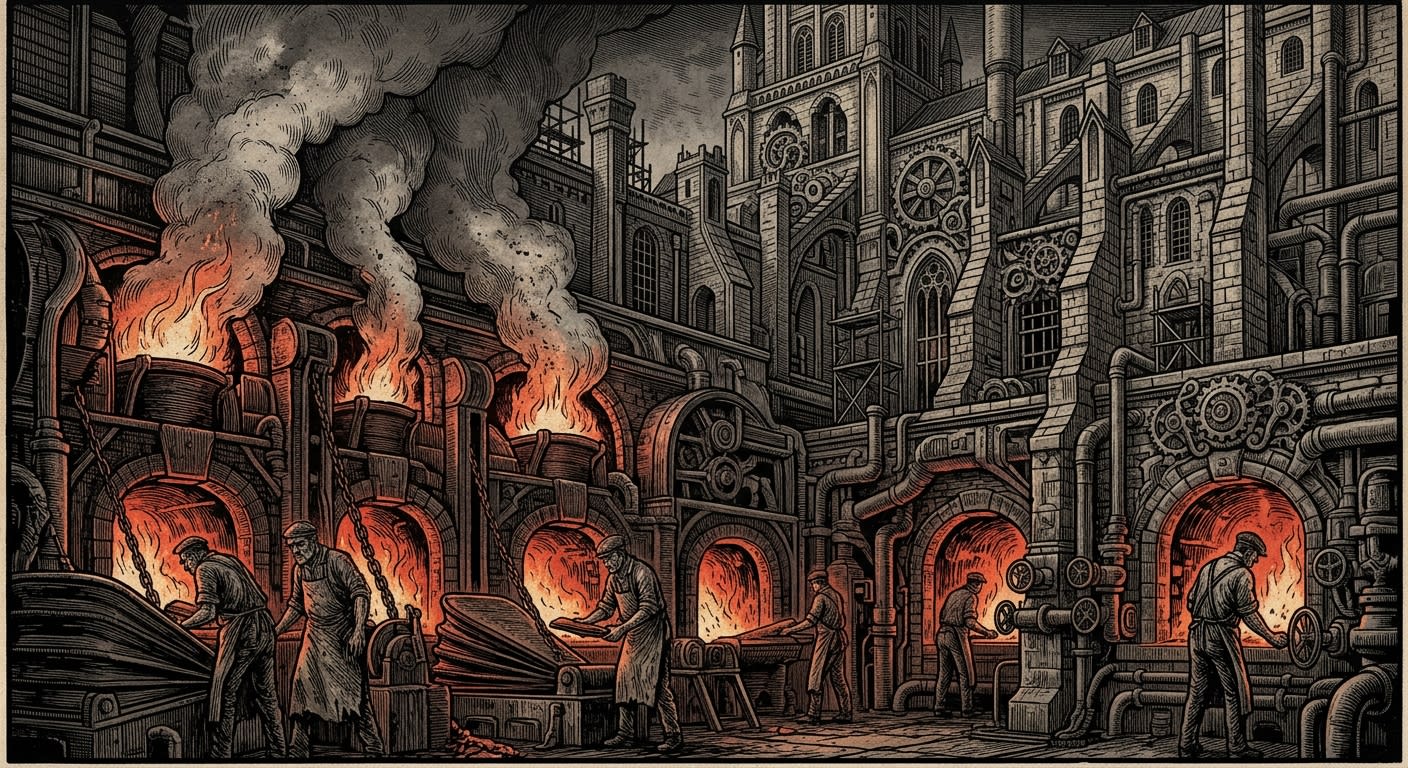
The mouths differ. Kiln Two burns clean and eats poor feedstock with the patience of a rural saint. Kiln Five drinks pressure and spits soot into the upper walk whenever a new foreman claims confidence. Kiln Nine needs its left flange warmed before dawn, though Engineering has filed sixteen notices calling this unnecessary. Kiln Eleven has never accepted substrate from grey drums marked with the southern receipt notch. Kiln Thirteen is officially ordinary. Nobody believes this. Kiln Seventeen, the newest shell after the A.S. 118 heat expansion, runs hottest during winter storms and coldest when inspectors arrive.
The Chapterhouse objects to temperament charts, then consults them. Engineering objects to worker names, then borrows them when writing urgent repair slips. The Distillers' Compact pretends to disdain all such superstition, yet its filter-men alter mesh issue according to kiln mood with the precision of surgeons and the faces of men who will deny artistry under oath.
The kilns are lined with fire-brick replaced on rotation, except where replacement has been delayed by relic claim, heat instability, prior accident, budgetary nausea, or the simple fact that a brick fused to its neighbour may be safer left in sin. The outer cladding is black iron polished with ash oil. The Chapterhouse calls it vestment. Engineering calls it removable furnace armour. This dispute has broken three fingers, all belonging to men who touched fastenings under the wrong vocabulary.
#On the Sanctification Nave
The sanctification nave occupies the centre of the half-circle, a long flagged floor marked with choir spacing, drip gutters, ash slots, brass tempo rails, and the thin red line no visitor is permitted to cross after third bell unless he has lungs, license, and a death wish countersigned by Ordnance. Raw condensate enters the nave at fourth bell. It arrives from the Still-Canals warm, sweet, unstable, half-obedient, and waiting for the measure that will turn useful distillate into lawful chrismole.
The Choir stands beneath the tempo spine with hands behind backs and throats warmed by bitter oil. Fourteen stanzas govern the cycle. The first steadies flow. The second answers vapour lift. The third clips foam. The fourth belongs to pressure. The fifth to ninth bind the cooling fractions. The tenth is disliked by workers because the valves answer it too quickly. The eleventh belongs to ash. The twelfth and thirteenth are sung softer than the written score permits. The fourteenth, if late, spoils fuel and ruins men.
The nave's ceiling carries old smoke in layers. Workers say the smoke contains every missed note. Doctrine calls this occupational folklore. Doctrine has not tried washing the ceiling. A young clerk once suggested it during a cleanliness audit. Kest looked at him, and he developed a fresh appreciation for soot as heritage.
GAUGE WARD INCIDENT NOTE, A.S. 201 During fourth-bell rehearsal, condensation gathered on the underside of the tempo spine and formed the words ████████████. Choir halted by Kest hand-signal. Kiln Five pressure rose without feed. One apprentice answered aloud before gagging himself. Disposition: transcript sealed; apprentice reassigned to non-vocal labour; ceiling left unwashed.
The nave is where Brast's quarrels become audible. The Chapterhouse hears prayer. Kest hears timing. Ruln hears his mixture being humiliated into obedience by clean-throated monopoly. Vale hears liability. Engineering hears data through clenched teeth. The fuel hears enough.
#On Custody and the Priests of Hot Iron
The Furnace Chapterhouse holds ritual custody of the Crown, which means it owns the keys everyone else requires when something catches fire in a sacred way. Its priests anoint feed rails, bless grey drums, change heat cloths, mark ash slips, collect worker confessions, guard the Kiln Three shrine, and keep the eastern furnace archive in cabinets of brass and asbestos cloth. Their robes are short, resin-stiff, soot-black, and cut to avoid open flame. Their theology is longer and less practical.
Every Crown day begins with first-bell anointing. The priest touches each feed rail with ash oil and recites the Litany of Combustive Submission. Workers wait because a missed rite becomes blame. At second bell, confession slips are collected near the pressure stairs: heard a word in a valve; saw a grey drum on the wrong siding; dreamed of a kiln with teeth; stole a warm chit; sang outside license; cursed Kiln Five and survived. The Chapterhouse receives such material as sin, symptom, evidence, and currency.
The priests defend their authority with the Kiln Three precedent. Nine dead in devotional posture. A shell preserved. A saint certified consistent with martyrdom. A Chapterhouse founded beneath soot-vigil. From that origin they claim the Crown as a living site of industrial holiness. The claim is absurd in several mechanical particulars and invincible in every meeting where the alternative is admitting the Synod sanctified an accident to protect output.
Engineering memoranda continue to describe Chapterhouse custody as “ceremonial access supervision.”
Corrected under Brast practice. Ceremonial access supervision does not decide who may unbolt cladding, inspect Kiln Three, open the eastern archive, or keep both hands after touching a vestment latch without prayer.
The Chapterhouse also guards the secret steps around substrate entry. It knows which line must be warmed, which ash must be mixed, which flange receives the left-hand seal, and which spoken name is omitted because omission is cheaper than exorcism. It does not know everything. It knows enough to remain dangerous.
#On Flow, Mesh, and the Compact's Hand
The Crown would be a holy ruin without the Compact. This annoys everybody honest enough to understand pipes.
Feedstock enters through first-stage hoppers under Compact supervision. Peat, coal, rendered tallow, mineral wash, canal solvent, ash trace, substrate. The recipe belongs to no single book. It lives in locked drawers, oily hands, remembered ratios, scratched mesh rings, and the little pauses by which a master distiller decides whether a batch may be rescued or should be blamed upon a dead boy. Ruln's men control condenser filters, Still-Canal locks, emergency screens, residue scraping, and the grey receipts that make theology sweat.
The Crown's pipes pass beneath the floor in lines warm enough to fog boot leather. Some are labelled. Some are deliberately mislabelled. Three are known only by worker names: Beggar, Throat, and Thin Mercy. The official plan shows two of these as abandoned. They are still in use. Nothing useful in Brast is abandoned; it is omitted from copies shown to visitors.
The Compact's power lies in making the Crown breathe at the speed it chooses. A filter declared unfit by smell can idle a kiln. A mesh shortage can become an apology from Ordnance. A delayed lock inspection can make the Choir stand ready while condensate thickens and priests pretend patience. The Compact rarely refuses outright. Refusal invites provosts. Delay invites negotiation, and negotiation arrives warmer.
Ruln hates the Choir because fourth bell steals authorship. He hates the Chapterhouse because it blesses what his men made and receives better candles. He hates Vale because auditors think numbers uncover truth. He hates amateur black-diesel men because their technique is poor. Hatred, in Ruln, is not emotional. It is a maintenance schedule.
#On the Machinery's Courtesy Problem
The Crown sulks more politely than the smaller engines because it has had longer to study authority.
A petty boiler may hiss. A rail engine may refuse pressure. The Crown prefers litigation through matter. A pressure bell rings half a beat late for a foreman who skipped introduction. A gauge corrects itself only after the priest uses the correct kiln name. Kiln Five keeps a steady heat until an inspector writes “stable,” then drops two degrees and waits. Kiln Three's railing warms when certain archive drawers are opened. Kiln Eleven refuses south-notch substrate, though no mechanism has been found by which a kiln may read a receipt mark. The machines of Brast may be alive, cursed, blessed, badly dampened, acoustically trained, or simply tired of fools. The category matters less than the behaviour.
The A.S. 199 Przemyśl misfire (Unregistered) dragged the Crown into the public file. Four rounds from Brast-fed artillery struck a friendly rail junction. Eleven dead. A supply train crippled. Ordnance blamed sabotage. The Compact blamed the Choir. The Choir blamed degraded feedstock. The Chapterhouse blamed insufficient rite. Engineering blamed harmonics. Vale blamed insufficient hanging. The Crown continued burning with the serenity of an institution that knows every accusation must pass through it again tomorrow.
Since the misfire, the Crown has lived under Amber review. Crew introductions are mandatory for certain rails. Insults directed toward equipment are discouraged in formal language and punished by experience. Kest's watch duties have doubled. The Chapterhouse oils more valves with Kiln Three ash. Engineering has installed instruments that report faithfully until the room grows quiet. Vale has audited seven missing drums into three confessions, fourteen arrests, and no drums. The Crown has offered no assistance except heat.
VAULT BRAST-4 CROSS-NOTE Night-syllable cylinder played within Crown hearing distance during sealed test. Kiln Three railing warmed. Kiln Five pressure rose without feed. Kiln Thirteen extinguished its own pilot flame, then relit after ████████████ was spoken by no recorded throat. Kest stopped the test. Ruln requested filter inspection to avoid remaining in the chamber.
#On Rank Within the Heat
The Crown sorts human beings faster than any heraldic office. At the top stand those allowed to halt a cycle: Kest, Ruln under filter emergency, the Chapter Prior under shrine danger, Vale under manifest seizure, and an Inquisitor-Mechanic if he arrives with enough warrant and too little self-preservation. Beneath them stand licensed choir-technicians, senior filter-men, pressure foremen, ash priests, gauge readers, vent walkers, seal clerks, decanting crews, residue boys, rag-boys, heat-debt porters, and the unregistered children who know which pipes warm through the wall at night.
Rank is heard before it is seen. The Choir's shoes make no sound on the nave floor. Filter-men jingle with little keys. Priests rustle like stiff curtains. Vale's clerks click abacus beads under their sleeves. Rag-boys cough. Heat-debt porters drag one foot because the floor burns through poor soles. Everyone steps around the red silence line. Everyone, even visitors who think courage is a posture.
The Crown pays in money, warmth, injury, and permission to remain near heat. Workers earn warm chits, shift rations, ash masks, and the right to sleep in districts whose walls do not freeze. They spend these wages on food, bunk space, resin filters, cough syrup, private hymns, and bribes to keep children from certain work details until hunger improves their courage.
Accidents are filed by bell, kiln, body part, and doctrinal value. A burn received during proper rite may earn compensation. A burn received while correcting a clerk's delay may earn censure. A death near Kiln Three may be reviewed for devotional character, which the families dislike because devotional character reduces certain payments. Martyrdom is splendid for plaques and poor for widows.
The Ash-Hospice Sisters keep better counts than the Crown's official ledgers. They know which kiln eats lungs fastest, which shift produces tooth-blackening, which priest's incense worsens fever, which batch caused three stillbirths in Boiler Commons, and which page in the Manifest Court should have recorded all of this but did not. The Sisters are dangerous because they are accurate. Brast tolerates them because dying men need bowls held near their mouths.
#On Maintenance, Repair, and the Theology of Access
Maintenance at the Crown is permission disguised as repair. A man may know exactly which bolt is failing and still lack the right prayer to touch it. A priest may possess the prayer and lack the wrist strength to turn the spanner. An engineer may possess the diagram and lack both prayer and permission. A Compact man may possess the key and pretend not to understand the diagram until his wage improves. The Crown survives by arranging these insufficiencies in productive sequence.
The ordinary maintenance hour begins after seventh-bell decanting, when the drums have rolled to the Manifest rail and the kilns rest at a heat that kills slowly enough for paperwork to keep pace. Vent walkers climb the upper galleries with resin masks and copper hooks. Ash priests follow with cloths, oil, and little censers whose smoke makes the workers sneeze into doctrinal compliance. Gauge readers mark needle drift. Filter-men listen beneath the floor. Engineering observers stand where they can be seen and ignored.
The tools have ranks. A red-handled spanner may loosen vestment bolts on Kilns One through Seven. Black-handled keys may open ash slots only under Chapterhouse sight. Bone scrapers belong to the Compact and are never loaned, though several have been found in Ordnance cupboards after men with commissions discovered that ownership is a flexible doctrine near hot residue. The Choir's tuning forks must not touch iron unless Kest permits it. Vale's seal knife may cut wax but not prayer ribbon. Such distinctions sound comic until one remembers that the wrong tool near warm chrismole can give a machine vocabulary.
The Bureau of Engineering keeps a master plan of the Crown in Strasbourg. Brast keeps a working plan in the Gauge Ward. The two disagree by thirty-four pipes, seven crawlspaces, two ash returns, and one entire service corridor beneath Kiln Eleven. Engineering calls these discrepancies unauthorised alterations. Brast calls them continued existence. A plan that has never been lied to by heat is a decorative document.
Major repairs become conclaves. When Kiln Nine's left flange warped in A.S. 198, five offices convened beside the mouth while the furnace clicked like teeth cooling in a cup. Engineering wanted the flange removed. The Chapterhouse wanted it soot-sealed and prayed over. Ruln wanted the attached pipe inspected first because residue had thickened in ways he refused to describe. Kest wanted silence. Vale wanted the delay charged to someone alive. The flange held for six hours while authority debated its own reflection in brass.
A rag-boy solved the matter by warming the wrong side with a stolen lamp, whereupon the flange settled and the pressure bell rang once without being struck. The boy was whipped for unauthorised intervention, awarded two warm chits for saving output, and reassigned to a safer detail that killed him three months later under a residue trough. The official repair note says: “thermal correction applied.” Records has a gift for brevity when shame grows expensive.
Crown maintenance manuals state that all repairs are performed under unified Brast Works authority.
Corrected. Unified authority exists only after the repair succeeds. Before success, authority is divided into enough pieces for every failure to find another office's pocket.
The Crown's repair history is a second scripture. Scorch marks are read like marginalia. Weld seams carry dates and curses. A patch near Kiln Five bears three tiny hammer dents made by a woman named Ossa Pell before a pressure burp took her sight; workers touch them before night shift. The lower rail by the sanctification nave has been replaced six times and still creaks on the anniversary of the Przemyśl misfire. Engineering denies memory in metal. Metal continues keeping anniversaries.
The Bureau of Ordnance cares only whether output holds. The Bureau of Doctrine cares whether the rite remains defensible. The Bureau of Records cares whether a form survives the fire. The Bureau of War cares whether drums ship east before commanders discover cold. Brast workers care whether the pipe above their bunk sings after midnight. This last category contains the most accurate theology.
#On the Present Amber Crown
As of A.S. 201, the Chrismole Crown remains productive, sanctified, suspect, over-watched, under-repaired, and too necessary to accuse by its true name.
Seven sealed drums remain missing from the Manifest Court inventory. Three belonged to ordinary fourth-bell batches. Two carried amber-white heat class. One came from Kiln Eleven after a south-notch refusal was overridden. One has no surviving line because the page is stained with oil that will not dry. Vale has executed nobody for these seven drums yet, which proves either restraint, uncertainty, or theatrical timing.
The heretical hymn reported near Kiln Three has not reappeared in full. Fragments move through Brast the way soot moves through laundry. Brother Furnace. Mercy reversed. Teeth warm. Children hum it until adults strike them silent. The Chapterhouse has burned seven slips. The Choir has altered two watch cadences. Ruln has denied training filter-men in private measures with such force that every sensible listener heard instruction behind the denial.
Lux Thane Mire has authority to test substance by heat, oath, resonance, insult, and methods sealed for public hygiene. He will find the Crown ready. The priests will present polished rails. Kest will present silence. Ruln will present clean ledgers. Vale will present arrests. Engineering will present instruments. The Crown will present seventeen mouths and the old lesson of Brast: a thing may be guilty, holy, useful, and immune in the same breath.
At fourth bell the nave clears. The Choir takes its marks. Priests stand by the ash slots. Compact men watch the flow gauges with oily contempt. Vale's clerks count drums not yet born. The seventeen mouths glow under soot-black vestments. The red tempo spine trembles once, as if clearing its throat.
Kest raises one finger.
Brast inhales.