
#On Mercy Downwind
Ash-Hospice Row occupies the western arc of Brast, downwind of the Chrismole Crown by deliberate and merciful design. The word merciful requires handling with tongs. It means the dying cough where the soot already travels, the wards receive what the wind was carrying anyway, and the rest of the city may continue believing that black snow is picturesque when observed from a safe balcony. The Ash-Hospice Sisters live there, breathe there, scrub there, write there, and bury there in shifts timed to the pressure bells of the Line's warmest wound.
Their order began without a charter. The first Brast nurses were wives of furnace crews, widowed aunties, failed novices, kitchen sisters, resin-boilers, and two Mercy laywomen whose names have been eaten by useful institutional modesty. By A.S. 76, after the Kiln Three explosion and the first soot-vigil at Saint-Combust, the lung benches beside the western wall had become a hospice. By A.S. 90, the Concordat found the work already necessary and made it official after the fact, the favourite sacrament of administration.
The Sisters' public office is simple: treat lungs. Resin poultices, vinegar steam, ash rinses, glass sputum dishes, fever sheets, throat bells, last broth, last prayer, last signature if the patient can still hold charcoal. Their true office is less comfortable. They archive accident truths.
#On the Wards and the Booths
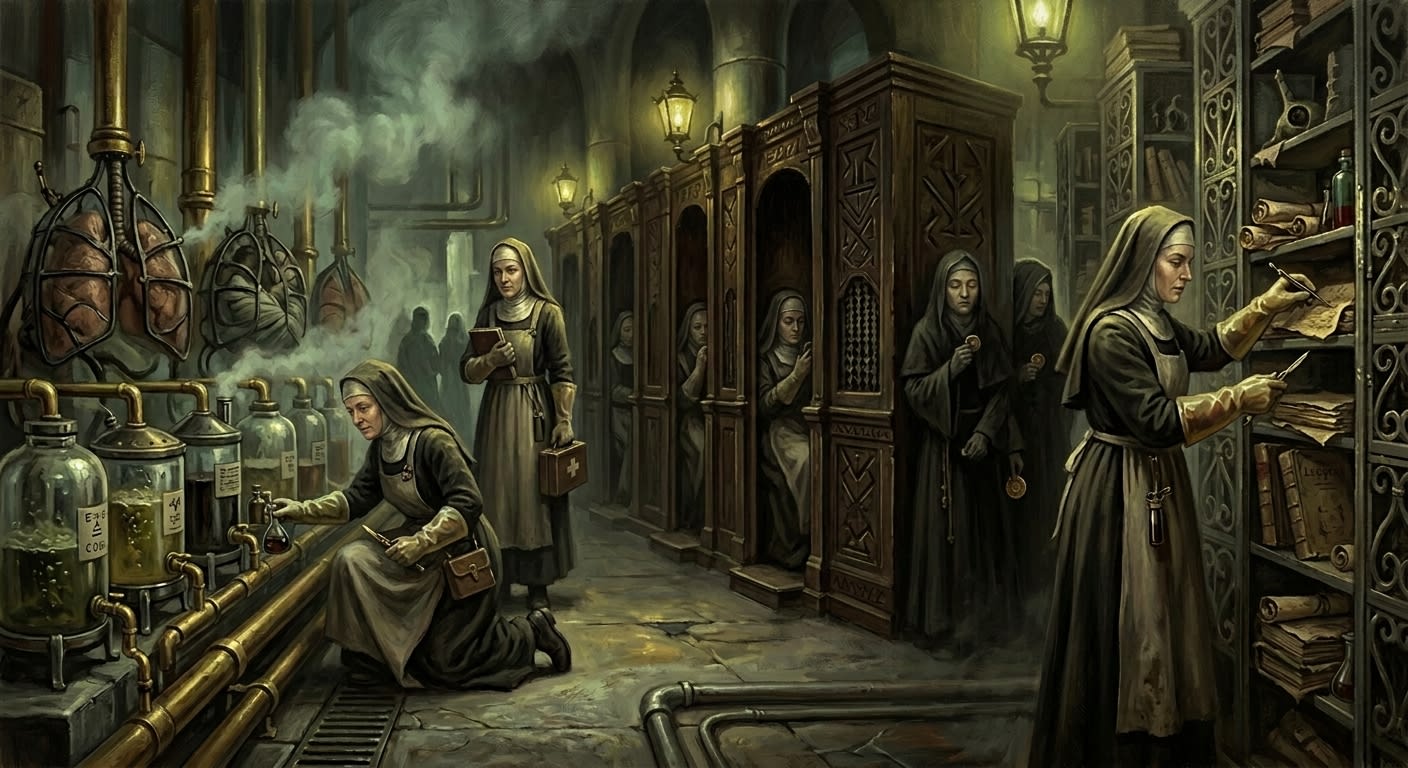
Hospice Row smells of resin, bleach, old prayers, wet wool, and the sweet metallic breath of men whose lungs have begun negotiating with the furnace. The wards are long, low rooms with black-glass clerestories and bed-bells tied to the wrists of patients who still possess wrists worth tying. The Sisters wear grey veils lacquered at the mouth with boiled resin. Their aprons are stiff with wash-salts. Their hands have the texture of scrubbed parchment and the authority of a warrant.
At the intake desk, a patient is weighed, named, listened to, questioned, masked, prayed over, and assigned a dish. The dish matters. Ordinary ash settles dull. Fume fever ash glistens at the edges. Furnace flashback ash carries a burnt-sugar smell that causes junior novices to vomit into their sleeves. Since A.S. 199, some ash writes.
The confession booths stand beside the lung wards, not in the chapel. The placement is deliberate. A worker who cannot breathe will confess quickly, and a quick confession is often more accurate than a polished one. The Sister behind the grille records sin, exposure, shift, kiln, foreman, feedstock batch, hymn irregularity, injury site, wage dispute, and last meal. The priest receives the soul. The Sister receives the facts. It is an efficient division and for that reason resented by every male office in Brast, especially those trained by the Bureau of Records to mistake neatness for truth.
Ordnance notices describe Ash-Hospice confession as “pastoral accompaniment to medical care.”
Corrected for accuracy. The booth is a ledger with incense. The pastoral portion is real, which makes the ledger worse.
#On the Archive Beneath the Poultice Room
The Ash-Hospice archive is the cleanest dirty thing in Brast. It lies under the poultice room, behind shelves of resin bricks and vinegar jars, in six narrow vaults lined with limewash, oilcloth, and the patience of women whom nobody thought to fear until their filing surpassed the Manifest Court. Every confession transcript is cross-indexed against every accident report the Sisters can obtain, steal, copy, reconstruct, or infer from missing fingers. Every fever case receives a kiln number. Every kiln number receives a shift. Every shift receives a foreman. Every foreman receives a shadow column.
The Manifest Court keeps official ledgers with the clean, bloodless beauty of a chapel floor after scrubbing. The Sisters keep ledgers that smell of broth and panic. Vale's ledgers prove what can be punished. The Sisters' ledgers prove what happened. These are related disciplines only in sermons.
The Furnace Chapterhouse envies the archive and pretends to pity it. Its eastern furnace cabinets hold accident prayers, substrate blessings, and confessional fragments under rite seal. The Sisters hold cough timing, ash characters, ward gossip, and the last honest words of men abandoned by procedure. Ruln's Compact wants to know which filter lots produce which coughs. Kest's Choir wants to know which throats stiffen near old furnace scars. Mire will want all of it.
Hospice Ledger B-19, shelf six, correlates fume-fever ash-script names with the A.S. 199 Przemyśl misfire inquiry (Unregistered). Four names appear before their recorded deaths. One name belongs to a worker still assigned to Boiler Commons Shift Red-Three. The Sisters have moved his bed twice. The ash keeps spelling him correctly.
The archive is partial. Mercy never is. A Sister may delay medicine for a foreman who falsified injury slips. She may move a fevered child ahead of an officer who complained about the smell. She may send a copied accident page to Vale, or to Kest, or to the Chapterhouse, or to no one until the price of truth improves. In Brast, a poultice is medicine, charity, verdict, and loan.
#On Their Enemies, Which Is to Say Their Patients
The Sisters' first enemy is soot. It enters the mouth in particles too small for doctrine and too numerous for apology. Ash lung begins as a grey line on the handkerchief, becomes a whistle under the ribs, and ends as a man sitting upright because lying down feels like burial rehearsed by amateurs. Fume fever comes faster: heat behind the eyes, resin taste, black sweat, speech slipping into furnace cadence, ash in the dish arranging itself as if instructed by a clerk with dreadful penmanship.
Their second enemy is the Ordnance Bureau, which prefers injuries that fit forms. Burns, crushes, severed hands, rail impacts: these behave. They arrive named and depart counted. Fume fever misbehaves. It points at ventilation, feedstock, hymn error, filter failure, hidden substrate steps, and the impolite possibility that the machines themselves have begun entering the medical record. Engineering dislikes illnesses that accuse infrastructure. Ordnance dislikes illnesses that require Engineering to be summoned sober.
Their third enemy is gratitude. Workers adore the Sisters in the manner of desperate people who know tenderness can still keep a file. A man will kiss a resin-gloved hand, then beg that his confession not be copied to the accident column because his heat debt passes to his wife. A woman will bring broth to a ward, then whisper that her husband's cough began after a grey drum split in Still-Canal South. The Sisters receive love, fear, secrets, and bribes of bread with the same nod. They waste nothing.
The Calibration Choir calls them a medical hazard because they track throat damage among licensed voices. The Distillers' Compact calls them sentimental nuisances because they remember filter-lot numbers better than clerks. The Furnace Chapterhouse calls them secular Mercy women when irritated and holy attendants when requesting access to a dying witness. Everyone uses them. Everyone fears what they heard while being useful.
#On the Mass Fume Fever
The present crisis began as a warding inconvenience, which is how most Brast disasters introduce themselves when still wearing manners. In late A.S. 201, after the seventh missing drum and before Mire's delayed arrival, thirty-seven workers from three districts developed fume fever within two bells of one another. Gauge Ward, Still-Canal South, Boiler Commons Red-Three. No shared meal. No shared dormitory. No shared foreman. Shared chrismole exposure, shared night roar, shared fourth-bell hymn.
By morning, the number was eighty-one. By the following pressure cycle, one hundred and twelve. The official notice called it a ventilation recurrence. The Sisters checked ventilation logs, feedstock quality, furnace operation, hymn schedule, filter replacement, and shift rosters. No ordinary cause held still long enough to be blamed.
The ash in the dishes wrote names.
Brast civic notice 201-F describes the fever cluster as “seasonal particulate irritation.”
It has always been the case that seasonal irritation does not spell the dead, correct accident dates, or indicate a still-sealed audit appendix by page number.
The names corresponded to workers dead in furnace incidents from A.S. 74 onward: Kiln Three martyrs, condenser drownings, rail crushes, sealed burns, fume suffocations, men recorded as transferred, women recorded as absent, children recorded nowhere because nobody likes counting small bodies in an industrial triumph. The Sisters cross-indexed the characters against their archive and found the spellings exact. The Ordnance ledger disagreed on eleven. The ash sided with the Sisters.
#On the Present Mercy
As of A.S. 201, the Ash-Hospice Sisters hold the most dangerous archive in Brast because it is accurate in a city governed by useful error. They can prove which accidents were accidents, which accidents were offerings, which accidents were invoices paid in flesh, and which accidents are still walking around with shift tokens and bad lungs. Their superior has not released the ledger. This restraint is praised as piety by fools and so recognised as power by anyone worth blackmailing.
Lux Thane Mire will ask for the fever dishes. He will ask for Ledger B-19. He will ask why the ash writes names the Manifest Court misplaced. He will ask why some names appear before death. The Sisters will offer him resin tea, a mask, and a chair by the intake desk, because every man eventually coughs in Brast and all authority sounds different through a damaged throat.
The wards are full. The booths remain open. The dishes settle in rows beneath little paper labels, and the ash writes with the grave patience of a clerk who has already won the appeal.