
#On the Mercy Built Downwind
"Put the beds where the soot already goes. It saves carrying." — attributed to a Boiler Commons shift-foreman, undated
Ash-Hospice Row occupies the western arc of Brast, downwind of the Chrismole Crown. Every civic notice calls this placement merciful. The reasoning has never needed a charter and has never had one. The prevailing wind carries the Crown's soot west, and the men who breathe worst were already breathing it. So Brast housed its dying where the ash would reach them anyway. This spared the cleaner districts a second exposure, and it spared them the trouble of watching the first.
The Row was never founded. It accreted. Before A.S. 74 the western wall held lung benches, plank seats set against warm brick where furnace crews sat out a coughing fit and went back to the kilns before the next bell. Then Kiln Three exploded. It killed nine men and left their bodies in postures later certified as devotion and venerated under the name of Saint-Combust. After the first soot-vigil, the benches filled with men who did not go back to the kilns. Women came to sit with them: furnace wives, widowed aunties, failed novices, kitchen sisters, resin-boilers, and two Mercy laywomen whose names the record has since mislaid. By A.S. 76 the benches had become a hospice. Nobody had authorised it. Nobody could afford to stop it.
The formal Synod arrived in A.S. 90. As it does with anything already indispensable, it recognised the Ash-Hospice Sisters after the fact. The street itself received no such honour. It appears on Brast survey maps because the surveyors grew tired of drawing around it.
#On Wards, Booths, and Dishes
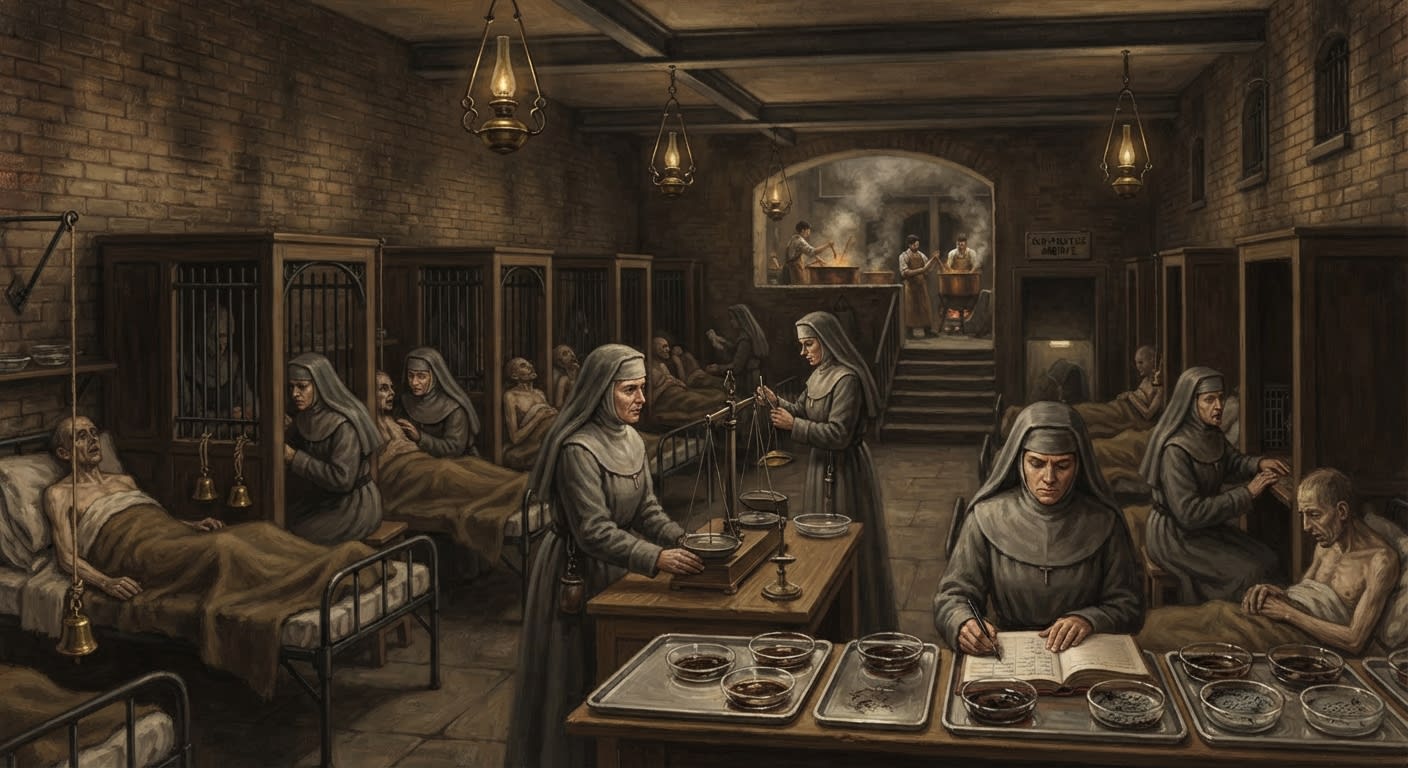
The Row runs in a long crescent along the old western wall. It is a single cobbled spine, with the lung wards stepping off it in low ranks. The wards are kept low on purpose, because ash settles and a short ceiling keeps it within reach of a broom. Their clerestories are glazed in glass that the soot has stained black. Noon arrives in the wards as a brown rumour, and the Sisters work by lamp in every season. Bed-bells are tied to the wrists of patients who can still lift a wrist. The rest are checked by ear.
The district smells of resin, bleach, old prayers, wet wool, and the metallic breath of sick workers. On a bad day the smell reaches the Slag Market. It never reaches the Gauge Ward, which is the whole theology of the wind.
Traffic enters from the east. Stretchers come down from the Boiler Commons at shift change. Barrows come up from the Still-Canals with men whose eyes have been cooked by solvent. Handcarts arrive from the rail yards after a crush. Now and then a covered litter comes from the Gauge Ward, carrying a choir-technician whose licence forbids him to be seen coughing. All of them stop first at the intake desk, a long oak counter at the Row's eastern mouth. There a Sister in a grey veil, lacquered at the mouth with boiled resin, weighs the patient, names him, listens to his chest, masks him, and assigns him a dish.
The dishes are glass, shallow and numbered, one to a bed. Each receives whatever the patient brings up. Trays of them go to the dish-room to settle in rows beneath paper labels bearing name, kiln, shift and hour. Ordinary ash lung settles dull. Fume fever glistens at the edges. Flashback ash smells of burnt sugar and sends junior novices into their sleeves. A trained Sister can read a man's employment history in his sputum faster than a manifest clerk can find his file.
The confession booths stand beside the beds. Brast's chapels lie east, under the Crown, and a man drowning in his own chest cannot walk there, so the grille comes to him. The priest takes the sin. The Sister at his elbow takes the shift, the kiln, the foreman, the feedstock batch, the skipped stanza, the valve that stuck, and the injury that was reported as something else. Confession becomes intake and intake becomes record. Once a Sister has held the pen, nobody can say where the sacrament ended and the file began.
Behind the wards, the resin poultice rooms boil day and night. Novices stir amber pitch in copper pans and learn the Row's first discipline, which is keeping their own hands out of it.
#On the Archive Beneath the Poultice Room
Under the poultice rooms, behind shelves of resin brick and vinegar jars, six narrow vaults hold the most accurate paper in Brast. They are lined with limewash and oilcloth against the damp that rises from the pitch boiling overhead. Every bedside confession goes down there. So does every accident slip the Sisters can obtain, copy, buy, or reconstruct from the evidence of missing fingers. Each case receives a kiln number, each kiln number a shift, and each shift a foreman. Each foreman receives a column of his own, kept quietly and never shown to him.
The Manifest Court, under Commander-Auditor Sorn Vale, keeps ledgers that establish what can be punished. The Furnace Chapterhouse keeps its eastern furnace cabinets of accident prayers and rite-sealed confession fragments, which establish what can be sanctified. The Row's vaults establish what happened. Neither office has ever asked for that, and both have tried to borrow it.
Pex Ruln's Distillers' Compact sends oiled men to ask which filter lots produce which coughs. Ilyra Kest's Calibration Choir sends listeners to ask which licensed throats have begun to stiffen. The Bureau of Records sends forms in triplicate and receives them back in single copy. Since the A.S. 199 misfire at Przemyśl, when a Brast-fed battery put four rounds into a friendly rail junction and killed eleven, every office in the city has wanted a key to vault six. The Sisters answer each petitioner according to the price of the season.
HOSPICE LEDGER B-19 — SUB-POULTICE VAULT SIX Correlation: fume-fever ash-script names against the A.S. 199 Przemyśl misfire inquiry Entries preceding recorded death: ██ Living entry: Boiler Commons Shift ████-Three. Bed moved twice. Spelling unchanged. Distribution: ████████████. Ordnance copy: none. Strasbourg copy: requested; ████████.
#On the Hospice Edge
The Row's western edge has no wall. It frays into the Slag Market through a belt of laundries, drying yards, pipe-runs and vinegar stalls where no two surveys agree which side of the line a given washtub stands on. The ambiguity suits everyone. It has therefore been maintained with a care that Brast rarely spends on its pipes.
Across this edge the Sisters buy what they condemn. They buy illegal resin, cooked in sheds under the slag berms, cheaper than the Ordnance allotment and cleaner. They buy cough tinctures of uncertain parentage, and old accident slips sold by clerks who were paid to lose them. They buy the names of workers who never reached an official roster and so cannot, officially, be dying. The morning sermon in the ward chapel calls the Slag Market a sink of theft. By noon the Sister who nodded through it is haggling for pitch at a scrap altar, and her basket is the heavier for it.
Traffic runs the other way through the laundries. Warmth Thieves move siphoned bladders through hospice linen, because a basket of fever sheets is the one cargo no provost in Brast volunteers to search. Nobody has ever shown that the Sisters arrange this. Nobody has ever shown that they object. Warm bricks wrapped in hospice cloth turn up under the cots of feverish children. On paper, the Row's heat allotment has not risen in living memory.
Where the Row meets the Boiler Commons, the trade is simpler and crueller. When a man enters the wards, his family inherits his heat debt. Sisters sit at kitchen tables and explain this, slowly, twice. Some wives beg that a husband's confession never reach the accident column, because an accident with a named cause can be charged to the dead man's household. Some Sisters agree. That is the Row's other ledger, and no vault holds it.
#On the Fever That Writes
"Seasonal." — Brast civic notice 201-F, operative word
By late A.S. 201, Brast was already at Amber for the Sulking Engines. Seven sealed drums were still missing from the Manifest Court, and Kest had recorded the new syllable in the night roar and locked the cylinder in Vault Brast-4. Then thirty-seven workers came down the intake road within two bells of one another. They came from the Gauge Ward, Still-Canal South, and Boiler Commons Red-Three. They shared no meal, no barracks and no foreman. They shared chrismole exposure, the night roar, and a fourth-bell hymn that had run irregular. By morning the intake desk had counted eighty-one. By the next pressure cycle it had counted one hundred and twelve, and patients lay along the cobbled spine on folded laundry.
The ash in the dishes wrote names.
The Sisters carried the dishes down to the vaults and matched them against the archive. The names belonged to dead furnace workers. They were spelled as the archive spelled them and, in several cases, as the Manifest Court did not. Some of the names appeared in the dishes before their owners' recorded deaths. One belongs to a man still assigned to Red-Three and still breathing, moved twice across the ward and spelled correctly in both beds. The Row has not said why the ash writes, or by whose hand. I will not guess on paper that Doctrine reads.
Civic notice 201-F: "a seasonal particulate irritation among furnace labour, expected to clear with the change of wind."
Corrected. The wind has changed twice since the notice was posted. The dishes have not noticed.
Inquisitor-Mechanic Lux Thane Mire is expected from Strasbourg, on trains that the eastern engines keep stalling. When he reaches the Row he will ask for the fever dishes. He will ask for Ledger B-19. He will ask why the ash writes names the Manifest Court misplaced. The Bureau of Engineering will want his answers in its own vocabulary, and Vale would prefer that he give none. The intake Sister will weigh him, name him, mask him, and assign him a dish. That is procedure.
Everywhere else in Brast, a fact must be filed, audited, sealed and stamped before it is allowed to exist. On Ash-Hospice Row it comes up with the cough, lands in glass, and waits under a paper label.