

#On the Licensed Hand
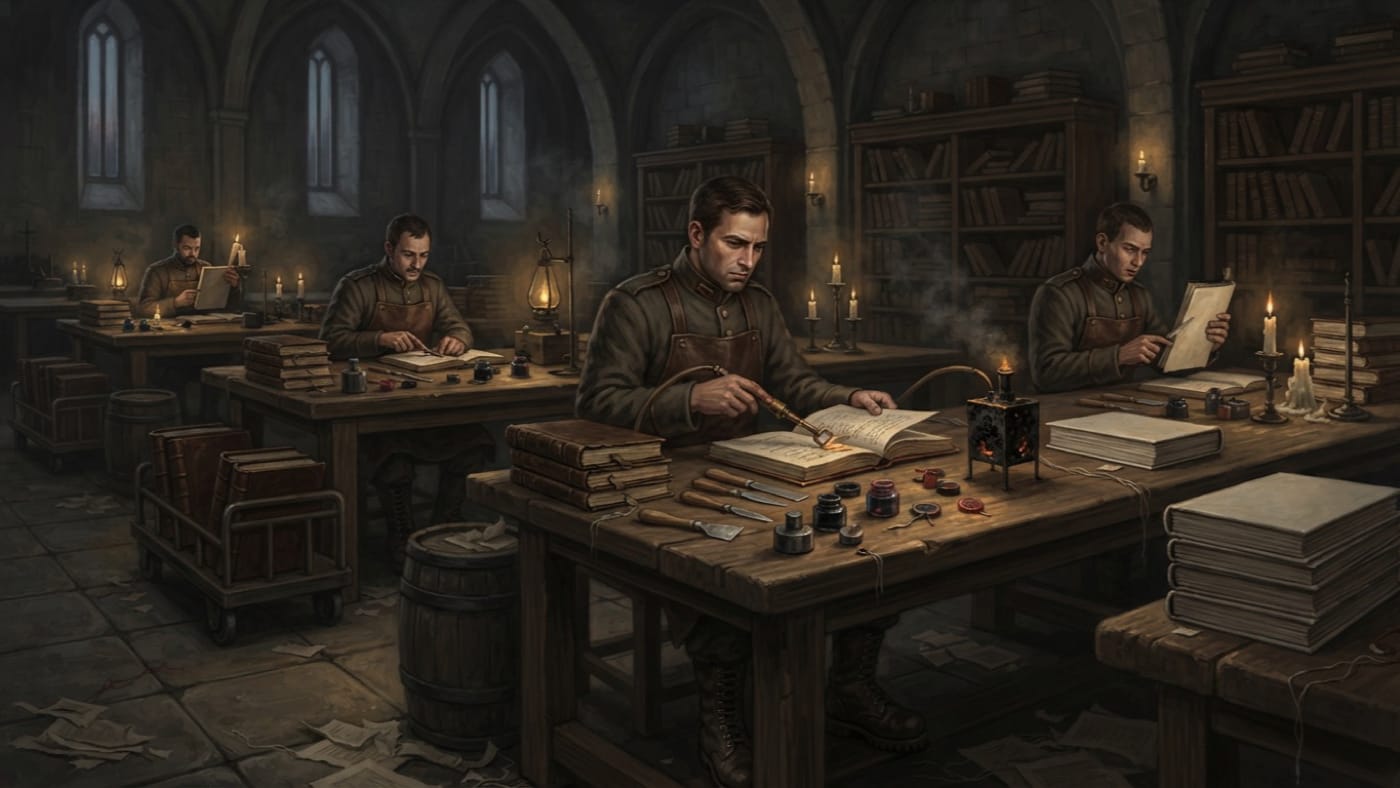
A Redactor is a copyist paid to forget on the Church's behalf. The Bureau of Silence licenses libraries and archives. Its Redactors are the hands that make each licence true. They open a book, sort the words that were approved from the words that simply turned up, and produce a copy that contains only the first kind.
That distinction is the whole trade. A licensed book is a settled thing: its text examined, its wording fixed, its place on the shelf granted. What a later reader writes beside it has never been examined by anyone. A monk's note in the gutter of a psalter may be devout, mistaken, or correct. To the licence, all three are the same offence, because none of them was asked for.
The name of the employer needs a clerk's caution. In A.S. 56–58 (1766–1768 CE) there was no formal Synod; that waited for the Concordat of Strasbourg in A.S. 90 / 1800 CE. There was the public Church, eleven years out of hiding after the Sundering of A.S. 45, an interim council that had governed since about A.S. 50, and a scatter of censorial organs still learning their own letterheads. The Codex files those organs under Bureau of Silence because that is what they became. Filing them as "assorted anxious clerks with knives" would be accurate and would upset the cabinet-makers.
#On the Monastery Sweep
Redaction became a system at a scriptorium outside Trier, in the Rhineland, in A.S. 56. Its name has not survived, which is one of the trade's quieter achievements. An auditor examining an approved antiphon found acoustics equations written beside it in a monk's small hand. The equations were correct. An incorrect gloss is a clerical nuisance. A correct one tells the reader that the margin knows something the licence does not.
The Redactors' work began after that discovery, and the order matters to anyone who keeps accounts. The auditor found the problem. The Redactors were sent to search for its relatives, and they found them in most places they looked. The Great Purge of Margins spread from the Rhine scriptoria to Mainz, Cologne, and Strasbourg, through copying houses whose names were later removed from their own lintels, and west out of the river country entirely to Ghent in Flanders. Where a library held books, a cart was assigned to it.
The campaign's totals were forty-seven scribes executed and twelve libraries confiscated. Those are campaign figures. They do not tell us how many Redactors served, and no ledger I have seen places a Redactor at the gallows. The hangings belonged to the campaign. The copying table belonged to the Redactors. Both were busy in the same three years, and the courtyard and the scriptorium share a wall in most Rhineland houses.
#On the Work of Correction
The published account of the Purge gives the Redactors carts, wax, knives, ash tubs and candles. I record those items as that campaign's equipment and nothing more. Any clerk who turns that list into a regulation kit will be asked to name the regulation.
The work started at the binding, because a careful monk does not keep his best notes on the open page. Redactors cut away endpapers to see what had been pasted beneath. They scraped boards to find writing pressed into the wood. They split bindings along the spine and examined the sewing for folded slips. They held leaves above a candle, close enough to warm the vellum without scorching it, because lemon-ink stays invisible until heat brings it up brown. They also swept the dust from under the reading desks and sifted it, which tells you how thoroughly they meant it.
The full treatment was not given to every seized volume. A hymnal with three pencilled corrections and a ledger with a hidden second account did not get the same handling, and the surviving material does not say how each book was judged. What it does describe is the outcome of the worst cases.
The original came back from the table as an exhibit: boards scraped bare, spine opened, endpapers gone, every leaf marked by heat at the edges. It went under seal to the Forbidden Stacks. The account gives the destination and nothing about the route or the building, and I add nothing. The replacement came from the same table as a fresh copy in a licensed hand, approved wording only, margins clean and blank. It went back to the shelf where the original had stood, so the shelf noticed nothing.
Ink redaction is a separate operation and should not be confused with clean copying. The Bureau blots out dangerous words inside licensed holdings with ink so thick it bleeds through the vellum. The blot takes the offending word from one side of the leaf and an innocent one from the other side, a word that had committed no offence beyond lying on the far side of the page.
#On What the Copy Lost
The clean copy kept everything that had been licensed and lost everything that had been learned around it.
Think of a commentary on fasting kept in a monastery infirmary. Its approved text sets out the days and the prayers. Its margins, filled in by several generations of infirmarians, recorded which fevers broke on the third day and which ones killed by the fifth. The Redactor copied the days and the prayers exactly. The infirmary got its book back, perfectly correct and of no use at a sickbed.
Bridge ratios went the same way. Load figures had been written beside psalms, apparently because a psalter was the book a builder could carry onto a site without a permit. The psalms survived the copying and the figures did not, and the next bridge was built by guesswork.
The bell harmonics were the worst loss, because the Church depends on bells. Notes on how a bell drifts out of tune in rain, and how much to compensate, were written beside the antiphons the bells accompanied. Silence filed those notes as contamination of hymnody. The antiphons kept their approved melodies, and the bells that had to carry them lost the corrections that kept them in tune.
None of these margins was a manifesto. They were working records, kept beside prayers because a prayer book was the one kind of book nobody would think to confiscate. The Redactors preserved the wording perfectly and threw away the know-how written around it. The Bureau still lists both as "preservation."
#On the Knowledge Beyond the Page
The sweep taught the people it hunted one thing: anything written where an auditor could see it was already confiscated, just not yet collected.
Some of the countermeasures were older than the Purge. The Redactors were warming leaves for lemon-ink in A.S. 56 because someone was already using it. What the campaign changed was how much people relied on these methods. Lemon-ink spread from occasional use to standard use. Ash-paper came into circulation: charcloth sheets made to be read once and burned without leaving a legible trace. Cipher wheels turned a note into nonsense for any clerk without the matching wheel. Bone needles let a binder replace a book's interior without cutting the spine afresh. A devotional cover passed every inspection while the pages inside were something else entirely.
The most effective method used no materials at all. Knowledge was split up and memorized. A single formula was divided among several people, none of whom held the whole of it, and some of whom were chosen partly because they disliked each other and would not compare notes. A Redactor could split a binding but could not split a person's memory, and could only seize a written fragment if someone wrote it down.
The scholars of the Ashen Circle traffic in forbidden histories and forbidden sciences, and the Ashen Circle Scholar still trains on what the Purge proved. Their novices learn lemon-ink by candlelight and then burn their own notes. The Purge did not found the Circle, and no surviving record gives it a founding date or a founder. The Purge did take a loose habit of hiding notes and turn it into a discipline.
#On the Present Trade
The Bureau of Silence still licenses libraries and archives, and its ink still bleeds through vellum. The Interdiction Squads still warm pages over candles and still split bindings, now looking for methods that the first sweep made common.
The trade has its own economy. At the Hollow-Script Scriptorium of Nemea in the Heartlands, redaction is a paid job like any other. It sits beside the ash-ink vats, the sealing-wax works, and the yards where scraps are shredded and burned. Corrected copies leave the town in sealed carts, and the leftover scraps go to the burn yards. Nemea's local customs are its own and are not Redactor law anywhere else. Its ledgers show what the Purge started: erasure as a regular, paid trade that runs on a schedule.
The forbidden knowledge kept moving after the sweep: from person to person, in recipes, in tallies, in hymns with a deliberate error in them. Silence still cannot say where it went.
Official result of the Great Purge of Margins: doctrinal correction achieved.
Corrected. The Redactors removed visible annotations from approved copies and sent the marked originals under seal to the Forbidden Stacks. The campaign executed forty-seven scribes and confiscated twelve libraries. The knowledge in those margins was not corrected. It left the books and became much harder to find. The phrase "doctrinal correction achieved" may stay in the training lectures. It may not stay in the Codex.