

#On the Field Office
The Silence Redactor is the hand of the Bureau of Silence that actually touches the page. About three hundred of them work in the field across the Bureau's reach in any season. That is the Bureau's complement. On any given morning some are ill, some are on the road, and one is always in a parish sacristy arguing over a hymnal. Above them sit the forty regional Audit-Cantors. Above the Cantors sits Censor-Prelate Aldara Vess the Younger, in the Cloister of Prescribed Silence in the Cathedral district of Strasbourg. Six hundred clerks keep the licence rolls behind all of them. None of the six hundred is a Redactor, whatever they tell their mothers.
The trade is older than this office. The Redactors of the Great Purge of Margins in A.S. 56–58 (1766–1768 CE) split bindings, warmed leaves to raise lemon-ink and made licensed clean copies. They did it for censorial organs that had no Synod to answer to, because the formal Synod did not exist until A.S. 90. The Codex files those organs under Silence's name because that is what they became. The present officer has inherited their suspicion and very little of their penmanship. He does not copy. He blots.
#On the Seven Instruments
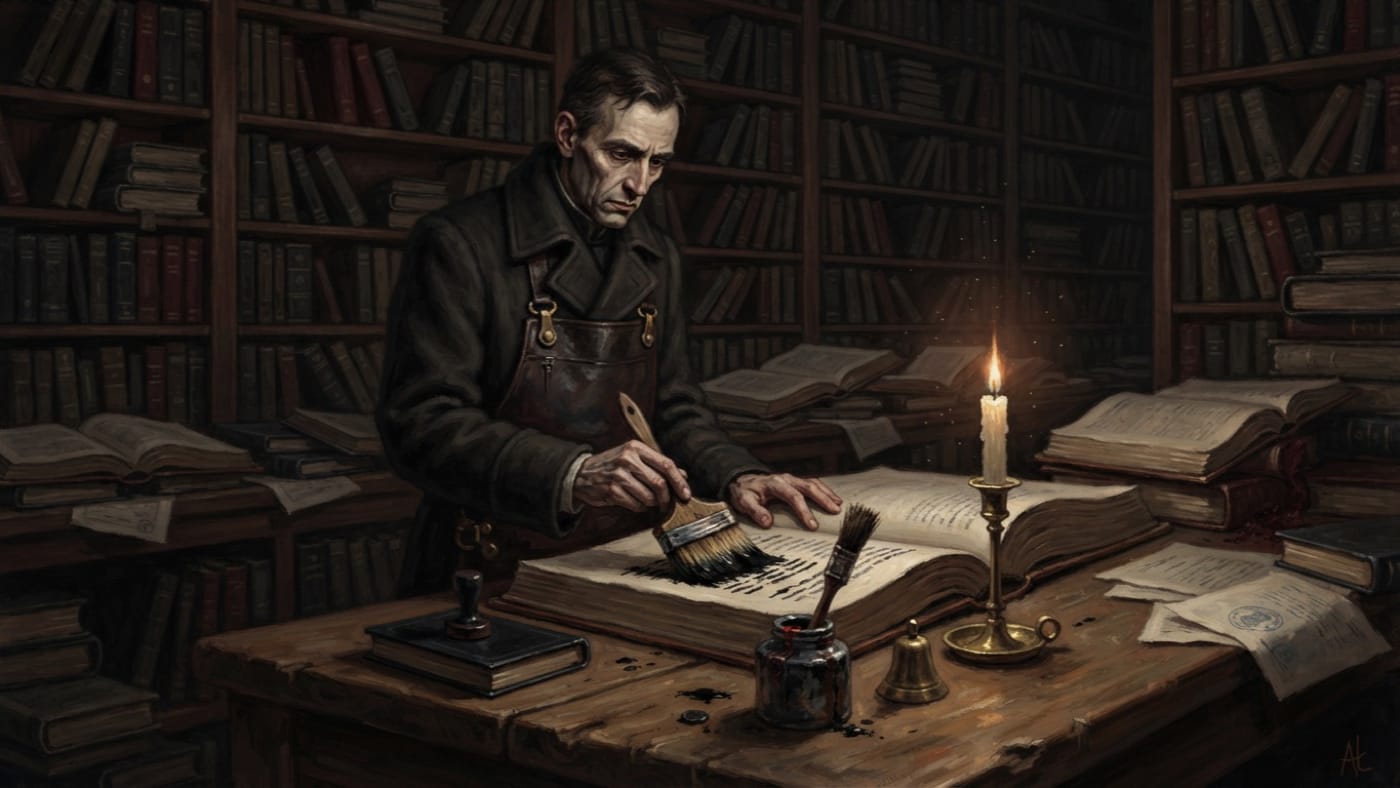
The standard kit has seven items, and the Bureau counts them the way a sacristan counts the altar plate.
First, the ink pot. It is sealed in lead and blessed weekly. The lead keeps the ink in. The blessing is there to reassure the lead.
Second, the application brush: boar-bristle, cut wide, never cleaned, replaced monthly. After a month of dried black, the heel of the bristles is stiff enough that the brush stands up in its case by itself. A Redactor who washes his brush to soften it has broken procedure. I have found no penalty for this, only looks.
Third, the approval stamp, which bears the Bureau's seal: a closed book on a black field. It is pressed onto whatever survives. Every licensed page in the Church has been approved by a picture of a book that cannot be opened.
Fourth, the licence register. Fifth, the parish assessment form, on which the visit is recorded for the regional Cantor to review. Sixth, the Redactor's personal copy of the Approved Content Index. Purity keeps the Index Damnatus. No regulation I have read says the two are the same book, and Purity would file a dispute against anyone who said they were.
Seventh, a small bell.
The bell is rung once when the Redactor enters a library and twice when he leaves. The parish follows his business by counting. If the shelves are so foul that the work runs long, the two departing strokes are held back, and until they sound the library is under interdiction and silence. The parish learns to stop counting at one.
The ruler that now comes to every audit is not on that list. It arrived with the margin directive, and that directive is a memorandum about margins that says nothing about kits. Any clerk who adds an eighth line to the issue sheet will be asked which ordinance authorises it. There is no such ordinance.
#On the Conduct of an Audit
Ordinance 14-A, revised in A.S. 187, requires a licence for every library, archive, scriptorium, reading room and private collection of more than seven volumes. It makes no exception for small ones. A village shelf of fourteen psalters is a library in law, and every library in law gets a Redactor.
The visit always runs in the same order. The bell sounds once. The Redactor checks the register against the shelf, title by title. He is looking for two things: unlicensed books that are present, and licensed books that are missing. The missing ones worry a Cantor more. Then the Cantor reads. Purity keeps the list and Doctrine decides what counts as heresy, but at the reading desk the judgement is the Cantor's. She marks the condemned passage, names any volume to be confiscated, and in the worst cases recommends that the library be closed. The Redactor stands at her shoulder with the pot unsealed. The Cantor points. The Redactor paints.
Bureau ink does not sit on the surface. Laid over a line, it soaks down through the vellum and comes out on the back of the leaf, often goes into the backing, and on old thin stock reaches the shelf below. In A.S. 178 the Bureau of Engineering found that it bonds with the page so firmly that no solvent will lift it. That finding is about bonding. Silence's theologians have since hung a good deal of the Creator's purpose on it, and Engineering never signed for any of that. Whatever the cause, the word disappears from both sides of the leaf, and so does whatever harmless word happened to sit behind it on the reverse.
This is how the field work differs from the old copying table. A clean copy discards the original and keeps the approved text whole. A blot keeps the original and damages it. The field kit has no copying desk, so the parish's only missal goes back on its shelf with a black bar through its third leaf and a closed book stamped underneath.
The Hollow-Script Scriptorium of Nemea runs its paid copying and redaction trade by its own customs, with its own correction bells and its own vows. Those customs belong to Nemea. Outside it, no field Redactor kneels to confess his margins.
#On the Limits of the Warrant
The Redactor's warrant covers the text and nothing else. Armed seizure is the work of the Interdiction Squads, who are seconded from the Bureau of Purity and serve under Silence's command. On a raid, one team secures the people, one secures the exits, and the Redactor secures the words. He has no power to arrest a librarian. The parish assessment form is, however, a fine place to begin the paperwork for someone who does.
His office does not open any door to the Forbidden Stacks beneath Strasbourg. A confiscated volume passes into the Bureau's custody, and the Redactor never sees it again. Access to the Stacks is governed by licences and counter-seals held far above any field officer. The Bureau of Records keeps the wider archive and its catalogues, and it reminds Silence of this in writing whenever Silence forgets.
What the brush removes is seldom a manifesto. Usually it is an infirmarian's note on which fevers break on the third day, a load figure written beside a psalm, or a bell-founder's adjustment for wet weather. The Ashen Circle keeps knowledge of that kind where no brush can reach it: in lemon-ink, inside re-sewn bindings, or split into fragments among six people who dislike one another. Every black bar teaches the craft a little better to the very people it was meant to stop.
The Bureau of Silence does not burn books.
Corrected. The Bureau's own figures for A.S. 200 list 2,106 volumes destroyed. The sentence above is still in use as a motto. It may not stand in the Codex as a description of practice.
#On the Present Ink
The Bureau's ink is brewed at Nemea to a formula that was classified in A.S. 96. The published account names an iron-gall base, lamp-black from consecrated tallow, ash from texts that have already been redacted, and a mineral binder that Alchemical Standards calls "possibly calite, certainly unsettling." The proportions are withheld, and I approve of that. Nemea's ordinary ash-ink for Records is described differently, and I do not certify that the two blacks share a recipe.
Ink Batch 4,891-K is docketed Nemea origin, 3rd Quartus A.S. 200. Its ash comes from texts redacted in A.S. 198 and 199. Like the older batches, it soaks down through the leaf. Then it spreads sideways. The stroke holds its edge while the bristles are on the page. Once they lift, the black creeps outward one to three millimetres past the ruled line, into words the Cantor read and approved. In a psalter written in a small hand, that is the end of an adjective or the first letter of a saint's name.
Alchemical Standards found the batch within acceptable parameters. Engineering found it chemically identical to earlier batches, with an unexplained increase in how much the page absorbs. Silence classified both findings. Production continues under Seal Amber. The A.S. 201 memorandum orders the margins of approved texts widened by exactly three millimetres. The observed spread is a range, and the remedy is a single number. The Bureau prefers a single number, because no one can argue about where they stand inside it.
The Redactor notices all this first. He lays the line and watches the black follow on after his brush has lifted. He turns the leaf by its corner to keep his thumb out of the wet ink. Then he stamps a closed book beneath a passage that is now three millimetres shorter than the one the Cantor approved.
Three Redactors have filed sealed depositions with the Bureau of Purity rather than with their own superiors. They testify that if a fresh redaction in the new ink is tilted to a precise angle in candlelight, words can be seen inside the black. According to the depositions, those words were not in the original passage and belong to no language the Bureau of Records catalogues. The deponents describe them, in their own phrase, as "the text the page was trying to write before we stopped it." No angle stated in the depositions has reached me, and no names that I am permitted to print. What they do mention is the candle, and every Redactor carries a candle into every library.
Purity has filed the depositions under ████████████████. The Bureau of Doctrine returned the file with one annotation: "████████████████████████." Silence has issued no reply.