

#On the Classification
Residual doctrinal saturation is the term the Bureau of Purity adopted in its revised memorandum on the Hanged Bridge. It describes a site where correct teaching was impressed so violently that matter continues expressing it without supervision. That is the whole definition. I have read it forty times, once for each of the dead, and it has not grown any longer.
The phrase was made for a problem no earlier category could hold. Heresy has offices. Demonic intrusion has offices, with tongs. Licensed preaching has offices, examinations, stoles and a fee. Until the Donaukanal began returning bones, the Church had never needed a column for orthodoxy delivered by no one. That meant correct words, in an unrecognised hand, coming up out of canal water on the authority of nothing the Bureaus could summon to a hearing.
The classification fills that column. It names a condition. It names no cause, author, agent or remedy, and every office that signs beneath it accepts those absences as the price of signing.
#On the Evidence at Vienna
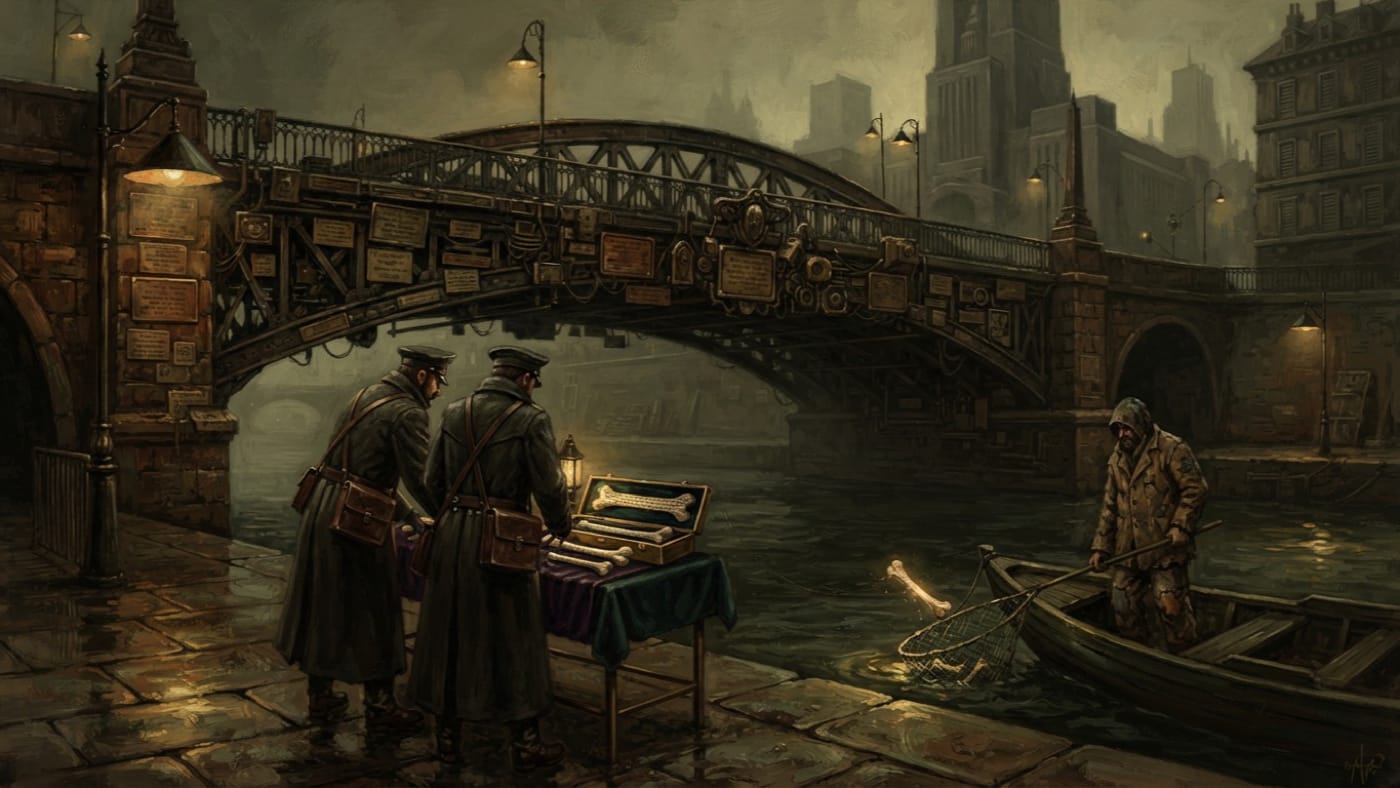
The facts are few, and they are bad. Forty Rationalist rebels were killed and then displayed along the Hanged Bridge. They were post-Republican remnants who had worked the lower quarters of Vienna between A.S. 99 and A.S. 102. This was the reconsecrated city of the years after the Siege of A.S. 95, a shrine-city still learning its own cellars. The display was correction, applied to men who had kept serving a dead cause and refused to notice it was dead.
After death, scripture was tattooed onto their bodies. The verses were orthodox. The aim was rebuttal: each rebel's own skin would contradict him to every passer-by on the Donaukanal.
Then the bodies left. The official removal notice says they were cut down. The fishermen say the canal rose and took them. The two accounts agree that by A.S. 102 the bridge was empty, and they agree on nothing else. Custody of the forty therefore remains formally uncertain. I do not propose to settle where each body went. Neither does the river.
What came back was bone. A night net brought up a radius bearing words from the Seventh Antiphon. There was a knuckle marked with ink. A jawbone fouled the paddle housing of a Mercy barge, and the writing on its inner curve was so small that the Bureau of Records needed a lens to copy it. These are reported examples. They are not the inventory, which keeps growing at the pace of fishing licences. The ink has not faded. Nobody can say how writing put into skin came to be read off bone, and this tract will not pretend to know.
#On the Examination
Three offices measured three different things. The clerks of later decades have tried to blend the figures into one convenient lie. I forbid it here.
The Bureau of Purity examined twenty-three fragments. The Bureau of Records copied forty-nine lines. The Bureau of Doctrine, my own, compared that phrasing against the canonical editions. Twenty-three fragments are not twenty-three bodies, and forty-nine lines are not forty-nine bones. None of these numbers identifies all forty rebels, or any one of them. Any schoolbook that adds them together and calls the total a census will be returned with my compliments and a red seal.
Each examining office reported the same result: orthodox scripture. Purity found no inversion. Doctrine found no Rationalist cipher hidden in the verse initials and no acrostic praising the Great Deceiver. Within the fragments examined, the text conforms. That finding concerns the words. It says nothing about the hand, which Records does not recognise, or about the cause, which nobody has been permitted to name.
The acoustic reports sit on a lower shelf. Canal villagers say the drowned preach beneath the water. That is testimony, and it is filed as testimony. Three witnesses reported that Object HB-17, a rib fragment recovered wet, recited under its breath. Purity tried to verify this and failed. Its field addendum gives the reason under a blackout I am not authorised to lift and would not quote if I were. The fragment was sealed in linen. The linen was later reported to be marked inside with the same verse, in another hand.
Read that sentence again if you must. I have stopped reading it.
#On Correct Teaching Without Leave
Here is the embarrassment, stated without upholstery. A text can be wholly orthodox and still be preached without leave. The Church does not license words. It licenses mouths, hands, pulpits and presses. Correct doctrine spoken by an unordained ferryman is still an offence. Correct doctrine from an unlicensed press is still contraband. Correct doctrine surfacing from the bones of forty executed rebels is a jurisdictional disgrace with excellent grammar.
Orthodoxy of text grants none of the rest. It gives the speaker no licence to preach, the fragment no standing as a relic, and the former owner no claim to sanctity. I will hear no petition that the forty "converted in the water." The Bureau certifies what the bones say. It has certified nothing about the men.
Purity's first answer was simpler, and wrong. It called the matter demonic interference: an enemy forging scripture to mock the display. That pleased everyone who owns a brazier. Then Doctrine reviewed the texts and found them clean. Purity sat through the meetings that followed, and its revised memorandum adopted the present term. The surviving file does not say who drafted the revision, in what year, or whether any wider instrument promulgated it. I have looked.
Hanged Bridge: active demonic site. Recommended handling: Purity suppression.
Withdrawn. The designation rested on Purity's initial memorandum, which was superseded after Doctrine's textual review. The site is classified under residual doctrinal saturation. No demonic agency has been established. This correction does not exclude one either. It fixes a label and makes no promise about the canal.
#On Custody and Public Use
The classification recommends no action, yet the site regulation acts anyway. Purity's recommendation and the regulation hang on the same notice board, and neither has asked the other to come down.
The regulation sealed for the bridge in A.S. 201 is local, narrow and exact. Pedestrians may cross and may touch the rail. Carts may not cross. Fishing beneath the span requires a licence. Removing inscribed bone is a felony unless the bone is surrendered within one bell. In practice it is surrendered at the Vienna Records office, where fishermen receive copper tokens and a silence receipt that they ignore. Reading recovered fragments aloud is suspended.
That last clause is the only one Doctrine drafted with real feeling. If the bones say correct things, a reader repeating them aloud also says correct things. Yet the act turns a fisherman into a lector and a quay into a chapel, with no ordination and no permission. The suspension costs nothing and offends no canon. It also stops the question of who is preaching from gathering a congregation.
These rules govern the Hanged Bridge and nowhere else. Any district warden who posts them at his own bridge because he heard a drainpipe gurgle will be invoiced for the paper.
Above the regulation, the offices circle. The Bureau of Pilgrimage wants the bridge added to the Vienna route, whose pilgrims already drop tokens from the Via Stahlhand into the same canal. The Bureau of Purity opposes devotional handling of anything it once suspected of demons. That position is consistent, if late. The Bureau of Tithes has drafted fee schedules, as it drafts fee schedules for eclipses. None of these proposals is in force. Doctrine holds interpretation, Purity holds enforcement, Records holds the bones, and Pilgrimage holds a map with a pencilled circle on it.
#On the Continuing Case
The canal keeps giving. Fragments still come up in licensed nets. Children on the quay lower prayer ribbons into the water and report that they come back annotated. On fog mornings, the locals say, lettering appears on the underside of the span and is gone before a ladder arrives. These are local observations and are recorded as such. They do not show that every rag, rope or plank in Vienna has begun copying scripture, and the Codex will burn the first pamphlet that says so.
Readers who know Strasbourg's published doctrine of relic saturation will hear the family likeness in the noun. The likeness ends at the noun. Strasbourg's doctrine is a claim about a city dense with sanctity and the demons that sicken there, and it has its own attributions and its own defenders. Nobody has shown that the Hanged Bridge repels anything. A shared word will not earn the canal Strasbourg's credentials.
The classification earns its keep by what it lets the Church stop arguing about. Purity can stand down without admitting fear. Records can receive bone without asking whose it was. Doctrine can certify the text and nothing more.
The file remains open and the cause line blank. As far as the Ledger can attest, the forty are still forty: scattered, unidentified, and in excellent doctrinal order.