

#On the Survey and the Office Surveyed
This survey is dated A.S. 201, the present year, which the old Rationalist almanacs would call 1911. That is the year of the survey and nothing more. The Vienna Water Office, called the Water Office by anyone who has to stand in its mud, has no founding year in any file placed before me. It has no charter I have been permitted to read and no seal of origin the Bureau of Records will swear to. I asked. Records told me the question lay "outside the present inventory," which is how Records says it lost something before I was born.
What the files do establish is narrow and wet. Vienna-Ruins has one civic water office. Its business is the Donaukanal. Its documented remit is sluices and dredging. It puts VIENNA WATER OFFICE at the head of its paperwork in capitals, as if shouting could make a canal obey.
#On Sluices, Silt, and the Uses of a Lesser Arm
The Donaukanal is Vienna's lesser arm of the Danube, and the city asks more of it than any arm should give. The official maps list it as a regulated watercourse, drainage channel, supply gutter, bridge corridor, minor barge route and shrine-boundary feature. Most of those labels belong to the canal. Two belong to the Water Office.
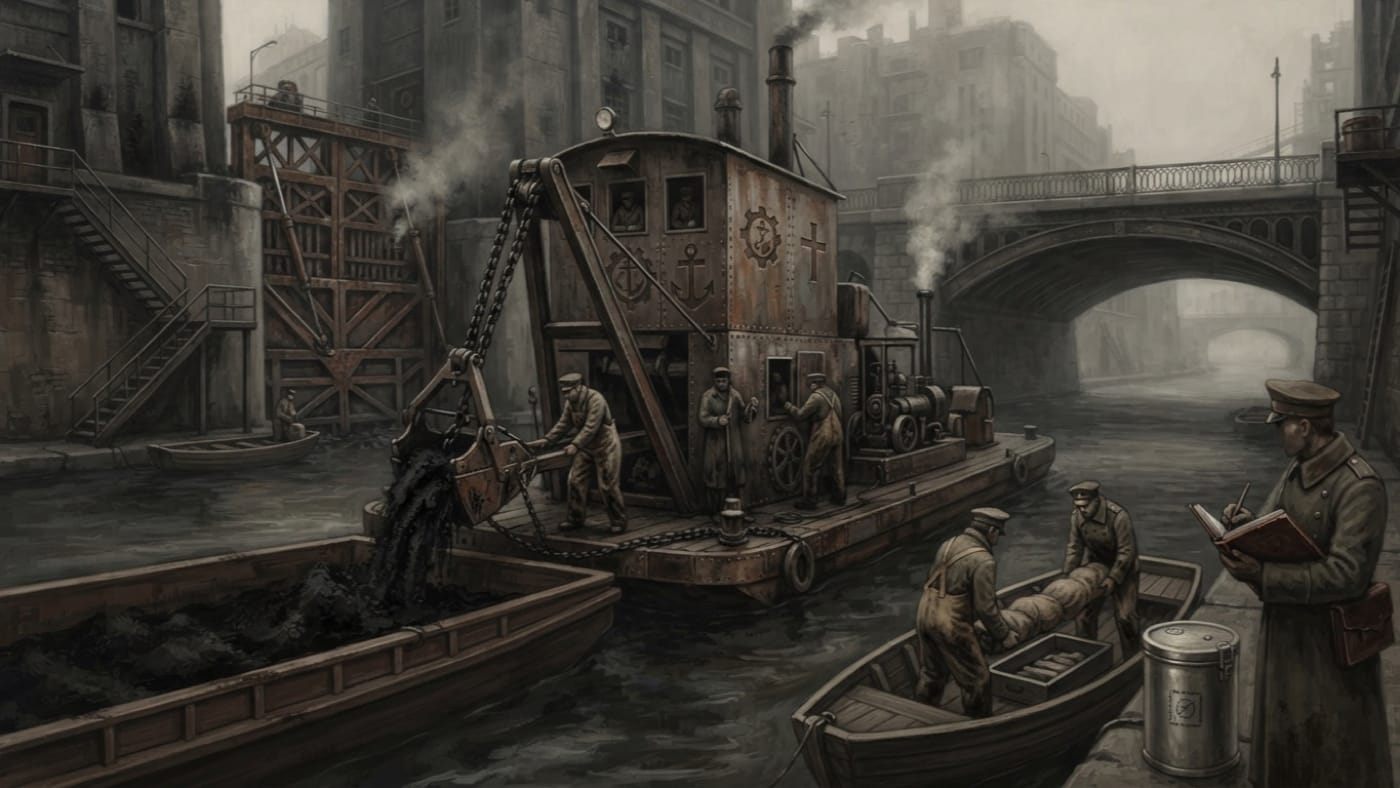
A sluice decides how much of the river the city receives. A dredge decides how much of the city the river is allowed to keep. Everything the Water Office is known to do sits between those two jobs. Barges carry grain, lime, candles and repair timber through the city when the locks permit. Silt builds up wherever a city of shrines, ration halls and cheap lodgings sends its rain, wax, barley and sewage. Somebody lifts it out. The files say the Water Office does.
I will not say how deep its men dig, how many men it keeps, where it keeps them, or which civic hand signs their wages. The survey did not find these things. A Hieromnemon who fills a blank with ornament has only committed forgery in better handwriting.
#On What the Dredge Brings Up
Here is the difficulty. A dredge does not choose what it lifts. It brings up silt, coins, fishbone and ration tags. Below the Hanged Bridge, it sometimes brings up something that quotes the Creed.
The city's chronology must be kept short and honest. Vienna was reclaimed at the Siege of Vienna in A.S. 95. That date belongs to the city's return. The Office's own beginning is not recorded. Forty Rationalist dead were then hung on the Hanged Bridge with orthodox scripture inked into their skin after death. By A.S. 102 they were gone. The official notice says they were removed. The fishermen say the canal took them. Both accounts are on file, and I decline to choose between them. It is the first time in my career that indecision has been the orthodox position. After that, inscribed bones began turning up in canal recoveries. The scripture on them was correct, in a hand Records could not identify, and Doctrine now files the condition as residual doctrinal saturation.
An inherited register summary states that "by A.S. 102 the canal removed the bodies."
Corrected. The record holds two claims: official removal, and the fishermen's account that the canal took them. Custody of the forty remains disputed. The canal has not been entered as a party.
So the office that lifts silt is the office most likely to lift scripture, and the Church has made sure that lifting is all it may do with it. Two rules apply here, and they are not the same rule.
The general classification, issued under the Water Office header, names the canal's known associations: the Hanged Bridge, the Mothers' Shrine and the low-quarter sweep of A.S. 112. Its handling note reads: ordinary contact permitted; recovered inscriptions reportable within one bell. The rule at the Hanged Bridge is narrower and harder. Any inscribed bone must be surrendered within one bell. Its script is copied under Records witness. Reading it aloud is suspended. The first rule covers inscriptions wherever the classification reaches. The second covers inscribed bone wherever the bridge rule reaches. Neither covers every bone in Vienna, which is fortunate, since Vienna's soil holds more bone than doctrine.
The inscription gets reported. It does not get read, at least not by the hand that lifted it. Records copies, Purity weighs the contamination, and the Water Office goes back to its silt. A municipal hydraulic office that started reading its own recoveries aloud would be a sect with a pump inside a week. The Synod has enough sects. It has too few pumps.
#On the Joint Addendum of A.S. 112
In A.S. 112 the Vienna Incident broke out in the pilgrim low quarters near the canal. Mothers sang a lullaby about rain and barley, and the children slept. Tone Inquisitors swept the stairwells and Purity cordoned the alleys. Five thousand mothers were branded and their children were reassigned to Mercy orphanages. That is the shortest honest account I can give, and it is still longer than Orison would like.
After the sweep, someone listened at the water. The result is the only document put before this survey that carries the Water Office's name beside another office's:
VIENNA WATER OFFICE / ORISON JOINT ADDENDUM — A.S. 112 Canal-side acoustic review after sweep found ███████ low-frequency recurrence beneath Third Horn Bridge. No singer identified. No full melody recorded. Three infants slept during exposure. Recommendation: seal stairwell drains; increase horn volume; deny recurrence.
It should be read as what it is: a document. A joint addendum is a truce signed by two offices that would each rather blame the other. Its first line has a redaction exactly where the reader wants a noun. Its next two lines are negative findings. Its fourth line is the only positive observation, and what it observes is that infants slept.
The recommendations split cleanly along remit. Sealing stairwell drains is a matter of masonry and water. Raising horn volume is Orison's answer to every question anyone has ever put to it. Deny recurrence is the clause both offices could sign without reading.
The addendum does not say whether the drains were sealed or the horns made louder. It recommends, and recommendations are the Church's cheapest relic. It also does not put the Water Office inside the sweep, which it calls finished ("after sweep"), and it does not put Orison in command of the Office. It shows two names over one finding, and the finding is mostly a list of things nobody found.
The official claim recorded in the Vienna Incident file holds that the lullaby "has not been heard since."
Amended for the canal file only. After the sweep, the joint addendum records a low-frequency recurrence beneath Third Horn Bridge, with no singer identified and no full melody recorded. Nobody has established that this recurrence was the lullaby. The official sentence may stand wherever the canal does not reach.
#On the First of November and the Present Canal
On the first of November the Donaukanal steams. The date is the Sundering's, A.S. 45, which the Church has never let anyone forget. The Water Office's classification records the condition in five words, steam observed on 1 November, and says nothing more. The Bureau of Engineering has put forward subsurface thermal exchange. The Bureau of Doctrine has kept the date. Pilgrims let ribbons down into the vapour and pull them back up. No file before me says the Office caused the steam, explained it or tried to sluice it away. It observed it and wrote it down, and on that morning that is more than most offices in Vienna manage with any credit.
As of this survey the canal is open, licensed, watched and dredged. The buckets still come up. The bell still counts. For one bell, whatever the dredge lifts belongs to an office whose remit ends where the mud ends, and then it belongs to someone with a better seal.