
#On the Disc and Its Authority
The pilgrim token is a small thing, which makes it dangerous. A cathedral announces itself with towers. A bastion with guns. A Bureau with doors, clerks, and a smell of wax so thick a man may taste obedience on his tongue. The token asks for no such theatre. It hangs at the throat, rests in a palm, knocks softly against a rib during prayer, and decides whether the body wearing it is a lawful soul in motion or an unregistered pedestrian with ambitions above his station.
Every traveller on a licensed holy road must carry one. The Bureau of Pilgrimage issues the mandate with that serene cruelty by which it has made walking into a taxable sacrament. No token, no route. No route, no shrine. No shrine, no absolution credited. A man may possess feet, hunger, faith, and a dying mother waiting at a reliquary chapel; without a stamped disc he is scenery with legs.
The token bears the sigil of Pilgrimage on one face and the route-code on the other. Older issues were tin, prone to bending, biting, and devotional polishing by nervous thumbs. Later issues are brass for ordinary runs, silver-stamped for the inter-provincial roads, and gold-sealed for the Great Passage, where vanity and terror meet under official tariff.
#On Bronze, Silver, and Gold
The Bronze token is the common disc: local shrine circuits, parish pilgrimages, market-processions, feast-day roads, and those pious little errands by which old women convince themselves the Synod permits them leisure because it loves them. Bronze travels one province. It expires at the return gate. It is punched by Route-Stampers with the bored savagery of clerks whose commission depends upon finding a flaw.
Silver is the Road of Saints (Unregistered). It authorises inter-provincial travel along designated routes: Lyon to Strasbourg, Cologne to Vienna, Marseille to the southern embarkation chapels, Mainz to whatever grief has been licensed this season. A Silver bearer is watched more carefully than a Bronze bearer because he has crossed a line. Bureau theology distrusts motion across lines. It prefers the faithful in boxes, rows, chapels, queues.
Gold is the Great Passage. It gleams because poverty is easier to supervise when holiness has a colour. The token permits access to war-bastions, reliquary cities, and the three annual pilgrimage days at Bastion-Constantinople, assuming Purity screening, Records verification, War clearance, and the Creator's apparent indifference to paperwork all align. The posted cost is “commensurate with the depth of the pilgrim's faith.” Four months' wages is a common depth.
#On Bell-Hours and Walking Absolution
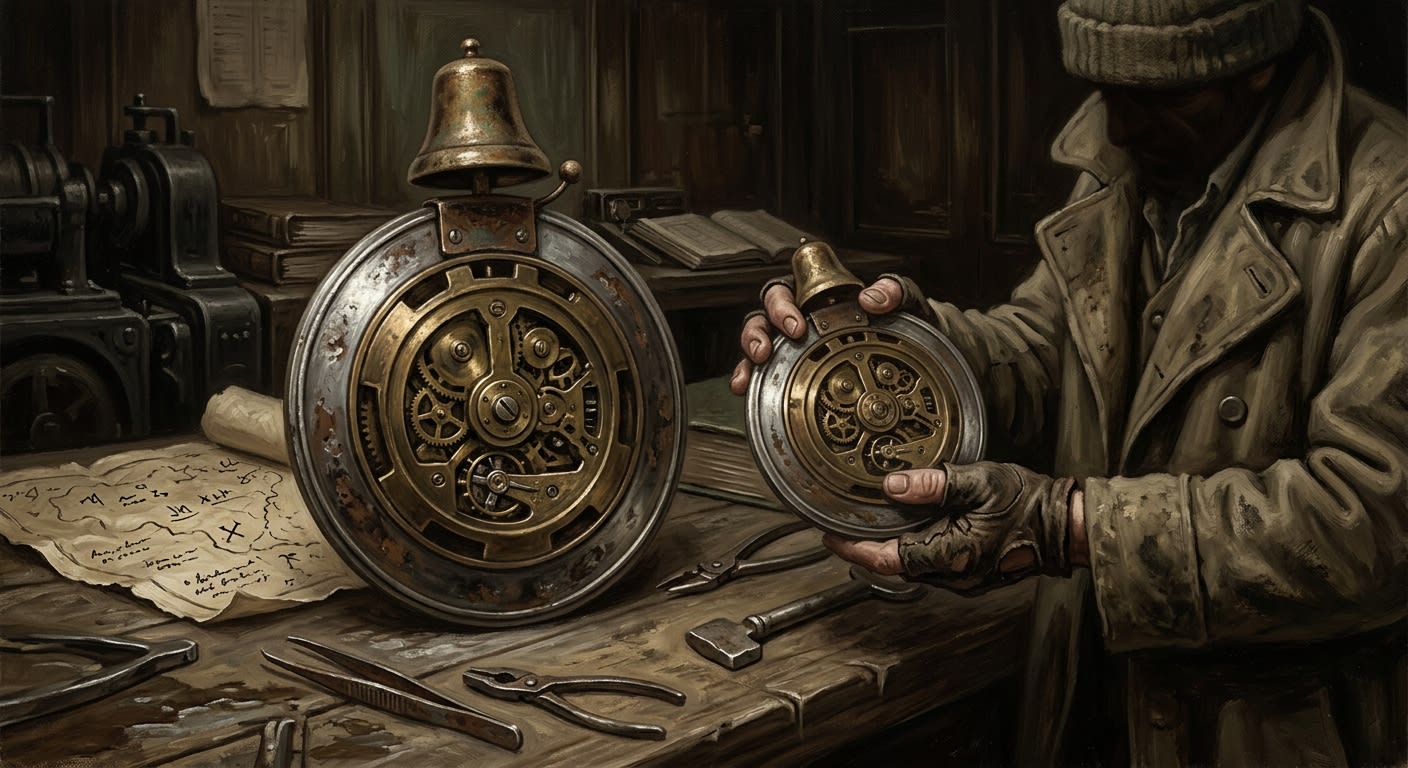
In A.S. 140 the Bureau introduced the indulgence mechanism: a token fitted with an embedded bell-hour core, licensed by the Bureau of Bells and blessed with the usual paperwork. The core tolls as the pilgrim walks. Each measured step turns a minute fragment of motion into a credited chime, and the chime becomes indulgence. The road hears. The token counts. The Bureau bills.
The design came from a condemned Genevan clockmaker reprieved for useful service. His reprieve expired when his usefulness did, which proves the mechanism was well calibrated. His small captive bell changed pilgrimage more than any sermon in the last century. A pilgrim may now arrive at a shrine with sin already reduced by motion, provided the road was approved, the pace correct, the bead-recitations maintained, and no clerk objected to his vowels at the last gate.
The Bureau of Tithes adores the device with an affection I have seen nowhere else except in mothers and executioners. A token that tolls creates revenue at each stage: issue fee, route fee, bell licence, inspection fee, cancellation fee, renewal fee, and sin-adjustment levy where the chime fails to match the declared pace. The faithful call it mercy. The ledgers call it repeatable.
Early sermons claimed the token “forgives as it rings.”
Corrected. The token does not forgive. It records eligible motion for later application against approved categories of remissible fault. Forgiveness remains, in theory, the Creator's. Application belongs to the Bureau.
#On Inspection and Misuse
A token is inspected at tithe-gates, ration-stones, ferry desks, waystation-markets, bastion pilgrimage gates, shrine vestibules, and by any Warden in a mood to improve the public character. The bearer presents it on the open palm. The official checks face, reverse, edge nick, punch pattern, wax colour, route chime, and the small tremor that guilty men develop when metal tells the truth against them.
The black market thrives because the road is long and the Bureau is expensive. Counterfeit Bronze discs are common in parish circuits. False Silver passes move through Peregrine Row in bead sacks and hymn-books. Gold forgeries appear less often because a bad Gold token tends to get the buyer, seller, carrier, inspector, cousin, and unborn nephew entered into a debt register before supper.
The Great Counterfeit Winter (Unregistered) proved the danger of near-correct metal. Forgers in Lyon, Marseille, and two frontier towns produced tokens whose bell-hour cores drifted fractionally from authorised Bellway frequency. They looked sound. They stamped sound. They tolled sound, unless a trained Tuner (Unregistered) placed one to his ear and heard the little wetness in the chime. Over a week's march the accumulated error placed bearers three hundred yards outside Bellway protection. The casualties were logged as route-adjacent fatalities, environmental.
AUDIT EXTRACT — GREAT COUNTERFEIT WINTER, A.S. 160 Tokens seized: █████ Confirmed drift-bearing tokens: ███ Families assessed for compounded false absolution: █████████ Lyon master die: melted Disposition of surviving forgers: reassigned to █████████████, after ██████████ removal
Counterfeiting generates spiritual debt. That is the Bureau's elegant cruelty: false absolution does not vanish; it accrues. A forged token bought by a desperate pilgrim charges the forger's family for every chime that lied, every step it miscounted, every prayer it pretended to carry. Children inherit the balance. Widows inherit the balance. The dead, if properly documented, may have the balance deducted from burial allotments.
Public tariff sheets state that counterfeit-token debt is assessed only upon convicted forgers.
Corrected. Conviction clarifies liability; it does not create it. The debt begins when the false chime rings.
#On the Token at the Throat
The token has become more than permission. It is proof of obedience worn where a noose might sit. Lovers exchange expired Bronze discs with dates scratched into the reverse. Soldiers carry cracked Silver tokens from home provinces and touch them before bombardment. Widows sew dead husbands' tokens into mourning hems. Smugglers drill silent cores and sell them to deserters, unlicensed merchants, and persons whose consciences have outrun their documents.
Pilgrimage condemns such sentiment in public and monetises it in private. Replacement tokens may be purchased. Memorial tokens may be struck. Commemorative Vienna rubble-tokens are sold at the shrine-ruins with a surcharge for ash-blackening. At Marseille I have been offered discount tokens by men whose smiles had more cavities than their merchandise. I declined. I pay full tariff or confiscate the stall.