

#On the Raised Road
"Keep to the boards. The boards at least have signed for you." — saying among the Ropewalk runners
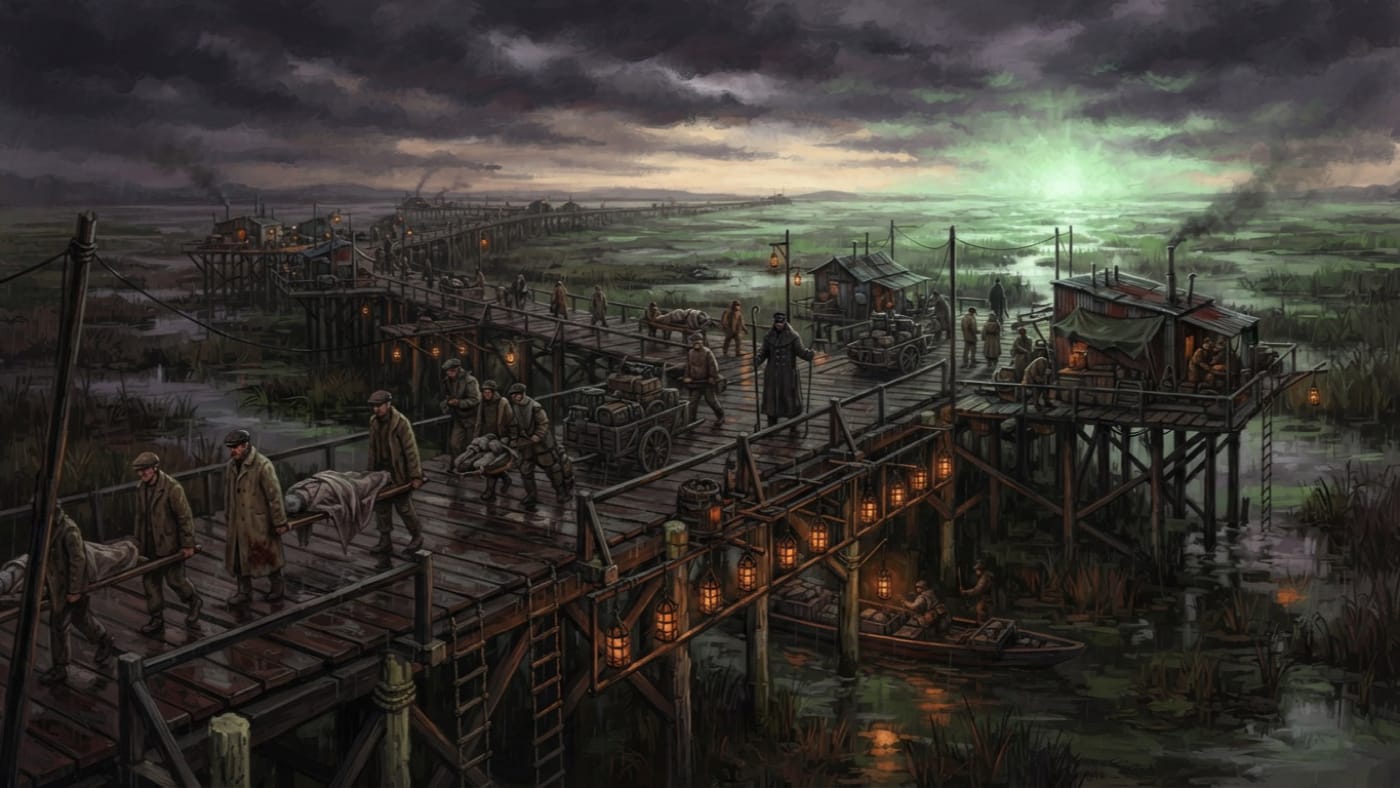
The Ash-Glyph Marshworks has one street, and the street stands on legs. The Ropewalk is a raised causeway of lashed timber set on Bone-lime pilings. It runs the length of the delta settlement, from the Causeway Gate at its western head to the Charnel Moorings at its eastern terminus. Beyond the Gate the same raised road carries on inland, a day by wagon to a city the delta's papers decline to name. Beyond the Moorings there is only the river mouth, and whatever the war has sent down it.
Everything of consequence in the Marshworks hangs from the Ropewalk, leans against it or drips onto it. Satellite platforms stand off it on stilts and are joined to it by plank bridges, which the locals replace so often that they no longer bother to name them. The settlement's register gives such a bridge two seasons. That figure belongs to the bridges. Nobody has filed a replacement cycle for the Ropewalk itself, and nobody has filed its length, its pile spacing, its load limit, its builder or its year. The lime in its pilings has no recorded batch or supplier. The Codex knows what bone-lime is and declines to guess whose.
What the record lacks in measurement the boards make up in texture. They are wet in every season. Lime grit works up between the lashings and comes off white on boot leather. Tarred rope swells around every joint. Somewhere along the deck a Warden's hook-pole taps the planking, at intervals, like a clerk testing whether a coin is lead. Watch towers rise on stilts above the reeds, and at low tide the submerged underwalks surface briefly from the mud, glistening, as if the settlement kept a second street for occasions it would rather not discuss.
The Ropewalk is sometimes credited with the settlement's founding date. That is a courtesy it has not earned. The Marshworks holds a mortuary charter of A.S. 74 (1784 CE), sealed by the war and records offices that later clerks have obligingly promoted to Bureaus. The charter dates the settlement. It does not date the first piling, the first lashing or the first fool to walk out onto them.
The Marshworks was chartered in A.S. 74, nine years after the Line solidified from desperate entrenchment into continental fact.
The Line did not solidify in a year. The Sagittal Line was defensible but incomplete by about A.S. 65–68, and its practices were standardized over the following years, about 68–72. A wall that took that long to set cannot be given an anniversary. The Bureau withdraws "nine years", keeps "desperate", and notes that the Ropewalk was never dated by either phrase.
#On What Crosses the Planks
"We do not bury the dead. We file them." — Cartographer-Provost Lysa Vane, in testimony before the Bureau of Records, A.S. 199
The Ropewalk's principal traffic travels west, and does not walk.
At the Moorings a barge-handler takes the manifest first and the tags after it, damp and fraying from the river. Then the haulers carry the wrapped dead up onto the causeway. The vinegar from the cloth darkens their shoulders and runs down their sleeves, and the smell goes along the planks ahead of them like a herald who has misplaced his trumpet. The haulers bear their loads toward Seal Shed Row, where the tag clerks stamp, seal and countersign. Only a sealed tag admits a body to the Glyphyard on the settlement's southern flank. There the Mortuary Cartography Office lays it in a grid ten paces by ten and enters it on the map. Until that moment the soldier exists only as a cargo carried along the boards.
Paper travels faster than the dead. Ropewalk runners carry manifests, countersigns and corrections between the docks and the sheds, ducking around the haulers with the agility of men who are paid by the errand and fined by the puddle. Float-carts take what the runners cannot. Lamp oil, dry cloth and eel broth come out of the Reed Market after curfew, in defiance of three mandates and by way of the same planks the mandates were carried along. Salvage comes up from the sorting tables of Diver's Gut, having first paid its tithe to "Softstep" Maro.
The Codex can give the Ropewalk's two ends with confidence and its middle with none. All the districts are on record, but the order in which they meet the boards is not. I will not supply an order the surveyors never filed.
The bottleneck is in the seal sheds. In a burial surge as many as forty barges queue off the Moorings. That number measures the queue. It says nothing of how many berths there are or how much the road can bear. The Ropewalk takes the dead as fast as the clerks will stamp them, one body at a time. Each tag that fails to match its manifest stops one body on the deck, and the next waits behind it.
Five things may not travel the planks: untagged bones, unsanctioned relics, unmapped dead, plague cloth and blank seal books. The Gate searches for all five. The boards themselves enforce nothing, and they carry all five anyway, every night.
#On Passage and Its Charges
"It is not a toll. A toll would require a charter." — Warden at the Causeway Gate, to a departing lime hauler
No office claims the Ropewalk, though every office uses it.
The Ashbound Wardens hold its western head. They are a quarantine militia by mandate and a clique by habit, and they hold no Church rank, whatever their name suggests to strangers. At the Gate they check causeway permits, quarantine passes, salvage tags and barge manifests. They levy an administrative charge on entry and another on exit, and they sell exemptions from the quarantine at the same counter. Their hook-poles patrol the boards. The settlement's defence rests on that patrol and on holding the causeway as a choke point.
The arithmetic is old and simple. Leaving costs more than a salvage season pays. Any worker who cannot meet the exit charge is entered in the Gate ledger as a release to service, and service means a night shift on the lamps or a turn in the diver rotation. The causeway lets a man in cheaply and charges him dearly to leave, and the difference keeps the Marshworks staffed.
The other powers each own a stretch of what the road connects. Lysa Vane owns the maps the dead are carried toward, and a forged grid cannot be walked off the causeway at any price. The Lantern Guild owns the water after dark. Maro owns whatever comes up out of the mud before it is allowed onto a tag. The haulers who carry all of it own debts in every one of those ledgers.
The order has stood for eighty-nine years. The rot-fever behind it is real and takes about a dozen workers a season. The temporary designation is the only part of the order that is false.
#On the Lamps Beneath the Road
"If it shines, don't follow." — Marshworks proverb
Under the deck, above the waterline, the Lantern Rackway hangs from iron brackets bolted to the Ropewalk's stilts. Its tallow lamps burn in coded sequences that guide barges and punts through the safe channels at night. The boards carry feet, and the lamps below them speak to boats. The two are bolted together and answer to different masters.
Those lamps belong to the Lantern Guild of the Third Brine and to Guildmaster Orren Pike: every wick, every bracket and every route designation. A brine-mark is the Guild's route credential for a boat. It gives its holder no right to the deck above and no title to the road. Riggers climb down rope ladders from the planking with wick-shears and tallow pails and work along the brackets with rust on their palms. Debtors make up a good part of the night crews. The night shift has the highest mortality in the settlement. Nobody has filed a figure for it, and the Guild has not asked anybody to.
Out over the burial shallows and the sinkholes the corpse-light blooms green-white. Crews report that it gives back their route signals from water where no bracket stands. The settlement's register also reports formations that copied its own geometry: lamp positions, platforms and the line of the causeway itself. Whether the light means anything by this the Codex leaves to the Glow Choir, which believes it does, and to the Bureau of Alchemical Standards, which has been unable to decide since A.S. 143.
For such nights the Guild keeps the Do Not Answer. Lamps are hooded or doused. Vinegar smoke is raised. A crew already on an authorized route holds to it, and the oarsmen are blindfolded and pull to the click of a bell, counting their strokes. The sequence, the intervals and the totals are the Guild's business and stay unprinted here. The Guild calls the procedure the only one that works. No register has ever compared it with anything.
The documented cost of trusting a familiar shape is the Seventh Bloom of A.S. 196 (1906 CE). A formation of light reproduced the stake geometry of the Glyphyard, a night barge followed it into a sinkhole, and three men drowned. The markers were gone by dawn. The finding read navigational error compounded by atmospheric conditions. All of it happened on the water. The Ropewalk stood above the event, as it stands above most things, and nobody consulted it.
#On the Present Condition
"Too bright to work safely." — Guildmaster Orren Pike, on the marsh in A.S. 201
At the A.S. 201 assessment the Ropewalk was in use from end to end, because nothing else could do its work. The water is reported to be brighter. The Mortuary Cartography Office has raised its demand for recovery yields. Each increase puts more barges at the Moorings, more haulers on the deck, more runners between the sheds and more debtors in the night crews. Pike has called the marsh too bright to work safely. The Office has noted the remark and raised the quota.
The Wardens close the causeway on several grounds, and one of them is a bloom near the road. In the reed tunnels and on the late boards the marsh has settled on a fear of its own: a bloom that climbs the causeway and maps the living. It has not happened. It has no date and no finding, and the Codex enters it as a fear. Everyone on the Ropewalk knows exactly where it would climb.